Edging Lobelia
Lobelia erinus
Family · Campanulaceae
Lobelia erinus is a South African bedding annual for baskets and edging: sowing tiny seed, the midsummer heat sulk, cutting back, and pet risk.
Lobelia erinus
Plant profile
- WateringHighWater every 4 days
- Light exposurePartial sun
- Ideal temperature1–5 °C
- Hardiness zoneUSDA 10–11
Growth
- Family
- Campanulaceae
- Life cycle
- Perennial
- Growth speed
- 6/10
- Mature size
- 10–50 cm
- Spread
- 10–50 cm
- Propagation
- Seed
FloweringLate spring through summer, often pausing in peak heat and picking up again as it cools
Dormancynone; treated as an annual outside mild, frost-free climates
Time to maturityflowers within a few months of a late-winter sowing
Soil & climate
- Soil types
- chalk, clay, loam, sand
- Drought tolerance
- No
Light & Placement
- Origin
- Tropical and southern Africa (POWO)
- Where to place it
- hanging basket
- window box
- edging
- bedding border
- patio container
Safety
- Pet safe
- No
ToxicityNot individually listed by the ASPCA; NC State Extension rates it medium-severity poisonous, containing lobeline alkaloids
Invasive speciesNo invasive status documented for this species by POWO or NC State Extension.
Data fromLobelia erinus L., GBIF Backbone TaxonomPOWO: Lobelia erinus L.RHS: Lobelia erinus (trailing lobelia)NC State Extension Gardener Plant ToolboASPCA: Toxic and Non-toxic Plants, Lobel
Where it grows
World distribution
Edging Lobelia is native to 18 countries: Angola, Botswana, Chad, Congo - Kinshasa, Eswatini, Ethiopia, Lesotho, and Malawi….GBIF records 19,740 documented identifications across 85 countries, with the largest concentrations in United Kingdom, South Africa, and Netherlands.
- Angola
- Botswana
- Chad
- Congo - Kinshasa
- Eswatini
- Ethiopia
- Lesotho
- Malawi
- Mozambique
- Namibia
- Niger
- Senegal
Show 6 more countriesShow fewer countries
- Somalia
- South Africa
- Sudan
- Tanzania
- Zambia
- Zimbabwe
Yellow to orange dots: concentration of documented identifications per country. Green countries: sourced native range. Source: GBIFNative range from POWO (Kew).
Lobelia erinus is the small, wiry-stemmed bedding plant sold every spring as a mound or a trailing curtain of tiny two-lipped flowers, almost always in some shade of blue. Kew's Plants of the World Online places its native range across tropical and southern Africa, and NC State Extension notes it grows wild in moist woods, fields and along stream edges there, which explains why it sulks the moment a garden turns hot and dry. In cultivation it is short-lived: treated as an annual almost everywhere, it earns a spot at the front of a border, in a window box, or spilling over the rim of a hanging basket for one growing season, then it is composted and resown the following year.
A South African Native Grown as a Season's Bedding
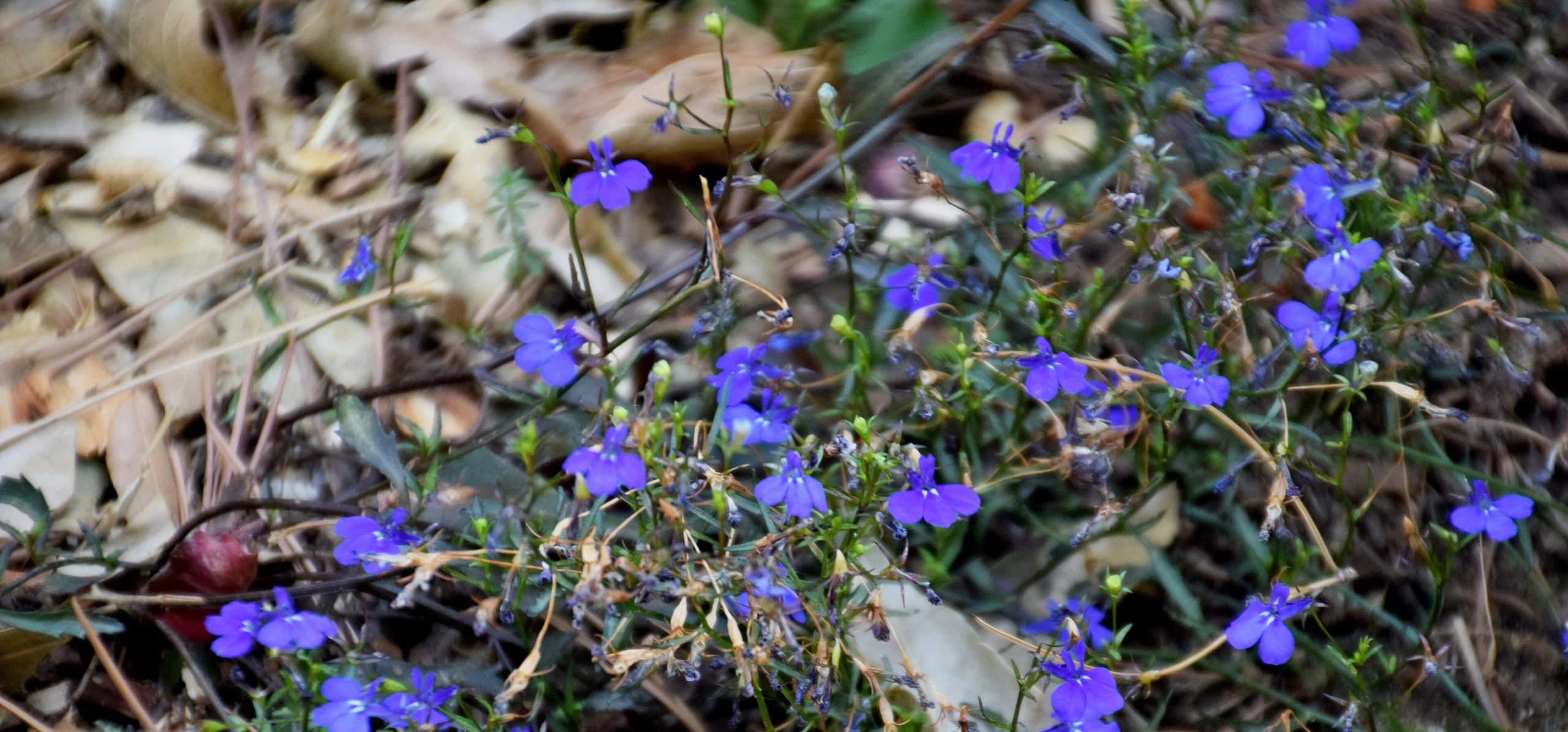
The species is a member of the bellflower family, Campanulaceae, with fine, spreading stems, small narrow leaves, and masses of small two-lipped flowers held singly or in loose racemes from late spring into autumn. In the wild the flowers run blue to violet with dark green leaves, but garden breeding has widened that into white, pale, mid- or dark blue, purple, red and pink, often centred with a white or yellow eye. RHS growing notes give it a time to maturity of about a year from seed, though in practice a spring sowing is in full flower well before summer ends, which is fast enough that most gardeners never carry it over to a second season even where it could survive as the tender perennial it technically is.
Compact Mounds or Trailing Curtains: Choosing a Type
Seed catalogues split lobelia into two habits bred from the same species. Compact types such as 'Crystal Palace' form a tight, bronze-green-leaved mound to about 10 cm with deep blue flowers roughly 2 cm across, useful for edging a path or filling gaps at the front of a bed where a sprawling habit would be a nuisance. Trailing types, sold as series like 'Cascade' or as named forms such as 'Sapphire' with its purple, white-eyed flowers, throw stems that drape 15 to 30 cm or more over the rim of a hanging basket or window box rather than mounding upward. Mixing a trailing series into a basket alongside upright plants, or ringing a bed with a compact one, is really a decision about which direction you want the flowers to grow rather than about hardiness or care, both habits share the same needs.


Sowing Dust-Fine Seed Under Cover
Lobelia seed is famously tiny, closer to ground pepper than a seed packet's usual contents, and it is sown on the surface of a moist, sterile seed mix rather than pushed in or buried, since seed this fine has almost no reserves to push through covering compost. The RHS recommends sowing in late winter at a germination temperature of 13 to 18 degrees C, which in most climates means starting it indoors or under glass well ahead of the last frost date. Because the resulting seedlings are too small and fragile to separate one by one without damaging the roots, the practical approach is to prick out small clumps of seedlings together into cell trays or small pots rather than trying to isolate individuals, letting each clump grow on as a single dense plug that fills out into a full mound or trailing plant later.
Planting Out After the Last Frost
Hold plugs or clumps back under cover until the risk of frost has passed in your area, since RHS hardiness rating H2 means the species tolerates cool temperatures but not being frozen, roughly down to 1 to 5 degrees C rather than genuine frost. Harden plants off over a week or two of increasing outdoor exposure before setting them into their final position, whether that is a gap left at the front of a border, a basket liner, or a window box, planting each clump as a unit rather than teasing the individual seedlings apart at this late stage.
Full Sun Where Summers Are Cool, Part Shade Where They Bake
The RHS grows Lobelia erinus in full sun or partial shade, and which end of that range suits a given garden depends heavily on climate. In cool-summer regions full sun keeps growth compact and flowering dense, but NC State Extension notes it does much better with cool springs than with hot or humid summers, so where summer heat is intense a spot with some midday or afternoon shade keeps the foliage from scorching and the flowering season from collapsing early. Soil matters as much as light: RHS guidance calls for deep, fertile, reliably moist, well-drained ground, and the species tolerates chalk, clay, loam and sand as long as it does not dry out or sit waterlogged.
Watering, Feeding and the Midsummer Sulk
This is not a plant to let dry between waterings. NC State Extension flags it as drought intolerant and says it should be consistently watered, and a basket or window box in full sun can need checking daily in warm weather since the shallow root mat has little reserve. RHS feeding advice is to apply a balanced fertiliser every two weeks through spring and early summer, switching to a nitrogen-free feed every two weeks from midsummer onward so the plant keeps putting energy into flowers rather than soft leafy growth. When the first flush fades in peak summer heat, cut the whole plant back by around half rather than deadheading flower by flower; NC State Extension confirms that cutting back once flowers and foliage begin to fail in summer brings on new blossoms, and the plant typically reflowers within a few weeks once temperatures ease in late summer.
Pests, Damping-Off, and a Note on Pets
The RHS lists Lobelia erinus as generally disease-free once established, with slugs and snails the main pest to watch for on young growth, but NC State Extension warns that damping-off, stem rot and root rot can all set in on seedlings kept too wet, which is the most common way a tray of this fine seed is lost before it ever reaches the garden. On safety, the ASPCA's toxic-plant database lists a Lobelia entry as toxic to dogs, cats and horses, but under the scientific name Lobelia cardinalis, the North American cardinal flower, a different species in the same genus rather than Lobelia erinus itself. NC State Extension separately rates Lobelia erinus as having medium-severity poison characteristics due to lobeline and related alkaloids present in the plant, so while it is not individually named on the ASPCA list, it is sensible to keep curious pets from chewing on it regardless.
Test your plant knowledge
Tap a card to flip it and reveal the answer.
Lobelia erinus is naturally a tender perennial, even though gardeners almost always grow it as an annual. Tap to reveal ✓ True
If lobelia stops flowering and looks tired in summer heat, cutting it back hard will usually kill it. Tap to reveal ✕ False
The RHS hardiness rating for Lobelia erinus means it survives hard frosts unprotected through a typical UK winter. Tap to reveal ✕ False
Depending on the cultivar, Lobelia erinus flowers can be blue, violet, purple, red, pink or white. Tap to reveal ✓ True
The ASPCA's toxic-plant database has an entry specifically naming Lobelia erinus as toxic to pets. Tap to reveal ✕ False
Sources
References consulted for this guide
- Lobelia erinus L., GBIF Backbone Taxonomygbif.org
- POWO: Lobelia erinus L.powo.science.kew.org
- RHS: Lobelia erinus (trailing lobelia)rhs.org.uk
- NC State Extension Gardener Plant Toolbox: Trailing lobelia (Lobelia erinus)plants.ces.ncsu.edu
- ASPCA: Toxic and Non-toxic Plants, Lobeliaaspca.org
- Reference entity : Wikipédiaen.wikipedia.org