Heartleaf Ice Plant
Mesembryanthemum cordifolium
Family · Aizoaceae
Aptenia cordifolia is now Mesembryanthemum cordifolium: how much sun this fast, magenta-flowered groundcover needs, and why wet winter soil kills it.
Mesembryanthemum cordifolium
Plant profile
- WateringLittleWater every 10 days
- Light exposureFull sun
- Ideal temperature1–35 °C
- Hardiness zoneUSDA 10–11
Growth
- Family
- Aizoaceae
- Life cycle
- Perennial
- Growth speed
- 7/10
- Mature size
- 5–10 cm
- Spread
- 30–60 cm
- Propagation
- Cutting
- Seed
FloweringSmall magenta to purplish-pink daisy flowers, spring to summer, near year-round in mild climates
DormancyNo true dormancy; cold, wet winters cause stem and root rot rather than a natural rest
Time to maturityFills a hanging basket or spills over a pot rim within one growing season
Soil & climate
- Soil types
- Sandy or loamy, free-draining mix, Standard cactus or succulent potting mix
- Saline soil
- Tolerated
- Drought tolerance
- Yes
Light & Placement
- Origin
- Eastern Cape Province to KwaZulu-Natal, South Africa
- Where to place it
- Sunniest windowsill available, ideally south- or west-facing
- A few hours of direct sun daily, or bright grow lights
- Full sun on a sheltered, east- or south-facing bank, rockery or wall top (RHS H2)
- Hanging basket to let stems trail and flower
- Shallow, wide terracotta pot for extra drainage
Safety
- Toxicity
- No ASPCA listing for Aptenia cordifolia or Mesembryanthemum cordifolium
- Pet safe
- Yes
Invasive speciesNaturalizes outside cultivation in mild coastal climates, including parts of California and the Mediterranean, where fallen stem pieces root readily in disturbed ground.
Data fromMesembryanthemum cordifolium L.f., GBIF Mesembryanthemum cordifolium L.f., PlantAptenia cordifolia (baby sun rose, dew pAptenia cordifolia 'Variegata' (v), RHSMesembryanthemum cordifolium: Baby Sun R
Where it grows
World distribution
Heartleaf Ice Plant is native to a single country: South Africa.GBIF records 8,181 documented identifications across 89 countries, with the largest concentrations in Spain, Portugal, and Mexico.
- South Africa
Yellow to orange dots: concentration of documented identifications per country. Green countries: sourced native range. Source: GBIFNative range from POWO (Kew).
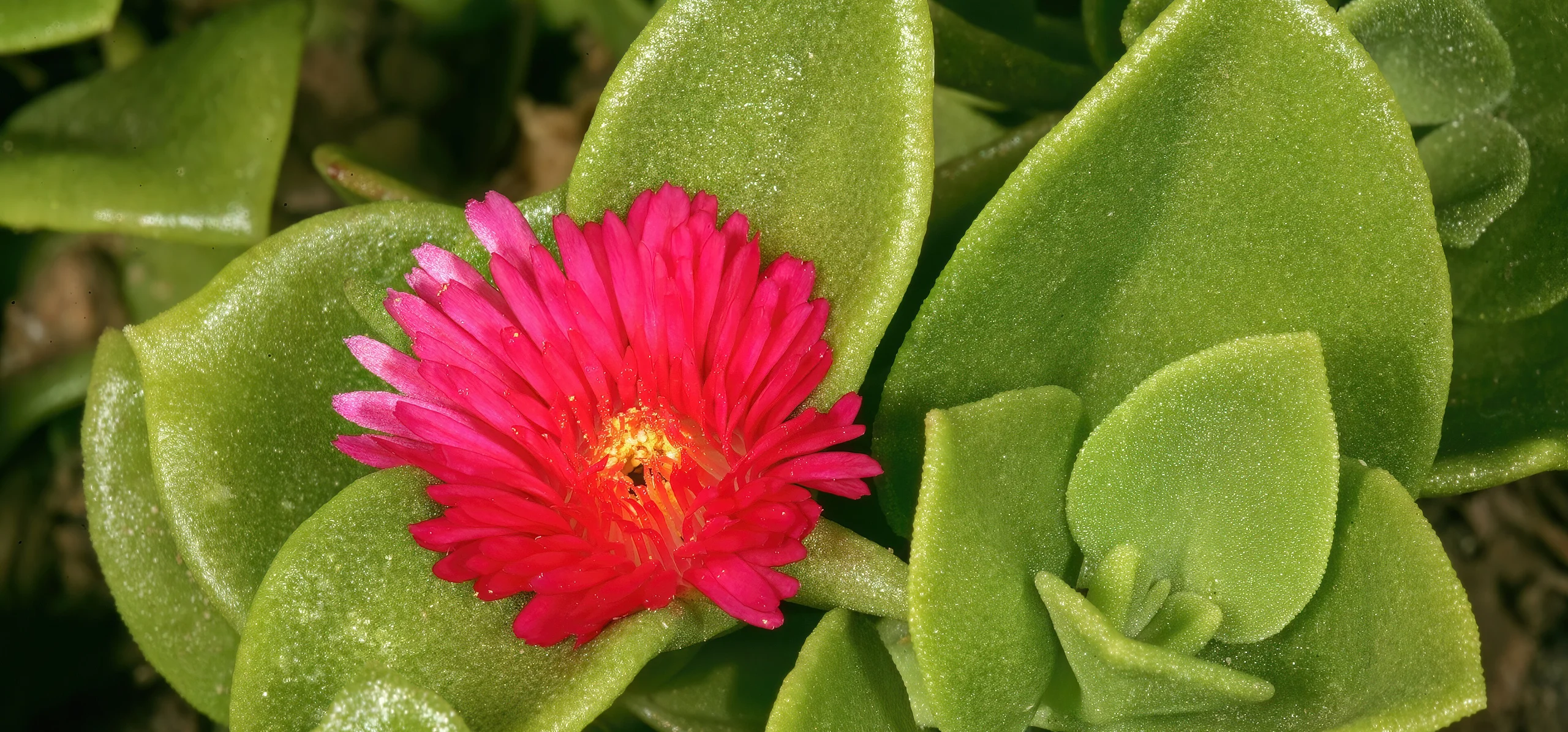
Sold almost everywhere as Aptenia cordifolia, this fast, mat-forming succulent is now classified as Mesembryanthemum cordifolium, and either name points to the same heartleaf ice plant: trailing stems lined with small, glossy, heart-shaped leaves that root wherever they touch soil, topped from spring through summer with bright magenta to purplish-pink daisy flowers that only open in sun. Give it full sun, a gritty mix that drains fast, and water only once the soil has dried, and a single starter plant will spill over a pot rim or knit into a solid groundcover within one season. The one thing it will not forgive is cold, wet soil over winter, which rots the fleshy stems from the base long before frost itself does any damage.
A South African sun-lover, reclassified from Aptenia back to Mesembryanthemum
The GBIF Backbone Taxonomy lists the accepted name as Mesembryanthemum cordifolium L.f., with Aptenia cordifolia (L.fil.) Schwantes recorded as a synonym, alongside older names such as Litocarpus cordifolius and Mesembryanthemum tetrasepalum. In practice almost every nursery tag, seed packet and gardening book still uses Aptenia, so expect to see both names side by side for years to come; they refer to the identical plant. Plants of the World Online (Kew) gives the native range as the Eastern Cape Province through to KwaZulu-Natal in South Africa, where it grows as a low, sprawling succulent on disturbed, sun-baked ground, close to the conditions that make it thrive on a hot balcony or a dry bank almost anywhere else.
Plain green species or the variegated form
The straight species carries small, fleshy, heart-shaped leaves in plain glossy green on trailing stems. 'Variegata', the form most often sold in garden centers, carries the same heart-shaped leaf edged in cream to white, with the green confined to the center; the contrast is sharpest on stems that get the most direct sun, and growth pushed into shade often comes back greener and less variegated. Both forms flower the same way and need the same care, so the choice comes down to whether a solid deep green mat or two-toned foliage suits the spot.
Light and placement
This is a full-sun plant outdoors, at its best on an east- or south-facing bank, rockery edge or wall top with some shelter from the coldest wind, the position the RHS recommends for its H2-rated hardiness. Indoors or in a greenhouse it wants the brightest window available, ideally with a few hours of direct sun; in bright, filtered light rather than harsh midday sun it still grows but flowers less, and the variegated form loses some of its cream edging. Too little light shows up as stretched, thin stems with pale leaves spaced far apart instead of the tight, cushioned mat the plant makes in strong sun.
Watering and drought tolerance
Water only once the top of the mix has dried out, then soak it and let it drain fully; established plants in the ground need little supplemental water beyond rain in most climates. The University of Florida's IFAS Extension rates its drought tolerance as high and its salt tolerance as good, which is why it turns up so often in coastal gardens and rockeries that get only occasional watering. The same extension guidance is just as direct about the opposite mistake: overwatering causes root rot, followed by poor growth, yellowing (chlorosis) and eventually the death of the plant, so when in doubt, wait another few days before watering again, especially in a container without generous drainage holes.
Soil, potting and feeding
A sandy or loamy mix that drains within seconds of watering suits it best; a standard cactus or succulent compost, or a normal potting mix cut with extra perlite or coarse sand, both work well. It tolerates acidic through to slightly alkaline soil without complaint, so drainage is the limiting factor far more often than pH. Because it spreads sideways rather than rooting deeply, a shallow, wide pot or hanging basket makes better use of its habit than a tall one. Feed lightly two or three times over spring and summer with a low-nitrogen liquid fertilizer, then stop; heavy feeding pushes soft growth that flowers less and rots more easily.


Overwintering: frost tenderness and easy cuttings
The RHS rates the species H2, hardy only to about 1 to 5°C, so anywhere winters dip below that it needs to come under glass or indoors before the first frost; a single hard freeze blackens and collapses the stems. Where it is grown outdoors year-round, USDA zones 10a to 11b according to the same IFAS Extension guide, it needs no winter protection at all. In colder gardens the simplest strategy is not to nurse the whole mat through winter but to take a batch of cuttings in late summer, root them indoors on a bright windowsill, and start again the following spring with fresh, vigorous plants rather than a straggly survivor.
Propagation from stem cuttings
Almost any stem segment roots on its own wherever a leaf node touches moist, free-draining soil, which is exactly how this plant spreads so quickly across open ground. A cutting of two or three inches, with the lowest leaves removed and the cut end left to callus for a day before it goes into a gritty mix, typically shows roots within one to two weeks if kept lightly moist. Several cuttings potted together fill a hanging basket far faster than waiting on one plant to branch, and it is the easiest way to carry a favorite variegated stem through winter indoors.
Common mistakes, invasive spread and pet safety
The most common failure is not disease but drainage: a saucer left full under a pot, or heavy soil that stays wet through a cold snap, rots the stems from the base far more often than any pest does. Where the climate allows it to survive outdoors year-round, including parts of coastal California and the Mediterranean, discarded cuttings and stem fragments root readily in disturbed ground, so spent trimmings from those regions are best composted rather than tossed over a fence into wild land. On pet safety, neither Aptenia cordifolia nor Mesembryanthemum cordifolium has a dedicated entry in the ASPCA's toxic and non-toxic plant database; an ASPCA listing sometimes cited for "ice plant" actually names a different genus, Lampranthus, so treat that entry as unrelated to this species rather than as a safety guarantee.
Test your plant knowledge
Tap a card to flip it and reveal the answer.
GBIF now lists the accepted name as Mesembryanthemum cordifolium, with Aptenia cordifolia as a synonym. Tap to reveal ✓ True
This plant tolerates hard outdoor frost in temperate climates without protection. Tap to reveal ✕ False
'Variegata' leaves are edged in cream to white instead of being plain green. Tap to reveal ✓ True
Because it is drought-tolerant, overwatering rarely causes any problems for this plant. Tap to reveal ✕ False
Stem cuttings root readily, making it easy to carry the plant through winter indoors. Tap to reveal ✓ True
Sources
References consulted for this guide
- Mesembryanthemum cordifolium L.f., GBIF Backbone Taxonomygbif.org
- Mesembryanthemum cordifolium L.f., Plants of the World Online (Kew)powo.science.kew.org
- Aptenia cordifolia (baby sun rose, dew plant), RHSrhs.org.uk
- Aptenia cordifolia 'Variegata' (v), RHSrhs.org.uk
- Mesembryanthemum cordifolium: Baby Sun Rose, Heartleaf Iceplant, UF/IFAS Extension (FP047)ask.ifas.ufl.edu
- Reference entity : Wikipédiaen.wikipedia.org