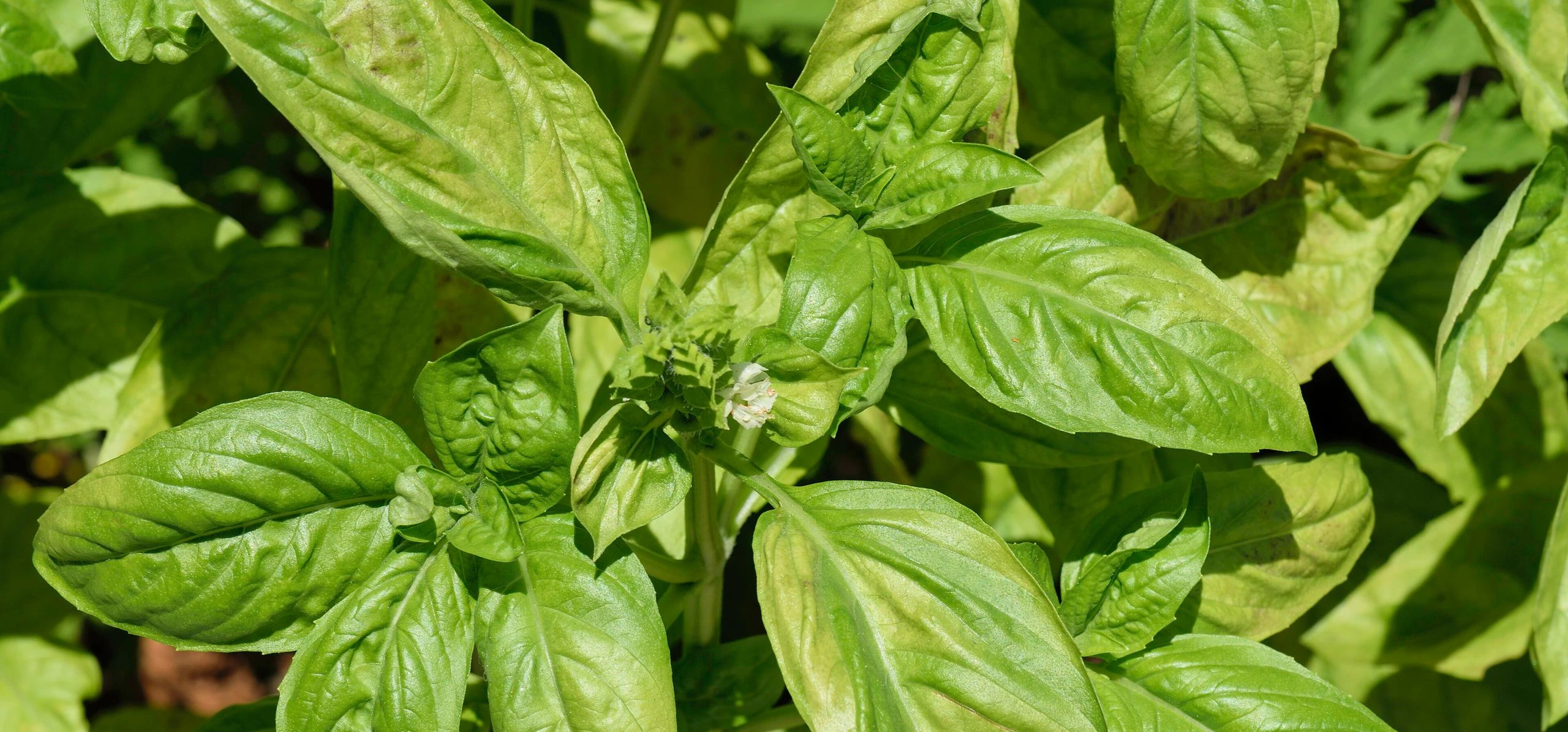
Basil
Ocimum basilicum
Family · Lamiaceae
Basil needs full sun, soil at pH 6.0 to 6.5, steady moisture and regular pinching to stay leafy; how to avoid downy mildew and stop it flowering too soon.
Ocimum basilicum
Plant profile
- WateringHighWater every 4 days
- Light exposureFull sun
Growth
- Family
- Lamiaceae
- Life cycle
- Annual
- Growth speed
- 7/10
- Mature size
- 10–50 cm
- Spread
- 10–50 cm
- Flowering
- Small white to purple flowers in summer; pinch off buds to keep leaves flavorful
- Propagation
- Seed
DormancyNone; a frost-tender annual killed outright by the first hard frost
Time to maturityGrown as a fast-cycling annual, usable within a single growing season
Soil & climate
- Soil pH
- pH 6–6.5
- Soil types
- loam, sand
- Drought tolerance
- No
Light & Placement
- Origin
- Tropical and subtropical Asia to northern Australia (POWO)
- Where to place it
- Brightest south- or west-facing windowsill
- Sheltered, south- or west-facing bed or border
- Grown as a container plant year round (RHS)
Safety
- Toxicity
- CatsSafe
- DogsSafe
- HumansSafe
Data fromOcimum basilicum L., GBIF Backbone TaxonOcimum basilicum L., Plants of the WorldASPCA: Toxic and Non-Toxic Plants, BasilRHS: Ocimum basilicum (sweet basil)Clemson Cooperative Extension HGIC: Basi
Where it grows
World distribution
Basil is native to 17 countries: Australia, Bangladesh, Bhutan, Cambodia, China, India, Indonesia, and Laos….GBIF records 9,532 documented identifications across 195 countries, with the largest concentrations in Brazil, United States, and Mexico.
- Australia
- Bangladesh
- Bhutan
- Cambodia
- China
- India
- Indonesia
- Laos
- Malaysia
- Myanmar (Burma)
- Nepal
- Papua New Guinea
Show 5 more countriesShow fewer countries
- Philippines
- Sri Lanka
- Taiwan
- Thailand
- Vietnam
Yellow to orange dots: concentration of documented identifications per country. Green countries: sourced native range. Source: GBIFNative range from POWO (Kew).
A basil seedling fresh from the nursery, or a pot of leggy stems on a windowsill, needs three things above everything else: as much direct sun as the spot allows, soil that never fully dries out, and a pinch of the growing tip before it tries to flower. Ocimum basilicum, sweet basil, is GBIF's accepted name for the herb grown worldwide in cooking, a member of the mint family Lamiaceae alongside lavender and rosemary. Get the light and the pinching right in the first few weeks and one plant keeps producing armfuls of leaves through an entire summer.
A Tender Annual Native to Tropical and Subtropical Asia
POWO lists the native range of Ocimum basilicum as tropical and subtropical Asia through to northern Australia, a span running from India and Sri Lanka across Southeast Asia to Queensland and Western Australia, where the species grows as an annual or short-lived subshrub in seasonally dry tropical habitat. The Missouri Botanical Garden describes the widely cultivated sweet basil the same way, as a herbaceous annual or short-lived perennial, which is why gardeners outside the tropics almost always grow it as a single-season annual: it comes from warm, frost-free country and has no cold tolerance to fall back on anywhere else.
Choosing a Full-Sun, Sheltered Spot
The RHS rates Ocimum basilicum H1C, meaning it needs protection from frost and is safe outdoors only in the warmest months, and its own growing notes call for a sheltered, south- or west-facing position in full sun, whether the plant lives in a border for summer or stays in a container year round. Clemson Cooperative Extension is just as direct about light, listing full sun as the requirement and part-sun as tolerated only down to around six hours of direct light a day, with both growth and flavor dropping off in deeper shade. Indoors, that means the brightest south- or west-facing window in the house, with a grow light added if that window misses direct sun for at least half the day in winter.
Soil, Containers and Feeding
The RHS lists loam or sandy soil, well-drained, across acid to alkaline pH, as suitable for basil, and Clemson Cooperative Extension narrows that further with a specific target: bring garden soil to pH 6.0 to 6.5 before planting, worked with compost or other organic matter. Clemson's feeding guidance is just as specific, an initial application of 5-10-10 fertilizer at roughly three pounds per 100 square feet worked in before planting, with a lighter follow-up of calcium nitrate around two months later only if growth has slowed. The same extension notes that an over-fertilized plant grows more leaf but loses flavor, so it is worth feeding lightly rather than on a fixed schedule.


Watering Without Wetting the Leaves
Clemson Cooperative Extension describes basil's water needs as a relatively constant supply of soil moisture, closer to a leafy vegetable than to a drought-tolerant Mediterranean herb, and recommends drip irrigation or hand-watering at the base of the plant rather than overhead, specifically to keep the foliage dry. A few centimetres of mulch helps hold that moisture between waterings in open ground; in containers, the smaller volume of soil dries out faster, so pots are worth checking daily once the weather turns warm. Wetting the leaves in the evening is the detail to avoid: standing moisture on basil foliage overnight is exactly the condition its main fungal disease needs to take hold.
Pinching and Harvesting to Keep It Bushy
Both the RHS and Clemson Cooperative Extension describe the same core technique: pinch out the growing tip, and later any flower buds, as soon as they appear. The RHS specifically recommends pinching out flowerheads to keep the plant producing leaves rather than diverting energy into seed, and Clemson notes that a plant left to flower and set seed loses flavor in the leaves that remain. Harvest by cutting whole branch ends carrying one or two sets of leaves, which is also how Clemson recommends picking it, rather than stripping single leaves; each cut made just above a leaf pair prompts two new shoots from that point, so shaping the plant and harvesting from it are the same job.
Downy Mildew and Other Problems
The disease to watch for is downy mildew, caused by the pathogen Peronospora belbahrii: yellowing patches spread across the upper leaf surface with a grey to purple fuzz visible on the underside, worse in humid weather, and once it takes hold in a leaf that leaf will not recover, so removing affected growth and improving airflow between plants matters more than any treatment applied afterward. Clemson Cooperative Extension's own list of basil problems adds Japanese beetles, aphids, spider mites, whiteflies and slugs among the pests, and fusarium wilt, gray mould, bacterial wilt and root rots among the other diseases, most of them worse in the same crowded, wet-foliage conditions that favor downy mildew.
Starting New Plants From Seed
The RHS recommends sowing basil seed in gentle heat in spring under glass or indoors, or sowing it in situ once summer weather has settled outdoors. Clemson Cooperative Extension gives a practical benchmark for moving seedlings outside: transplant only once daytime temperatures sit consistently in the 70s Fahrenheit with nights staying above 50 degrees, and expect seed itself to germinate in five to ten days at around 70 degrees Fahrenheit. Because a single hard frost kills the plant outright, gardeners in cooler climates typically start seed indoors several weeks ahead of the last expected frost date rather than sowing directly outside.
Common Mistakes
The most common mistake is watering overhead in the evening, which leaves foliage wet through the night and creates exactly the humid conditions downy mildew needs. The second is letting the plant flower before pinching it back, the point at which both the RHS and Clemson Cooperative Extension say leaf flavor drops off even as the plant keeps growing. The third is treating basil as tolerant of shade or cold when it is neither: a spot getting less than around six hours of direct sun, or a night below 50 degrees Fahrenheit, shows up as slower growth and duller leaves within days.
Test your plant knowledge
Tap a card to flip it and reveal the answer.
Basil needs at least around six hours of direct sun a day to grow well. Tap to reveal ✓ True
Letting basil flower and set seed improves the flavor of its remaining leaves. Tap to reveal ✕ False
A light frost does little harm to a basil plant. Tap to reveal ✕ False
The ASPCA lists basil as non-toxic to both cats and dogs. Tap to reveal ✓ True
Basil grows best in soil around pH 6.0 to 6.5. Tap to reveal ✓ True
Sources
References consulted for this guide
- Ocimum basilicum L., GBIF Backbone Taxonomygbif.org
- Ocimum basilicum L., Plants of the World Online, Kew Sciencepowo.science.kew.org
- ASPCA: Toxic and Non-Toxic Plants, Basilaspca.org
- RHS: Ocimum basilicum (sweet basil)rhs.org.uk
- Clemson Cooperative Extension HGIC: Basilhgic.clemson.edu
- Reference entity : Wikipédiaen.wikipedia.org