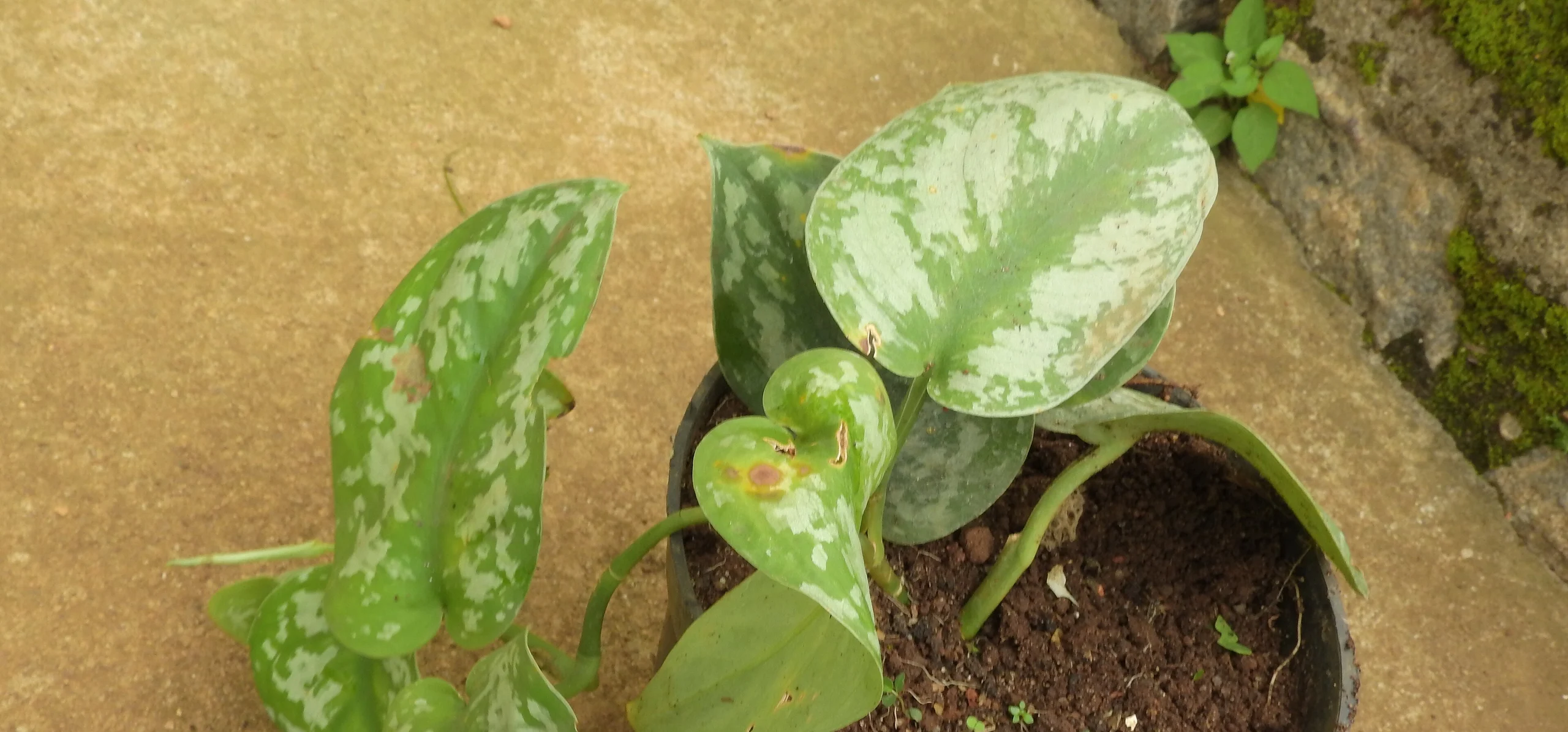
Satin Pothos
Scindapsus pictus
Family · Araceae
Satin pothos needs bright indirect light and soil that dries slightly between waterings. Covers naming, potting mix, propagation, pruning and pet safety.
Scindapsus pictus
Plant profile
- WateringModerateWater every 8 days
- Light exposureIndirect light
- Ideal temperature15–29 °C
Growth
- Family
- Araceae
- Life cycle
- Perennial
- Growth speed
- 3/10
- Mature size
- 100–150 cm
- Spread
- 50–100 cm
- Flowering
- Rarely flowers indoors (RHS)
- Propagation
- Cutting
Dormancyslows below 15 degrees C in winter
Time to maturity5 to 10 years to full size (RHS)
Soil & climate
- Soil types
- Loam, Sand, Peat-free potting compost
- Drought tolerance
- No
Light & Placement
- Origin
- SE Bangladesh to W and Central Malesia
- Where to place it
- East-facing window
- A few steps back from a south or west window
- Bright bathroom or hallway
- Sheltered, shaded spot outdoors in summer in frost-free climates (RHS H1c)
- Hanging basket
- Pot with a moss pole or totem for climbing
Safety
- Toxicity
- CatsToxic
- DogsToxic
- HorsesToxic
- HumansToxic
Data fromScindapsus pictus Hassk., GBIF Backbone Scindapsus pictus Hassk., Plants of the Satin Pothos toxicity, ASPCA Animal PoisScindapsus pictus 'Argyraeus', Missouri Scindapsus pictus 'Argyraeus', RHS
Where it grows
World distribution
Satin Pothos is native to 5 countries: Bangladesh, Indonesia, Malaysia, Philippines, and Thailand.GBIF records 537 documented identifications across 17 countries, with the largest concentrations in Malaysia, Indonesia, and Philippines.
- Bangladesh
- Indonesia
- Malaysia
- Philippines
- Thailand
Yellow to orange dots: concentration of documented identifications per country. Green countries: sourced native range. Source: GBIFNative range from POWO (Kew).
Scindapsus pictus, sold almost everywhere as satin pothos or silver pothos, is not a true pothos at all: it sits in its own genus within the arum family, one branch away from Epipremnum aureum on the family tree. The species name pictus means painted, a nod to the frosted, metallic-silver blotches scattered across each heart-shaped leaf, no two patterned quite alike. Missouri Botanical Garden lists it as slow-growing, so a freshly potted cutting can sit at the same size for weeks before the next leaf finally unfurls. Give it bright, indirect light and soil that is allowed to dry a little between waterings, and it settles in without much fuss.
Satin Pothos Versus True Pothos
The common name is where the confusion starts. Golden pothos, the trailing vine sold in nearly every home store, is Epipremnum aureum. Satin pothos is Scindapsus pictus, a related but separate genus in the same family, Araceae, and its dull, velvety leaf surface is the fastest way to tell the two apart from a glossy true pothos across a room. GBIF records the accepted name as Scindapsus pictus Hassk., with older names such as Pothos argyraeus now folded in as synonyms. The cultivar sold most widely, 'Argyraeus', carries smallish, pine-green leaves with fine silver spotting and has earned the RHS Award of Garden Merit; other trade forms sold as 'Exotica' show broader, denser patches of silver on a larger leaf.
Light and Placement
Bright, indirect light keeps the silver patterning crisp and the growth compact. Missouri Botanical Garden's care notes call for bright indirect light with direct sun avoided, and RHS growing advice for the 'Argyraeus' cultivar echoes this: full light but with shade from hot sun, in a sheltered spot near an east or south-facing window rather than pressed against the glass. Too little light does not kill the plant, but new leaves come in smaller, more evenly green and less silvered, since the plant has less reason to keep laying down reflective cells it cannot photosynthesise through anyway. A spot a step or two back from a bright window, or a shelf lit by a north or east-facing opening, usually strikes the right balance indoors.
Watering
Water moderately while the plant is actively growing, then let up considerably once temperatures drop. Missouri Botanical Garden's guidance is to keep the soil consistently moist through the growing season and reduce both watering and feeding over winter; RHS phrases the same idea as water moderately in growth, sparingly at other times. In practice this means checking the topsoil before each watering rather than working from a fixed calendar, and erring toward slightly dry rather than soggy, since constantly wet potting mix is the more common route to trouble for a vining aroid like this one. A pot with a drainage hole matters more here than any specific watering interval.


Soil and Potting
RHS lists loam and sand among the suitable soil types, grown in a peat-free, loam-based potting compost that stays moist but well-drained; Missouri Botanical Garden describes the same requirement more simply as a peaty potting mix. The goal either way is a medium that holds some moisture around the roots without staying saturated, so working a handful of coarse sand or perlite into a standard houseplant compost gives the drainage this climber wants. A pot only slightly larger than the current rootball suits it better than a large one, since Scindapsus pictus is a slow grower that does not need much reserve soil volume and can sit in soggy, unused compost in an oversized pot for a long time between refills of roots.
Feeding
Apply a balanced liquid fertiliser monthly while the plant is in active growth, both RHS and Missouri Botanical Garden agree on this rhythm. Cut feeding back sharply, or stop altogether, once growth slows in the cooler months, since a dormant or semi-dormant plant cannot use the nutrients and unabsorbed fertiliser salts simply build up in the pot. Resume the monthly routine as soon as a new leaf starts to unfurl in spring, which is usually the clearest sign the plant has come back into active growth.
Training on a Support and Pruning
Left to trail, Scindapsus pictus makes a neat hanging-basket plant, which is exactly how RHS lists its main use. Given a moss pole, bark totem or similar support to climb instead, the stems press their aerial roots against the surface and the vine thickens and fills out rather than dangling as a single thin strand. RHS notes that no routine pruning is required, but pinching a stem back just above a leaf encourages it to branch from that point rather than growing as one long, leggy strand, which is the simplest way to keep a young plant bushy instead of sparse.
Propagation From Stem Cuttings
Stem cuttings are the propagation method both RHS and Missouri Botanical Garden point to, with MBG specifying cuttings of around 4 inches (10 cm) taken in spring or early summer, while growth is active. Cut just below a node, the small joint on the stem where a leaf attaches and where new roots will form, and remove any leaf that would otherwise sit underwater or buried in the mix. A cutting can root in water or be set directly into moist potting compost; either way, keep it warm and out of direct sun until new growth confirms roots have taken hold.
Common Problems, Pests and Toxicity
RHS describes Scindapsus pictus as generally pest-free and disease-free, which holds up well compared with fussier houseplants, though dry indoor air during winter heating season can still bring on mealybugs or spider mites, the usual culprits on most aroid houseplants kept indoors year-round. Yellowing lower leaves combined with soggy compost point to overwatering rather than a pest; easing off and checking the roots for a sour smell or dark, mushy tissue confirms it. On the safety side, ASPCA lists satin pothos as toxic to cats, dogs and horses, with insoluble calcium oxalates causing oral irritation, drooling and vomiting if chewed. RHS adds that the sap is also harmful if eaten and can irritate skin and eyes in people, worth a pair of gloves when taking cuttings or doing any pruning, and worth keeping the plant out of reach of curious pets.
Test your plant knowledge
Tap a card to flip it and reveal the answer.
Satin pothos belongs to a different genus than golden pothos, even though both share the common name pothos. Tap to reveal ✓ True
Scindapsus pictus keeps its best silver patterning in full, direct sun all day. Tap to reveal ✕ False
The ASPCA lists satin pothos as toxic to cats, dogs and horses. Tap to reveal ✓ True
Missouri Botanical Garden recommends letting the soil dry out completely for weeks at a time. Tap to reveal ✕ False
New plants can be started from stem cuttings that include at least one leaf node. Tap to reveal ✓ True
Sources
References consulted for this guide
- Scindapsus pictus Hassk., GBIF Backbone Taxonomygbif.org
- Scindapsus pictus Hassk., Plants of the World Online (Kew)powo.science.kew.org
- Satin Pothos toxicity, ASPCA Animal Poison Controlaspca.org
- Scindapsus pictus 'Argyraeus', Missouri Botanical Garden Plant Findermissouribotanicalgarden.org
- Scindapsus pictus 'Argyraeus', RHSrhs.org.uk
- Reference entity : Wikipédiaen.wikipedia.org