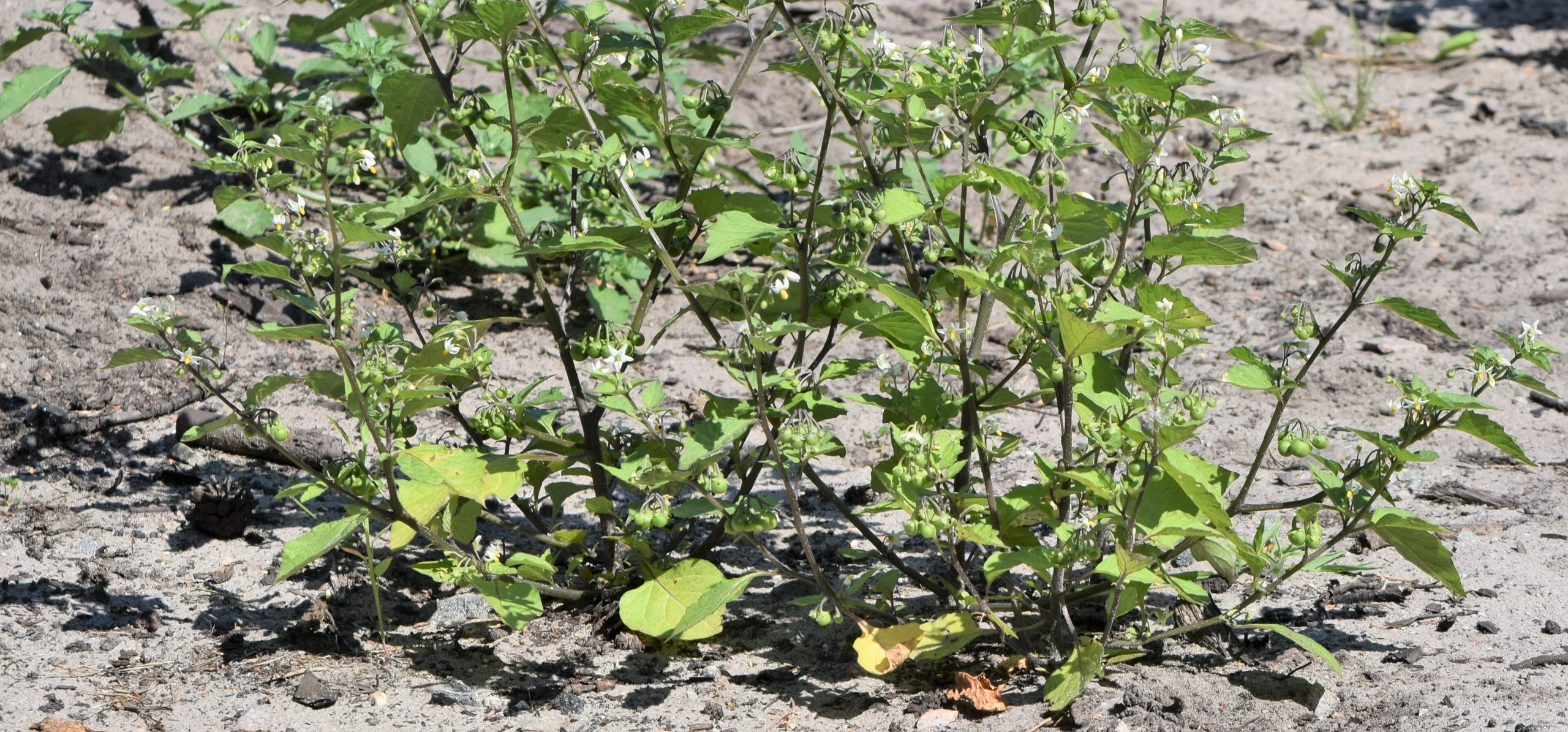
Black Nightshade
Solanum nigrum
Family · Solanaceae
Black nightshade germinates in vegetable beds all summer from a huge seedbank; how to identify it, tell it from deadly nightshade, and stop it before it seeds.
Solanum nigrum
Plant profile
- WateringModerateWater every 7 days
- Light exposureFull sun
- Hardiness zoneUSDA 10–11
Growth
- Family
- Solanaceae
- Life cycle
- Annual
- Growth speed
- 6/10
- Mature size
- 30–137 cm
- Spread
- 10–91 cm
- Propagation
- Seed
FloweringSmall white star-shaped flowers with yellow anthers, May to August; berries ripen green to dull black, July to November
DormancyNone; germinates all summer
Time to maturityFlowers May to August, then sets berries from July into autumn
Soil & climate
- Drought tolerance
- No
Soil typescultivated garden soil, moist, well-drained soil, disturbed ground, pastures and waste ground
Light & Placement
- Where to place it
- vegetable garden beds
- recently disturbed or cultivated soil
- pastures and waste ground
OriginNative to temperate Eurasia, Macaronesia, and North/Northeast Tropical Africa; naturalized worldwide as a weed in over 60 countries
Safety
- Toxicity
- CatsToxic
- DogsToxic
- HorsesToxic
- HumansToxic
Invasive speciesClassified as a weed in 61 countries; reproduces only by seed and rebuilds its seedbank quickly if plants are left to berry
Data fromGBIF: Solanum nigrum L.POWO: Solanum nigrum L.NC State Extension Gardener Plant ToolboASPCA Toxic and Non-Toxic Plants: Black University of Wisconsin-Madison Extensio
Where it grows
World distribution
Black Nightshade is native to 60 countries: Afghanistan, Albania, Algeria, Austria, Bangladesh, Belgium, Bhutan, and Bulgaria….GBIF records 379,471 documented identifications across 210 countries, with the largest concentrations in France, United Kingdom, and Netherlands.
- Afghanistan
- Albania
- Algeria
- Austria
- Bangladesh
- Belgium
- Bhutan
- Bulgaria
- Cape Verde
- Chad
- China
- Croatia
Show 48 more countriesShow fewer countries
- Cyprus
- Czechia
- Djibouti
- Egypt
- Eritrea
- Ethiopia
- France
- Georgia
- Germany
- Greece
- Hungary
- India
- Iran
- Iraq
- Ireland
- Italy
- Japan
- Kuwait
- Laos
- Lebanon
- Libya
- Morocco
- Myanmar (Burma)
- Nepal
- Netherlands
- Oman
- Pakistan
- Palestinian Territories
- Poland
- Portugal
- Romania
- Russia
- Saudi Arabia
- South Korea
- Spain
- Sudan
- Switzerland
- Taiwan
- Thailand
- Tunisia
- Türkiye
- Turkmenistan
- Ukraine
- United Arab Emirates
- United Kingdom
- Vietnam
- Western Sahara
- Yemen
Yellow to orange dots: concentration of documented identifications per country. Green countries: sourced native range. Source: GBIFNative range from POWO (Kew).
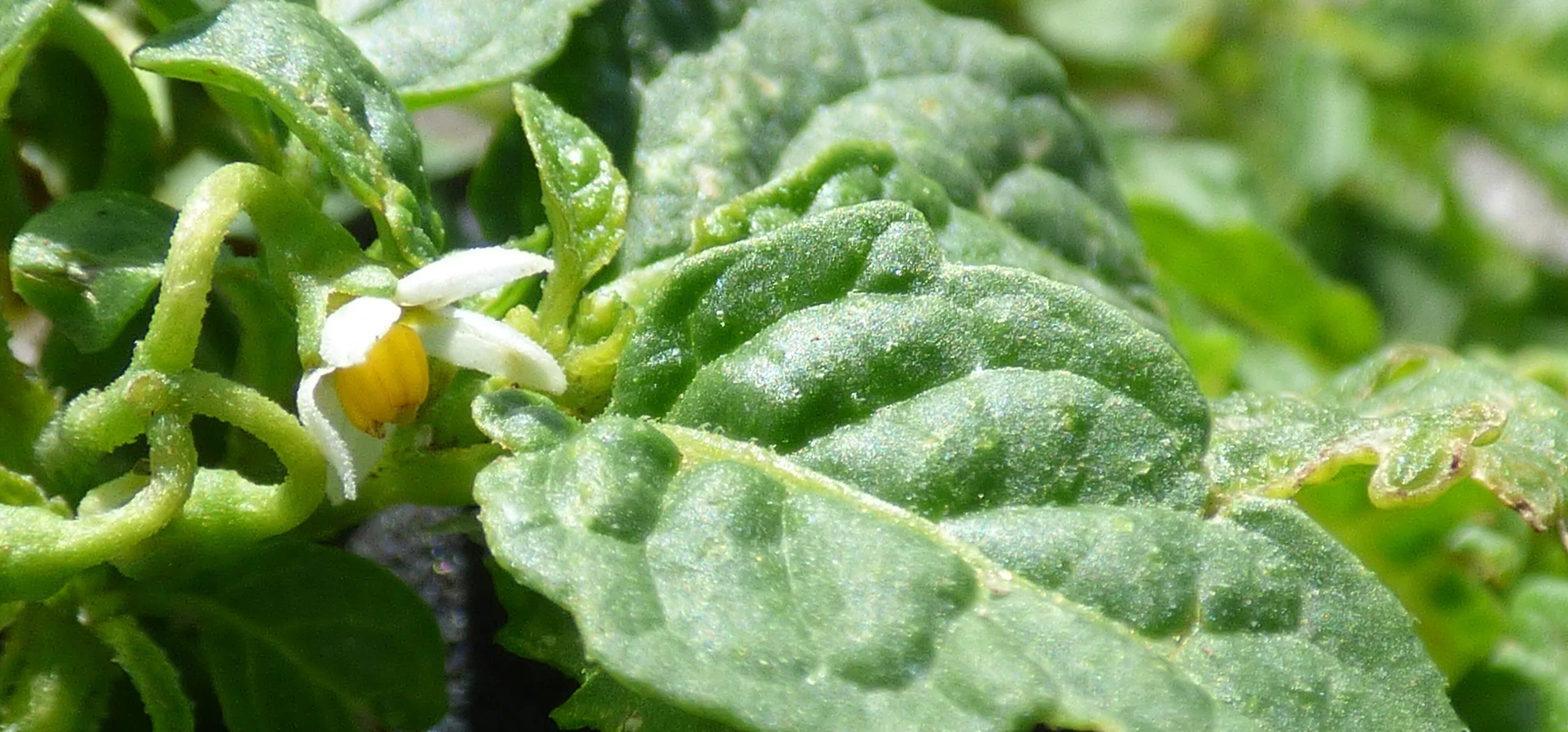
A knee-high, branching plant with small white star-shaped flowers, yellow beaked anthers, and loose clusters of small, dull black berries turning up in a vegetable bed or a patch of freshly turned soil is almost always black nightshade, Solanum nigrum. GBIF's accepted classification places it in the Solanaceae, the same family as tomato and potato, and NC State Extension already counts it as a weed in 61 countries. It is not a one-flush spring weed: it keeps germinating through the whole warm season, so a bed hoed clean in May can be full of new seedlings again by August. The three things worth sorting out before pulling anything are whether this is really black nightshade rather than a stray tomato or potato seedling, whether it could instead be the far more dangerous deadly nightshade, Atropa belladonna, and how to stop it from ever dropping seed in that bed again.
Small White Flowers, Yellow Anthers, Dull Black Berries
NC State Extension describes the flowers as tiny, star-shaped, white with five petals and prominent yellow anthers, opening in clusters of three to twelve from May into August, sometimes flushed pale purple or blue. Leaves are simple, not divided into leaflets: dark green above, lighter and often purple-tinged underneath, ovate to lanceolate, 1.5 to 4 inches long, with margins that are entire, wavy, or coarsely toothed. As the small green berries mature between July and November they turn black to purplish-black, with a matte, not glossy, skin, hanging in loose clusters rather than singly. Stems are erect, stout, angular, hairy or hairless, green or purple-tinged, and the whole plant reaches roughly 1 to 4.5 ft (30 to 137 cm) tall and 4 in to 3 ft (10 to 91 cm) wide.
Not a Tomato or Potato Seedling
Before it flowers, a black nightshade seedling gets pulled or left alone by guesswork, which is how it survives in beds where gardeners are actively weeding. The giveaway is the leaf: tomato and potato both carry compound leaves made of several leaflets along a central stalk, while black nightshade's leaf blade is a single, undivided piece. Once flowers appear the difference is unmistakable, since neither tomato's yellow blooms nor potato's larger pale flowers look anything like black nightshade's small white stars with yellow anthers. When in doubt, the safest move is to leave a suspect seedling in place until it flowers or fruits and the identification is certain, rather than guess from the leaf shape alone.
The One Look-Alike That Actually Matters: Deadly Nightshade
The comparison worth taking seriously is with Atropa belladonna, deadly nightshade, an unrelated and far more toxic plant. The RHS describes its flowers as bell-shaped and tubular, dusky pink to lilac, nothing like black nightshade's flat white stars, and its berries hang singly rather than in clusters, glossy rather than matte, each one cupped by a large, persistent green calyx that reaches well past the fruit. Black nightshade's berries, by contrast, cluster together with only a small calyx at the base. Every part of deadly nightshade is dangerously toxic, and its berries in particular have been mistaken for edible ones with fatal results, so a plant with single glossy berries and bell-shaped flowers should never be assumed to be the same, more forgiving, garden weed.


A Weed Built to Return: Germination and the Seedbank
Black nightshade reproduces only by seed, and NC State Extension notes those seeds are readily carried off by birds that eat the ripe berries, spreading the plant into pastures and waste ground as well as cultivated beds. Because it keeps germinating in flushes through the warm months rather than all at once in spring, a bed can look clear in June and be seeded again by a plant that was missed, or by seed blown or carried in from elsewhere, by late summer. Every uncontrolled plant that reaches berry stage adds to a seedbank sitting in the soil, ready to resprout the following year and the year after, which is why the plant is now established as a weed of cultivated ground in dozens of countries rather than a rare curiosity.
Hoeing Young, Mulching, and Never Letting It Seed
The practical response follows directly from that biology. Hoe or hand-pull plants while they are still small, ideally before the first flowers open, since a plant that has already set berries has already contributed to next year's seedbank whether it gets pulled or not. A mulch layer over bare soil between crop rows cuts down on the light and disturbance new seedlings need to establish, and it is worth walking the same bed again every few weeks through summer rather than assuming one early-season hoeing pass has settled the matter. Pulled plants carrying berries should go in the trash rather than the compost pile, since an ordinary home compost heap rarely gets hot enough to reliably kill every seed.
A Host Plant Potato and Tomato Growers Should Recognize
Because it belongs to the same family as the vegetable garden's tomatoes, potatoes, and peppers, black nightshade is not a neutral bystander. The University of Wisconsin-Madison Extension's vegetable entomology program notes that when potato itself is unavailable, the Colorado potato beetle turns to alternate solanaceous weeds, black nightshade among them, describing common nightshade weeds in the environment as a green bridge that lets the beetle colonize new plantings. CABI's Invasive Species Compendium likewise classifies Solanum nigrum as a host plant as well as a weed, one more reason a patch of it left standing next to the vegetable beds is worth clearing rather than ignoring, even where the plant itself looks harmless enough.
The Confusing Toxicity Story: Solanine, and Berries Eaten Elsewhere as Food
NC State Extension is direct about the risk: the leaves and the immature green berries contain solanine, saponins, and atropine-like substances, and are described as poisonous to humans and animals, with symptoms ranging from vomiting and abdominal pain to drowsiness, confusion, and, in severe cases, death. What complicates the picture is that the same species, once its berries have fully ripened to black, is eaten as food well beyond the garden: in parts of India it is grown deliberately and known as manathakkali, its leaves cooked as a green vegetable and its ripe berries used as a fruit, and related preparations exist elsewhere in Africa and Asia. That local, generations-deep knowledge of exactly when and how to prepare it does not transfer to a plant that volunteered itself into a garden bed. A gardener without certainty of identification, and without that tradition, should treat the berries and leaves as something to remove, not sample.
Toxic to Pets and Livestock, and a Frost-Tender Annual
The ASPCA lists black nightshade as toxic to dogs, cats, and horses, with the same solanine, saponins, and atropine-like compounds behind signs that include hypersalivation, loss of appetite, vomiting, diarrhea, drowsiness, weakness, and a slowed heart rate. Livestock poisoning from nightshade-contaminated pasture or hay is a long-documented hazard for the same reasons, which makes clearing it from paddock edges and grazing land as relevant as clearing it from the vegetable patch. As for hardiness, NC State Extension lists it as reliably surviving as a short-lived perennial only in USDA zones 10a to 11b; anywhere colder, frost kills it back each year and it behaves as a straightforward summer annual, regrowing only from the seed already banked in the soil. One last detail worth knowing before pulling every last one: NC State notes bees and other insects pollinate the small flowers, though the nectar itself is reported toxic to honeybees, a reminder that even a weed slated for removal is doing some ecological work while it stands.
Test your plant knowledge
Tap a card to flip it and reveal the answer.
Black nightshade's berries grow in loose clusters with a dull, matte black skin, unlike the single glossy black berries of deadly nightshade (Atropa belladonna). Tap to reveal ✓ True
The ripe black berries of Solanum nigrum are eaten as food in parts of India, Africa, and Asia, while the unripe green berries and leaves are considered toxic. Tap to reveal ✓ True
Solanum nigrum is officially listed as safe for cats, dogs, and horses by the ASPCA. Tap to reveal ✕ False
Because black nightshade only germinates once in spring, a single early hoeing is enough to clear it from a bed for the whole season. Tap to reveal ✕ False
Deadly nightshade (Atropa belladonna) has bell-shaped, tubular flowers, while black nightshade has small star-shaped flowers with yellow anthers. Tap to reveal ✓ True
Sources
References consulted for this guide
- GBIF: Solanum nigrum L.gbif.org
- POWO: Solanum nigrum L.powo.science.kew.org
- NC State Extension Gardener Plant Toolbox: Solanum nigrumplants.ces.ncsu.edu
- ASPCA Toxic and Non-Toxic Plants: Black Nightshadeaspca.org
- University of Wisconsin-Madison Extension, Vegetable Entomology: Colorado Potato Beetlevegento.russell.wisc.edu
- Reference entity : Wikipédiaen.wikipedia.org