Jimsonweed
Datura stramonium
Family · Solanaceae
Jimsonweed hides tropane alkaloids in every part behind trumpet flowers and a spiky capsule; how to identify it and remove it safely before the seed pod splits.
Datura stramonium
Plant profile
- WateringModerateWater every 7 days
- Light exposureFull sun
Growth
- Family
- Solanaceae
- Life cycle
- Annual
- Growth speed
- 7/10
- Mature size
- 30–150 cm
- Spread
- 30–120 cm
- Flowering
- White to purple trumpet flowers, 2-4 in long, open at dusk, June to September
- Propagation
- Seed
DormancySeeds remain viable in the soil for years, so germination can resume long after visible plants are removed
Time to maturityFlowers from June to September and sets seed the same season
Soil
- Soil types
- disturbed ground, nitrogen-rich, fertile, barnyard soil, waste land
Light & Placement
- Origin
- Native to Mexico; naturalized as a cosmopolitan weed worldwide
- Where to place it
- vegetable garden beds
- barnyards and livestock enclosures
- roadsides and waste ground
- freshly disturbed or newly delivered topsoil
Safety
- Toxicity
- HumansToxic
Invasive speciesA vigorous, self-seeding annual weed naturalized worldwide; NC State Extension notes its seeds remain viable in the soil for years, so a bed can keep producing seedlings long after every visible plant is pulled.
Data fromGBIF: Datura stramonium L.POWO: Datura stramonium L.NC State Extension Gardener Plant ToolboCornell University Department of Animal University of Wisconsin-Madison Extensio
Where it grows
World distribution
Jimsonweed is native to a single country: Mexico.GBIF records 176,014 documented identifications across 188 countries, with the largest concentrations in France, Netherlands, and Belgium.
- Mexico
Yellow to orange dots: concentration of documented identifications per country. Green countries: sourced native range. Source: GBIFNative range from POWO (Kew).
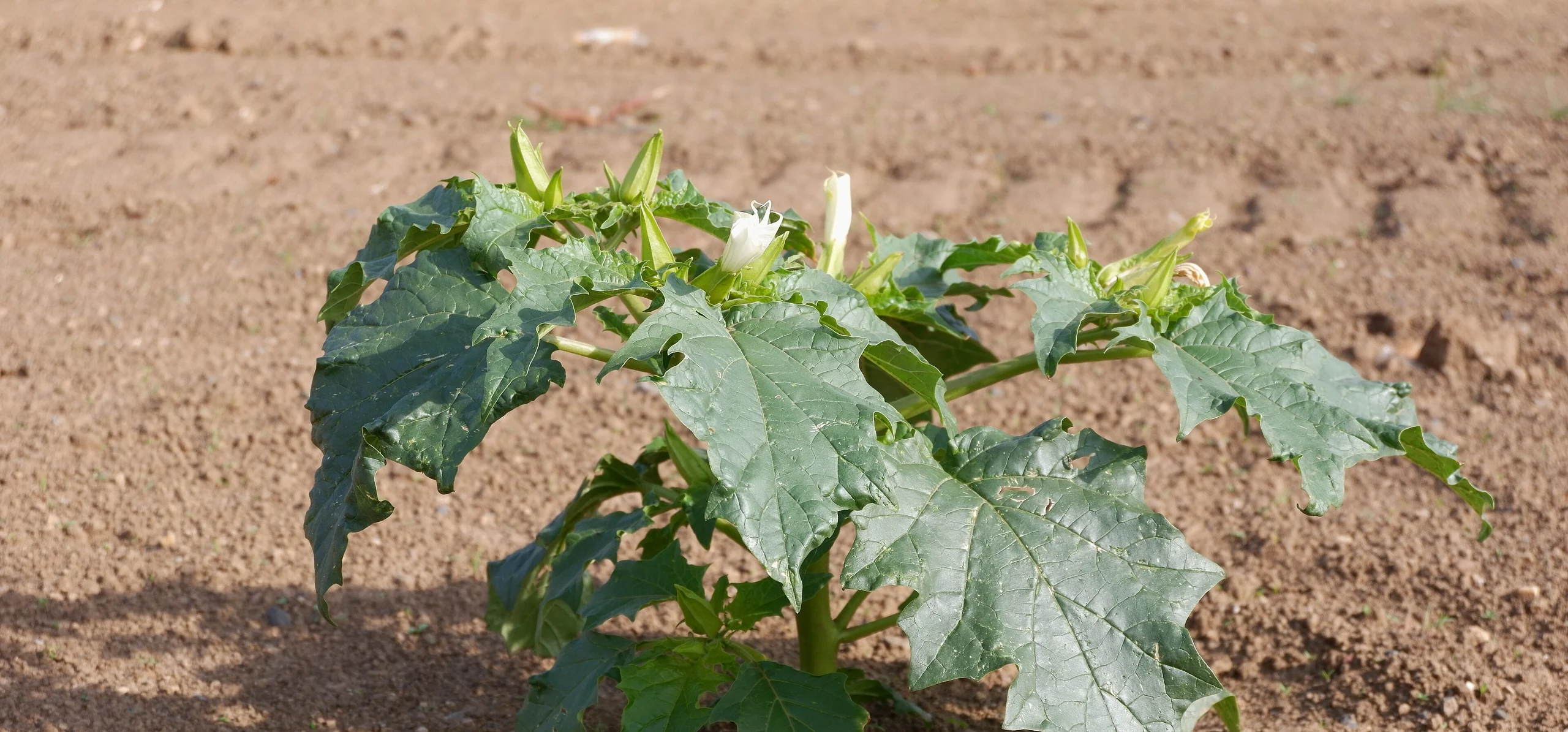
A rank-smelling, waist-to-shoulder-high plant with white or purple trumpet flowers and a spiky green pod where a fruit should be is almost always jimsonweed, Datura stramonium, and every part of it, root to seed, carries tropane alkaloids strong enough to kill livestock and send a curious child to the hospital. Nobody plants it on purpose: it seeds itself into vegetable beds, barnyards, and freshly turned dirt, then bulks up from a bare patch to a branching, several-foot bush in a single season. It is not rare or exotic. GBIF's accepted classification places it as native to Mexico but now naturalized on every temperate and subtropical continent, one of the most widely spread weeds on the planet. The three things worth knowing before deciding what to do about the plant in front of you are how to identify it fast, why it turned up in that particular spot, and how to remove it without spreading its seed further.
Identifying It: Trumpet Flowers and a Spiny Capsule
NC State Extension's Plant Toolbox describes the leaves as simple, alternate, 3 to 7 inches long, ovate to oblong-elliptical with wavy, coarsely toothed margins. The flower is the giveaway: a trumpet 2 to 4 inches long, white to purple-tinged, with five shallow lobes meeting at a toothed tip. University of Wisconsin-Madison Extension notes the furled, cigar-shaped buds unwind after dusk and stay open until around noon the next day, which is why a jimsonweed patch can look flowerless all afternoon and be full of open blooms the following morning. Once the flower drops, an egg-shaped capsule takes its place, covered in stiff spines and roughly 1 to 2 inches long. Cornell's Department of Animal Science notes the ripe capsule splits into four sections from the tip, spilling out many flat, dark, pitted, kidney-shaped seeds.
The Smell, the Sap, and Other Field Marks
Crushed foliage gives off what NC State Extension calls a very foul odor, which is often the first thing that flags the plant before anyone has looked closely at a leaf. Curiously, the flowers work the opposite way: their scent is sweet at night to draw in pollinators, strong enough that leaning in for a close smell can bring on a headache or dizziness. The sap is a separate hazard from the alkaloids inside the plant: both NC State Extension and University of Wisconsin-Madison Extension note it can irritate skin and cause contact dermatitis in sensitive people, which is reason enough to handle the plant in gloves even before considering what happens if any part of it is eaten.
Why It Shows Up in Barnyards, Manure, and Fresh Topsoil
Jimsonweed is not distributed evenly across a property. Cornell's Department of Animal Science lists its habitat as cultivated fields, overgrazed pastures, and barnyards, on rich soils, and University of Wisconsin-Madison Extension likewise describes it as a weedier, opportunistic species of disturbed ground rather than of settled, undisturbed land. In practice, that means the ground most likely to sprout it is exactly the ground that has just been turned over or heavily enriched: a new load of topsoil, a bed that got a dose of manure or compost, the churned dirt around a construction fence, or the packed, nutrient-loaded soil of a barnyard or animal pen. The seed itself may already be sitting dormant in that soil, or it may have hitched a ride in with the material that was just brought in; either way, disturbing rich ground is what wakes it up.
Every Part Is Toxic: The Tropane Alkaloids
The danger is not concentrated in one part of the plant. Cornell's Department of Animal Science attributes it to tropane alkaloids, chiefly atropine, hyoscine, and hyoscyamine, with total alkaloid content in the plant reaching up to 0.7 percent, and notes that the leaves and seeds carry the greatest risk, with livestock poisoning most often traced to hay, silage, or grain contaminated with plant material. Symptoms described by Cornell and reflected across the wider extension literature include dilated pupils, intense thirst, fever, loss of coordination, a racing pulse, hallucinations, convulsions, and coma in severe cases. Cornell also makes a point worth repeating here: poisoning is more common in humans than in animals, largely because children are drawn to the showy flowers and pods. Worth knowing separately: jimsonweed does not appear on the ASPCA's toxic and non-toxic plant lists under that name or under Datura, so it carries no ASPCA rating for cats, dogs, or horses; the Thorn Apple entry that does exist on the ASPCA's site is a different plant entirely, the black hawthorn, Crataegus douglasii, an unrelated species that happens to share a common name.
Handling and Removing It: Gloves, and Never Into the Compost With Seed
Pull or dig it while it is still young. NC State Extension notes the plant develops a taproot, and a mature specimen is genuinely hard to remove by hand once that root has set. Gloves are non-negotiable given the sap, and the real deadline is the capsule: once it has split open, the seeds it drops are viable in the soil for years, according to NC State Extension, so a plant pulled after that point has already done its damage regardless of what happens to the uprooted stalk. A pulled plant, seeded or not, should never go into a home compost pile; ordinary garden compost rarely reaches a temperature reliable enough to destroy every seed, and a jimsonweed patch that seems to have been cleared for good has a way of reappearing from compost spread the following spring. Bag mature plants for disposal instead, and check the same bed again a few weeks later, since more than one flush of germination from the existing seed bank is normal.
Jimsonweed Is Not the Same as Angel's Trumpet
The plant is frequently confused with its ornamental relative, Brugmansia, sold as angel's trumpet. University of Wisconsin-Madison Extension draws the line clearly: Brugmansia is a South American genus with woody stems, flowers that hang downward, and seed pods that have to be broken open by hand, while Datura holds its trumpets upright, has soft annual growth, and produces a capsule that splits open on its own. Both genera are loaded with the same class of tropane alkaloids and both are dangerous, but they are not interchangeable plants, and a gardener who bought a potted angel's trumpet for the patio is not growing the same species as the volunteer weed in the vegetable bed, even though the flowers look like cousins at a glance.
Sphinx Moths, Not Bees, Do the Pollinating
The flower's schedule only makes sense once the pollinator is known. University of Wisconsin-Madison Extension explains that the blooms open after dusk and release a strong, sweet scent specifically to attract night-flying sphinx moths, which is why a jimsonweed flower is built to reward a visitor working in darkness rather than one working in daylight. By the time daytime bees are active the following morning, the flower has already been open for hours and is close to wilting for good, so moths get first and best access to the nectar while bees pick up only incidental, late visits. It is one more way this weed keeps a low profile during the day and does its most important business, from opening its worst-smelling leaves to its most fragrant flowers, after the sun goes down.
Test your plant knowledge
Tap a card to flip it and reveal the answer.
The spiny seed capsule of Datura stramonium splits open on its own when ripe, unlike the seed pods of the related ornamental Brugmansia (angel's trumpet), which have to be broken open by hand. Tap to reveal ✓ True
Every part of Datura stramonium, including the leaves and seeds, contains toxic tropane alkaloids. Tap to reveal ✓ True
Datura stramonium (jimsonweed) is officially listed as toxic to dogs, cats, and horses on the ASPCA's toxic and non-toxic plant lists. Tap to reveal ✕ False
Jimsonweed flowers are pollinated mainly by daytime bees. Tap to reveal ✕ False
A jimsonweed plant that has already dropped seed into the soil can keep producing new seedlings for years, even after every visible plant is removed. Tap to reveal ✓ True
Sources
References consulted for this guide
- GBIF: Datura stramonium L.gbif.org
- POWO: Datura stramonium L.powo.science.kew.org
- NC State Extension Gardener Plant Toolbox: Datura stramoniumplants.ces.ncsu.edu
- Cornell University Department of Animal Science, Poisonous Plants: Jimsonweedpoisonousplants.ansci.cornell.edu
- University of Wisconsin-Madison Extension, Wisconsin Horticulture: Daturahort.extension.wisc.edu
- Reference entity : Wikipédiaen.wikipedia.org