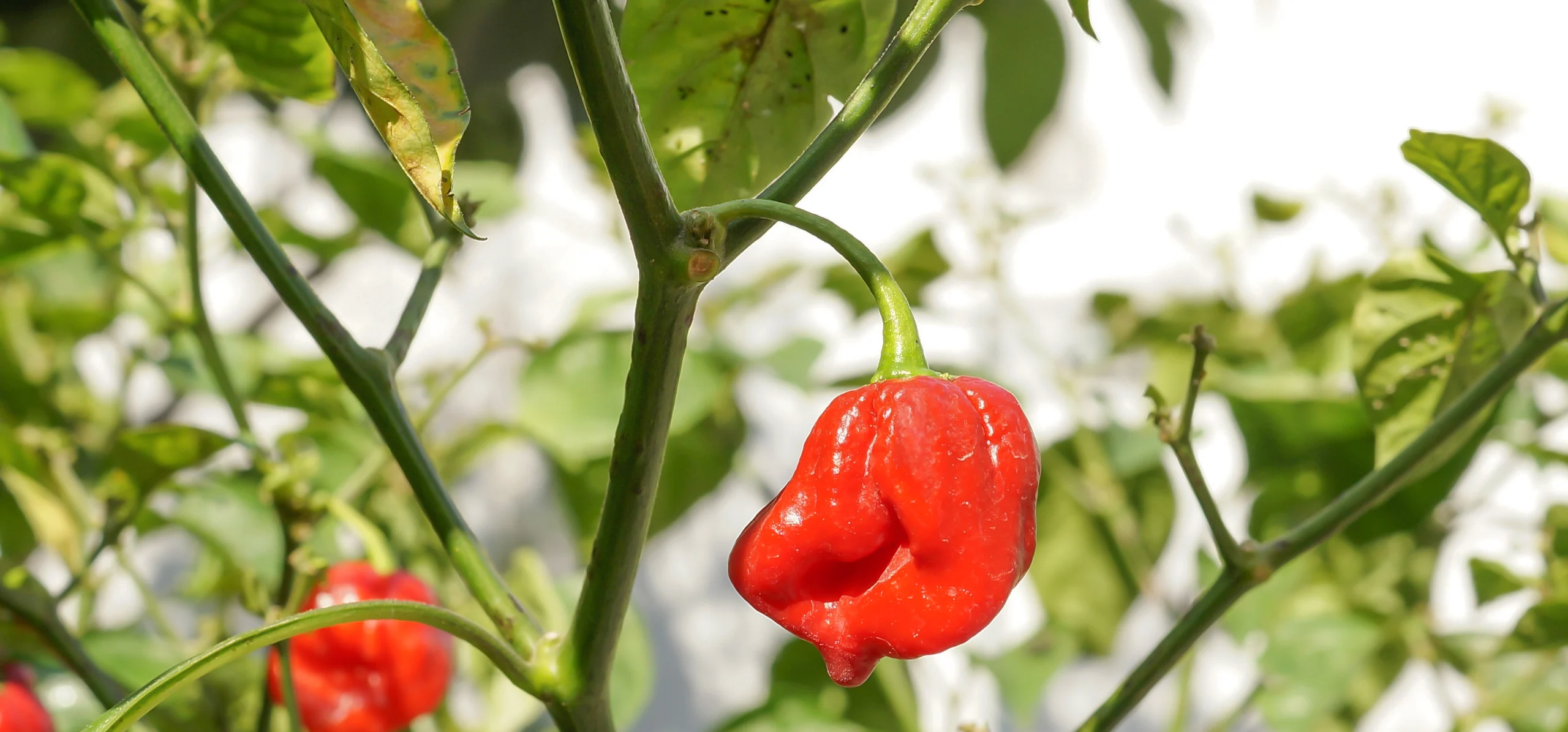
Bell Pepper
Capsicum annuum
Family · Solanaceae
Capsicum annuum needs full sun, warm days and steady moisture to set fruit. Covers feeding, blossom end rot, pests and hardiness for bell and chili peppers.
Capsicum annuum
Plant profile
- WateringModerateWater every 4 days
- Light exposureFull sun
- Ideal temperature13–29 °C
Growth
- Family
- Solanaceae
- Life cycle
- Annual
- Growth speed
- 5/10
- Mature size
- 50–100 cm
- Spread
- 10–50 cm
- Flowering
- Midsummer into autumn once temperatures stay consistently warm
- Propagation
- Seed
Dormancynone; grown as a single warm-season crop and typically replaced each year rather than overwintered
Time to maturityreaches fruiting maturity within about a year from sowing (RHS)
Soil & climate
- Soil pH
- pH 6–6.5
- Soil types
- loam, sand
- Drought tolerance
- No
Light & Placement
- Origin
- Southern USA to Brazil and the Caribbean
- Where to place it
- sunny windowsill
- greenhouse bench
- polytunnel border
- sheltered sunny patio
- south or west facing bed
- large pot of fertile, peat-free compost with good drainage
Safety
- Toxicity
- HumansToxic
Invasive speciesNo invasive status documented in the sources consulted; it is grown as a controlled annual crop
Data fromCapsicum annuum, GBIF Backbone TaxonomyCapsicum annuum L., Plants of the World RHS: Capsicum annuum (sweet pepper)UC IPM: Cultural Tips for Growing PepperUC IPM: Blossom End Rot
Where it grows
World distribution
Bell Pepper is native to 29 countries: Antigua & Barbuda, Bahamas, Belize, Bolivia, Brazil, Cayman Islands, Colombia, and Costa Rica….GBIF records 69,450 documented identifications across 198 countries, with the largest concentrations in Mexico, United States, and Spain.
- Antigua & Barbuda
- Bahamas
- Belize
- Bolivia
- Brazil
- Cayman Islands
- Colombia
- Costa Rica
- Cuba
- Curaçao
- Dominican Republic
- Ecuador
Show 17 more countriesShow fewer countries
- El Salvador
- Guatemala
- Guyana
- Haiti
- Honduras
- Jamaica
- Mexico
- Nicaragua
- Panama
- Peru
- Puerto Rico
- St. Lucia
- Suriname
- Trinidad & Tobago
- Turks & Caicos Islands
- United States
- Venezuela
Yellow to orange dots: concentration of documented identifications per country. Green countries: sourced native range. Source: GBIFNative range from POWO (Kew).
A pot-grown Capsicum annuum could turn out to be a blocky green bell pepper, a slim cayenne, or a squat little ornamental crowded with tiny fruit: all three are the same species, and all three want the same core conditions. The plant is frost-tender, slows down once temperatures drop toward 13C (55F), and reaches fruiting maturity within about a year from sowing. Give it full sun, a sheltered spot, consistent moisture and regular feeding once flowers open, and a single plant will carry fruit from midsummer into autumn.
One Species, Two Very Different Vegetables
The RHS splits its Capsicum annuum cultivars into named groups that explain the confusion at the seed rack: the Grossum Group covers the blocky, thick-walled bell and green peppers sold for stuffing and roasting, while the Longum Group covers narrower, hotter types such as jalapeno and habanero-shaped chilies. Both come from one species, and the difference in heat comes down to how much capsaicin a particular cultivar's fruit accumulates, not a different plant underneath. A gardener choosing sweet fruit and one choosing fire are picking a cultivar within Capsicum annuum, not a different species, so the seed packet or plant tag matters more here than the Latin name alone.
Light, Heat and a Sheltered Spot
Capsicum annuum needs full sun, and the RHS specifically recommends a south or west facing aspect. It grows best with daytime temperatures of 75 to 85F (24 to 29C) and nights of 55 to 65F (13 to 18C); push daytime heat past 100F (38C) and pollination and fruit set both drop off, according to the University of California's IPM program. The RHS rates the species H1C, meaning it only tolerates being outside through summer where winter lows stay above roughly 5 to 10C; everywhere colder it needs a greenhouse, polytunnel, or a bright, sheltered patio pot that can be moved under cover.


Soil and Watering
Loam or sandy soil that stays moist but drains freely suits it best, at a pH the University of California puts at 6.0 to 6.5. Roots run to around 60 cm (2 feet) deep once established, and the plant wants consistent moisture there rather than a cycle of drought and flood: UC IPM notes that a newly planted pepper usually needs only one or two waterings in its first month, after which deeper, less frequent watering builds a stronger root system than a daily light sprinkle.
Feeding Through the Fruiting Season
The RHS recommends a balanced liquid feed every ten days once the plant is actively growing, continuing until the fruit starts to change color. Too much nitrogen early on pushes leafy growth at the expense of flowers, so a bushy plant with few blooms is usually an overfed one rather than a struggling one. Pinching out the growing tip once a young plant reaches about 20 cm tall, as the RHS advises, encourages branching and gives a shorter, sturdier plant with more flowering points than one left to grow a single tall stem.
Flowering, Pollination and Fruit Set
Flowers are self-fertile and largely wind or insect pollinated, but they are sensitive to heat stress: temperatures above 100F (38C) or a run of cold nights both cause buds and small fruit to drop before they develop, per UC IPM. A plant that flowers heavily but sets little fruit during a heatwave is not diseased, it is simply too stressed to hold pollen viable; the fix is shade cloth during the hottest afternoons and patience until temperatures ease, not more fertilizer.
Blossom End Rot and Other Common Problems
A sunken, leathery brown patch on the fruit's blossom end is blossom end rot, caused by a combination of low calcium in the developing fruit and uneven watering rather than a soil-borne disease, so no pesticide will treat it. UC IPM notes that high soil salts and sandy soils make the problem worse and that adding calcium to the soil rarely helps if the real issue is inconsistent moisture; the reliable fix is even watering that keeps the root zone from swinging between dry and saturated.
Pests to Watch
The RHS lists glasshouse red spider mite, glasshouse whitefly and aphids as the main pests under cover, with slugs and snails targeting young plants outdoors. Red spider mite thrives in the same hot, dry conditions the plant is grown in, so misting the foliage or raising humidity around greenhouse plants helps keep populations down without reaching for a chemical treatment over a light infestation.
Harvesting
Fruit can be picked green or left on the plant to ripen fully to red, orange or yellow depending on the cultivar; leaving it longer deepens both color and sweetness but slows the plant's production of new fruit, so picking a steady stream of slightly under-ripe pods usually keeps more flowers coming than waiting for every pepper to fully color. All fruit and foliage carry an irritant warning from the RHS, since even sweet cultivars share the same compounds as hot ones in smaller amounts, so gloves are worth wearing when handling a heavy harvest of the hotter cultivars in particular.
Test your plant knowledge
Tap a card to flip it and reveal the answer.
Sweet bell peppers and hot chili peppers like jalapeno can both be Capsicum annuum. Tap to reveal ✓ True
Pepper flowers set fruit best once daytime temperatures climb above 100F (38C). Tap to reveal ✕ False
Blossom end rot on peppers is mainly a watering problem, not simply a lack of calcium in the soil. Tap to reveal ✓ True
The RHS rates Capsicum annuum as hardy enough to stay outdoors year-round in a temperate climate. Tap to reveal ✕ False
The ASPCA specifically lists Capsicum annuum by name as toxic or non-toxic to pets. Tap to reveal ✕ False
Sources
References consulted for this guide
- Capsicum annuum, GBIF Backbone Taxonomygbif.org
- Capsicum annuum L., Plants of the World Online (Kew)powo.science.kew.org
- RHS: Capsicum annuum (sweet pepper)rhs.org.uk
- UC IPM: Cultural Tips for Growing Peppersipm.ucanr.edu
- UC IPM: Blossom End Rotipm.ucanr.edu
- Reference entity : Wikipédiaen.wikipedia.org