American Black Nightshade
Solanum americanum
Family · Solanaceae
American black nightshade reseeds by the thousand, hides solanine in its leaves and unripe berries, and gets mixed up with deadly nightshade.
Solanum americanum
Plant profile
- WateringModerateWater every 7 days
- Light exposurePartial sun
Growth
- Family
- Solanaceae
- Life cycle
- Annual
- Growth speed
- 7/10
- Mature size
- 75–120 cm
- Spread
- 45–90 cm
- Propagation
- Seed
- Cutting
FloweringSmall white star-shaped flowers with a yellow center, in clusters, summer through fall
DormancySeed forms a persistent soil seedbank and germinates in flushes across seasons
Time to maturityFlowers and sets fruit within the first growing season, continuously from summer into fall
Soil & climate
- Soil types
- clay, loam, sand
- Drought tolerance
- No
Light & Placement
- Origin
- Native from western Canada to tropical and subtropical America; naturalized worldwide
- Where to place it
- vegetable garden beds
- disturbed and freshly tilled ground
- field margins and waste ground
Safety
- Toxicity
- HumansToxic
Invasive speciesA prolific self-seeding annual weed of cultivated and disturbed ground; NC State Extension notes it competes with vegetable crops and hosts the Colorado potato beetle and southern bacterial wilt.
Data fromGBIF: Solanum americanum Mill.POWO: Solanum americanum Mill.NC State Extension Gardener Plant ToolboASPCA: Toxic and Non-Toxic Plants, Black
Where it grows
World distribution
American Black Nightshade is native to 36 countries: Antigua & Barbuda, Argentina, Aruba, Bahamas, Belize, Bolivia, Brazil, and Canada….GBIF records 52,313 documented identifications across 187 countries, with the largest concentrations in United States, Brazil, and Taiwan.
- Antigua & Barbuda
- Argentina
- Aruba
- Bahamas
- Belize
- Bolivia
- Brazil
- Canada
- Cayman Islands
- Chile
- Colombia
- Costa Rica
Show 24 more countriesShow fewer countries
- Cuba
- Curaçao
- Dominican Republic
- Ecuador
- El Salvador
- French Guiana
- Guatemala
- Guyana
- Haiti
- Honduras
- Jamaica
- Mexico
- Nicaragua
- Panama
- Paraguay
- Peru
- Puerto Rico
- St. Lucia
- Suriname
- Trinidad & Tobago
- Turks & Caicos Islands
- United States
- Uruguay
- Venezuela
Yellow to orange dots: concentration of documented identifications per country. Green countries: sourced native range. Source: GBIFNative range from POWO (Kew).
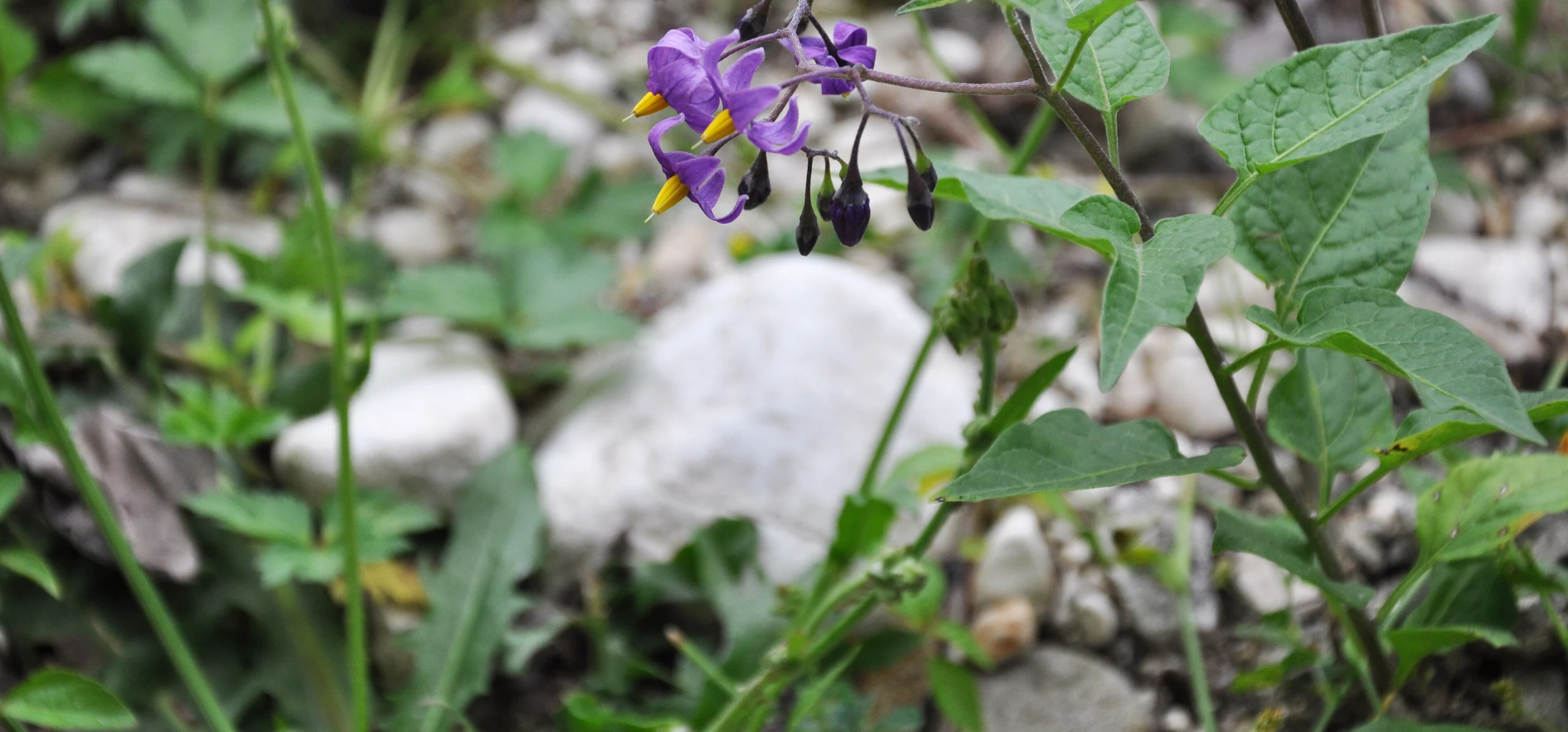
A low, branching weed with small white star-shaped flowers and clusters of glossy black berries the size of peppercorns turning up in a vegetable bed, flowerbed, or any patch of freshly turned soil is very likely American black nightshade, Solanum americanum. GBIF's accepted classification places it in the nightshade family, Solanaceae, the same family as tomato and potato, with a native range that Kew's Plants of the World Online gives as western Canada to tropical and subtropical America, though it has since naturalized across Africa, Asia, Europe, and the Pacific. It is not the same plant as European black nightshade, Solanum nigrum, though gardeners constantly mix the two up, and it is a different genus entirely from deadly nightshade, Atropa belladonna. What matters in the moment is identifying it correctly, pulling it before the berries ripen, and knowing which parts are actually dangerous.
Identifying It: Star Flowers and Glossy Black Berries
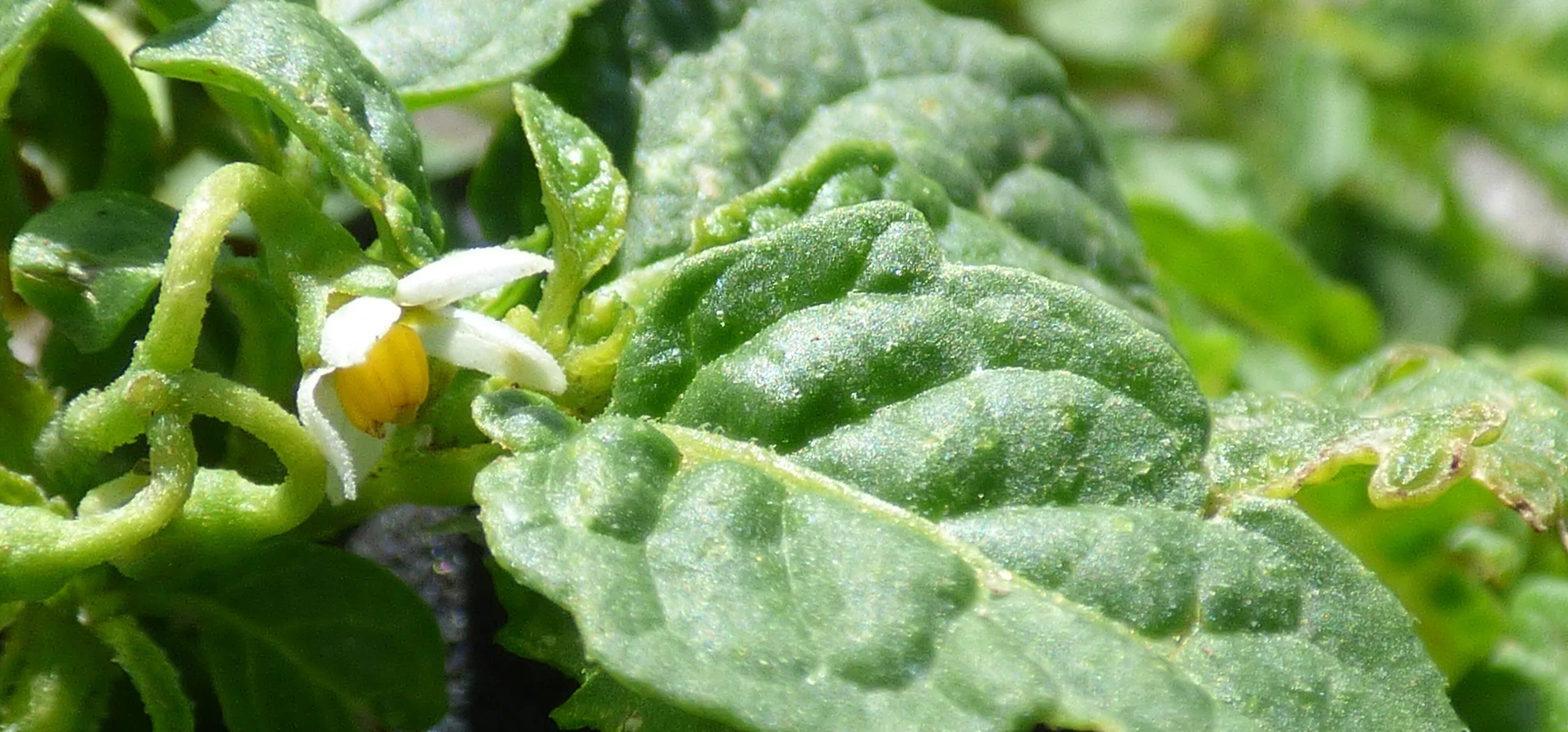
North Carolina State Extension's Plant Toolbox describes the leaves as green to dark green, ovate to lanceolate, 1 to 3 inches long and wide, with slightly hairy undersides and dentate or undulate margins, arranged alternately on green, erect, angular, many-branched stems that are smooth or only slightly hairy, never spiny. The flowers are small, star-shaped, five-petaled, white, with a yellow columnar center, opening in loose umbel-like clusters of three to ten from summer into fall. The fruit starts green with faint white flecks and ripens to a shiny black or blackish-purple berry under a quarter-inch across, packed with 50 to 100 tiny tan seeds. That glossy finish is the detail worth remembering: American black nightshade's berries ripen shiny and comparatively small, while the closely related European black nightshade, Solanum nigrum, produces a duller, larger berry. Bumblebees, flies, and other insects work the flowers, per NC State Extension, and wild turkeys, catbirds, meadowlarks, and pheasants eat the ripe fruit, which is how the seed keeps turning up in new corners of a property.
Not Deadly Nightshade, and Not Quite Its European Cousin Either
The word nightshade alarms people, and the alarm sends some straight to deadly nightshade, Atropa belladonna, a different genus with a different growth habit. NC State Extension's page on Atropa bella-donna describes its ripe fruit as larger than black nightshade's, borne singly rather than in clusters, and backed by a large stellate calyx with long lobes that protrude past the berry; the flowers are bell-shaped and purple-brown, not small white stars. American black nightshade never carries a berry alone like that; it clusters them in umbels the way a cherry tomato plant clusters its fruit. The more common mix-up in the field is with Solanum nigrum, a related but distinct species with duller, slightly larger berries; NC State Extension notes the two are frequently confused.
Why It Turns Up in Vegetable Beds and Disturbed Ground
American black nightshade grows best in full sun with six or more hours of direct light, though NC State Extension notes it tolerates partial shade, and it is not picky about soil texture, rooting equally well in clay, loam, or sand with good drainage or consistently moist conditions. It behaves as a summer annual across most of its range: seed germinates as the soil warms, and a plant can flower, fruit, and drop seed within a single growing season, which is exactly why it shows up first in the ground that was worked most recently, a newly dug vegetable bed, a tilled row, the loose soil at the edge of a path. It is not a plant anyone sets out to grow; it arrives on its own, and freshly disturbed, sunny, fertile ground is what it is waiting for.

A Prolific Seeder: Why One Missed Plant Becomes Fifty
A single plant can carry dozens of berries at once, each one holding 50 to 100 seeds, and those seeds do not all germinate together. Research on the species' germination biology has found that alternating day and night temperatures are the main trigger for sprouting, and that seed sitting on the soil surface, uncovered by mulch or crop residue, germinates far more readily than buried seed, which is one reason the same bed can keep producing new seedlings in flushes through an entire season rather than all at once. Seed that does not germinate the first year does not necessarily die; it joins the soil seedbank and can resurface in a later season when conditions line up again, which is why a bed that looked clean in spring can be full of nightshade by August.
Control: Hoe It Young, Mulch the Bed, Never Let It Seed
NC State Extension recommends manual hand weeding as the main control option once vegetable crops are already in the ground, since herbicide choices narrow considerably around food plants; hoeing seedlings while they are still small, before the taproot sets, is the easiest and most reliable time to remove them. A mulch layer that keeps light and open soil surface away from dormant seed reduces new germination, and cover crops used between vegetable plantings do the same job over a wider area, per NC State Extension. The one deadline that actually matters is the berry: green fruit with white flecks is still closing in on ripeness, but once it turns glossy black it is ready to drop viable seed, so a plant left standing past that point has already reseeded the bed regardless of when it is eventually pulled.
A Host for the Pests and Diseases of Tomato and Potato
Because it belongs to the same genus as potato and shares the family with tomato, American black nightshade does more than compete for space and light in a vegetable bed. NC State Extension lists it as a host plant for the Colorado potato beetle and notes it carries southern bacterial wilt, a disease that also affects herbaceous ornamentals; standing plants of it near a vegetable patch give both a place to persist between crops. NC State Extension is blunt about the practical cost too: the species competes with vegetable crops and reduces the harvest, reason enough to remove it from a food garden even before weighing the disease risk.
Toxicity: Solanine in the Leaves and Unripe Berries
NC State Extension rates American black nightshade's poison severity as high, identifies solanine as the toxic alkaloid, and lists the flowers, fruit, leaves, roots, and sap as all carrying it, with humans, livestock, dogs, cats, and children named as the groups at risk; reported symptoms range from nausea, vomiting, and salivation to abdominal pain, weakness, respiratory depression, convulsions, and hallucinations in serious cases, and the entry notes poisoning may be fatal. The ASPCA's own toxic and non-toxic plant lists do not carry an entry for Solanum americanum by name, so it has no ASPCA rating of its own; the ASPCA does list a close relative, Solanum nigrum, as Black Nightshade, toxic to dogs, cats, and horses on solanine, saponins, and atropine-like compounds, a fair sense of the risk the wider genus carries even where this species is not separately listed. Unripe, green-flecked berries carry the most solanine and should never be tasted.
Eaten as a Vegetable in Africa and Southeast Asia, Not From Your Garden
The same species has a long history as a leafy vegetable elsewhere in the world. It is collected from the wild or cultivated in Sierra Leone, the lowlands of Ethiopia, Kenya, Uganda, and Tanzania, and on Seychelles and Mauritius, and is a popular wild pot herb in Cote d'Ivoire and Cameroon, with the leaves also eaten in eastern Zimbabwe and Mozambique; across Southeast Asia it is sold as a green vegetable, ripe green fruit included, in ordinary supermarkets. The preparation in every case is the young leaves and shoots boiled, often with the cooking water discarded and changed partway through, which cuts the bitterness and the soluble alkaloid content before the greens are eaten. That tradition applies to known, often locally selected populations prepared a specific way; it is not a reason to sample the leaves or berries of a nightshade volunteering in a home vegetable bed without an expert identifying it first.
Test your plant knowledge
Tap a card to flip it and reveal the answer.
American black nightshade (Solanum americanum) is officially listed as toxic to cats, dogs, and horses on the ASPCA's toxic and non-toxic plant lists. Tap to reveal ✕ False
The ripe berries of Solanum americanum are shinier and smaller than those of the related European black nightshade, Solanum nigrum, which produces duller, larger fruit. Tap to reveal ✓ True
A single plant of Solanum americanum can produce seed that stays dormant in the soil and germinates in flushes over more than one growing season. Tap to reveal ✓ True
Deadly nightshade, Atropa belladonna, produces its berries in clusters of several fruit, just like Solanum americanum. Tap to reveal ✕ False
In parts of Africa and Southeast Asia, the young leaves of Solanum americanum are boiled and eaten as a cooked leafy vegetable. Tap to reveal ✓ True
Sources
References consulted for this guide
- GBIF: Solanum americanum Mill.gbif.org
- POWO: Solanum americanum Mill.powo.science.kew.org
- NC State Extension Gardener Plant Toolbox: Solanum americanumplants.ces.ncsu.edu
- NC State Extension Gardener Plant Toolbox: Atropa bella-donnaplants.ces.ncsu.edu
- ASPCA: Toxic and Non-Toxic Plants, Black Nightshadeaspca.org
- Reference entity : Wikipédiaen.wikipedia.org