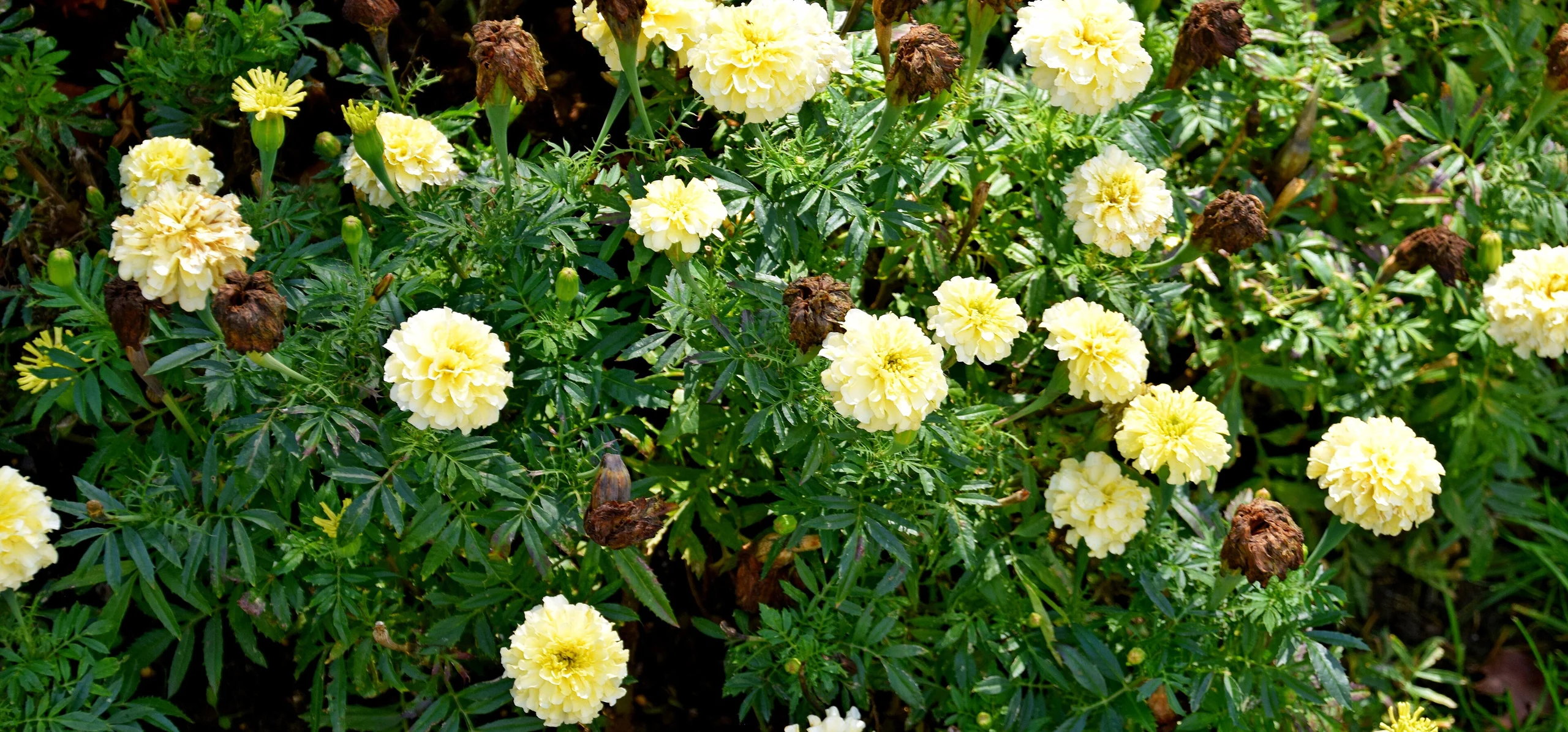
African Marigold
Tagetes erecta
Family · Asteraceae
African marigold (Tagetes erecta) grows 1 to 4 ft tall in full sun, needs about 1 in of water weekly, and suppresses root-knot nematodes when solid-planted.
Tagetes erecta
Plant profile
- WateringModerateWater every 7 days
- Light exposureFull sun
- Hardiness zoneUSDA 2–11
Growth
- Family
- Asteraceae
- Life cycle
- Annual
- Growth speed
- 7/10
- Mature size
- 30–122 cm
- Spread
- 30–61 cm
- Flowering
- June until first frost
- Propagation
- Seed
DormancyNone, killed by the first frost
Time to maturityJune to frost
Soil & climate
- Soil pH
- pH 5.5–7
- Soil types
- loam, clay, well-drained
- Drought tolerance
- No
Light & Placement
- Origin
- Mexico to Guatemala
- Where to place it
- beds and borders
- edging
- cutting garden
- containers with good drainage, especially compact and triploid hybrid cultivars
Safety
- Toxicity
- Not listed by the ASPCA for cats, dogs or horses
- Pet safe
- No
Data fromGBIF: Tagetes erecta L.Plants of the World Online (Kew): TageteMissouri Botanical Garden Plant Finder: Clemson HGIC: How to Grow and Care for MClemson HGIC: Root-Knot Nematodes in the
Where it grows
World distribution
African Marigold is native to 2 countries: Guatemala and Mexico.GBIF records 14,476 documented identifications across 175 countries, with the largest concentrations in Mexico, Sweden, and United States.
- Guatemala
- Mexico
Yellow to orange dots: concentration of documented identifications per country. Green countries: sourced native range. Source: GBIFNative range from POWO (Kew).
Tagetes erecta produces the biggest flowerheads in the marigold genus, up to 4 in (10 cm) across on the fully double cultivars, and it is the parent species behind most tall "African" or "American" marigolds sold at garden centers. It is a frost-tender annual native to Mexico and Guatemala, in the daisy family Asteraceae, and once established it flowers continuously from June until the first hard frost. Buy or start it with full sun in mind: this species will not flower well in shade, and the tallest strains need a spot sheltered from wind.
Choosing an African Marigold Variety
'Crackerjack' and 'Taishan Mix' are classic tall African marigold strains grown for cutting and bedding, reaching up to 3 ft (about 90 cm) with fully double, globe-shaped blooms in yellow, orange or whitish tones. Triploid F1 hybrids, crosses between African marigold (T. erecta) and French marigold (T. patula), combine the large 2 to 3 in flowers of the African parent with the compact 10 to 18 in habit of the French parent, and hold up better through summer heat. Compact pale cultivars such as 'Vanilla Cream', shown in the photo on this page, keep the same dense double flowerhead structure on a shorter, bushier plant.
Sun, Soil and Planting
African marigold needs full sun, at least 6 hours of direct light a day, in average, evenly moist, well-drained soil with a pH between 5.5 and 7.0. It tolerates clay soil better than many annuals but still performs best in loam worked with organic matter to a depth of about 6 in. Sow seed roughly a quarter inch deep directly in the garden after the last frost date, spacing plants 12 to 16 in apart, or start seed indoors 8 weeks before the outdoor planting date at 70 to 75°F. When transplanting taller varieties, strip a few of the lower stem leaves and set the plant slightly deeper than it grew in its pot, below the remaining leaf scars, which reduces the need for staking later.


Watering
Give established plants about 1 in of water a week and let the soil surface dry before watering again. Missouri Botanical Garden rates the species as medium water use, not the frequent misting some bedding annuals need. Overwatering in heavy or poorly drained soil is a more common problem than underwatering, since standing moisture encourages the root and stem rots this species is prone to.
Feeding, Pinching and Deadheading
Work a slow-release fertilizer formulated for annuals into the soil at planting time; African marigold does not need much extra feeding beyond that first application. Pinch young plants back by an inch or two to force branching into a bushier, more floriferous habit instead of one tall stem. Deadhead spent flowerheads promptly and the plant keeps producing new buds from June through frost; left unpicked, older flowerheads turn papery and slow the plant's production of new ones.
Staking and Weather Protection
Tall African marigold varieties carry heavy, top-heavy flowerheads on comparatively soft stems, and Missouri Botanical Garden's growing notes single this out as the main structural weakness of the species: stems often snap in strong wind or heavy rain once the flowerheads open fully. Stake taller cultivars at planting time rather than after a storm has already flattened them, and choose a site sheltered from prevailing wind for full-size types rather than a compact triploid hybrid, which stays low enough to shrug off most weather.
Pests and Diseases
Watch for spider mites and thrips in hot, dry weather, checking the undersides of leaves and inside packed flowerheads where both hide. Slugs target seedlings in the first weeks after sowing; leafminers, aphids and whiteflies tend to show up later in the season, usually without doing serious damage to established plants. The main disease risks are powdery mildew, gray mold (Botrytis), leaf spot and root or stem rots, all worse in crowded plantings with poor airflow or soil that stays wet. Occasional plants develop bacterial wilt or one of the viral diseases that circulate through the aster family: tomato spotted wilt virus, cucumber mosaic virus or aster yellows.
African Marigold as a Nematode-Suppressing Cover Crop
Both African marigold and French marigold have a documented, if narrow, use against root-knot nematodes in vegetable gardens. Clemson Cooperative Extension recommends planting African marigold cultivars such as 'Crackerjack' or 'Flor de Muerto' as a solid block, no more than 7 in apart, grown for at least two months and then turned into the soil. The planting has to be kept free of grass and weeds so nematodes cannot feed on anything but the marigold roots, and the rotation needs repeating at least every other year for as long as nematode pressure continues. A few marigolds scattered through a vegetable bed as companion plants will not reproduce this effect: the nematode suppression comes from the dense, weed-free monoculture, not from simple proximity.
Toxicity and Pet Safety
Tagetes erecta does not appear by name on the ASPCA's toxic or non-toxic plant lists for dogs, cats or horses, so there is no official ASPCA rating to point to either way for this exact species. Given that gap, treat it with ordinary caution around pets that chew on foliage: watch for stomach upset after ingestion, and contact a veterinarian or the ASPCA Animal Poison Control Center if a pet eats a large quantity of leaves or flowers.
Test your plant knowledge
Tap a card to flip it and reveal the answer.
African marigolds should be pinched when young to encourage bushier growth. Tap to reveal ✓ True
Deadheading spent flowers shortens the length of the blooming season. Tap to reveal ✕ False
Planting marigolds in a solid, weed-free block and turning them under after two months can reduce root-knot nematode populations. Tap to reveal ✓ True
The ASPCA lists African marigold (Tagetes erecta) by name as toxic to cats and dogs. Tap to reveal ✕ False
Tall African marigold varieties can have their stems snap in wind or heavy rain because of the weight of their flowerheads. Tap to reveal ✓ True
Sources
References consulted for this guide
- GBIF: Tagetes erecta L.gbif.org
- Plants of the World Online (Kew): Tagetes erectapowo.science.kew.org
- Missouri Botanical Garden Plant Finder: Tagetes erectamissouribotanicalgarden.org
- Clemson HGIC: How to Grow and Care for Marigolds in South Carolinahgic.clemson.edu
- Clemson HGIC: Root-Knot Nematodes in the Vegetable Gardenhgic.clemson.edu
- Reference entity : Wikipédiaen.wikipedia.org