English Yew
Taxus baccata
Family · Taxaceae
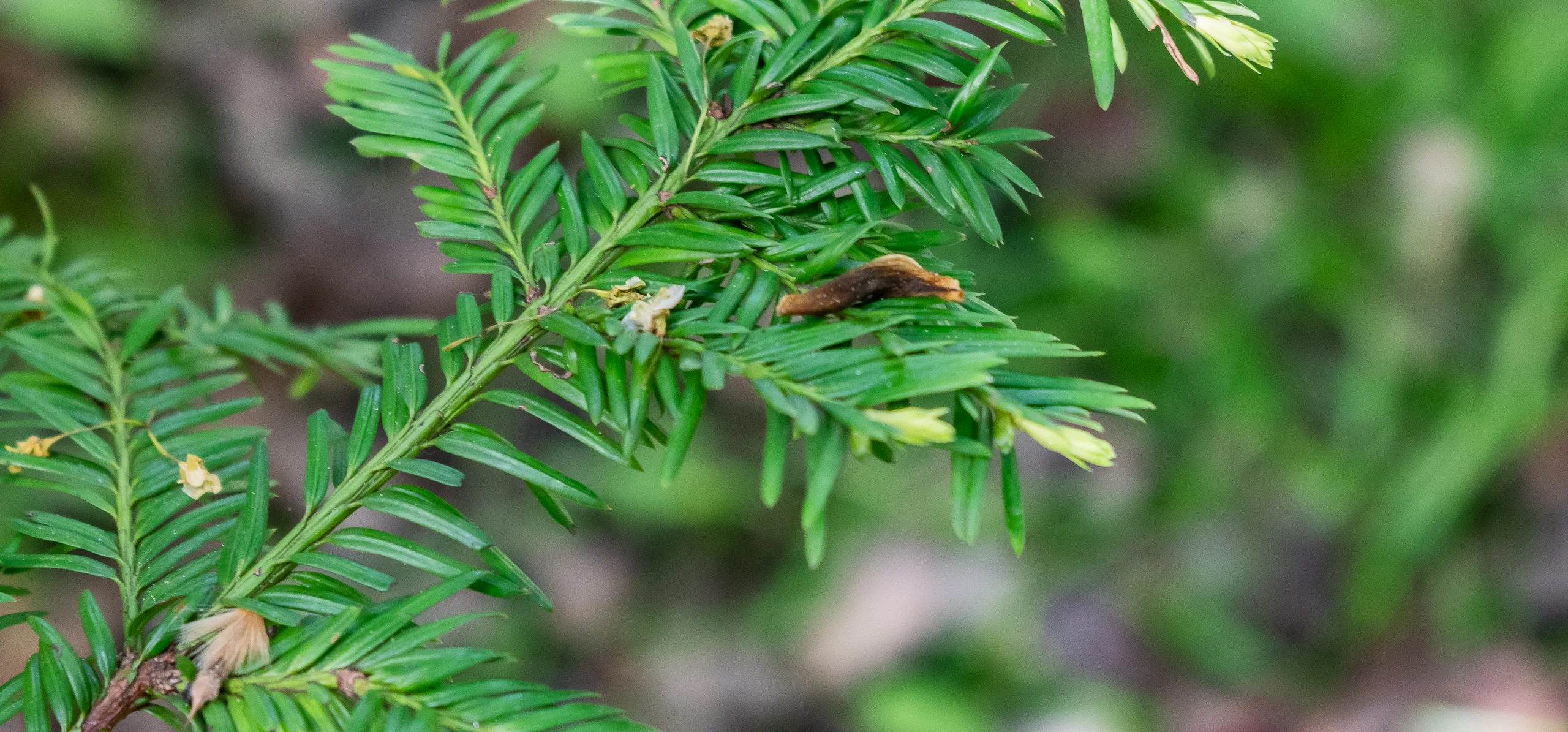
English yew clips into the sharpest formal hedges and topiary of any conifer, regrows from bare old wood, tolerates deep shade, but standing water kills it.
Taxus baccata
Plant profile
- WateringLittleWater every 14 days
- Light exposurePartial shade
- Hardiness zoneUSDA 5–7
Growth
- Family
- Taxaceae
- Life cycle
- Perennial
- Growth speed
- 3/10
- Mature size
- 900–1800 cm
- Spread
- 460–760 cm
- Propagation
- Cutting
- Seed
- Grafting
FloweringInconspicuous spring flowers on separate male and female plants; females bear fleshy red arils in autumn
Dormancyevergreen, no winter dormancy
Time to maturity20 to 50 years to reach ultimate size; hedges are kept clipped indefinitely
Soil & climate
- Soil types
- chalk, clay, loam, sand
- Drought tolerance
- Yes
Light & Placement
- Origin
- Azores, Europe to northern Iran and northwest Africa
- Where to place it
- formal hedge
- topiary shapes
- deep shade under tree canopy
- north-facing boundary
- churchyard or woodland edge planting
- large container topiary
Safety
- Toxicity
- CatsToxic
- DogsToxic
- HorsesToxic
- HumansToxic
Data fromGBIF Backbone Taxonomy: Taxus baccata L.Plants of the World Online (Kew): Taxus RHS: Taxus baccata (common yew)Missouri Botanical Garden Plant Finder: ASPCA: Toxic and Non-Toxic Plants, Engli
Where it grows
World distribution
English Yew is native to 32 countries: Albania, Algeria, Austria, Belarus, Belgium, Bulgaria, Croatia, and Czechia….GBIF records 315,463 documented identifications across 87 countries, with the largest concentrations in United Kingdom, Sweden, and France.
- Albania
- Algeria
- Austria
- Belarus
- Belgium
- Bulgaria
- Croatia
- Czechia
- Denmark
- Estonia
- Finland
- France
Show 20 more countriesShow fewer countries
- Georgia
- Germany
- Greece
- Hungary
- Iran
- Ireland
- Italy
- Morocco
- Netherlands
- Norway
- Poland
- Portugal
- Romania
- Russia
- Spain
- Sweden
- Switzerland
- Türkiye
- Ukraine
- United Kingdom
Yellow to orange dots: concentration of documented identifications per country. Green countries: sourced native range. Source: GBIFNative range from POWO (Kew).
A newly delivered yew that looks almost black-green and barely seems to move for the first season is behaving normally, not failing: Taxus baccata is one of the slower-looking conifers to establish, yet it is also the only common hedging conifer that will regenerate from bare, leafless old wood if a hedge is ever cut back hard, which is exactly why it remains the standard choice for the crispest formal hedges, topiary balls and mazes across Britain and much of Europe. Every part of the plant except the fleshy red aril around the seed is poisonous, so where it goes in the garden, and where the clippings end up afterward, matters as much as how it is pruned. The one condition it will not forgive is standing water at the roots; almost everything else about growing it, including a genuine tolerance for deep shade, follows from the fact that this is an ancient, slow-growing woodland tree that has been trained into a hedge for centuries.
Why Yew Beats Every Other Conifer for Hedging and Topiary
Most conifers grown for hedging, leylandii, thuja, most cypress, will not produce new shoots if the clippers ever go past the green foliage into bare brown wood: cut too hard and that patch of hedge stays bald for good. Yew is the exception. Regrowth from old wood means a yew hedge or topiary shape can be renovated by hard pruning, and even a badly overgrown hedge can be coppiced back to 15 to 20 cm above the ground and left to regenerate over several years, an option that simply does not exist for most needle conifers. Combined with a dense, fine-twigged habit that holds a sharp edge, this is why yew rather than any faster-growing conifer is the material of choice for architectural hedging, cones, spirals and the large topiary shapes seen in historic gardens.
Origin, Ancient Churchyard Yews and a Line on Taxol
Plants of the World Online lists the native range of Taxus baccata as the Azores, Europe east to northern Iran, and northwest Africa, making it one of the few conifers actually native to Britain rather than introduced. Its longevity is part of the reason it became a churchyard tree: many British and Irish churchyards hold a yew reckoned older than the church standing next to it, with some claimed at well over a thousand years, though exact ages are disputed because old trunks hollow out from the inside and lose the growth rings a forester would normally count to date a tree. The genus also lends its name to the taxanes, the toxic compounds found throughout the plant; one of them, extracted from clipped foliage rather than felled bark, is the starting material for semi-synthesising paclitaxel, the chemotherapy drug better known as Taxol.
Shade Tolerance: Where Box and Privet Thin Out, Yew Stays Dense
The RHS rates yew as tolerant of full sun, partial shade and full shade alike, and the Missouri Botanical Garden goes further, calling it one of the best evergreen conifers for shady sites. That range covers situations where most hedging plants, including box, privet and the popular cypress hedges, thin out and go leggy: a north-facing boundary, a run of hedge shaded for half the day by a building, or planting beneath the high canopy of established trees. A yew hedge grown in deep shade will simply be slower and slightly less dense on its darkest face than one in full sun, not bare, which is why it is routinely used as the dark, structural backdrop in gardens where the site rules out sun-loving hedging altogether.


Soil and the One Thing Yew Will Not Forgive
Any well-drained soil suits yew: the RHS lists chalk, clay, loam and sand as all acceptable, with a neutral to alkaline pH preferred, though acid soils are tolerated too. What the plant genuinely cannot handle is the opposite of drought: waterlogged ground causes root rot, and the first visible sign is foliage turning a dull bronze or yellow rather than staying dark green, the same symptom that shows up on plants left too dry before they are established. On heavy clay that puddles after rain, the fix is to plant on a slightly raised ridge or improve drainage before planting rather than choose a different hedging species, since yew otherwise tolerates that soil type well once the water table is not sitting at the roots.
Planting and Spacing a Yew Hedge
The RHS recommends starting with plants around 45 to 60 cm tall for hedging, since they establish and grow away faster than larger, more expensive specimens. Within a single row, space plants 30 to 60 cm apart depending on the final size of hedge wanted and how vigorous the young plants are; for a hedge thicker than about 90 cm, a staggered double row works better, with roughly 45 cm between the two rows and plants spaced about 90 cm apart along each row. Cut the top of newly planted hedging back by at least 15 cm below the eventual target height in the first year, which pushes the plant to bush out low down rather than growing straight up into a thin, leggy hedge.
Clipping: One Cut a Year, Even From Bare Wood
An established yew hedge needs trimming once a year, in summer or early autumn, to stay dense; a more formal shape kept on view year round can take two or three light clips through the summer instead of one. That single annual cut is possible precisely because yew keeps growing at a real, if modest, rate all season, not because the plant is doing nothing: the old reputation for yew as barely moving from one year to the next undersells a conifer that, left unclipped, reaches over 12 m tall and more than 8 m wide within 20 to 50 years, according to the RHS. In containers, yew takes readily to formal shapes such as cones, pyramids and spirals, provided it gets regular watering and feeding, since a pot's compost runs out of nutrients far faster than open ground does.
'Fastigiata', the Irish Yew, and Other Forms
'Fastigiata', the Irish yew, was found as a single upright-growing wild seedling in the Irish countryside, and every plant sold under that name descends from cuttings or grafts of that one original tree rather than from seed, which would not reproduce its narrow shape reliably. The RHS lists its ultimate size as 8 to 12 m tall by 2.5 to 4 m wide, a tall, narrow column quite unlike the broader, rounded outline of the species, and it shares the same H7 hardiness rating: hardy through the coldest continental winters, below minus 20 degrees C. Golden-leaved forms such as 'Fastigiata Aurea' and low, spreading forms such as 'Repandens' are propagated the same way, by cutting or graft, since none of these garden forms come reliably true from seed.
Toxicity: Every Part but the Red Aril
Plants of the World Online describes every part of Taxus baccata as poisonous with a single exception, the bright red aril, the soft, fleshy cup that partly wraps around the seed and is the only harmless tissue on the entire plant; the seed sitting inside that aril remains toxic even though the flesh around it is not. The ASPCA lists English yew as toxic to cats, dogs and horses, with taxine A and B and a volatile oil as the toxic principles, producing tremors, breathing difficulty and vomiting in dogs and, in the worst cases, sudden death from acute heart failure. Horses and other livestock are especially at risk from hedge trimmings: wilted or dried yew foliage stays just as toxic as fresh growth and is often more palatable to grazing animals, so clippings from a yew hedge should never be dropped over a fence or left where livestock can reach them.
Test your plant knowledge
Tap a card to flip it and reveal the answer.
Yew is one of the few conifers that will sprout new growth from old, leafless wood after hard pruning. Tap to reveal ✓ True
Yew hedges thrive in ground that stays waterlogged through winter. Tap to reveal ✕ False
Every part of the yew plant is toxic except the fleshy red aril around the seed. Tap to reveal ✓ True
Yew needs full sun and performs poorly in shaded gardens. Tap to reveal ✕ False
'Fastigiata', the Irish yew, has a broad, spreading habit rather than a narrow, upright one. Tap to reveal ✕ False
Sources
References consulted for this guide
- GBIF Backbone Taxonomy: Taxus baccata L.gbif.org
- Plants of the World Online (Kew): Taxus baccata L.powo.science.kew.org
- RHS: Taxus baccata (common yew)rhs.org.uk
- Missouri Botanical Garden Plant Finder: Taxus baccatamissouribotanicalgarden.org
- ASPCA: Toxic and Non-Toxic Plants, English Yewaspca.org
- Reference entity : Wikipédiaen.wikipedia.org