Stinging Nettle
Urtica dioica
Family · Urticaceae
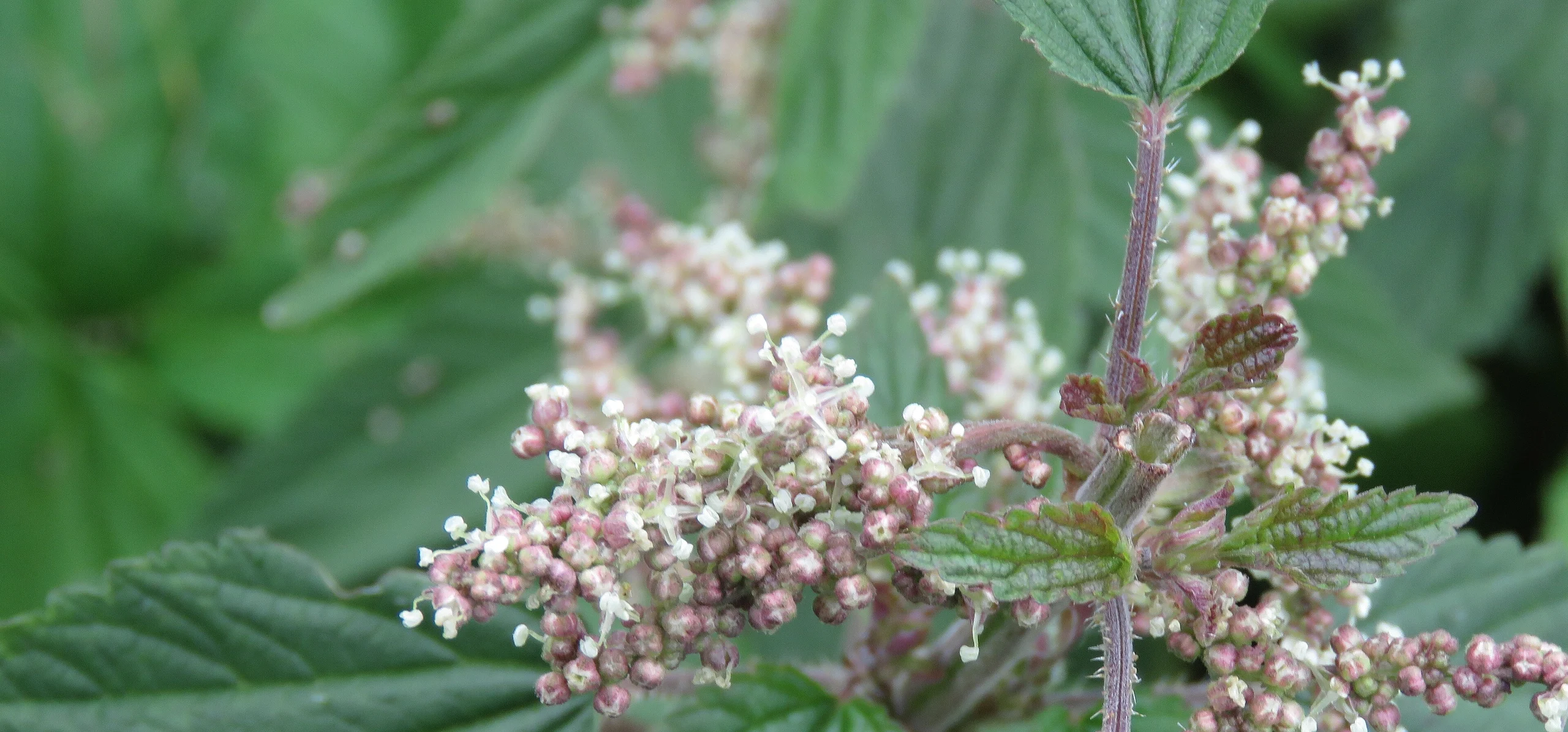
Nettle's sting comes from silica-tipped hairs injecting formic acid and histamine. The same patch signals nitrogen-rich soil and feeds peacock caterpillars.
Urtica dioica
Plant profile
- WateringHighWater every 5 days
- Light exposurePartial sun
- Hardiness zoneUSDA 4–10
Growth
- Family
- Urticaceae
- Life cycle
- Perennial
- Growth speed
- 9/10
- Mature size
- 90–275 cm
- Spread
- 30–91 cm
- Flowering
- Small greenish flower clusters in leaf axils through summer
- Propagation
- Seed
- Division
DormancyDies back to the rhizome in winter; rhizome persists and resprouts each spring
Time to maturityYoung spring tops ready to harvest within about a month of growth, before flowering
Soil & climate
- Soil types
- clay, loam, sand, chalk, high in organic matter
- Drought tolerance
- No
Light & Placement
- Origin
- Europe to Siberia and western China, northwestern Africa
- Where to place it
- hedgerow edge
- woodland margin
- riverbank
- damp meadow
- dedicated butterfly corner
- large container to contain the rhizome
Safety
- Toxicity
- HumansToxic
Invasive speciesSpreads aggressively by rhizome and self-seeds; the RHS notes it can be difficult to control or eradicate once established.
Data fromGBIF: Urtica dioica L.Plants of the World Online (Kew): UrticaNC State Extension: Urtica dioicaRHS: Urtica dioica
Where it grows
World distribution
Stinging Nettle is native to 51 countries: Afghanistan, Albania, Algeria, Austria, Belarus, Belgium, Bhutan, and Bulgaria….GBIF records 2,250,865 documented identifications across 109 countries, with the largest concentrations in United Kingdom, France, and Netherlands.
- Afghanistan
- Albania
- Algeria
- Austria
- Belarus
- Belgium
- Bhutan
- Bulgaria
- China
- Croatia
- Czechia
- Denmark
Show 39 more countriesShow fewer countries
- Estonia
- Faroe Islands
- Finland
- France
- Georgia
- Germany
- Greece
- Hungary
- Iceland
- India
- Iran
- Iraq
- Ireland
- Italy
- Japan
- Kazakhstan
- Kyrgyzstan
- Lebanon
- Mongolia
- Morocco
- Nepal
- Netherlands
- Norway
- Pakistan
- Poland
- Portugal
- Romania
- Russia
- South Korea
- Spain
- Sweden
- Switzerland
- Tajikistan
- Tunisia
- Türkiye
- Turkmenistan
- Ukraine
- United Kingdom
- Uzbekistan
Yellow to orange dots: concentration of documented identifications per country. Green countries: sourced native range. Source: GBIFNative range from POWO (Kew).
Urtica dioica is the plant most people meet by accident, usually as a line of raised welts across a bare ankle. It is a rhizomatous perennial that forms dense, spreading patches wherever the soil is damp and rich, and every part of the stem and leaf above ground carries stinging hairs. That sting is the plant's whole reputation, but it is only half the story: the same patch is a reliable clue to what is going on underground, a butterfly nursery worth leaving alone in a corner, and, cut young and cooked, a genuinely good spring vegetable.
The Sting: Silica-Tipped Hairs, Formic Acid and the Dock Leaf Myth
Each stinging hair, or trichome, is a hollow tube tipped with a bulb of brittle silica. Brush against it and the tip snaps off at an angle, turning it into a hypodermic needle that punctures skin and injects a mix of chemicals, chiefly formic acid and histamine, along with acetylcholine and serotonin. NC State Extension rates the resulting contact dermatitis as low-severity but notes the burning and itching can last for minutes. The traditional fix, rubbing a dock leaf (Rumex species, which grows in the same damp ground) over the sting, is almost always the first thing reached for in the countryside. Dock sap has no known antihistamine or anti-formic-acid action, so the relief is more likely mechanical, a cooling, moist leaf pressed onto irritated skin, and the psychological comfort of doing something, rather than a real chemical antidote. It is harmless to try and it does not make the sting worse, which is probably why the habit has outlived any scientific basis for it.
Habit, Size and Where It Spreads
According to GBIF, Urtica dioica belongs to the nettle family, Urticaceae, in the order Rosales. NC State Extension lists a height of 3 to 9 feet (roughly 90 to 275 cm) with a spread of 1 to 3 feet per stem, though that figure understates how far an established patch travels: the plant spreads by tough, pale rhizomes just under the soil surface, so what looks like one clump is usually dozens of stems on a single root network. Growth is rapid once the rhizome is established, and NC State Extension flags it as high-maintenance to keep in bounds for exactly that reason. It tolerates clay, loam, sand and chalk, and the RHS notes it grows in acid, alkaline or neutral soil across full sun to full shade, which is part of why it turns up in hedgerows, woodland margins, riverbanks and neglected corners with almost no help.
A Nitrogen Indicator: What a Nettle Patch Tells You About the Soil
The RHS describes stinging nettle as thriving in nitrogen-rich soil, and gardeners use that as a shortcut: a vigorous, dark green patch of nettles is a decent field sign that the ground underneath is fertile, often from years of manure, compost, old farmyard sites or rotting organic debris. It is not a precise soil test, but it is consistent enough that finding a strong nettle stand on a new plot is usually read as good news for whatever is planted there next, once the nettles themselves are dealt with. NC State Extension also lists stinging nettle as tolerant of soils high in organic matter, which fits the same pattern: it is a plant that grows fastest exactly where nitrogen has accumulated.
Clearing a Patch You Do Not Want
Pulling the top growth does nothing, because the rhizome underneath is what keeps the patch alive. Digging is the only reliable single pass: lift the pale, cream to yellow rhizomes with a fork rather than a spade, since a spade tends to chop them into pieces that each resprout, and work outward until no rhizome fragments remain in the loosened soil. Where digging out the whole root system is not practical, repeated cutting works instead, mowing or scything the patch back to the ground every few weeks through the growing season. This does not kill the rhizome outright but starves it over one to two seasons, since the plant is forced to keep rebuilding top growth from stored reserves instead of spreading. A thick mulch, cardboard or black plastic laid over a cut-back patch and left in place for a full season blocks the light regrowth needs and finishes the job faster than cutting alone. Whichever method is used, the cut or pulled material is worth keeping rather than binning, since it goes straight into the liquid feed described below.
Leaving a Patch for Butterflies
Stinging nettle is also worth deliberately keeping, not just tolerating. The RHS names it an important larval food plant for peacock and small tortoiseshell butterflies, both of which lay eggs in batches on the undersides of young nettle leaves; the caterpillars that hatch feed in visible, gregarious clusters before dispersing to pupate. A patch grown for this purpose works better in full sun, since both species favour warm, sheltered nettle stands over shaded ones, and it should be left uncut through late spring and summer while eggs and caterpillars are present, with cutting held back to autumn or split so part of the patch is always growing fresh leaf. NC State Extension notes the same plant supports painted lady, eastern comma, mourning cloak and question mark caterpillars in North America, so a nettle corner earns its keep as habitat well beyond the two species most gardeners picture.


Nettle Liquid Feed: Ratio and Smell
Cut nettle tops, packed into a bucket and covered with water, break down into a nitrogen-rich liquid feed within two to four weeks, faster in warm weather. A weighted lid or brick keeps the leaves submerged as they rot. The finished black liquid is diluted before use, typically around one part nettle feed to ten parts water, aiming for a colour close to weak tea rather than pouring it on undiluted. It smells genuinely bad, a sulphurous, ammonia-heavy odour that gets worse the longer the bucket sits, so it is worth brewing away from a patio or kitchen door and using it up within a week or two of straining rather than storing it. Poured at the base of leafy vegetables and heavy feeders, it functions as a fast nitrogen top-up, the same nutrient the plant itself was busy concentrating from the soil it grew in.
Young Tops as a Spring Green
The first flush of growth in early spring, the top two or four leaves and growing tip before flowering starts, is edible and, by most accounts, better than its reputation suggests: a mineral-rich, spinach-like green with a flavour some compare to spinach crossed with cucumber. NC State Extension's edibility notes describe soaking the young shoots, then boiling them for five minutes in salted water before serving as a vegetable or adding to soups. Cooking, blanching or drying reliably destroys the stinging hairs' ability to sting, since heat and drying both break down the brittle silica tip and denature the chemical mix inside, which is why gloves are needed only for picking, not for eating. Older leaves past the first flush turn coarse and develop gritty calcium oxalate crystals, so the harvest window for eating nettle is narrow, roughly the first month of spring growth before the plant flowers.
Toxicity to People and Pets
Fresh contact with the stinging hairs causes the low-severity skin irritation described above; NC State Extension does not record any more serious systemic poisoning risk from casual contact or from eating the cooked young growth. A search of the ASPCA's toxic and non-toxic plant lists for cats, dogs and horses turns up no entry for stinging nettle or Urtica dioica, so there is no formal ASPCA verdict either way. That is not the same as a safety guarantee: an animal that pushes through a fresh, uncut patch can still pick up the same contact stings a person would, so it is worth fencing off or cutting back a patch in an area pets use regularly, independent of any formal toxicity rating.
Test your plant knowledge
Tap a card to flip it and reveal the answer.
Nettle's sting comes from hollow, silica-tipped hairs that inject formic acid and histamine into the skin. Tap to reveal ✓ True
Rubbing a dock leaf on a nettle sting has been shown to chemically neutralize the venom. Tap to reveal ✕ False
A vigorous, dark green nettle patch is generally read as a sign of nitrogen-poor soil. Tap to reveal ✕ False
Peacock and small tortoiseshell butterflies lay their eggs on stinging nettle, and the caterpillars feed on the leaves. Tap to reveal ✓ True
Cooking or drying nettle leaves destroys the stinging hairs' ability to sting. Tap to reveal ✓ True
Sources
References consulted for this guide
- GBIF: Urtica dioica L.gbif.org
- Plants of the World Online (Kew): Urtica dioica L.powo.science.kew.org
- NC State Extension: Urtica dioicaplants.ces.ncsu.edu
- RHS: Urtica dioicarhs.org.uk
- Reference entity : Wikipédiaen.wikipedia.org