Tree of Heaven
Ailanthus altissima
Family · Simaroubaceae
Identify Ailanthus altissima by its smell and smooth leaflets, understand why it is banned as invasive, and remove it without triggering more suckers.
Ailanthus altissima
Plant profile
- WateringLittleWater every 10 days
- Light exposurePartial sun
- Hardiness zoneUSDA 4–8
Growth
- Family
- Simaroubaceae
- Life cycle
- Perennial
- Growth speed
- 9/10
- Mature size
- 1200–1800 cm
- Spread
- 450–900 cm
- Flowering
- Small yellow-green flowers early summer, heavy seed set by autumn
- Propagation
- Seed
DormancyDeciduous, winter dormant
Time to maturityCan seed by age 2 to 3
Soil & climate
- Soil types
- clay, loam, sand, shallow rocky soil
- Drought tolerance
- Yes
Light & Placement
- Origin
- China and Taiwan
- Where to place it
- Not recommended, do not plant
Safety
- Toxicity
- HumansToxic
Invasive speciesEU invasive alien species of Union concern since 2019; do not plant, cutting alone triggers suckering
Data fromGBIF: Ailanthus altissima (Mill.) SwinglPlants of the World Online (Kew): AilantPenn State Extension: Tree-of-HeavenNC State Extension Gardener Plant ToolboRutgers Cooperative Extension: Spotted L
Where it grows
World distribution
Tree of Heaven is native to 2 countries: China and Taiwan.GBIF records 226,115 documented identifications across 88 countries, with the largest concentrations in United States, France, and Switzerland.
- China
- Taiwan
Yellow to orange dots: concentration of documented identifications per country. Green countries: sourced native range. Source: GBIFNative range from POWO (Kew).
A tree that pushes up new stems thirty feet from a cut stump, seeds itself into every pavement crack within a block, and gives off a rank, burnt-peanut-butter smell when you snap a twig is almost never one anybody planted on purpose. If you are looking at large compound leaves with smooth-edged leaflets and that unmistakable odor, you very likely have Ailanthus altissima, tree of heaven. This guide covers how to identify it, why it is banned or restricted across much of Europe and North America, and how to remove it correctly, because cutting it down the obvious way is usually the one thing that makes it spread faster.
Origin and How It Became a Problem Elsewhere
Tree of heaven is native to China and Taiwan. It was carried around the world as a fast, tough shade tree that would grow almost anywhere, including bombed-out cities and industrial wasteland, and that toughness is exactly what let it escape gardens and street plantings everywhere it was introduced. It is now on the European Union's list of invasive alien species of Union concern, in force since 2019, which bans its sale, planting and deliberate spread across all EU member states. In the United States it is regulated or listed as noxious in numerous states, and land managers from the Alps to Appalachia spend real budget every year just holding it back along roads, rail lines and riverbanks.
Identification: Leaves, Bark and That Smell
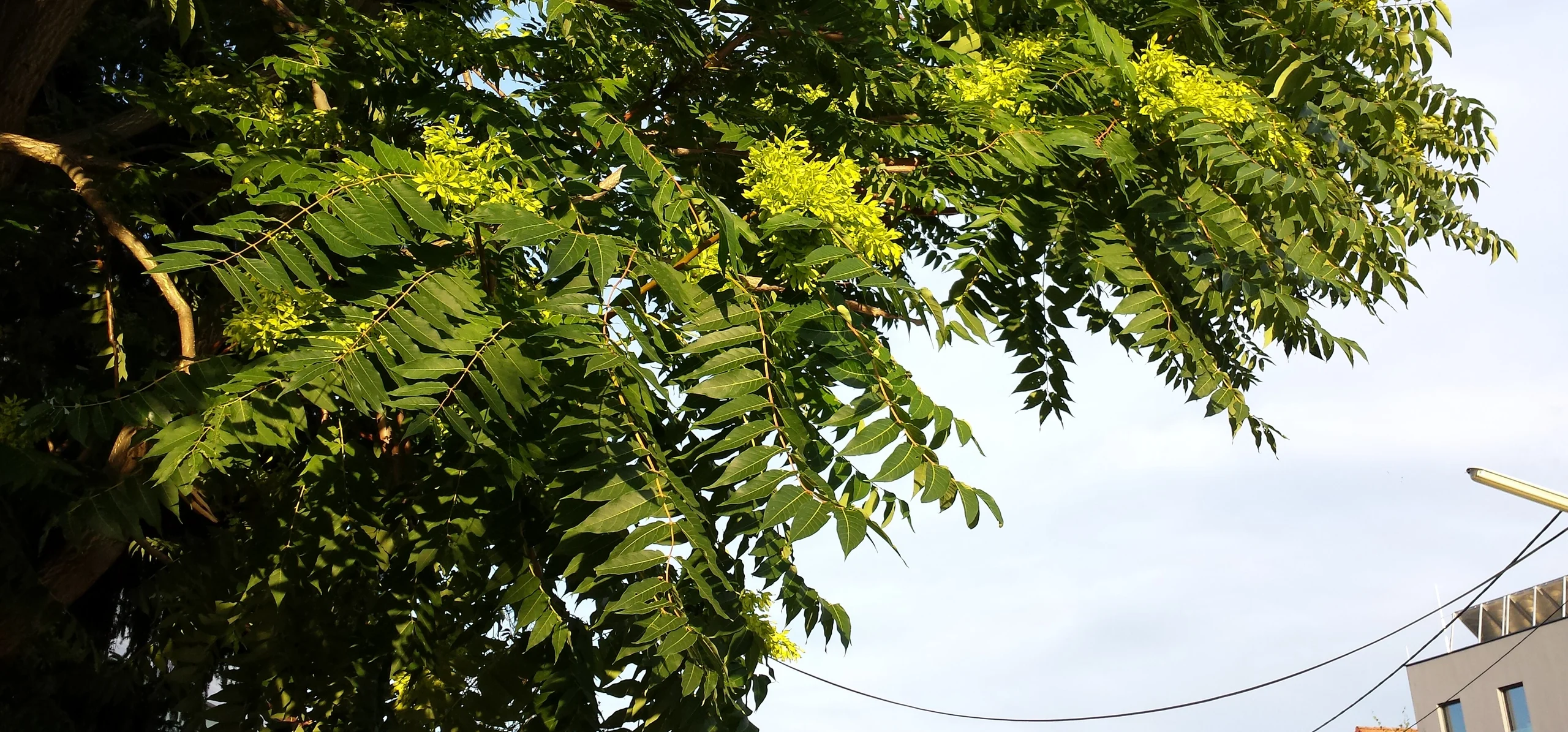
The leaves are pinnately compound, 30 to 90 cm long, carrying 10 to 40 lance-shaped leaflets with smooth margins except for one or two blunt teeth near the base, each hiding a small gland underneath. Young bark is smooth and brownish-green; on a mature trunk it turns pale grey with a texture often compared to cantaloupe rind. The single fastest confirmation is smell: crush a leaflet or snap a twig and it releases a strong, unpleasant odor, often described as rancid or burnt peanut butter, unlike anything a native tree produces. Trees are either male or female. Male flowers open in small yellow-green clusters in early summer and add their own disagreeable scent to the air; female trees follow with heavy clusters of twisted, papery, single-winged samaras that turn tan and often hang on well into winter.
Tree of Heaven vs Sumac and Black Walnut
The leaf shape fools people constantly. Native sumacs (Rhus species) have fully serrated leaflet edges and carry small, fuzzy, red drupes in upright clusters that persist through winter, nothing like ailanthus's smooth leaflets and papery seed clusters. Black walnut and hickory also have serrated leaflets; slice a young twig and walnut shows a chambered pith with a clean, citrussy scent, while ailanthus has continuous spongy pith and that rank smell. Run a finger down a leaflet edge before you reach for a saw: smooth with one or two basal teeth means ailanthus, fully toothed means a native tree you want to keep.


Why It Is Not a Tree to Keep or Plant
Tree of heaven produces allelopathic compounds, including ailanthone, that leach into the soil and suppress the germination and growth of other plants around it, which is part of how it forms dense, near-monoculture stands. A single female tree can shed several hundred thousand wind-dispersed seeds in a year, and established trees send out root suckers as far as 15 metres from the trunk, capable of surfacing through driveway cracks, sewer laterals and building foundations. It tolerates compacted, poor, rocky or alkaline soil and full urban pollution without slowing down, which is precisely why it thrives on the neglected margins where nothing is there to stop it.
Why the Spotted Lanternfly Makes This Worse
Tree of heaven is the preferred host of the spotted lanternfly (Lycorma delicatula), an invasive planthopper now established across a growing number of US states that feeds on grapevines, stone fruit and many hardwood trees. Adult lanternflies favor ailanthus for feeding and egg-laying even though they can survive on other hosts, so extension services in affected regions treat removing nearby tree of heaven as one plank of integrated lanternfly management, alongside monitoring and targeted insecticide use on remaining hosts. A property with tree of heaven left standing is a magnet for an insect that will then move on to the grapevines, fruit trees and hardwoods next door.
Sap, Sawdust and Skin Irritation
Handling cut wood, sap or sawdust can cause contact dermatitis; broken skin exposed to the sap is the usual trigger, and cases of skin irritation after cutting or clearing ailanthus are documented in the arboriculture literature. Heavy pollen from male flowers can also provoke allergic reactions in season. Wear gloves and long sleeves for any cutting or stump work, and wash exposed skin promptly afterward. The ASPCA does not list tree of heaven in its toxic or non-toxic plant database, so no claim about toxicity to cats, dogs or horses can be sourced either way; treat the sap with the same basic caution you would use for any tree with a known skin-irritant reputation.
How to Remove It Without Making It Worse
Cutting a trunk without treating it is the single most common and most counterproductive move: a felled tree of heaven typically responds with dozens of new stump and root sprouts, turning one trunk into a thicket. The method that actually works pairs cutting with herbicide, applied to living tissue, and gets the timing right. For stems under about 15 cm diameter, a basal bark application works well; for larger trunks, a hack-and-squirt or frill method, cutting shallow downward notches around the trunk and applying herbicide directly into them, is more reliable. Timing matters as much as the chemical: treat from midsummer into the start of autumn color, when the tree is actively moving sugars down into the roots, so the herbicide travels with them. Treating in spring or winter kills only the top growth and provokes a fresh wave of suckering instead. Small seedlings can be hand-pulled, but only when the soil is soft enough to lift the whole root; any snapped-off root fragment left in the ground can resprout. Plan on monitoring and retreating suckers for two to three growing seasons after the main treatment, not one.
Common Mistakes
The most frequent error is reaching for a chainsaw before a herbicide, which multiplies the stems instead of removing the tree. The second is spraying in spring because that is when other yard work happens, which wastes the treatment on top growth alone. The third is misidentification in either direction: pulling out a native sumac or young walnut mistaken for ailanthus, or leaving a real tree of heaven alone because it was mistaken for one of those. The fourth is treating only the visible trunk near a fence line while root suckers keep emerging from the same root system metres away, sometimes on a neighbor's property, so a full removal usually means tracing and treating every connected sucker, not just the parent stem.
Test your plant knowledge
Tap a card to flip it and reveal the answer.
Cutting down a tree of heaven trunk without treating it usually kills the tree for good. Tap to reveal ✕ False
Crushed leaves and broken twigs of tree of heaven give off a strong, unpleasant smell. Tap to reveal ✓ True
Tree of heaven is the preferred host plant of the invasive spotted lanternfly. Tap to reveal ✓ True
Herbicide works best on tree of heaven when applied in spring, right as new growth starts. Tap to reveal ✕ False
The ASPCA lists tree of heaven as toxic to cats and dogs. Tap to reveal ✕ False
Sources
References consulted for this guide
- GBIF: Ailanthus altissima (Mill.) Swinglegbif.org
- Plants of the World Online (Kew): Ailanthus altissimapowo.science.kew.org
- Penn State Extension: Tree-of-Heavenextension.psu.edu
- NC State Extension Gardener Plant Toolbox: Ailanthus altissimaplants.ces.ncsu.edu
- Rutgers Cooperative Extension: Spotted Lanternflyextension.rutgers.edu
- Reference entity : Wikipédiaen.wikipedia.org