Northern Catalpa
Catalpa speciosa
Family · Bignoniaceae
Northern catalpa grows 12 to 21 m tall, blooms weeks before southern catalpa, and survives to USDA zone 4: how to site it and manage the brittle wood.
Catalpa speciosa
Plant profile
- WateringModerateWater every 9 days
- Light exposurePartial sun
- Hardiness zoneUSDA 4–8
Growth
- Family
- Bignoniaceae
- Life cycle
- Perennial
- Growth speed
- 7/10
- Mature size
- 1200–2100 cm
- Spread
- 600–1500 cm
- Propagation
- Seed
- Cutting
FloweringFragrant white panicles with orange stripes and purple spots, late spring to early summer
Dormancydeciduous, bare in winter
Soil & climate
- Soil types
- clay, loam
- Drought tolerance
- Yes
Light & Placement
- Where to place it
- open lawn or park
- large garden with room for a full canopy
- roadside or old fence line
- sheltered spot away from strong wind
OriginCentral and eastern United States to Utah; historic native core in the upper Mississippi River valley
Safety
- Toxicity
- Not listed by the ASPCA as toxic or non-toxic to pets
- Pet safe
- Yes
Invasive speciesself-sows readily from wind-blown seed and has naturalized well beyond its historic native range; rake up or mow down unwanted seedlings
Data fromGBIF Backbone Taxonomy: Catalpa speciosaPlants of the World Online (Kew): CatalpMissouri Botanical Garden Plant Finder: North Carolina Extension Gardener Plant University of Illinois Extension: Plant
Where it grows
World distribution
Northern Catalpa is native to a single country: United States.GBIF records 11,513 documented identifications across 31 countries, with the largest concentrations in United States, Portugal, and Canada.
- United States
Yellow to orange dots: concentration of documented identifications per country. Green countries: sourced native range. Source: GBIFNative range from POWO (Kew).
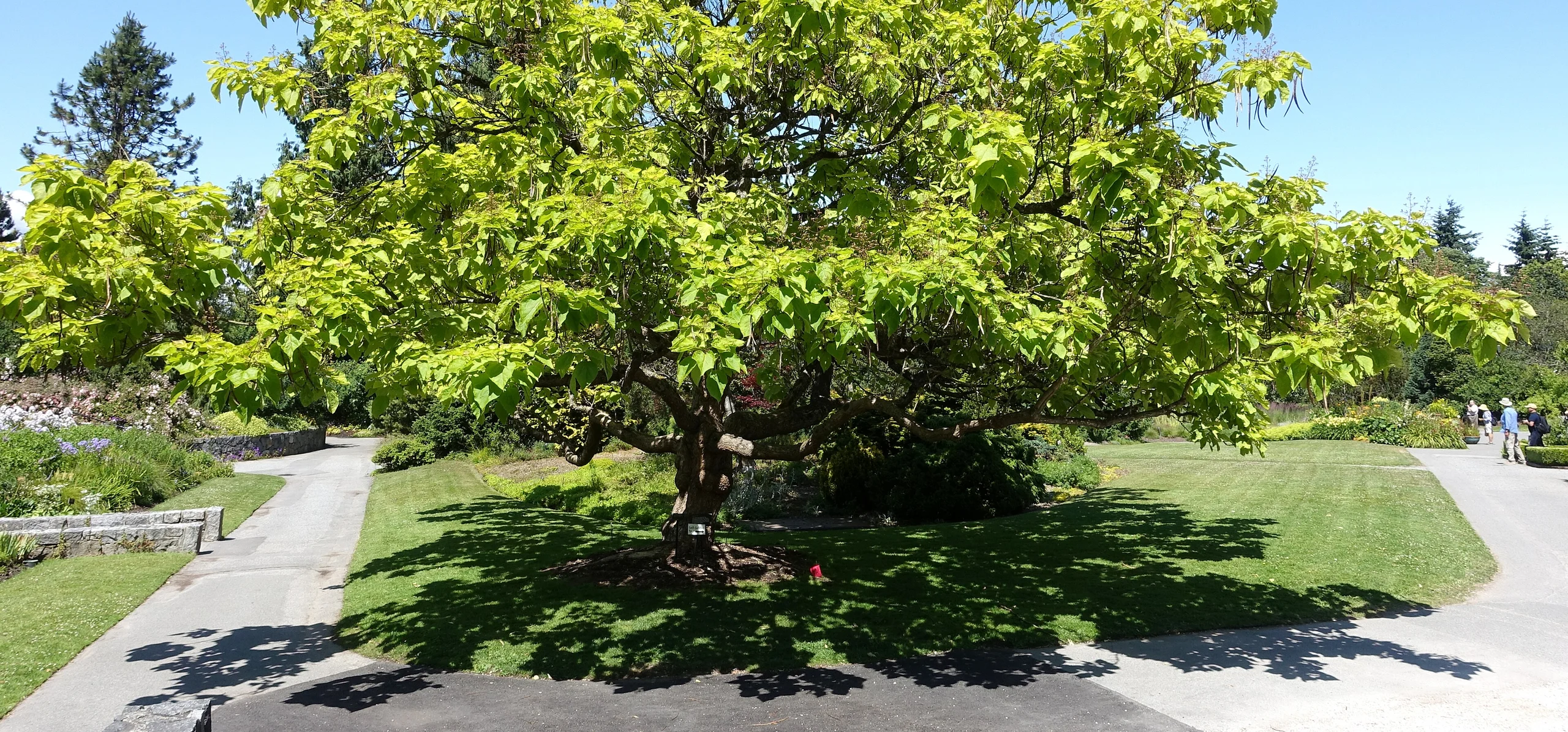
A Northern catalpa (Catalpa speciosa) bought as a small tree from a nursery pot is a long-term commitment: expect a broad, fast-growing tree 12 to 21 meters tall with a spread of 6 to 15 meters within a few decades, larger and hardier than its close relative the southern catalpa (Catalpa bignonioides). It flowers in late spring to early summer, several weeks before the southern species, with fragrant white panicles marked in orange stripes and purple spots, then carries huge heart-shaped leaves through the season before dropping bean-like pods that can reach half a meter long. It was also the tree a whole generation of Midwestern farmers planted by the acre for fence posts, so if you find a straight, tall specimen along an old property line, there is a real chance it was put there on purpose over a century ago.
Origin, Native Range and a Common Mix-Up
Plants of the World Online (Kew) gives the native range of Catalpa speciosa as Central and Eastern U.S.A. to Utah, but the tree's original home was far smaller than that: extension sources place its true native pocket in the upper Mississippi River embayment, a band running through southern Illinois and Indiana, western Kentucky and Tennessee, southeastern Missouri and northeastern Arkansas, where it grew along stream banks and rich bottomland. Everywhere else it now grows, including much of the eastern and central United States, it arrived through more than a century of deliberate planting and self-seeding; North Carolina State Extension notes that some botanists consider it introduced rather than native that far east. It is easy to confuse with the southern catalpa (Catalpa bignonioides), whose separate native range sits entirely below it, from east Texas to south Georgia.
How Northern Catalpa Differs from Southern Catalpa
The two species are planted for nearly identical reasons and are frequently sold under the wrong name, but a handful of consistent differences separate them once you know what to check.
| Trait | Catalpa speciosa (Northern) | Catalpa bignonioides (Southern) |
|---|---|---|
| Hardiness | USDA zones 4 to 8 | USDA zones 5 to 9 |
| Mature height | 12 to 21 m, occasionally more | 9 to 18 m |
| Bloom time | Late spring to early summer | Early to late summer, later than speciosa |
| Seed pod | Stouter, usually over 13 mm thick | Slender, usually under 13 mm thick |
| Crushed leaf scent | No unpleasant smell | Unpleasant smell |
University of Illinois Extension adds that these are subtle differences in most cases: Northern catalpa tends to carry slightly larger flowers with fewer purple spots and fewer blooms per panicle, blunt-tipped seeds with more fringing hair, and more deeply furrowed bark once mature, but none of these is reliable alone without the others.
Size and Where to Plant It
Give it space before anything else. The Missouri Botanical Garden lists a mature spread of 20 to 50 feet (about 6 to 15 m) under an irregular, open-rounded to narrow-oval crown, on a trunk that can occasionally push past 21 m and, rarely, close to 30 m in the right bottomland conditions. That crown, plus a root system extensive enough to have made the tree useful for stabilizing eroding banks, rules out planting close to a foundation, a septic field, or a narrow side yard. The wood is soft and prone to splitting at branch unions, so an open, wind-exposed corner is also a poor choice; give it distance from patios and driveways too, since flowers, pods and twigs will drop onto them for the tree's entire life.
The "Hardy Catalpa" Boom of the 1870s
Northern catalpa owes much of its wide range today to a specific historical episode. In the 1870s, nurseryman Robert Douglas promoted Catalpa speciosa, marketed as the Hardy Catalpa, as a fast-growing source of rot-resistant railroad ties, and speculators planted large tracts of it across the Midwest on that promise. The railroad tie plan failed: the wood, while genuinely resistant to decay in the ground, is too soft and light to hold spikes and bear rail traffic. What did work was fence posts. Farmers who had bought bare-root seedlings by the bundle found that Catalpa speciosa posts, planted straight from a cut trunk, could stand solid in the ground for over a century, and plantings sold for that purpose are part of why the species now grows well outside its original Mississippi Valley range.
Flowers and Seed Pods
Flowers open in upright panicles roughly 10 to 20 cm long, each bell-shaped bloom white with orange stripes and a scatter of purple spots inside the throat, fragrant and produced in late spring to early summer. What follows is the tree's most memorable feature: narrow, bean-like capsules that lengthen through summer to as much as 20 to 22 inches (roughly 50 to 56 cm), noticeably stouter than the southern species' pods, hanging in clusters and giving the tree its old nicknames cigar tree and Indian bean tree. Pods ripen dark brown by autumn and split lengthwise to release flat, winged, heavily fringed seeds. Because the seeds travel on the wind and germinate readily in disturbed ground, a tree near open lawn or a field edge will self-sow every year; rake up or mow down what you do not want growing on.
Soil, Sun and Watering
Full sun gives the heaviest bloom, though North Carolina State Extension notes the species tolerates part shade down to as little as two hours of direct light. It is notably unfussy about soil, tolerating clay, loam and soils high in organic matter, and it is comfortable in both alkaline ground and, per the Missouri Botanical Garden, occasionally wet or flooded sites, though it grows best in moist, well-drained loam. Water a young tree deeply and regularly through its first one to two growing seasons while roots establish; once settled in, an established Northern catalpa tolerates real drought and needs no routine supplemental watering outside prolonged dry spells.
How often to water your Northern Catalpa
Propagation
Seed is the easiest route: Catalpa speciosa germinates without any pretreatment, though a few weeks of cold, moist stratification in a refrigerator improves the germination rate, and seedlings started in moist, well-drained soil in early spring come up within a few weeks. Semi-hardwood cuttings taken in late summer will root as well, and the species can also be grown from root cuttings, short sections taken in late winter or early spring and laid horizontally in a moist rooting medium, a technique nurseries used during the fence-post boom to multiply selected trees quickly.
Pests, Disease and Brittle Wood
The caterpillar most likely to strip a Northern catalpa's leaves in summer is the larva of the catalpa sphinx moth (Ceratomia catalpae), which feeds on nothing else; North Carolina State Extension also lists the tersa sphinx moth as an occasional feeder. Damage from either can look dramatic, defoliating a branch or more within days, but a healthy tree pushes out new leaves and recovers the same season, and the caterpillars themselves are valuable food for birds and bats as well as prized fishing bait in the South. Disease pressure is generally light: Verticillium wilt is the one to watch for, with leaf spot and powdery mildew as minor, mostly cosmetic problems. The tree's real weak point is structural rather than biological: the same soft wood that once made it a poor railroad tie splits easily at narrow branch forks, so train a young tree to a single leader, remove tight V-shaped crotches early, and inspect an older tree's crown after any serious storm.


Test your plant knowledge
Tap a card to flip it and reveal the answer.
Northern catalpa (Catalpa speciosa) is generally taller and hardier than southern catalpa (Catalpa bignonioides). Tap to reveal ✓ True
Northern catalpa flowers later in the summer than southern catalpa. Tap to reveal ✕ False
In the 1870s, Northern catalpa was planted across the Midwest on the promise that it would make durable railroad ties. Tap to reveal ✓ True
Northern catalpa seed pods are usually thinner than those of the southern species. Tap to reveal ✕ False
Crushed Northern catalpa leaves have an unpleasant smell. Tap to reveal ✕ False
Sources
References consulted for this guide
- GBIF Backbone Taxonomy: Catalpa speciosa (Warder ex Barney) Warder ex Engelm.gbif.org
- Plants of the World Online (Kew): Catalpa speciosa Warder ex Teaspowo.science.kew.org
- Missouri Botanical Garden Plant Finder: Catalpa speciosamissouribotanicalgarden.org
- North Carolina Extension Gardener Plant Toolbox: Catalpa speciosaplants.ces.ncsu.edu
- University of Illinois Extension: Plant of the Week, Catalpaextension.illinois.edu
- Reference entity : Wikipédiaen.wikipedia.org