Persian Cyclamen
Cyclamen persicum
Family · Primulaceae
Cyclamen persicum stalls in a heated living room but blooms for months near 10 to 16°C. How to water from below, deadhead by twisting, and restart the tuber.
Cyclamen persicum
Plant profile
- WateringModerateWater every 5 days
- Light exposureIndirect light
- Ideal temperature10–18 °C
Growth
- Family
- Primulaceae
- Life cycle
- Perennial
- Growth speed
- 3/10
- Mature size
- 10–50 cm
- Spread
- 10–50 cm
- Flowering
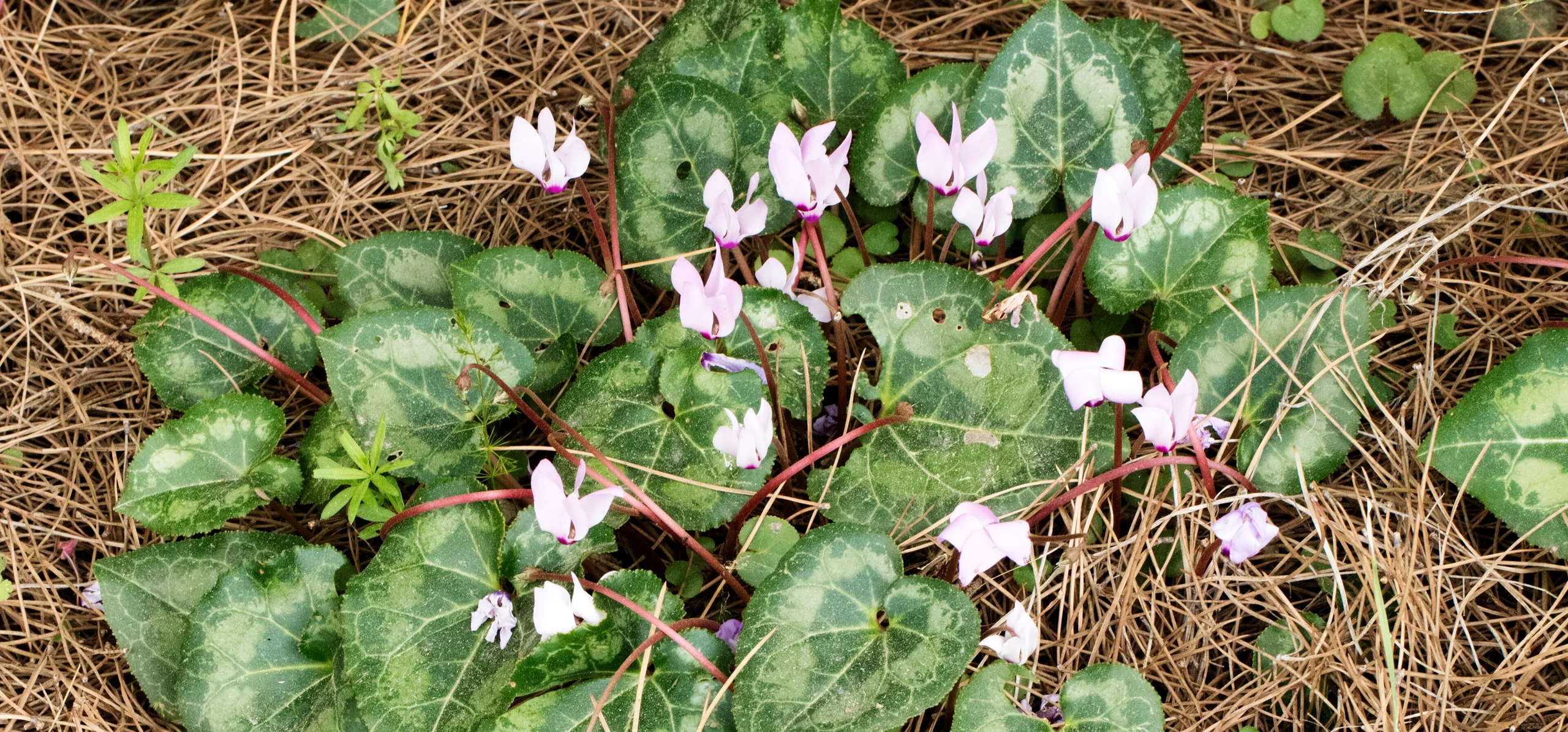
- White to pink or red reflexed flowers, mainly winter to spring
- Propagation
- Seed
DormancySummer dormancy of about 6 to 8 weeks: leaves yellow and die back, the tuber is kept cool and nearly dry until new growth resumes in late summer
Time to maturity2 to 5 years to ultimate size (RHS)
Soil & climate
- Soil types
- Peat-free, loam-based potting compost
- Drought tolerance
- No
Light & Placement
- Origin
- Algeria to the eastern Mediterranean (POWO)
- Where to place it
- Bright windowsill out of direct midday sun
- Cool hallway or unheated room away from radiators
- Sheltered, shaded spot outdoors only in mild summer weather
- Snug pot only slightly wider than the tuber, with drainage; tuber sitting proud of the compost
Safety
- Toxicity
- CatsToxic
- DogsToxic
- HorsesToxic
Data fromCyclamen persicum Mill., GBIF Backbone TCyclamen persicum Mill. | Plants of the Cyclamen persicum | Persian cyclamen, RHFlorist Cyclamen, Home & Garden InformatCyclamen, Toxic and Non-Toxic Plants, AS
Where it grows
World distribution
Persian Cyclamen is native to 7 countries: Algeria, Cyprus, Greece, Lebanon, Palestinian Territories, Tunisia, and Türkiye.GBIF records 10,987 documented identifications across 44 countries, with the largest concentrations in Israel, Cyprus, and Palestinian Territories.
- Algeria
- Cyprus
- Greece
- Lebanon
- Palestinian Territories
- Tunisia
- Türkiye
Yellow to orange dots: concentration of documented identifications per country. Green countries: sourced native range. Source: GBIFNative range from POWO (Kew).
A cyclamen that arrives from the florist in full bloom is not an ordinary houseplant, it is a greenhouse crop expected to finish its display somewhere cool, not on a radiator shelf or a centrally heated windowsill. Its silvery, heart-shaped leaves grow from a flattened tuber that sits half exposed at the compost surface, and that tuber rots within days if water collects around it, which is exactly what a normal watering-can habit does. Kept warm, the flowers fade within a few weeks; kept close to 10 to 16°C, the same plant can keep opening new buds from autumn into spring. What looks like the plant dying in late spring, leaves yellowing and the whole thing collapsing, is a scheduled summer rest the tuber needs, not a failure on the grower's part.
A cool room, not a warm windowsill
The Clemson Cooperative Extension gives daytime temperatures of 60 to 65°F (about 15 to 18°C) and nights near 50°F (10°C) as ideal while the plant is flowering, and warns that once the room reaches above 70°F (21°C) the flower buds simply fail to open. The RHS lists a minimum winter temperature of 13 to 16°C for the species, which sets the floor rather than the ceiling: an unheated spare room, a cool hallway, or a windowsill well away from a radiator all work, while a living room kept at 20°C or more for comfort does not. This is the single biggest reason a shop-bought cyclamen disappoints within a month: it is being grown in the temperature meant for the people in the room, not for the plant.
Watering from below, never onto the tuber
Clemson's advice is to always water along the edge of the pot or stand the pot in a saucer of water so it can be drawn up from below, and to avoid wetting the crown of the tuber at all. Water sitting in the dip where the leaf stalks emerge, or poured straight over the top of the tuber, works its way into the tissue and starts a soft rot that no amount of subsequent care reverses. In practice this means checking the compost surface and only watering when it has started to dry, then either tipping water gently around the rim of the pot or letting the pot stand in an inch of water for ten to fifteen minutes before tipping the rest away.
Bright light, out of direct sun
The RHS recommends bright filtered light with moderate humidity and protection from draughts and hot, dry air, the kind of position found a little back from an east- or north-facing window rather than on a south-facing sill in full midday sun. Direct sun through glass heats the leaves and compost quickly, which compounds the temperature problem above and dries the surface faster than the shallow root system can keep up with, while too little light produces stretched, pale leaf stalks and fewer flowers.


Twisting off spent flowers and yellowing leaves
Cyclamen are deadheaded by hand rather than with scissors: grip the flower stem as close to the tuber as possible and twist gently while pulling, so the whole stalk comes away cleanly from its growing point on the crown. Cutting with a blade leaves a stub that can rot and let disease into the tuber, which is exactly the entry point the plant cannot afford. The same twist-and-pull motion removes yellowing leaves, and doing this promptly, rather than letting spent flowers and dying foliage pile up over the crown, keeps the crown open to air and measurably reduces the fungal problems described below.
The summer rest, and how to restart the tuber
After flowering finishes, the leaves yellow and fall as the plant follows its native dry-summer rhythm, and most home growers read this correctly as the end of the plant rather than a pause in it. If the tuber is kept, reduce watering as the leaves die back, then keep it almost dry and in a cool, shaded spot for roughly six to eight weeks over summer, just enough moisture to stop the tuber shrivelling completely. New growth resumes on its own in late summer as temperatures ease; that is the cue to move the pot back into a bright, cool spot, resume watering gradually from below, and top-dress or repot into fresh, peat-free loam-based compost with the top of the tuber still sitting proud of the surface rather than buried.
Why most cyclamen end up in the compost bin
Clemson's extension guide is blunt about it: keeping a florist cyclamen through its summer dormancy and getting it to flower again is possible but genuinely fiddly, since it depends on hitting a narrow temperature and watering window for months with no visible plant to check progress against, which is why most gardeners discard the tuber once the flowers are gone rather than gamble a windowsill's worth of space on it. A cheap florist pot is easy to treat as disposable for exactly that reason; a named or inherited plant is usually worth the attempt, since a rested tuber that survives the summer tends to flower more heavily in its second and third years than it did as a young plant.
Vine weevil and grey mould
The RHS lists Cyclamen persicum as susceptible to vine weevil in containers and to cyclamen grey mould among its diseases. Vine weevil larvae live in the compost and feed on roots and the base of the tuber through autumn and winter, and because the damage is underground the first sign is often a plant that wilts and collapses abruptly with no warning above soil; checking the compost for pale, C-shaped grubs at repotting time and picking off the dark, flightless adult beetles at night are the main non-chemical defences. Grey mould, caused by the fungus Botrytis cinerea, shows up as a greyish, fuzzy coating on damaged or dying tissue, especially where spent flowers and yellow leaves have been left to sit wet against the crown, and it spreads fastest in still, humid air. Prompt removal of dead material by twisting it away, as above, plus a little space around the pot for air to move, does more to prevent it than any spray.
Toxic to cats, dogs and horses
The ASPCA lists cyclamen as toxic to dogs, cats and horses, naming terpenoid saponins as the toxic principle and describing salivation, vomiting and diarrhoea as the typical clinical signs. The toxin is concentrated in the tuber rather than the leaves or flowers, so the ASPCA notes that a substantial ingestion of tuber tissue, a dog digging up and chewing the corm rather than a cat nibbling a leaf, can bring on heart rhythm abnormalities, seizures and in severe cases death. A pot kept out of reach of a digging dog or a chewing cat, rather than assumed safe because the visible foliage looks unremarkable, is the practical takeaway.
Test your plant knowledge
Tap a card to flip it and reveal the answer.
Cyclamen persicum flowers longest in a warm, centrally heated room. Tap to reveal ✕ False
Water should be poured directly over the top of the tuber. Tap to reveal ✕ False
Yellowing leaves and a collapsing plant in late spring usually mean a normal summer dormancy, not a dead plant. Tap to reveal ✓ True
Spent flowers should be cut off with scissors close to the leaves. Tap to reveal ✕ False
The ASPCA lists cyclamen as toxic to dogs, cats and horses. Tap to reveal ✓ True
Sources
References consulted for this guide
- Cyclamen persicum Mill., GBIF Backbone Taxonomygbif.org
- Cyclamen persicum Mill. | Plants of the World Online, Kew Sciencepowo.science.kew.org
- Cyclamen persicum | Persian cyclamen, RHS Plantsrhs.org.uk
- Florist Cyclamen, Home & Garden Information Center, Clemson Cooperative Extensionhgic.clemson.edu
- Cyclamen, Toxic and Non-Toxic Plants, ASPCA Animal Poison Controlaspca.org
- Reference entity : Wikipédiaen.wikipedia.org