Annual Fleabane
Erigeron annuus
Family · Asteraceae
Erigeron annuus is a North American daisy turned invasive weed in Europe and Asia: identify it, tell it from Erigeron karvinskianus and asters, and control it.
Erigeron annuus
Plant profile
- WateringLittleWater every 14 days
- Light exposurePartial sun
Growth
- Family
- Asteraceae
- Life cycle
- Annual
- Mature size
- 30–150 cm
- Propagation
- Seed
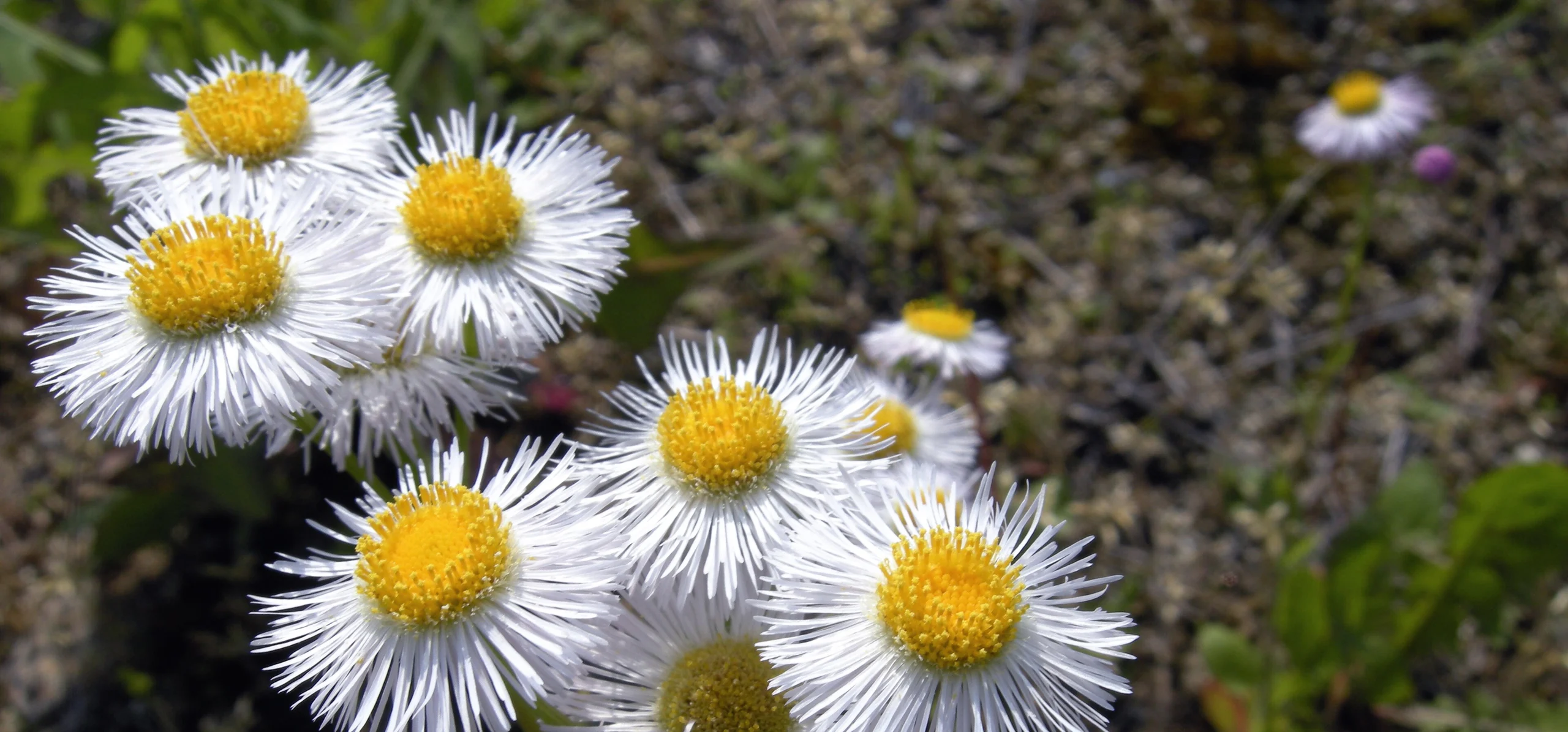
FloweringDozens of small daisy-like heads with slender white rays and a yellow disc, blooming roughly mid-June to late August, sometimes into early autumn
Dormancythe basal rosette can overwinter and bolt into a branching flowering stem the following year
Time to maturityflowers from its first or second year, roughly mid-June to late August
Soil & climate
- Soil types
- sandy, loamy, clay
- Drought tolerance
- Yes
Light & Placement
- Where to place it
- meadow
- roadside verge
- disturbed ground
- field edge
OriginNative to central and eastern Canada and the United States (POWO); introduced and now naturalized or invasive across Europe, East Asia and parts of Oceania
Safety
- Toxicity
- Not listed by the ASPCA for cats, dogs or horses
- Pet safe
- No
Invasive speciesnaturalized or flagged as invasive in much of Europe and in parts of East Asia including Japan and China; a common early-successional weed of disturbed ground across most of its native US and Canadian range
Data fromGBIF: Erigeron annuus (L.) Pers.Plants of the World Online (Kew): ErigerUniversity of Maine Cooperative Extensio
Where it grows
World distribution
Annual Fleabane is native to 2 countries: Canada and United States.GBIF records 415,604 documented identifications across 78 countries, with the largest concentrations in Switzerland, France, and Germany.
- Canada
- United States
Yellow to orange dots: concentration of documented identifications per country. Green countries: sourced native range. Source: GBIFNative range from POWO (Kew).
A North American Daisy That Became a Global Weed
Erigeron annuus, annual fleabane, is a daisy-like member of the aster family (Asteraceae) native to central and eastern Canada and the United States. Outside that native range it has spread widely, naturalized across much of Europe and flagged as an invasive plant in Japan and China, where it colonizes disturbed ground much as it does at home. If you are looking at a patch of small white daisies in a field, a roadside or a garden bed, the first things worth working out are whether you are in its native range or an introduced one, and whether this is really Erigeron annuus rather than the low, mounding Mexican fleabane sold for walls and paving, or one of the native asters it often flowers alongside.
GBIF's accepted name for the species is Erigeron annuus (L.) Pers., family Asteraceae, order Asterales. Older herbals and some regional floras still use the synonym Aster annuus, a reminder that the genus Erigeron was only split out of Aster in the eighteenth and nineteenth centuries, and the two remain easy to confuse at a glance.
Identifying the Flowers, Leaves and Stem
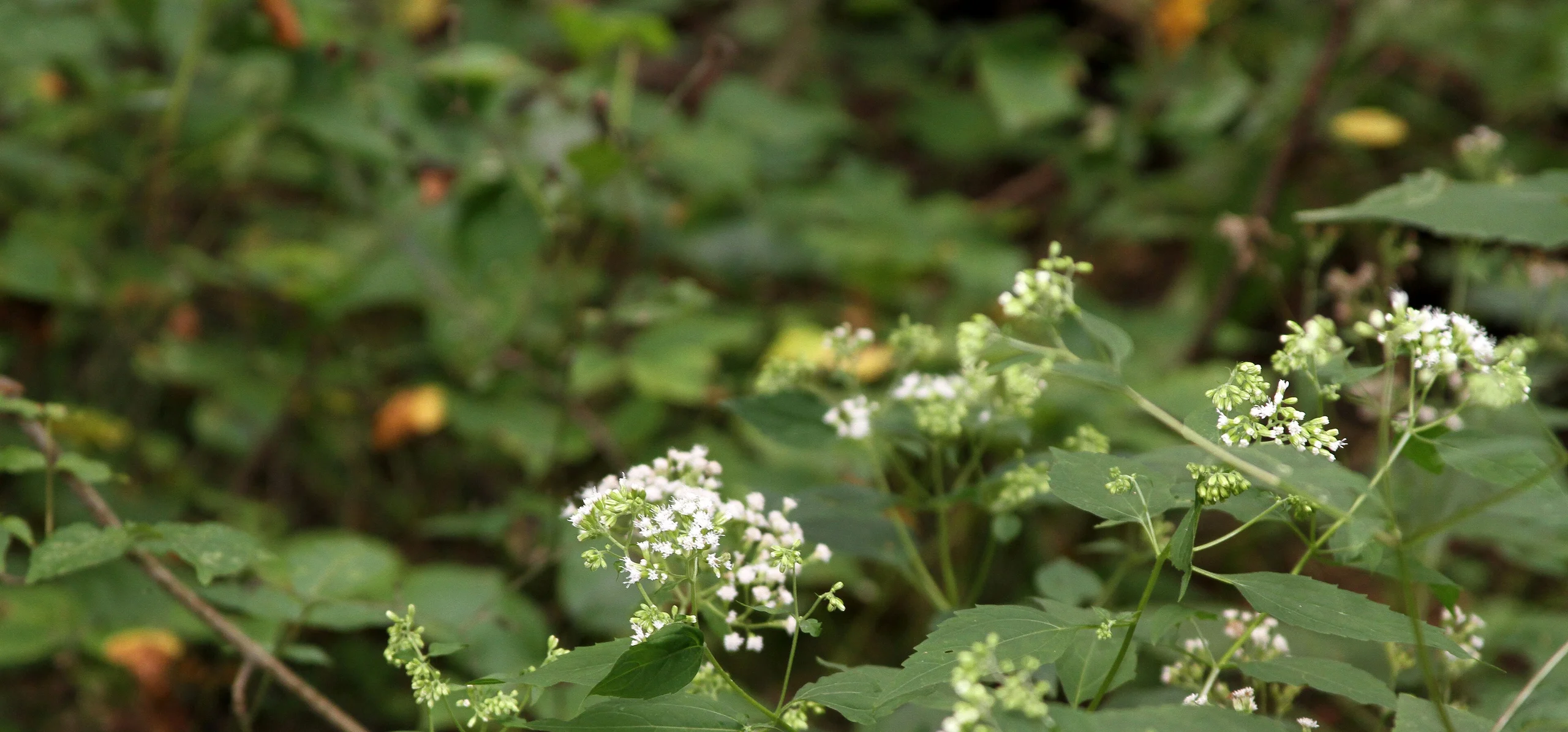
A mature plant carries dozens of small flower heads in loosely branching clusters, each head ringed by more than forty thread-narrow white ray florets, sometimes faintly tinged pink, around a small yellow disc. The University of Maine Cooperative Extension records bloom running from about mid-June through late August in the northeastern United States, often continuing into early autumn farther south. Basal leaves, present from the first-year rosette onward, are oval to elliptic, coarsely toothed and carried on distinct stalks; the leaves higher up the branching stem are narrower, stalkless and get smaller toward the flower heads, though still toothed. Stems and leaves are covered in short, stiff, spreading hairs that give the whole plant a slightly rough, unshiny texture, one of the easiest field checks when a specimen is out of flower.
Erigeron annuus, Mexican Fleabane and the Native Asters
Erigeron annuus is regularly confused with two very different plants. Erigeron karvinskianus, Mexican fleabane, is a low, wiry, semi-trailing perennial from Mexico and Central America widely planted in walls and paving cracks; its leaves are narrow, untoothed and never clasp the stem, its mature clumps rarely pass a few tens of centimetres, and its ray florets open pale pink and deepen to rose as they age rather than staying white. Erigeron annuus, by contrast, stands upright to well over a metre, has coarsely toothed leaves, and keeps white rays throughout the bloom. Against the native asters (Symphyotrichum species) it flowers alongside in late summer, the clearest field differences are timing and ray count: annual fleabane is usually in flower by midsummer, well before most asters open in late summer and fall, and its heads carry noticeably more, narrower ray florets than the broader-rayed asters. Its root system is shallow and fibrous rather than spreading by rhizomes, another point of difference from several rhizomatous native asters.


Habitat and Spread
Annual fleabane favors disturbed, open ground and is rarely found in undisturbed woodland or dense turf: fields, meadows, roadsides, waste ground and the edges of cultivated land are its usual habitat, in soils ranging from sandy to loamy to clay. That tolerance for poor, compacted, recently disturbed soil is exactly what lets it move into farmland, nursery beds and construction sites so readily, in North America and in the regions where it has since naturalized. Each plant produces very large numbers of small, wind-dispersed seeds over its long bloom season, which is the main reason a single missed plant can reseed a cleared patch within one summer.
Wildlife Value: Pollinators and What Eats It
The long bloom window works in the plant's favor ecologically even where it is unwelcome horticulturally. Its open, shallow flower heads are visited by a wide range of short-tongued pollinators, sweat bees and masked bees among the native bees, along with hoverflies, soldier flies and various wasps, at a point in the summer when some other nectar sources have already finished. It is also listed among the host plants used by pollen specialist bee species in the eastern United States, giving it a real, if unglamorous, role in supporting small native pollinators wherever it grows, native range or not.
Controlling an Unwanted Patch
Where annual fleabane needs to come out, its shallow, fibrous roots make hand-pulling straightforward, especially while a plant is still a basal rosette and has not yet bolted into a branching flowering stem. The harder part is timing: because the bloom period runs from roughly midsummer into early autumn, a single pass of pulling or mowing rarely removes every flowering stem, and plants cut back early in the season often resprout and flower again before the season ends. Mowing or pulling before ray florets open prevents that batch of heads from setting seed, but a site needs repeat visits through the season, and monitoring the following year, before it can be considered clear; the seed produced by even a few missed plants is enough to restart a patch.
Where It's Worth Tolerating
In parts of its native range, and in gardens where it is not a regulated weed, some naturalistic and wildflower-meadow plantings simply let self-sown annual fleabane stay. Its long bloom season fills a gap between spring wildflowers and true autumn bloomers, and it self-seeds readily into bare patches at a meadow's edge without needing to be sown deliberately. That tolerance makes sense only where the species is not flagged as invasive: in the parts of Europe and East Asia where it has naturalized aggressively, treating it as an ordinary self-seeder rather than pulling it is how a small patch turns into a much larger one within a few seasons.
Common Mistakes
The most frequent mix-up is planting or keeping annual fleabane on purpose because it looks like the compact, long-flowering Erigeron karvinskianus sold at garden centers, when the two behave completely differently: one stays a tidy low mound, the other is an upright, freely seeding weed that can reach well over a metre. The second is assuming a plant that looks like a native aster must be left alone by default; where Erigeron annuus is regulated as invasive, it should be pulled like any other weed regardless of how native the asters nearby look. The third is treating one round of pulling or mowing as the end of the job: given its months-long bloom window and heavy seed production, a site needs to be checked and cleared again through the rest of the season, not just once.
Test your plant knowledge
Tap a card to flip it and reveal the answer.
Erigeron annuus usually comes into flower earlier in the season than most of the native asters it grows alongside. Tap to reveal ✓ True
Erigeron karvinskianus, the low trailing Mexican fleabane grown in walls and paving, is the same species as Erigeron annuus. Tap to reveal ✕ False
Once an Erigeron annuus plant has flowered and set seed, that individual dies. Tap to reveal ✓ True
The ASPCA lists Erigeron annuus as toxic to cats and dogs. Tap to reveal ✕ False
A single round of pulling or mowing in early summer is usually enough to clear a patch of annual fleabane for the season. Tap to reveal ✕ False
Sources
References consulted for this guide
- GBIF: Erigeron annuus (L.) Pers.gbif.org
- Plants of the World Online (Kew): Erigeron annuuspowo.science.kew.org
- University of Maine Cooperative Extension: Eastern Daisy Fleabaneextension.umaine.edu
- Reference entity : Wikipédiaen.wikipedia.org