Horseweed
Erigeron canadensis
Family · Asteraceae
Identify horseweed by its rosette-to-stalk life cycle, tiny flower heads, and 200,000-seed output, and why glyphosate often fails to kill it.
Erigeron canadensis
Plant profile
- WateringLittleWater every 14 days
- Light exposureFull sun
Growth
- Family
- Asteraceae
- Life cycle
- Annual
- Growth speed
- 8/10
- Mature size
- 90–213 cm
- Spread
- 15–60 cm
- Flowering
- Mid-summer through fall
- Propagation
- Seed
DormancyOverwinters as a leaf rosette
Time to maturityOne growing season, seed to seed
Soil & climate
- Soil types
- disturbed or compacted ground, gravel and paving cracks, well-drained soil
- Drought tolerance
- Yes
Light & Placement
- Origin
- New World (native to North America)
- Where to place it
- waste ground and roadsides
- gravel drives and paving joints
- field and garden margins
Safety
- Toxicity
- HumansToxic
Invasive speciesAggressive self-seeding weed of disturbed ground; increasingly resistant to glyphosate
Data fromGBIF: Erigeron canadensis L.Plants of the World Online (Kew): ErigerNC State Extension Gardener Plant ToolboUniversity of Delaware Cooperative ExtenNDSU Agriculture: Horseweed
Where it grows
World distribution
Horseweed is native to 28 countries: Antigua & Barbuda, Bahamas, Belize, Bolivia, Brazil, Canada, Cayman Islands, and Colombia….GBIF records 537,118 documented identifications across 177 countries, with the largest concentrations in France, Netherlands, and Belgium.
- Antigua & Barbuda
- Bahamas
- Belize
- Bolivia
- Brazil
- Canada
- Cayman Islands
- Colombia
- Costa Rica
- Dominican Republic
- Ecuador
- El Salvador
Show 16 more countriesShow fewer countries
- French Guiana
- Guatemala
- Haiti
- Honduras
- Jamaica
- Mexico
- Nicaragua
- Panama
- Peru
- Puerto Rico
- St. Lucia
- Suriname
- Trinidad & Tobago
- Turks & Caicos Islands
- United States
- Venezuela
Yellow to orange dots: concentration of documented identifications per country. Green countries: sourced native range. Source: GBIFNative range from POWO (Kew).
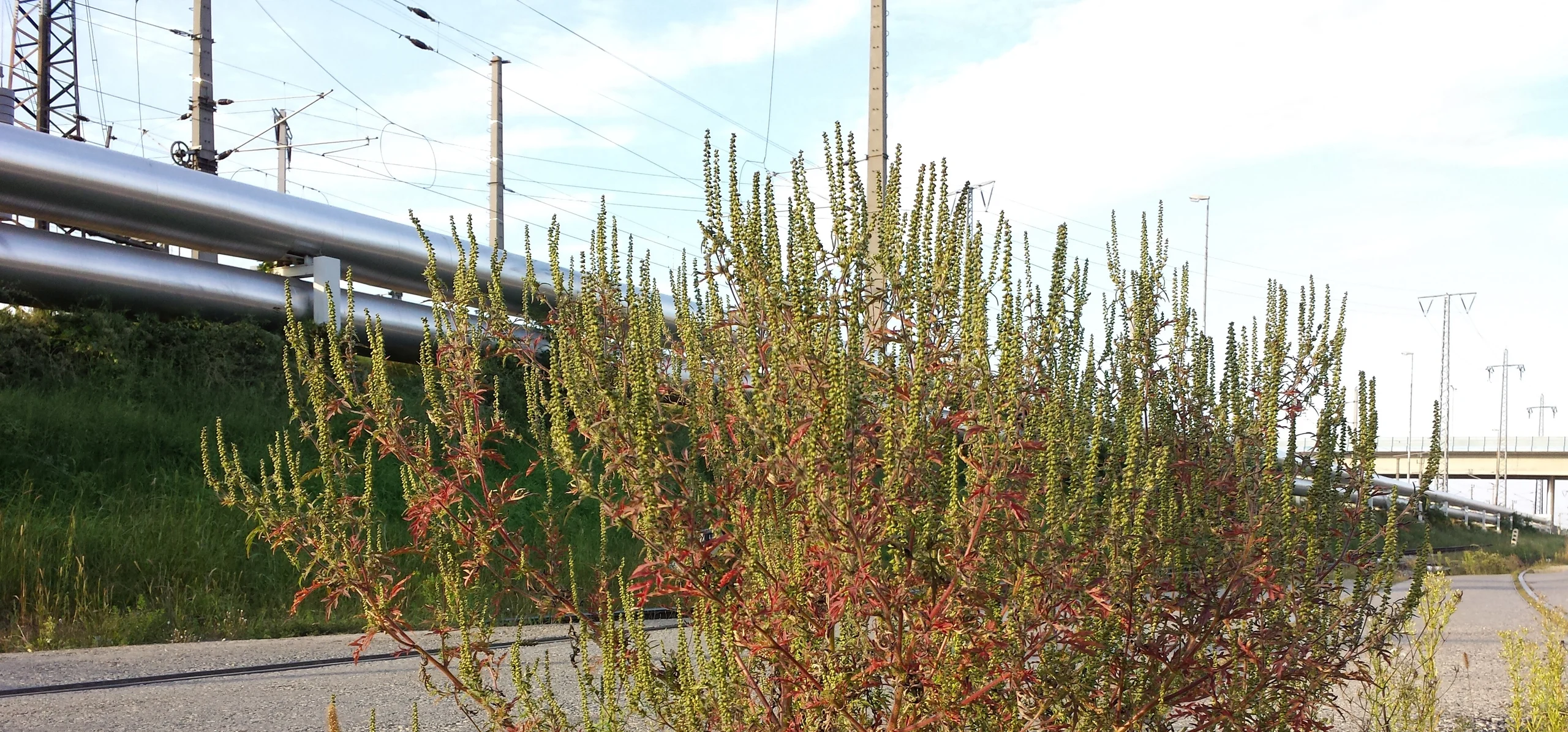
That wiry, narrow-leaved weed that shot up from a rosette to a chest-high stalk in a gravel drive, a fallow bed, or a crack between paving stones is almost certainly Erigeron canadensis, horseweed. It germinates low to the ground, bolts in a single season once the weather warms, and sets hundreds of thousands of wind-borne seeds before the first hard frost. It is not dangerous to brush against in normal garden handling, but its sap can irritate mucous membranes, and it has become one of the most herbicide-resistant weeds in North American farmland. The facts below, on its life cycle, its seed output, and why glyphosate alone no longer controls it, come from university extension research on this exact species.
A Name in Flux: Erigeron or Conyza?
Older field guides and many herbicide labels still call this plant Conyza canadensis, and some botanists have even placed it in its own genus, Leptilon. GBIF, the Global Biodiversity Information Facility, lists Erigeron canadensis L. as the currently accepted name, with Conyza canadensis and Leptilon canadense recorded as synonyms in the same taxon record. The shuffling reflects a long-running debate among taxonomists about how distinct the horseweeds are from the true fleabanes (Erigeron), a debate that GBIF's current classification resolves in favour of keeping the species inside Erigeron. Common names are just as varied: horseweed, marestail, Canadian fleabane, coltstail, and butterweed all refer to the same plant.
Origin and Where It Grows Today
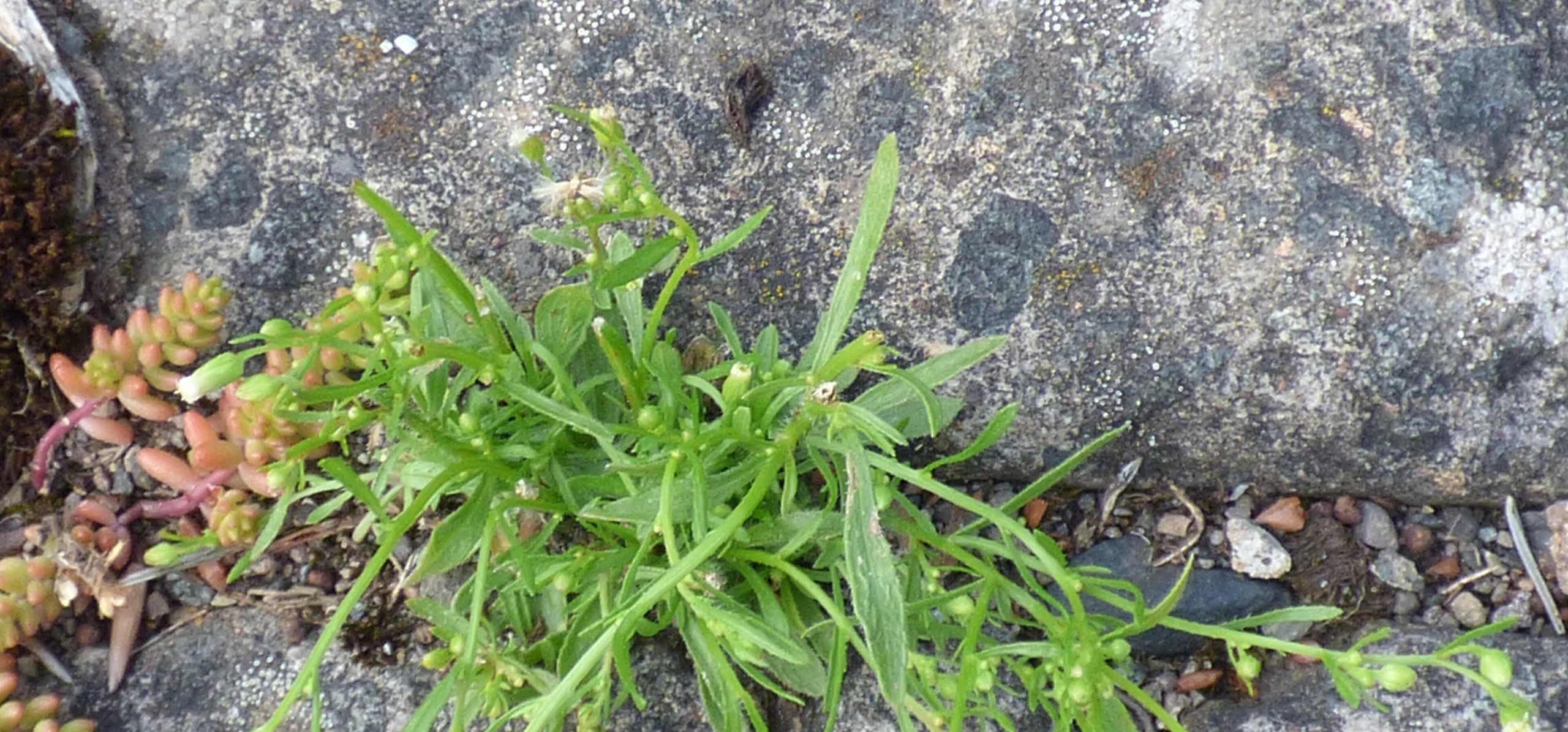
Plants of the World Online, the Kew Science database, records the native range of Erigeron canadensis as the New World, an annual of the temperate biome. From that North American base it has become a fixture of disturbed ground almost anywhere people cultivate soil, pouring itself into the bare, compacted, or gravelly patches that competing plants avoid. It rarely appears in an intact meadow or forest floor; look instead at field margins, construction sites, rail beds, and the joints in a patio, exactly the kind of crack-in-the-pavement spot where the plant photographed for this guide was growing.


From Autumn Rosette to Summer Stalk
Horseweed behaves as a winter annual across most of its range. Seeds that land in late summer or autumn germinate quickly, since the seed carries little dormancy, and spend the cold months as a low, hairy rosette of leaves pressed flat to the ground. North Dakota State University Extension reports that up to 91% of these fall-emerging rosettes survive to spring, and that overwintered plants bolt earlier and grow larger than the ones that germinate fresh in spring. Once temperatures rise, the rosette sends up a single upright, leafy, branching stem that can reach 0.9 to 2.1 m (3 to 7 feet) tall on a spread of only 15 to 60 cm, according to North Carolina State Extension's plant profile. Flowering runs from mid-summer through fall, in a narrow terminal cluster of small heads with white ray florets around a yellow disc, each head barely a centimetre across.
Light, Soil and Habitat It Tolerates
NC State's profile is explicit that horseweed requires full sun, at least six hours of direct light a day, which explains why it colonises open ground so fast but fades out under a shading canopy or a thick lawn. Soil is almost never the limiting factor: the same source lists it as tolerant of acid, neutral, and alkaline conditions, provided drainage is reasonable, and it is recorded growing in lawns and other disturbed sites across coastal, piedmont, and mountain habitats. In practice it favours poor, compacted, or gravelly ground over rich cultivated beds, one reason it thrives in gravel drives, verges, and paving joints rather than in a well-tended border.
Extreme Seed Output and Wind Dispersal
Horseweed's real advantage over garden and crop plants is fecundity. NDSU Extension puts seed production at up to 200,000 seeds on a single plant, each one tipped with a whitish pappus, the same parachute-like structure that carries a dandelion seed, and capable of riding the wind several hundred yards from the parent. Combined with fast, dormancy-free germination, that output means a handful of missed plants at the edge of a field or yard can reseed a wide area within one season. Cutting or pulling plants before the flower heads open is the only way to stop this cycle once bolting has begun.
Managing Horseweed, and Why Glyphosate Often Fails
In 2000, a horseweed population in Delaware became the first broadleaf weed in the United States confirmed resistant to glyphosate, after only a few years of repeated applications, according to University of Delaware Cooperative Extension. Resistant populations have since been confirmed well beyond the Mid-Atlantic, including in North Dakota, where NDSU Extension now advises growers not to rely on glyphosate alone and to rotate herbicide modes of action instead. In a home garden, the more reliable approach is mechanical: pull or hoe rosettes in autumn or early spring while the taproot is still small, since mature plants develop a tough taproot with fibrous roots that resists pulling, and always remove plants before the flower heads open to cut off seed production at the source.
Flowers, Look-Alikes and Value to Pollinators
The flower heads themselves are easy to overlook, small, greenish-white, and packed into a narrow branching panicle rather than displayed as showy daisies, which is part of why horseweed reads as background weed rather than wildflower. Despite that, NC State Extension notes it serves as a nectar and pollen source for native bees, and that its dead, hollow stems are used as nesting sites over winter, a small ecological role worth weighing before pulling every last plant on a property. Gardeners often confuse it with its taller-flowered relative Erigeron annuus, also naturalised across similar disturbed ground, but the two are easiest to tell apart in bloom: horseweed's heads are far smaller and more numerous, crowded along a tall central stem, rather than held as individually visible white daisies.
Test your plant knowledge
Tap a card to flip it and reveal the answer.
Horseweed is a perennial that regrows from the same root system every year. Tap to reveal ✕ False
A single horseweed plant can produce more than 100,000 seeds. Tap to reveal ✓ True
Horseweed grows best in shaded, sheltered spots. Tap to reveal ✕ False
Glyphosate herbicide still reliably kills every horseweed population today. Tap to reveal ✕ False
The scientific name currently accepted by GBIF is Erigeron canadensis, even though many sources still use Conyza canadensis. Tap to reveal ✓ True
Sources
References consulted for this guide
- GBIF: Erigeron canadensis L.gbif.org
- Plants of the World Online (Kew): Erigeron canadensis L.powo.science.kew.org
- NC State Extension Gardener Plant Toolbox: Erigeron canadensisplants.ces.ncsu.edu
- University of Delaware Cooperative Extension: Determining the Presence of Glyphosate-Resistant Horseweedudel.edu
- NDSU Agriculture: Horseweedndsu.edu
- Reference entity : Wikipédiaen.wikipedia.org