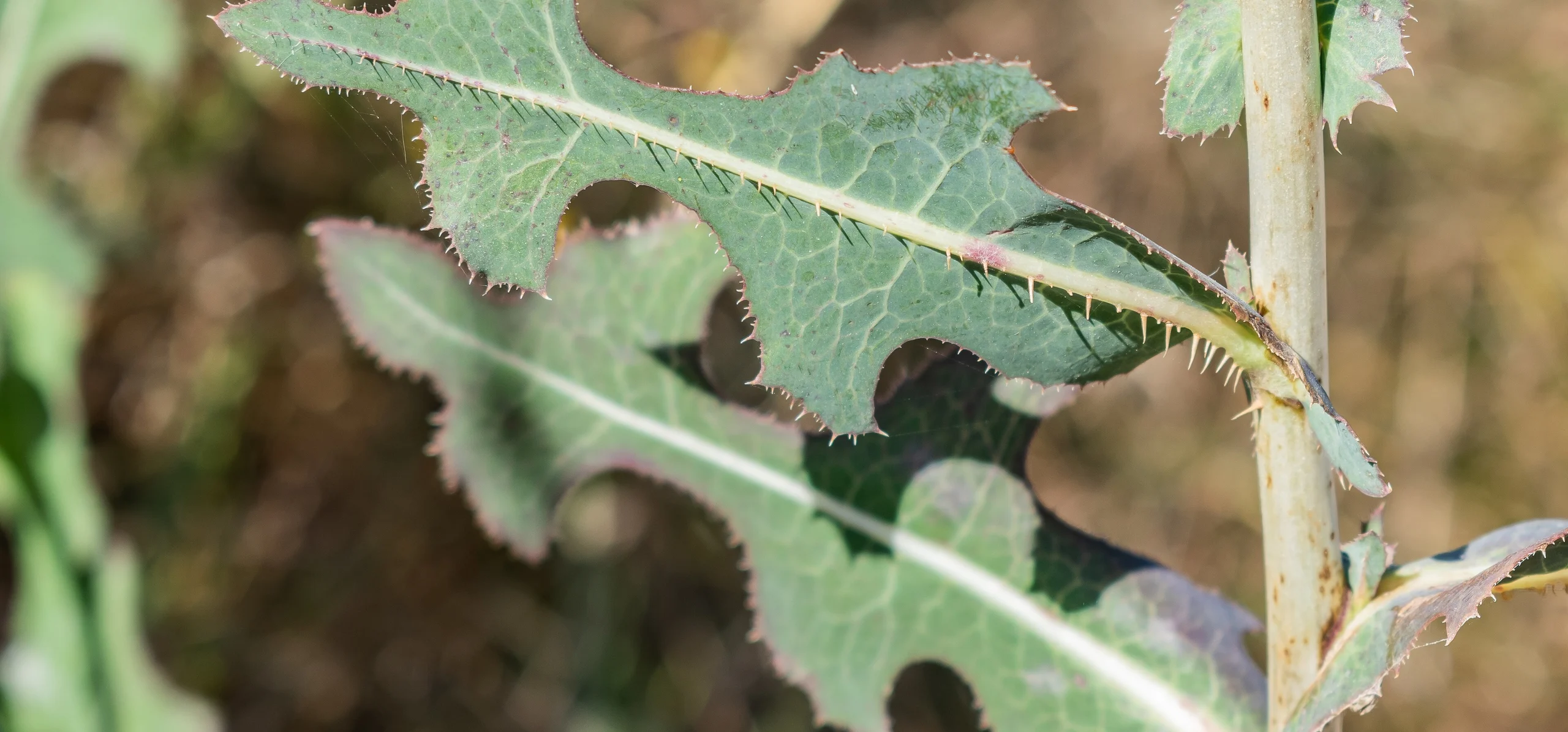
Prickly Lettuce
Lactuca serriola
Family · Asteraceae
Prickly lettuce twists its leaves north-south in full sun, bleeds milky sap when cut, and can drop up to 100,000 seeds if not pulled before it flowers.
Lactuca serriola
Plant profile
- WateringLittleWater every 10 days
- Light exposureFull sun
Growth
- Family
- Asteraceae
- Life cycle
- Annual
- Growth speed
- 8/10
- Mature size
- 30–150 cm
- Flowering
- Small yellow dandelion-like flowers, about 1/3 in (8 mm) across, in loose clusters
- Propagation
- Seed
DormancySeeds show little primary dormancy and germinate readily, but persist in a short-term soil seed bank for up to about three years
Time to maturityBolts and completes its life cycle, rosette to flowering to seed drop, within a single growing season
Soil & climate
- Soil types
- disturbed, gravelly, compacted, nutrient-poor, waste ground
- Drought tolerance
- Yes
Light & Placement
- Where to place it
- waste ground and vacant lots
- gravel driveways and roadside verges
- unmowed field margins
- vegetable bed edges (as an unwanted volunteer)
OriginEurope to southwestern Siberia and the western Himalaya, north Africa to Somalia (naturalized worldwide)
Safety
- Pet safe
- No
ToxicityNot listed by the ASPCA for cats, dogs, or horses; keep the bitter, milky sap away from grazing pets
Invasive speciesNaturalized on most continents and treated as an invasive weed in numerous countries by CABI's Compendium; a single plant can produce up to 100,000 wind-dispersed seeds.
Data fromGBIF: Lactuca serriola L.POWO: Lactuca serriola L.CABI Compendium: Lactuca serriola (prickWashington State University Hortsense: PUC Statewide IPM Program: Lettuce Mosaic
Where it grows
World distribution
Prickly Lettuce is native to 53 countries: Afghanistan, Albania, Algeria, Austria, Belarus, Belgium, Bulgaria, and China….GBIF records 417,141 documented identifications across 118 countries, with the largest concentrations in France, United Kingdom, and Germany.
- Afghanistan
- Albania
- Algeria
- Austria
- Belarus
- Belgium
- Bulgaria
- China
- Croatia
- Cyprus
- Czechia
- Denmark
Show 41 more countriesShow fewer countries
- Egypt
- Eritrea
- Estonia
- Ethiopia
- Finland
- France
- Georgia
- Germany
- Greece
- Hungary
- India
- Iran
- Iraq
- Italy
- Kazakhstan
- Kyrgyzstan
- Lebanon
- Libya
- Mongolia
- Morocco
- Netherlands
- Norway
- Pakistan
- Palestinian Territories
- Poland
- Portugal
- Romania
- Russia
- Saudi Arabia
- Somalia
- Spain
- Sudan
- Sweden
- Switzerland
- Tajikistan
- Tunisia
- Türkiye
- Turkmenistan
- Ukraine
- Uzbekistan
- Yemen
Yellow to orange dots: concentration of documented identifications per country. Green countries: sourced native range. Source: GBIFNative range from POWO (Kew).
Lactuca serriola shows up in gravel driveways, waste lots, and the cracked edges of a vegetable bed, and it is not a random weed: it is the closest wild relative of garden lettuce, Lactuca sativa, according to Kew's Plants of the World Online. The plant in front of you usually gives itself away fast, a tall, spiny-leaved stalk with a row of pale spines running down the underside of each leaf's midrib and a milky sap that beads up the moment a leaf or stem is broken. Left alone past flowering it drops seed by the tens of thousands, so the real decision with this plant is rarely whether to identify it, but how fast to pull it before it sets seed.
Identifying It: The Spine Row and the Milky Sap
The single most reliable field mark, per Washington State University's Hortsense weed profile, is a row of spines running along the midrib on the underside of the leaf, easy to feel by running a thumb along the vein from below. The leaves themselves are alternate, deeply lobed with spiny margins, and clasp the stem directly with little or no leaf stalk. Snap a leaf, a stem, or the taproot and a milky white sap wells up within seconds, the same latex family trait that gives dandelions and sow thistles their bitter, sticky break. The flowers are small, roughly a third of an inch across, dandelion-yellow, and open in loose branching clusters at the top of a stalk that can run 1 to 5 feet tall.
The Compass Plant Habit
In open ground with nothing shading it, the leaves on the main stem twist at the base until they stand nearly vertical in a north-south plane, edge-on to the midday sun, which is where the common name compass plant comes from. The orientation is easiest to see on a single plant standing alone in gravel or a bare lot at midday, when the leaf blades face east and west rather than up, minimizing the flat surface exposed to the harshest overhead light while still catching the low morning and evening sun. Plants growing shaded or crowded among other vegetation rarely show the alignment as cleanly, so it is worth checking a lone specimen in full sun before ruling the identification in or out.


Where It Grows: Waste Ground, Not Garden Soil
Plants of the World Online lists the native range as Europe to southwestern Siberia and the western Himalaya, and north Africa to Somalia; the species has since naturalized on most continents and is treated as an invasive weed in numerous countries by CABI's Compendium. It favors exactly the ground most garden plants avoid: compacted, gravelly, nutrient-poor, and disturbed, which is why it is as much a fixture of parking-lot cracks and roadside shoulders as of field margins. A deep, thin, branching taproot lets it establish in ground too dry and compacted for most vegetables, and that same taproot is what makes a well-rooted plant hard to pull cleanly once it is more than a few weeks old.
A Fast Life Cycle Built Around One Huge Seed Drop
Prickly lettuce behaves as an annual or biennial: seed can germinate and bolt to flower within a single season, or a rosette can overwinter close to the ground and bolt the following spring. Either way the plant commits everything to one seed event. CABI's Compendium puts seed output at up to 100,000 seeds per plant, dispersed on a dandelion-style pappus that carries them well beyond the parent plant, with little primary dormancy but a short-term seed bank that can persist in soil for up to about three years. That combination, enormous output plus a seed bank measured in years rather than decades, is exactly why pulling or hoeing before the flower heads open is the only control that matters: once seed is set, the population in that patch of ground is effectively locked in for the next few seasons regardless of how thoroughly the parent plants are removed afterward.
Why It Is a Problem Next to a Vegetable Bed
A dense patch of prickly lettuce tolerated at the edge of a vegetable garden is not a neutral weed the way a grass or a plantain would be. It is in the same genus as cultivated lettuce, and the University of California's Statewide IPM Program lists it as a seed-borne reservoir of lettuce mosaic virus, a disease that aphids pick up while feeding on an infected weed and carry into a nearby lettuce crop within seconds of probing the next leaf. Green peach aphid and several other common aphid species move between prickly lettuce and garden lettuce without any trouble telling the two apart, which is why UC IPM's guidance for lettuce growers is to clear prickly lettuce and other weed hosts from in and around the field, not just from inside the crop rows. In a home garden the same logic applies at a smaller scale: a stand of prickly lettuce left to grow beside a lettuce bed is a standing bridge for both the aphids and whatever they are carrying.
The Wild Ancestor Behind Garden Lettuce
Kew's Plants of the World Online records Lactuca serriola as the closest wild relative of Lactuca sativa, the lettuce grown in vegetable beds worldwide, which is a useful thing to know before reaching for the hoe. The bitterness, the milky sap, and even the spiny leaf margins are traits garden lettuce breeding has spent centuries selecting against, but they are still visible, unfiltered, in the weed growing in the gravel. It is a rare case of a common garden vegetable's direct wild ancestor still growing uncultivated in the same yard as its domesticated descendant, rather than surviving only in a distant native range.
Lactucarium and the Lettuce Opium Folklore
The same milky sap that identifies the plant has a long folk history under the name lactucarium, a dried latex collected from cut stems and used since antiquity, first documented by the physician Galen in the 2nd century, as a mild folk sedative and cough remedy. Nineteenth-century pharmacopeias in the United States and Britain listed lactucarium under the popular name lettuce opium, though the name is misleading: the latex contains no morphine, codeine, or other opium alkaloids, and works through an entirely different and far less studied chemistry. None of this is a reason to harvest or dose the sap; it is folklore worth knowing when a gardener asks why an old herbal remedy shares a plant with a driveway weed, not a recommendation.
Toxicity and Pets
Prickly lettuce does not appear on the ASPCA's toxic or non-toxic plant lists for cats, dogs, or horses; a direct search of aspca.org turns up no entry for the species under either its Latin or common names. That absence is not the same as a clean bill of health, so the practical approach is the one that applies to any unlisted weed with a bitter, sticky sap: keep pulled plants out of reach of grazing animals and do not treat the lack of a listing as reassurance to let pets browse it freely.
Test your plant knowledge
Tap a card to flip it and reveal the answer.
Prickly lettuce earns the nickname compass plant because its leaves twist to stand in a north-south plane in full sun. Tap to reveal ✓ True
Prickly lettuce poses no disease risk to a nearby lettuce crop because it belongs to a different plant family. Tap to reveal ✕ False
A single prickly lettuce plant can produce up to 100,000 seeds if it is allowed to flower. Tap to reveal ✓ True
Breaking a prickly lettuce leaf or stem produces a milky white sap. Tap to reveal ✓ True
The ASPCA lists prickly lettuce as toxic to cats and dogs. Tap to reveal ✕ False
Sources
References consulted for this guide
- GBIF: Lactuca serriola L.gbif.org
- POWO: Lactuca serriola L.powo.science.kew.org
- CABI Compendium: Lactuca serriola (prickly lettuce)cabi.org
- Washington State University Hortsense: Prickly Lettuce (China Lettuce), Lactuca serriolahortsense.cahnrs.wsu.edu
- UC Statewide IPM Program: Lettuce Mosaic (Lettuce Pest Management Guidelines)ipm.ucanr.edu
- Reference entity : Wikipédiaen.wikipedia.org