Four O'Clock Flower
Mirabilis jalapa
Family · Nyctaginaceae
Grow four o'clock (Mirabilis jalapa): evening-scented multicolor blooms, tuber overwintering in cold climates, and the toxicity of its seeds and roots.
Mirabilis jalapa
Plant profile
- WateringModerateWater every 7 days
- Light exposurePartial sun
- Ideal temperature-5–35 °C
- Hardiness zoneUSDA 9–10
Growth
- Family
- Nyctaginaceae
- Life cycle
- Perennial
- Growth speed
- 7/10
- Mature size
- 46–122 cm
- Spread
- 30–61 cm
- Flowering
- Summer to first frost, opens in late afternoon
- Propagation
- Seed
- Division
Dormancytop growth dies back at frost; the tuber goes dormant and resprouts from the root or from self-sown seed in spring
Time to maturityflowers by midsummer from spring-sown seed
Soil & climate
- Soil types
- loam, sand, chalk
- Drought tolerance
- Yes
Light & Placement
- Origin
- Mexico to Central America
- Where to place it
- bright windowsill for starting seed in early spring
- sheltered south-facing border
- sunny mixed bed
- large patio container
- large container with drainage, movable indoors for winter
Safety
- Toxicity
- HumansToxic
Invasive speciesself-seeds readily and can naturalize into a weedy stand in warm climates (NC State Extension)
Data fromGBIF: Mirabilis jalapa L.POWO (Kew): Mirabilis jalapa L.NC State Extension: Mirabilis jalapa (MaMissouri Botanical Garden Plant Finder: RHS: Mirabilis jalapa (marvel of Peru)
Where it grows
World distribution
Four O'Clock Flower is native to 6 countries: Belize, El Salvador, Guatemala, Honduras, Mexico, and Nicaragua.GBIF records 50,249 documented identifications across 197 countries, with the largest concentrations in France, United States, and Spain.
- Belize
- El Salvador
- Guatemala
- Honduras
- Mexico
- Nicaragua
Yellow to orange dots: concentration of documented identifications per country. Green countries: sourced native range. Source: GBIFNative range from POWO (Kew).
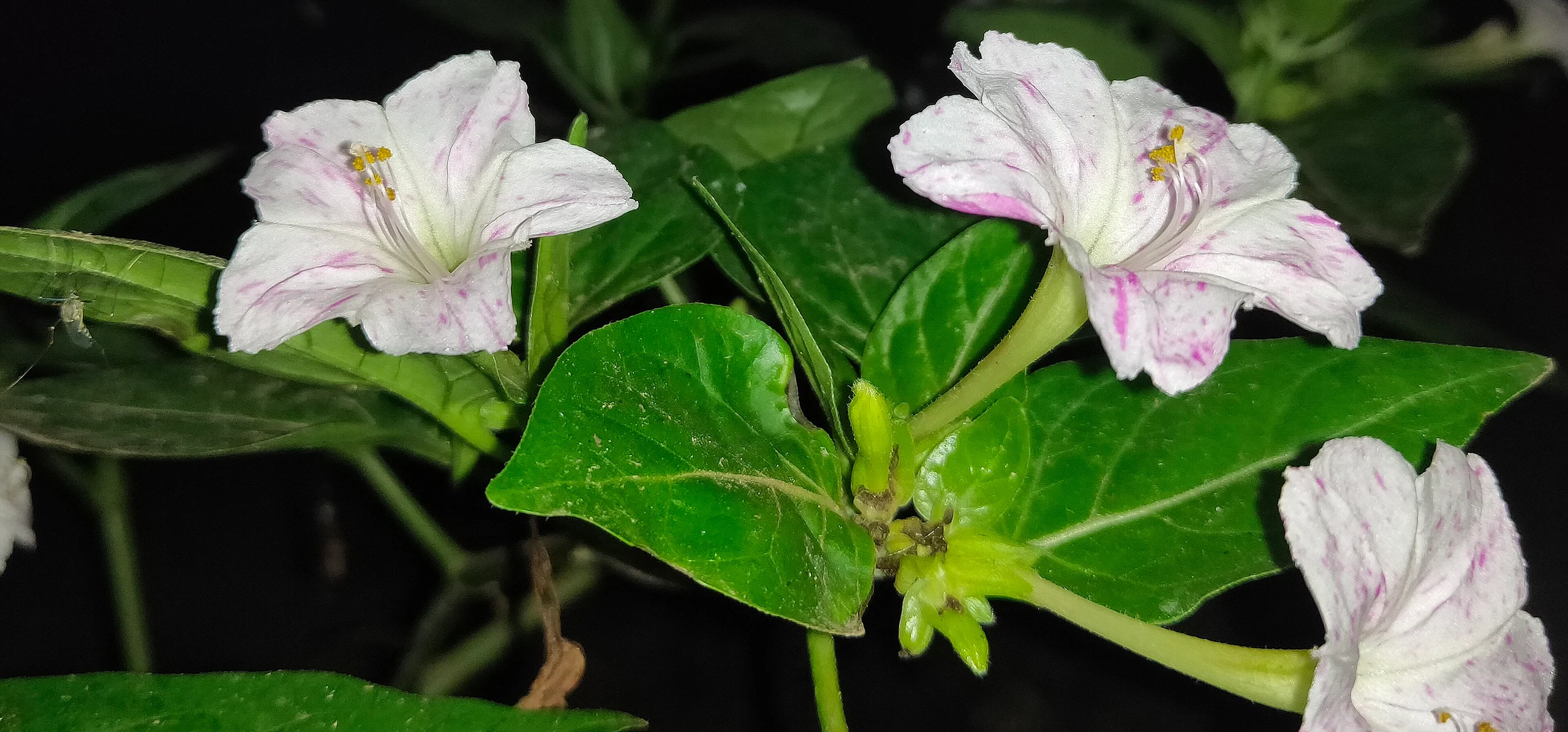
Mirabilis jalapa keeps its trumpet-shaped flowers shut through the heat of the day and unfurls them in the late afternoon, releasing a sweet scent that carries after dark, which is exactly why it is sold as the four o'clock flower. It grows from a thick, tuberous root that behaves like a dahlia's: it can live for years in a mild climate, or it can be lifted and stored indoors where winters bite. A single plant regularly carries flowers in two or three different colors at once, some solid, some streaked or speckled, so no two four o'clocks quite match. Give it a sunny, sheltered spot and ordinary garden soil and it asks for very little else, though the seeds and roots are toxic and worth keeping away from children and curious pets.
Origin and a Name Borrowed from a Mexican Town
Plants of the World Online places the native range of Mirabilis jalapa from Mexico to Nicaragua, and NC State Extension describes the same broad native range as Mexico to Central America. The species epithet does not describe the flower at all: Missouri Botanical Garden notes it refers to Jalapa, the old name for Xalapa in Veracruz, Mexico, a place the plant was long associated with rather than a botanical trait. GBIF records the accepted name as Mirabilis jalapa L. in the family Nyctaginaceae, the four o'clock family, alongside older synonyms such as Jalapa officinalis and Jalapa congesta that show up in historical texts but are no longer in use.
Flowers That Open on Their Own Schedule
The trumpet-shaped, five-lobed flowers cluster where the leaves meet the stem and open in the afternoon or in very cloudy weather, according to Missouri Botanical Garden, then close again by the next morning. NC State Extension notes the blooms are visited by hummingbirds and moths, both active at dusk, which lines up with the flower's habit of opening exactly when day-flying pollinators are giving way to night-flying ones. The scent is strongest in the evening and is one of the plant's main draws for a patio or a path used after sunset, even though the individual flowers rarely last more than a single night.


One Plant, Several Colors
RHS describes the flowers as coming in a wide range of colors and sometimes bicoloured, and in practice that variability shows up on a single plant rather than only across a packet of seed. It is common to see white, pink, magenta, yellow, and red blooms open together on the same stems, with some flowers streaked or speckled rather than solid. Seed saved from a multicolor plant will not reliably reproduce the exact mix of its parent, so gardeners who want a specific color combination tend to propagate by dividing the tuber instead of relying on self-sown seedlings.
Choosing a Spot: Sun, Soil, and Shelter
NC State Extension lists full sun to part shade as suitable, while RHS is more specific, recommending a south-facing, sheltered position in full sun with protection from cold, drying wind. Soil should be humus-rich and moist but well-drained; RHS notes the plant tolerates chalk, loam, or sandy soils across acid, alkaline, or neutral pH, which makes it forgiving of whatever bed it lands in as long as water does not sit around the root. A spot against a warm wall or fence extends the sheltered microclimate that this tender perennial appreciates going into autumn.
Watering and Feeding
Keep the soil evenly moist while young plants are establishing a root system, then let up slightly once they are settled, since NC State Extension rates the species as moderately drought tolerant. Containers dry out faster than open ground and need checking more often through summer heat. A light, balanced feed every few weeks supports steady flowering without the lush, floppy growth that heavy nitrogen tends to encourage in this family.
Overwintering the Tuber
RHS rates Mirabilis jalapa at hardiness H3, meaning the root survives outdoors only in coastal or otherwise mild areas, roughly matching the USDA zone 9a to 10b range NC State Extension gives for the species growing as a perennial. Where winters go colder than that, treat the tuber the way a dahlia grower treats theirs: after the first frost blackens the foliage, either mulch the crown heavily and hope for the best in a borderline zone, or lift the root, let it dry, and store it somewhere cool and frost-free until the ground warms again in spring. Plants grown in large containers can simply be moved under cover for winter instead of being dug up.
Self-Seeding and Propagation
RHS lists two propagation routes: sow seed in early spring and germinate at 13 to 18 degrees C, or divide the tuber in spring before new growth starts. Missouri Botanical Garden adds that soaking seed overnight speeds germination. Left to its own devices, a four o'clock drops seed freely, and NC State Extension warns that it can self-seed vigorously enough to become weedy, so a gardener who wants to keep the planting contained should deadhead before seed pods form or plant it somewhere a volunteer seedling is not a problem.
Toxicity: Seeds and Roots Deserve Caution
NC State Extension rates Mirabilis jalapa as toxic at low severity, with the seeds and roots as the toxic parts, capable of causing stomach pain, nausea, vomiting, and diarrhea if eaten, and dermatitis from handling the roots. RHS goes further, marking the plant harmful if eaten and recommending protective gloves when working with it. ASPCA's own toxic and non-toxic plant list, checked directly against its dogs and cats entries, does not carry a specific listing for four o'clock, Mirabilis jalapa, or marvel of Peru, so no pet-specific verdict from that source exists either way. Given the documented human toxicity from the roots and seeds, the safest approach is to treat the tuber and any seed as off-limits for children and pets, and to wash hands after dividing or handling the roots.
Test your plant knowledge
Tap a card to flip it and reveal the answer.
Four o'clock flowers typically stay closed during the heat of the day and open in the late afternoon or on overcast days. Tap to reveal ✓ True
A single Mirabilis jalapa plant always produces flowers of one uniform color. Tap to reveal ✕ False
In climates with hard winter frost, the tuberous root of a four o'clock can be lifted and stored indoors like a dahlia tuber. Tap to reveal ✓ True
The seeds and roots of Mirabilis jalapa are edible and used raw in salads. Tap to reveal ✕ False
Because it self-seeds so readily, four o'clock can naturalize and turn weedy in warm climates. Tap to reveal ✓ True
Sources
References consulted for this guide
- GBIF: Mirabilis jalapa L.gbif.org
- POWO (Kew): Mirabilis jalapa L.powo.science.kew.org
- NC State Extension: Mirabilis jalapa (Marvel-of-Peru)plants.ces.ncsu.edu
- Missouri Botanical Garden Plant Finder: Mirabilis jalapamissouribotanicalgarden.org
- RHS: Mirabilis jalapa (marvel of Peru)rhs.org.uk
- Reference entity : Wikipédiaen.wikipedia.org