White Mulberry
Morus alba
Family · Moraceae
White mulberry (Morus alba) is a fast, tough shade tree for USDA zones 4 to 8: prune it dormant, pick a fruiting or fruitless variety, manage roots and pollen.
Morus alba
Plant profile
- WateringLittleWater every 10 days
- Light exposurePartial sun
- Hardiness zoneUSDA 4–8
Growth
- Family
- Moraceae
- Life cycle
- Perennial
- Growth speed
- 8/10
- Mature size
- 900–1800 cm
- Spread
- 900–1500 cm
- Flowering
- Inconspicuous spring catkins; berries ripen through June
- Propagation
- Seed
- Layering
Dormancydeciduous, dormant in winter
Time to maturityfast early growth; reaches full mature size over roughly 20 to 50 years
Soil & climate
- Soil types
- clay, loam, sand
- Drought tolerance
- Yes
Light & Placement
- Origin
- Central China
- Where to place it
- street tree
- shade tree
- windbreak
- wildlife garden
Safety
- Toxicity
- CatsSafe
- DogsSafe
- HorsesSafe
- HumansToxic
Invasive speciesNaturalized and considered invasive or weedy across much of North America; hybridizes with and threatens the native red mulberry (Morus rubra).
Data fromGBIF Backbone Taxonomy: Morus alba L.Plants of the World Online (Kew): Morus ASPCA: Toxic and Non-Toxic Plants, MulbeNC State Extension Gardener Plant ToolboRHS: Morus alba (white mulberry)
Where it grows
World distribution
White Mulberry is native to a single country: China.GBIF records 51,169 documented identifications across 150 countries, with the largest concentrations in United States, Romania, and France.
- China
Yellow to orange dots: concentration of documented identifications per country. Green countries: sourced native range. Source: GBIFNative range from POWO (Kew).
A white mulberry, Morus alba, growing at the edge of a yard or arriving as a bare-root whip from a nursery is rarely there for its fruit: it is one of the fastest, toughest deciduous trees available, native to China and grown worldwide for millennia as fodder for silkworms rather than for people. Expect a fast-growing, spreading tree that reaches roughly 9 to 18 m tall and nearly as wide within a few decades, hardy from USDA zone 4 to 8, and tolerant of heat, drought, poor soil and urban pollution once established. The one decision that matters most before planting is whether you want a fruiting female, a pollen-heavy male, or one of the sterile ornamental cultivars sold for landscaping, because that choice shapes everything from sidewalk mess to allergy symptoms for decades to come.
Recognizing a White Mulberry
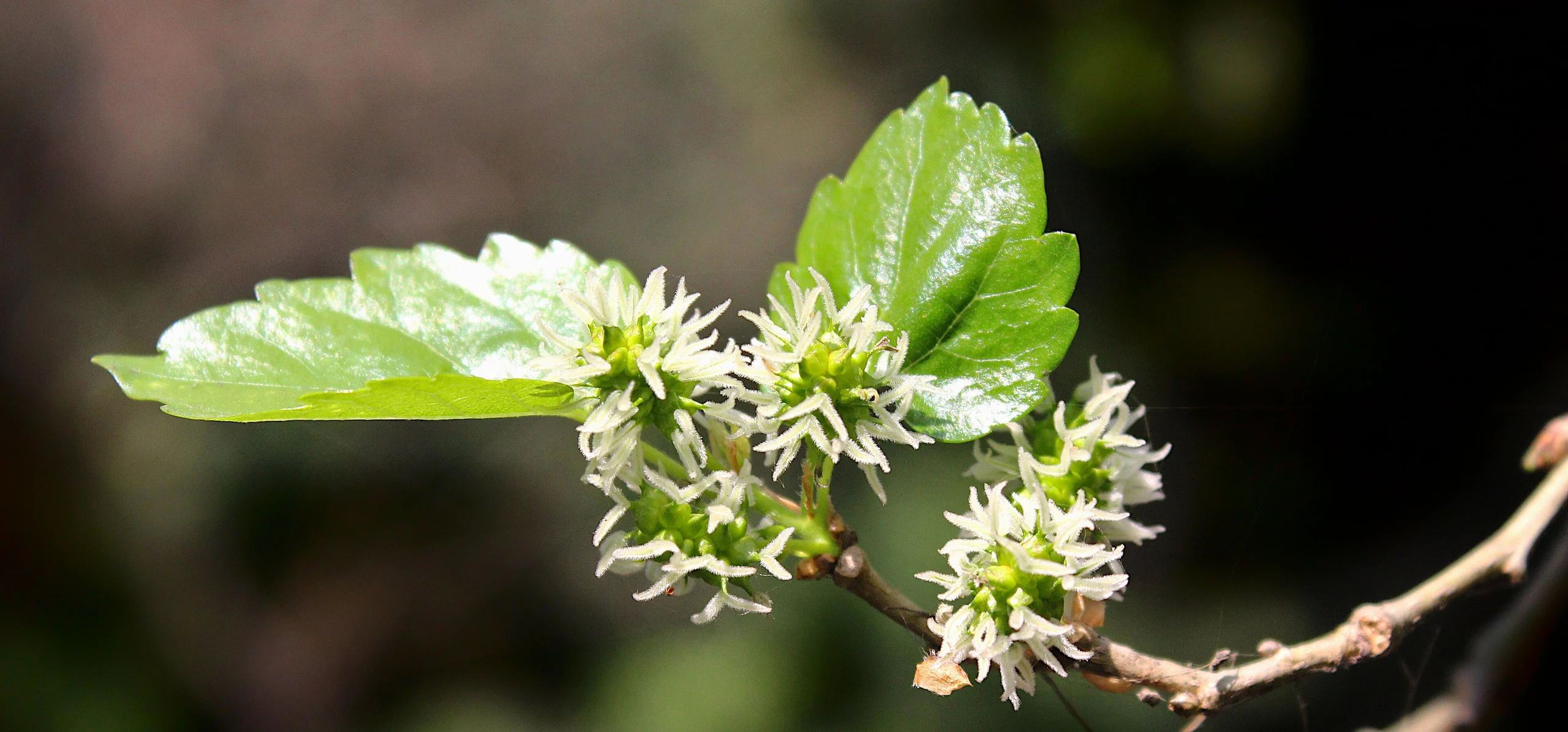
Young bark is smooth and pale grey-brown, developing shallow, irregular fissures with age. Leaves are alternate, glossy on top, coarsely toothed, and famously variable on the same tree: some are simple ovate blades with a long pointed tip, others split into two- or three-lobed shapes reminiscent of a mitten, especially on vigorous young shoots and root sprouts. Crushed leaves and cut stems release a milky white latex sap, the surest field mark once you know to look for it. In spring, small greenish catkins cluster densely at the leaf axils before or with the new leaves, easy to mistake for flower buds rather than the flowers they actually are.
Site and Hardiness: Where It Thrives
Plant in full sun for the densest canopy and heaviest fruit set, though white mulberry tolerates partial shade better than most fast-growing trees. It is hardy across USDA zones 4 to 8, shrugging off both hard winter cold and summer heat that stress more refined ornamentals, and extension sources rate it fast-growing on almost any soil. Give it room: mature height runs roughly 9 to 18 m with a spread nearly as wide, reached over 20 to 50 years according to the RHS, so plant well clear of a house, patio or driveway. Avoid low, poorly drained ground; the species tolerates drought far better than it tolerates standing water.
Soil, Water and Feeding
Few trees ask less of their soil. White mulberry grows in clay, loam or sand and tolerates acidic, neutral and alkaline ground alike, which is why it turns up on disturbed, low-fertility sites where fussier trees fail. Water a newly planted tree deeply every week or two through its first one or two growing seasons while roots establish; after that, an established tree draws on a deep root system and rarely needs irrigation outside prolonged drought. Routine feeding is rarely necessary; a light spring application of balanced fertilizer is enough on visibly poor soil, and overfeeding only produces soft, fast growth that snaps more easily in wind.


Choosing a Variety: Male, Female or Fruitless
White mulberry is dioecious, meaning an individual tree is either male or female. Female trees fruit heavily, and despite the species name, ripe berries run from white or pink through darker reds to nearly black depending on the tree, not uniformly white as the common name suggests. Male trees never fruit but release large amounts of wind-borne pollen each spring; because fruitless males avoid the sidewalk mess of dropped berries, cities and nurseries have planted them by the thousand, concentrating one of the more allergenic urban tree pollens in parks and street plantings. If pollen sensitivity is a concern in your household, choose a known fruiting female or a sterile ornamental cultivar such as the weeping Pendula rather than an unlabeled seedling, and ask the nursery which sex you are buying before you plant.
Pruning: Why Timing Matters
Mulberries bleed. Cut a branch while sap is moving in spring or summer and the wound weeps for days, slowing healing and inviting disease into the cut. Prune only during full dormancy, from leaf fall in autumn through midwinter before buds swell, and keep individual cuts small; large wounds on this comparatively soft wood bleed longest and close slowest. Structural training matters more than routine cutting: shape a young tree to a single leader with well-spaced branches early, since correcting poor structure on a mature, brittle-wooded mulberry later is both harder and riskier in wind or ice.
Harvest and a Note on Toxicity
Berries ripen through June in most climates and do not all color at once, so a fruiting female drops fruit steadily over several weeks rather than in one flush, worth remembering before planting one over a deck or driveway. Ripe fruit is sweet and safe to eat fresh, but extension sources rate the rest of the plant, unripe green berries, foliage and especially the milky sap, as low toxicity if eaten: enough to cause stomach upset and, in quantity, mild hallucinogenic effects in people who eat unripe fruit, plus skin irritation from the sap. For pets the picture is milder still: the ASPCA lists mulberry as non-toxic to cats, dogs and horses, though a dog that gorges on fallen unripe fruit can still get a day of vomiting or diarrhea.
Pests, Disease and Other Problems
White mulberry is rarely killed outright by pests, but extension sources list borers, whiteflies, bacterial blight and coral spot canker as recurring problems, most of them cosmetic or manageable with basic sanitation rather than routine spraying. Borers and canker are the ones worth watching on a stressed or wounded tree, since both exploit damaged bark and can girdle a branch over a season or two; pruning out and destroying affected wood promptly, always during dormancy, is the main defense. The tree's bigger reputation problem is not disease but behavior: extension sources flag messy fruit drop, weedy self-seeding from bird-dispersed berries, and a shallow, aggressive root system as the recurring complaints from anyone who has lived with a mature specimen near a patio, path or septic line.
The Hybridization Threat to Native Red Mulberry
In North America, white mulberry carries a reputation problem beyond messy fruit and aggressive pollen: it readily cross-pollinates with the native red mulberry, Morus rubra, and the resulting hybrids are steadily displacing pure red mulberry across much of its range. Red mulberry is now listed endangered in Connecticut and Massachusetts and threatened in Vermont and Michigan largely because of this genetic swamping, since vigorous hybrid seedlings outcompete pure natives in the same disturbed, edge habitats both species favor. Anyone planting in North America to support wildlife or native plant communities should weigh a fruiting white mulberry against locally sourced red mulberry stock, and pull volunteer white mulberry seedlings near any woodland edge where red mulberry still grows wild.
Test your plant knowledge
Tap a card to flip it and reveal the answer.
Ripe white mulberry fruit is always pure white, matching the common name. Tap to reveal ✕ False
Mulberries should be pruned while the tree is dormant, not during the growing season. Tap to reveal ✓ True
The ASPCA lists white mulberry as toxic to dogs, cats and horses. Tap to reveal ✕ False
White mulberry hybridizes with the native red mulberry in North America, threatening its genetic integrity. Tap to reveal ✓ True
Male white mulberry trees produce fruit but very little pollen. Tap to reveal ✕ False
Sources
References consulted for this guide
- GBIF Backbone Taxonomy: Morus alba L.gbif.org
- Plants of the World Online (Kew): Morus alba L.powo.science.kew.org
- ASPCA: Toxic and Non-Toxic Plants, Mulberry Treeaspca.org
- NC State Extension Gardener Plant Toolbox: Morus albaplants.ces.ncsu.edu
- RHS: Morus alba (white mulberry)rhs.org.uk
- Reference entity : Wikipédiaen.wikipedia.org