Common Fig
Ficus carica
Family · Moraceae
Ficus carica fruits best with restricted roots, a warm wall and winter protection. Covers Brown Turkey, Violette de Bordeaux, sap irritation and fig rust.
Ficus carica
Plant profile
- WateringModerateWater every 4 days
- Light exposureFull sun
- Ideal temperature-10–-5 °C
- Hardiness zoneUSDA 7–10
Growth
- Family
- Moraceae
- Life cycle
- Perennial
- Growth speed
- 7/10
- Mature size
- 300–900 cm
- Spread
- 300–900 cm
- Propagation
- Cutting
- Layering
FloweringFlowers are hidden inside the fig itself; two fruit flushes a year, an early breba crop and a later main crop
Dormancydeciduous, leafless through winter dormancy
Time to maturityFruits within a few years, sooner when root restricted in a pot or pit
Soil & climate
- Soil pH
- pH 5.5–7.5
- Soil types
- loam
- Drought tolerance
- Yes
Light & Placement
- Origin
- Eastern Mediterranean to Central Asia and the western Himalaya
- Where to place it
- Bright, unheated greenhouse or porch, for winter storage of a potted tree only
- Fan trained against a south or west facing wall
- Sunny, sheltered patio in a large pot
- Peat free, loam based potting compost
Safety
- Toxicity
- HumansToxic
Invasive speciesRecorded as invasive in Florida and California
Data fromFicus carica, GBIF Backbone TaxonomyRHS: How to grow figsRHS: Figs, pruning and trainingRHS: Ficus carica 'Violette de Bordeaux'NC State Extension Gardener Plant ToolboClemson HGIC: Plants that Tolerate Droug
Where it grows
World distribution
Common Fig is native to 14 countries: Afghanistan, Cyprus, Georgia, Greece, India, Iran, Iraq, and Lebanon….GBIF records 111,560 documented identifications across 148 countries, with the largest concentrations in France, Spain, and Italy.
- Afghanistan
- Cyprus
- Georgia
- Greece
- India
- Iran
- Iraq
- Lebanon
- Pakistan
- Palestinian Territories
- Russia
- Tajikistan
- Türkiye
- Turkmenistan
Yellow to orange dots: concentration of documented identifications per country. Green countries: sourced native range. Source: GBIFNative range from POWO (Kew).
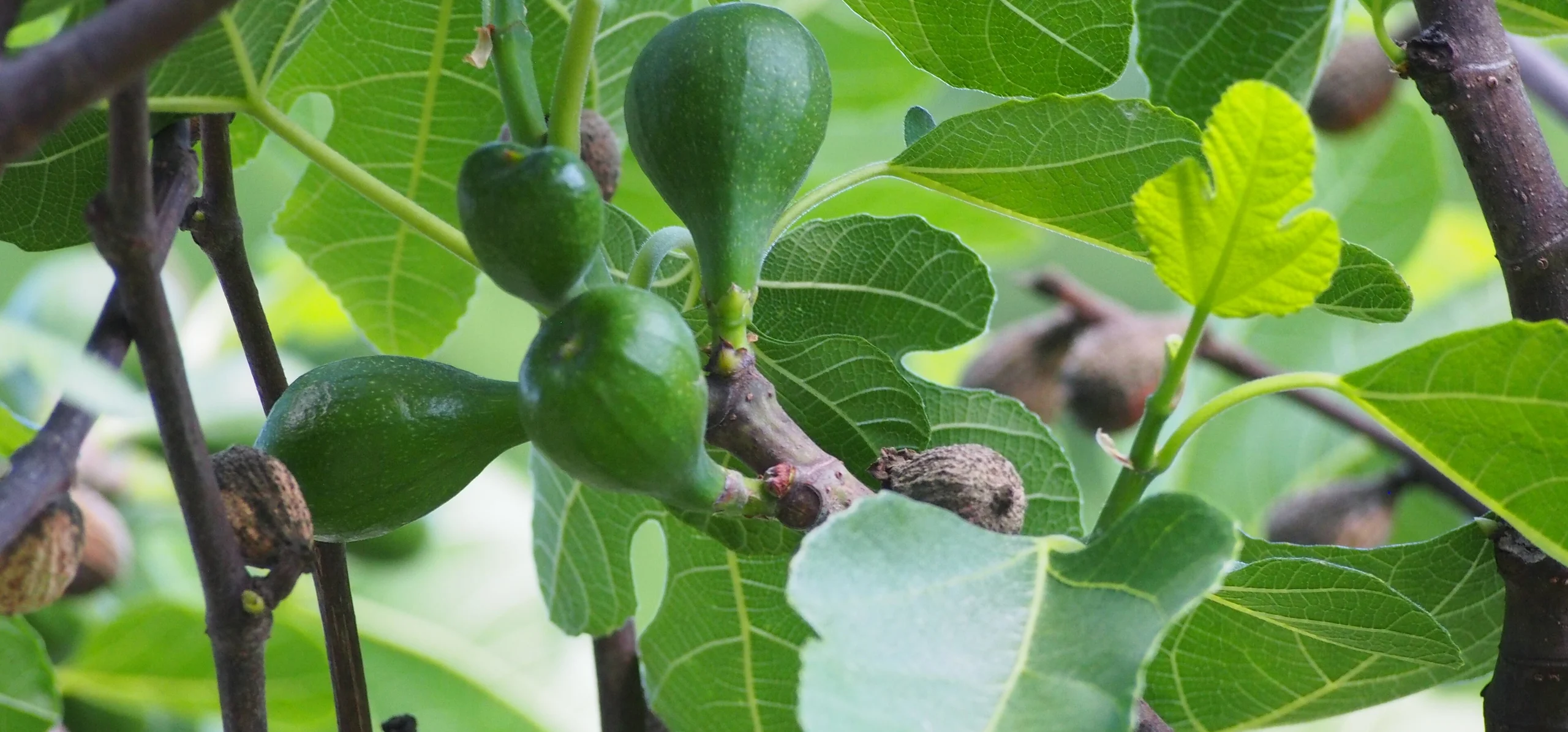
A young fig in a nursery pot looks unassuming, a few lobed leaves and maybe a couple of small green knobs at the tips of the stems. Those knobs matter more than the leaves. Ficus carica is unusual among fruit trees in that a generous, unrestricted root run produces a leafy tree that fruits late and poorly, while a plant deliberately kept hungry at the roots, confined to a pit lined with paving slabs or simply left in a pot, puts that energy into ripening fruit instead of growing wood. Understand that trade off early and the rest of fig growing, choosing a variety, training it against a wall, and getting it through winter, falls into place.
Choosing a Variety: Brown Turkey and Violette de Bordeaux
GBIF's accepted name for the species is simply Ficus carica L., with Fig, Edible Fig and Common Fig recorded as its English vernacular names; older references also list it as Ficus vulgaris or Ficus carica var. caprificus, names once applied to wild and cultivated forms of the same tree. Among garden cultivars, Brown Turkey is one of the most widely sold, valued as an undemanding, reliable cropper with brown skinned, sweet fruit. Violette de Bordeaux is a smaller French cultivar with dark purplish black fruit and pink to red flesh; the RHS rates it H4, hardy through most of the UK and tolerant down to about -10 to -5 C, reputedly hardier than many other cultivars, and it fruits young when fan trained on a warm wall or kept root restricted in a container.


Restricting the Roots for Fruit, Not Leaves
The classic way to force a fig into cropping mode is to dig a pit roughly 60cm (2ft) deep and wide and line the sides with paving slabs set on edge, forming a rim about 2.5cm above soil level so roots cannot climb out over the top. Backfill with soil and plant into that confined pocket. The RHS recommends checking around the outside of the slabs occasionally for escaped roots and severing them, then patching any gaps, since one root reaching open ground undoes the point of the exercise. A large pot does the same job with less digging: start a young plant in around a 30cm pot of peat free, loam based compost, repot into a slightly larger container every couple of years, and once it reaches a manageable size, stop potting up and instead lift the tree every year or two to trim the roots and refresh the compost.
Fan Training on a Warm Wall
Outside the mildest gardens, a fig grown as a free standing tree rarely ripens a worthwhile crop. The RHS recommends training it as a fan against a south or west facing wall or fence, sheltered from wind, where reflected heat helps the wood ripen and the fruit colour up. Fix horizontal wires to the wall roughly 30cm (1ft) apart and tie in new shoots as they extend, spreading them out evenly rather than letting them cross. Combined with root restriction, wall training is what lets a fig start fruiting within a few years instead of taking a decade to settle in.
Breba and Main Crop: What Actually Ripens
A fig tree carries two distinct flushes of fruit. The first crop develops from pea sized embryonic figs that formed at the shoot tips the previous late summer and overwintered on the wood; given a reasonable spring, these swell and ripen earliest. The second, main crop forms later on the current season's new growth, and in cooler climates it seldom has time to ripen before autumn cold arrives. That second flush is where most disappointment comes from: by mid autumn, any fig still hard and green will not ripen and will not survive winter usefully, so the RHS advises stripping off every fig larger than a pea at that point. Left in place, the tree wastes energy on fruit going nowhere; removed, both its energy and its winter hardiness improve. What you deliberately leave behind are the pea sized embryonic figs at the shoot tips, since those are next year's first crop, and in cold districts they benefit from the same straw or fleece wrapping used to protect the wood over winter.
Pruning in Late Winter, and a Word on the Sap
Prune a fan trained fig in late winter or very early spring, before growth restarts. Cut back around a third of the previous year's young shoots to a stub of about 2.5cm (1in) to force new replacement growth, remove shoots that grew straight into the wall without fruitlets on them, and hard prune old bare wood back to 5 to 8cm (2 to 3in) stubs to renew it. Wear gloves and cover bare arms while doing this: every cut releases the tree's white, milky latex, which contains furanocoumarins that sensitise skin to sunlight. Left on skin that is then exposed to sun, it produces phytophotodermatitis, a delayed, blistering, sometimes badly pigmented burn documented in gardeners who handled fig branches bare handed. Wash off any splashes straight away rather than waiting to see if they react. For pets, the ASPCA's plant database has no entry specifically for Ficus carica; its page titled simply Fig actually describes the unrelated weeping fig, Ficus benjamina. Treat common fig sap as a skin hazard for people rather than a confirmed pet poison listing, and still keep animals from chewing cut stems or fallen leaves as ordinary caution.
Watering in Pots and Feeding
A container fig has a small volume of compost working hard in summer sun, so check it daily in hot, dry weather and water enough to keep it evenly moist. The RHS is equally clear that pots should never stand in a saucer of water, especially through winter, when soggy roots are a bigger risk than dry ones. Clemson Cooperative Extension notes that fig simply sheds leaves if it gets too dry, a visible and recoverable warning rather than a fatal one, though a tree that drops leaves repeatedly through a dry summer will not ripen fruit well that year. Because the point of root restriction is to limit vigour, feed lightly: a container or pit grown fig given heavy regular fertiliser will happily grow new wood at the expense of the fruit its roots were restricted to produce.
Winter Protection and Hardiness
North Carolina State Extension places Ficus carica in USDA hardiness zones 7a to 10b outdoors, and named cultivars vary within that range: the RHS rates Violette de Bordeaux H4, hardy through most of the UK down to about -10 C. Where winters run colder than a cultivar's rating, the practical answer for a container tree is to move it into an unheated greenhouse, shed or porch from autumn until after the last spring frost. A wall trained fig that cannot be moved is instead packed around the branches with a thick layer of straw or bracken once its leaves drop, held in place with netting or fleece, and unwrapped gradually once frosts stop. The pea sized fruitlets destined to be next year's first crop are the most frost tender part of the whole plant, which is exactly what this wrapping protects.
Fig Rust and Wasps
Fig rust shows up as small, angular, yellow green flecks on the upper leaf surface that enlarge and turn yellow to orange or brown through the season, with tiny fungal pustules on the underside. The University of Arkansas Cooperative Extension notes that heavily infected leaves die and drop early, and a tree stripped bare this way can push out replacement foliage too late to harden off before frost, leaving it more vulnerable to cold that winter. Two sprays of a copper based fungicide, one once the first leaves of spring reach full size and a second three to four weeks later, are the standard control window. North Carolina State Extension lists rust among the diseases recorded on the species, alongside blight and leaf spots. Wasps, by contrast, are a harvest problem rather than a growing one: fruit that splits or hangs too long draws them in, so picking figs as soon as they soften and hang down cuts down the nuisance. Garden fig cultivars are also parthenocarpic, setting fruit without pollination at all, so none of this depends on the specialised fig wasp that pollinates wild and commercial caprifigs elsewhere.
Test your plant knowledge
Tap a card to flip it and reveal the answer.
Restricting a fig's roots, in a pit or a pot, tends to increase fruiting rather than leafy growth. Tap to reveal ✓ True
In a cool climate, the main crop that forms on the current season's new growth almost always ripens fully outdoors. Tap to reveal ✕ False
In autumn, the RHS advises removing the pea sized embryonic figs and leaving the larger unripe ones to overwinter. Tap to reveal ✕ False
Cut fig stems release a milky latex that can cause a delayed, blistering skin reaction after sun exposure. Tap to reveal ✓ True
The ASPCA's poison control database has a dedicated entry confirming Ficus carica as toxic to cats and dogs. Tap to reveal ✕ False
Sources
References consulted for this guide
- Ficus carica, GBIF Backbone Taxonomygbif.org
- RHS: How to grow figsrhs.org.uk
- RHS: Figs, pruning and trainingrhs.org.uk
- RHS: Ficus carica 'Violette de Bordeaux'rhs.org.uk
- NC State Extension Gardener Plant Toolbox: Ficus carica (Common Fig)plants.ces.ncsu.edu
- Clemson HGIC: Plants that Tolerate Droughthgic.clemson.edu
- UT Gardens, University of Tennessee: Common Fig, Ficus caricautgardens.tennessee.edu
- University of Arkansas Cooperative Extension: Fig Rustuaex.uada.edu
- Reference entity : Wikipédiaen.wikipedia.org