
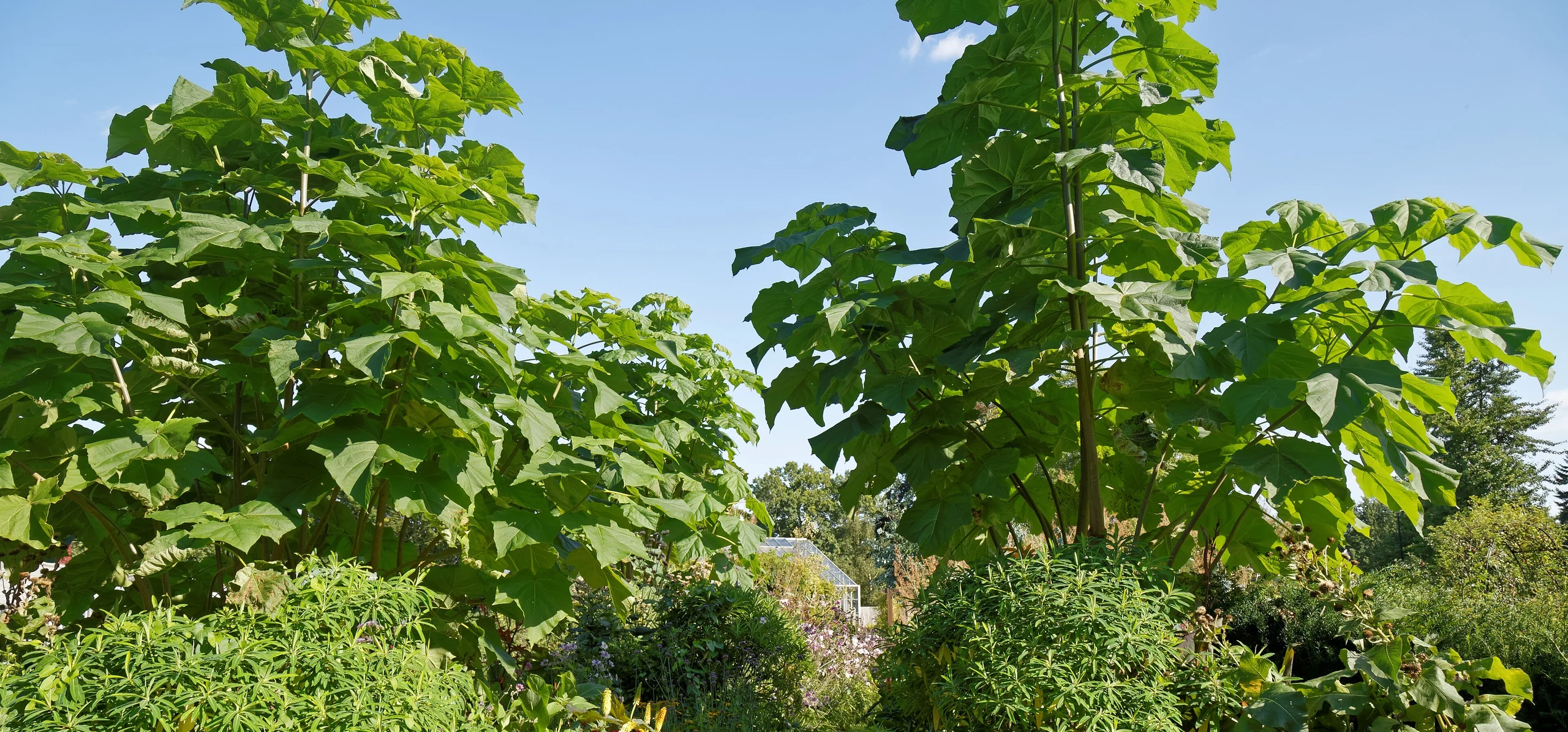
Princess Tree
Paulownia tomentosa
Family · Paulowniaceae
Princess tree grows faster than almost any other shade tree, needs a wind-sheltered site, and self-seeds so freely it is flagged invasive across the eastern US.
Paulownia tomentosa
Plant profile
- WateringModerateWater every 10 days
- Light exposurePartial sun
- Hardiness zoneUSDA 5–9
Growth
- Family
- Paulowniaceae
- Life cycle
- Perennial
- Growth speed
- 9/10
- Mature size
- 900–1500 cm
- Spread
- 600–900 cm
- Flowering
- Fragrant lavender to pale purple clusters in early spring, opening before the leaves
- Propagation
- Seed
Dormancydeciduous; bare branches in winter carry next spring's fuzzy flower buds and the previous year's dried seed capsules
Time to maturityreaches full height in about a decade; young shoots can add up to 15 ft (4.5 m) in a single growing season
Soil & climate
- Soil types
- sand, loam, clay
- Saline soil
- Partially tolerated
- Drought tolerance
- Yes
Light & Placement
- Origin
- Central and eastern China, South Korea
- Where to place it
- open, sunny site sheltered from prevailing wind
- large border well clear of structures and overhead wires
Safety
- Toxicity
- Not evaluated by the ASPCA; toxicity undetermined
- Pet safe
- No
Invasive speciesflagged invasive non-native and not recommended for planting in Florida (UF/IFAS Extension), and listed by state forestry and invasive-plant councils across the eastern United States, where it self-seeds prolifically, naturalizes in disturbed woodland and resprouts persistently from cut stumps and roots
Data fromGBIF Backbone Taxonomy: Paulownia tomentPlants of the World Online (Kew): PaulowRHS Growing Guide: Paulownia tomentosa (NC State Extension Gardener Plant ToolboUF/IFAS Extension: Paulownia tomentosa,
Where it grows
World distribution
Princess Tree is native to 2 countries: China and South Korea.GBIF records 61,012 documented identifications across 77 countries, with the largest concentrations in United States, France, and Switzerland.
- China
- South Korea
Yellow to orange dots: concentration of documented identifications per country. Green countries: sourced native range. Source: GBIFNative range from POWO (Kew).
A Paulownia tomentosa seedling rarely gets planted on purpose in North America anymore; more often it turns up self-sown in a fence line, a gravel driveway or a neglected border, its heart-shaped leaves already the size of a dinner plate by its first autumn. Whether you inherited one or bought a named tree for its fragrant spring flowers, it will add height faster than almost anything else you could plant, shrug off soil most trees refuse, and, if left to seed, spread well beyond the spot where you found it. Knowing what it becomes in year three changes how you handle it in year one.
Origin and Naming
Princess tree is native to central and eastern China and South Korea, where it grows as a component of open, disturbed and temperate woodland. It belongs to its own family, Paulowniaceae, in the order Lamiales, and it is sold under several overlapping common names: princess tree, empress tree and foxglove tree all refer to the same species, the last one a nod to its funnel-shaped flowers, which do resemble oversized foxglove blooms. It was carried out of Asia as an ornamental and shade tree and has since been planted, and has self-seeded, across temperate regions worldwide.
A Growth Rate That Outpaces Almost Every Shade Tree
This is the fastest-growing tree most gardeners will ever plant. A young shoot can add up to 15 feet (4.5 m) of new growth in a single season, and the tree reaches its full size of roughly 30 to 50 feet (9 to 15 m) tall and nearly as wide within about a decade, far quicker than an oak, maple or even most poplars. That speed is exactly why it needs planning before it goes in the ground: a tree that size arrives fast, and moving or removing an established specimen later is a much bigger job than deciding on a better spot now.
Siting: Full Sun, Shelter From Wind, Room to Spread
Give it full sun to part shade and, just as important, a position sheltered from strong, prevailing wind. The wood is light and comparatively brittle, and the leaves on young growth are enormous, so a gusty, exposed site tears foliage and snaps branches that a calmer corner would leave intact. Because the crown eventually spreads 20 to 30 feet (6 to 9 m), keep it well clear of the house, overhead wires and any structure that a large, brittle-limbed tree could damage as it matures.


Soil, Watering and Feeding
Princess tree tolerates sand, loam and clay, acidic to slightly alkaline soil, and even ground that stays occasionally wet, as long as drainage is not consistently poor. Water a young tree regularly through its first one or two seasons while roots establish; afterward it copes with dry spells reasonably well, showing moderate drought tolerance once its root system is in. Skip routine feeding on an established tree: this is not a plant that needs coaxing along, and pushing extra growth on an already fast grower mostly means more pruning later.
Flowers That Open Before the Leaves
Fuzzy, cinnamon-colored flower buds form on the branch tips in autumn and sit through winter on the bare tree, visible alongside the previous year's dried seed capsules. They open in early spring, before or just as the leaves emerge, in large upright clusters of fragrant, funnel-shaped lavender to pale purple flowers with a faint vanilla scent, carried on the second year's wood. A hard spring frost while the buds are swelling can wipe out that year's bloom, so a sheltered site protects the flower display as much as the branches.
Pruning and Coppicing
Left alone, princess tree develops a rounded crown and flowers reliably each spring on older wood. Some growers instead coppice it hard in late winter, cutting the trunk back close to the ground; the tree responds with a single season's regrowth of leaves that can reach dinner-plate size or larger, an effect sometimes used for bold foliage in a border, though it sacrifices that year's flowers entirely. Either way, prune out any dead, damaged or crossing wood while the tree is dormant, since the brittle branches are prone to storm damage and torn wood invites decay.
Common Problems: Weak Wood, Litter and Root Sprouts
This species is largely free of serious insect pests, but it is not trouble-free. Branches break in wind and ice storms because the wood is light and weak; fallen flowers, capsules and the oversized leaves create a real litter problem under the canopy each year; and cut stumps and disturbed roots resprout persistently, so removing an unwanted tree usually takes more than one cut. Occasional mildew, leaf spot and twig canker show up in damp, poorly ventilated sites, generally without threatening the tree's survival.
Why It Is Regulated as Invasive in Parts of the US
A single seed capsule can hold up to two thousand papery, wind-blown seeds, and a mature tree carries many capsules, which is how it naturalizes so readily in disturbed woodland, roadsides and stream banks once it escapes cultivation. It is flagged as invasive non-native and not recommended for planting in Florida, and it appears on invasive-species lists maintained by state forestry and invasive-plant councils across the eastern United States. Before planting one, especially in the Southeast, check your state's current invasive-species list, and if you already have a self-seeded tree you do not want, deadhead the spring flowers before they set capsules and be ready to cut back root sprouts more than once.
Test your plant knowledge
Tap a card to flip it and reveal the answer.
A princess tree can add up to 15 feet (4.5 m) of new growth in a single season. Tap to reveal ✓ True
Princess tree flowers open only after the new leaves have fully unfurled. Tap to reveal ✕ False
A single seed capsule can hold up to two thousand seeds. Tap to reveal ✓ True
The ASPCA lists princess tree as toxic to cats and dogs. Tap to reveal ✕ False
Cut stumps and disturbed roots readily resprout, making an unwanted tree hard to remove in one go. Tap to reveal ✓ True
Sources
References consulted for this guide
- GBIF Backbone Taxonomy: Paulownia tomentosa (Thunb.) Steud.gbif.org
- Plants of the World Online (Kew): Paulownia tomentosa (Thunb.) Steud.powo.science.kew.org
- RHS Growing Guide: Paulownia tomentosa (foxglove tree)rhs.org.uk
- NC State Extension Gardener Plant Toolbox: Paulownia tomentosaplants.ces.ncsu.edu
- UF/IFAS Extension: Paulownia tomentosa, Princess-Tree (ENH-592/ST433)ask.ifas.ufl.edu
- Reference entity : Wikipédiaen.wikipedia.org