Eastern White Pine
Pinus strobus
Family · Pinaceae
Pinus strobus is North America's tallest eastern conifer: five soft needles per bundle, rapid growth, and a weevil that kills the leader if you top it.
Pinus strobus
Plant profile
- WateringLittleWater every 10 days
- Light exposureFull sun
- Ideal temperature-37–35 °C
- Hardiness zoneUSDA 3–8
Growth
- Family
- Pinaceae
- Life cycle
- Perennial
- Growth speed
- 7/10
- Mature size
- 1500–3000 cm
- Spread
- 600–1200 cm
- Flowering
- Wind-pollinated cones in spring; seed cones mature and open over two growing seasons
- Propagation
- Seed
- Grafting
Dormancyevergreen; growth pauses in winter, needles persist year round
Time to maturityreaches full height over many decades; effective as a screen within 10 to 15 years
Soil & climate
- Soil types
- sand, loam, sandy loam
- Saline soil
- Not tolerated
- Drought tolerance
- No
Light & Placement
- Origin
- Central and eastern Canada to north-central and eastern United States
- Where to place it
- open lawn or parkland
- windbreak row
- woodland edge with high shade
- screening away from roads
Safety
- Toxicity
- Not evaluated by the ASPCA; toxicity undetermined
- Pet safe
- No
Data fromGBIF Backbone Taxonomy: Pinus strobus L.Plants of the World Online (Kew): Pinus NC State Extension Gardener Plant ToolboPenn State Extension: Eastern White PinePenn State Extension: White Pine Weevil
Where it grows
World distribution
Eastern White Pine is native to 2 countries: Canada and United States.GBIF records 121,997 documented identifications across 59 countries, with the largest concentrations in United States, Canada, and Germany.
- Canada
- United States
Yellow to orange dots: concentration of documented identifications per country. Green countries: sourced native range. Source: GBIFNative range from POWO (Kew).
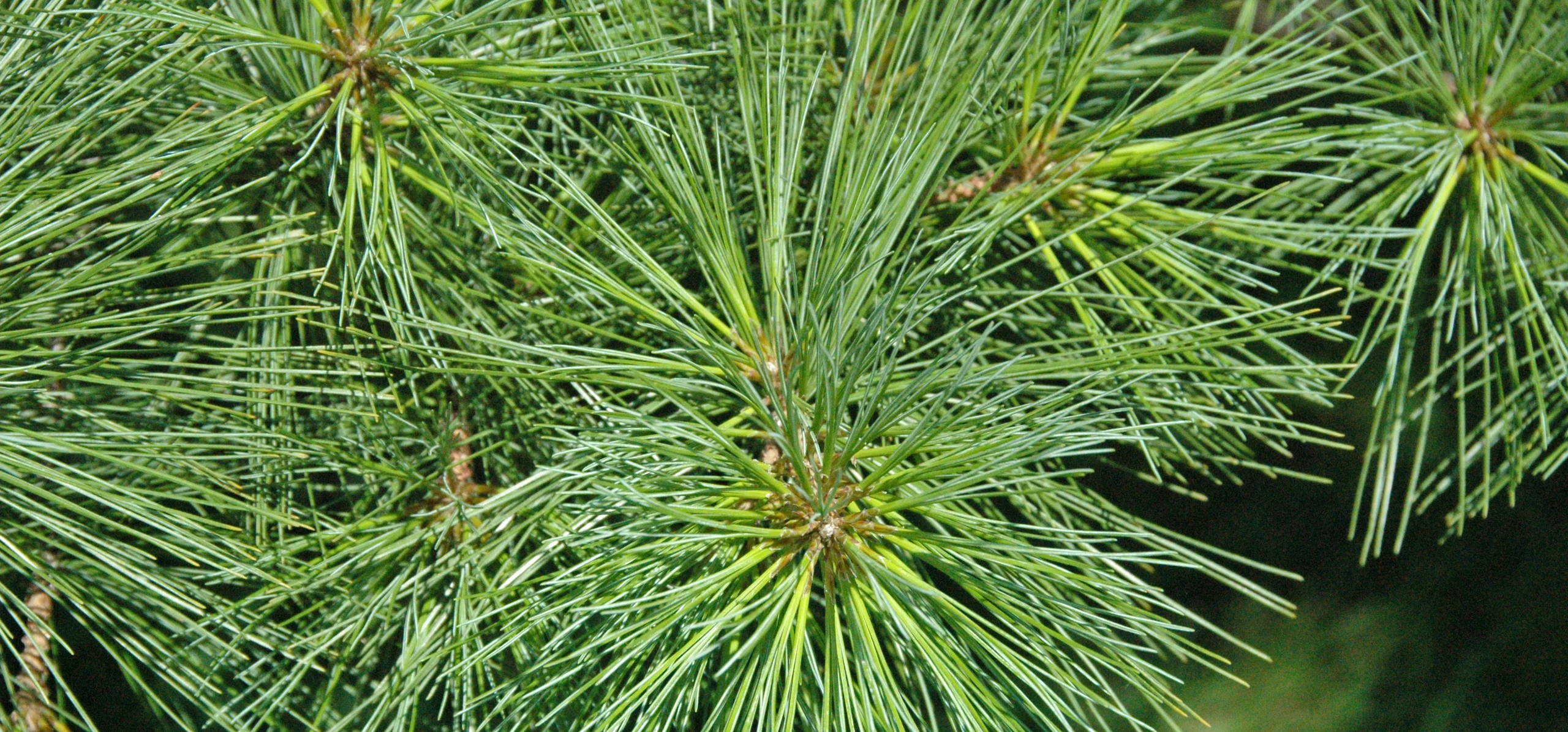
A young Pinus strobus straight out of the nursery pot is deceiving: it looks slow and shrubby, then puts on 30 to 60 cm of new growth a year once it settles in, and needs the space to match. The giveaway that you are looking at the true eastern white pine, not one of the two or three-needled pines often sold alongside it, is the needle bundle: five soft, blue-green needles per fascicle, the only pine native east of the Rockies with that count. Give it acidic, well-drained soil and full sun, and the real decisions become where to put a tree that will outgrow most garden beds, and how to tell normal autumn needle drop from the diseases that actually threaten it.
Where it grows and how tall it gets
Pinus strobus is native from central and eastern Canada south through the north-central and eastern United States, ranging from Newfoundland and Manitoba down through the Appalachians into Georgia, according to Plants of the World Online. It is the tallest conifer native to that range: cultivated trees commonly reach 15 to 24 m with a 6 to 12 m spread, and open-grown specimens on good ground can pass 30 m over a long lifetime, according to the North Carolina State Extension plant database. Growth is rapid for a conifer, so a tree planted as a screen or specimen needs 6 to 12 m of clearance on every side within a decade or two, not the 3 m gap that looks generous at planting time.
Site and light
Full sun for six or more hours a day gives the densest, most pyramidal growth; two to six hours of shade is tolerated but the crown opens up and leans toward the light. This is not a street tree or a courtyard specimen: eastern white pine is intolerant of air pollution, de-icing salt spray, and compacted urban soil, all traits documented by the North Carolina State Extension. A wind-exposed hilltop is also a poor match, mature trees are prone to wind and ice damage because the wood is soft and the crown catches wind; a site with some shelter from prevailing storms holds its shape far better over the decades.
Soil, watering and feeding
Moist, well-drained sandy loam with an acidic pH below 6.0 is the benchmark this species is measured against, and it will not thrive on chalky or alkaline ground no matter how much fertiliser is applied. Water new transplants deeply and consistently through the first two growing seasons while the root system establishes; established trees handle average rainfall and short dry spells but decline visibly on thin, drought-prone soil through a hot summer. Skip routine fertilising on an established tree in reasonable soil, a mulch ring that breaks down each year supplies more nitrogen than most young pines need, and keeps mower and string-trimmer damage away from the shallow root flare, a far more common killer of young trees than any nutrient shortfall.


Growth habit, pruning and the mast-pine legacy
Left alone, a young tree grows in tidy whorls of branches, one new tier added each year, which is why counting whorls from the ground is a rough way to age a young white pine. The straight, uniform trunk that results is exactly what made this species the preferred mast timber for the Royal Navy in colonial New England: surveyors marked the tallest trees with the King's Broad Arrow, reserving them for shipbuilding, and the resentment that provoked fed directly into events like the 1772 Pine Tree Riot. That same single leading shoot is worth protecting today. Never cut the leader to control height, it forces several competing tops and a permanently misshapen crown; instead, shorten the spring candles by about half before the needles expand if a denser, more compact plant is the goal.
Reading needle drop: normal versus disease
Every autumn a healthy Pinus strobus sheds its oldest needle whorl, typically growth from two years back, so a wave of yellowing and browning needles toward the interior of the crown in September and October is normal housekeeping, not a symptom. What is not normal is browning that starts on new, current-year needles, or needle loss paired with resin bleeding and sunken bark. Those point toward one of the fungal needle diseases grouped as white pine needle disease, which Penn State Extension links to wetter spring weather, with symptoms often not showing until the year after infection.
Pests and diseases that actually threaten it
White pine blister rust, caused by Cronartium ribicola, is the disease to watch for: it needs a currant or gooseberry (Ribes) host nearby to complete its cycle, produces orange spore masses and sunken cankers on the trunk and branches, and can girdle and kill a tree over several years. White pine weevil is the more immediate threat to young trees: larvae tunnel downward under the bark of the leading shoot each spring, girdling and killing it, which produces the classic wilted, hooked 'shepherd's crook' tip described by Penn State Extension; a tree can usually be retrained to a single new leader if the dead tip is removed promptly. Caliciopsis canker, sometimes combined with white pine bast scale, is a newer and less familiar problem that shows as resin-weeping depressions along the branches rather than the trunk.
Common mistakes
The two mistakes that account for most failed plantings are siting the tree where winter road salt drifts onto it, and planting on heavy clay or limestone-derived alkaline soil and expecting mulch alone to fix the pH. A close third is topping a tree that has outgrown its space instead of accepting that this was never a small-garden conifer, topping only produces a cluster of weak, storm-prone replacement leaders. Mistaking the normal autumn shedding of two-year-old interior needles for disease, and spraying or removing an otherwise healthy tree in response, rounds out the list.
Wildlife value and toxicity
The ASPCA does not list Pinus strobus specifically among its toxic or non-toxic plant entries, so toxicity to cats, dogs or horses is undetermined rather than confirmed safe. What is well documented is its wildlife value: the North Carolina State Extension notes that seeds feed squirrels, rabbits and birds, bark is browsed by porcupines and beavers, and the foliage hosts Imperial Moth larvae, making a mature white pine one of the more productive trees for a semi-wild garden edge or woodland planting.
Test your plant knowledge
Tap a card to flip it and reveal the answer.
Eastern white pine needles grow in bundles of five. Tap to reveal ✓ True
It's normal for a healthy white pine to drop its two-year-old inner needles every autumn. Tap to reveal ✓ True
Eastern white pine tolerates road salt and alkaline soil well. Tap to reveal ✕ False
White pine weevil damage shows up as a wilted, hooked 'shepherd's crook' at the top of the tree. Tap to reveal ✓ True
Pinus strobus stays under 10 m tall at maturity, making it suitable for a small garden. Tap to reveal ✕ False
Sources
References consulted for this guide
- GBIF Backbone Taxonomy: Pinus strobus L.gbif.org
- Plants of the World Online (Kew): Pinus strobus L.powo.science.kew.org
- NC State Extension Gardener Plant Toolbox: Pinus strobusplants.ces.ncsu.edu
- Penn State Extension: Eastern White Pine, Threats to a Historically Important Speciesextension.psu.edu
- Penn State Extension: White Pine Weevilextension.psu.edu
- Reference entity : Wikipédiaen.wikipedia.org