Prickly Sowthistle
Sonchus asper
Family · Asteraceae
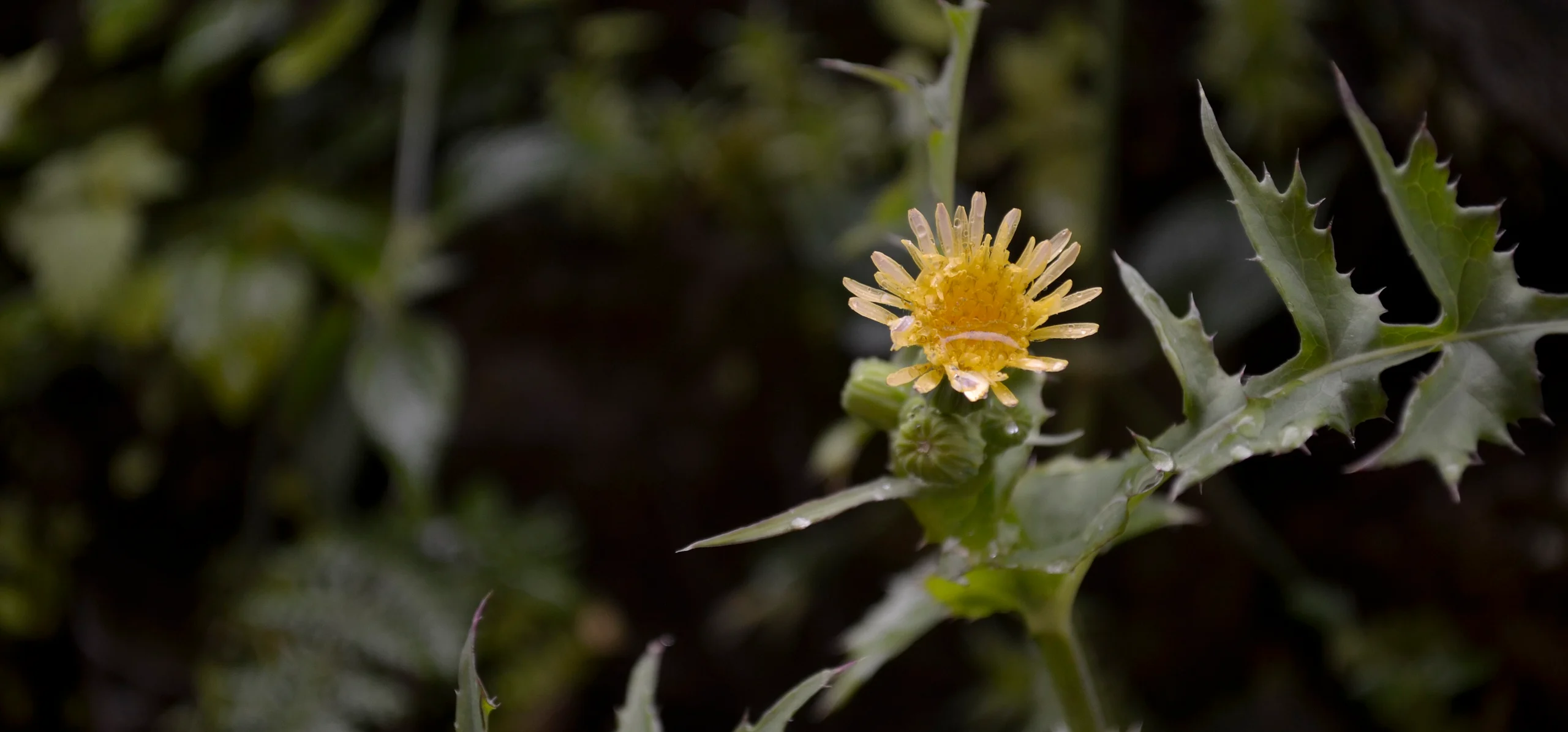
Prickly sowthistle's rounded, clasping leaf lobes separate it from Sonchus oleraceus, and its shallow taproot pulls out clean if you catch it before it flowers.
Sonchus asper
Plant profile
- WateringLittleWater every 7 days
- Light exposureFull sun
Growth
- Family
- Asteraceae
- Life cycle
- Annual
- Growth speed
- 8/10
- Mature size
- 60–180 cm
- Flowering
- Small yellow, dandelion-like flowerheads, roughly June to August
- Propagation
- Seed
Time to maturityBolts and forms flowerheads within weeks once conditions turn favorable
Soil & climate
- Soil types
- fertile, cultivated, disturbed, loam, clay-loam, gravelly
- Drought tolerance
- Yes
Light & Placement
- Origin
- Temperate Eurasia, North Africa to the Sahel and Somalia
- Where to place it
- vegetable garden bed
- disturbed or newly tilled ground
- roadsides and waste ground
Safety
- Toxicity
- HumansSafe
Invasive speciesNaturalized well beyond its native range as one of the more stress-tolerant sowthistles, colonizing everything from rich garden soil to roadsides and gravelly ground; the University of California Statewide IPM Program also lists it as a weed reservoir for lettuce mosaic virus, spread onward by aphids.
Data fromGBIF: Sonchus asper (L.) HillPOWO: Sonchus asper (L.) HillMissouri State University WeedID: Spiny NC State Extension Gardener Plant ToolboUC Statewide IPM Program: Lettuce Mosaic
Where it grows
World distribution
Prickly Sowthistle is native to 65 countries: Afghanistan, Albania, Algeria, Austria, Belarus, Belgium, Bhutan, and Bulgaria….GBIF records 720,514 documented identifications across 165 countries, with the largest concentrations in United Kingdom, France, and Netherlands.
- Afghanistan
- Albania
- Algeria
- Austria
- Belarus
- Belgium
- Bhutan
- Bulgaria
- Burkina Faso
- Cameroon
- Chad
- Croatia
Show 53 more countriesShow fewer countries
- Cyprus
- Czechia
- Denmark
- Djibouti
- Egypt
- Eritrea
- Estonia
- Ethiopia
- Finland
- France
- Georgia
- Germany
- Greece
- Hungary
- India
- Iran
- Iraq
- Ireland
- Italy
- Kazakhstan
- Kyrgyzstan
- Lebanon
- Libya
- Morocco
- Myanmar (Burma)
- Nepal
- Netherlands
- Nigeria
- Norway
- Pakistan
- Palestinian Territories
- Papua New Guinea
- Poland
- Portugal
- Romania
- Russia
- Saudi Arabia
- Senegal
- Somalia
- Spain
- Sri Lanka
- Sudan
- Sweden
- Switzerland
- Tajikistan
- Tunisia
- Türkiye
- Turkmenistan
- Ukraine
- United Arab Emirates
- United Kingdom
- Uzbekistan
- Yemen
Yellow to orange dots: concentration of documented identifications per country. Green countries: sourced native range. Source: GBIFNative range from POWO (Kew).
Sonchus asper turns up fast in freshly dug beds, gravel cracks, and any patch of ground that has just been disturbed, and at a glance it is easy to mistake for its close relative Sonchus oleraceus. Both share the same spiny, wavy-toothed leaves and hollow stems that bleed a milky white sap when cut, but S. asper gives itself away at the point where each leaf wraps around the stem. Left alone, it moves from a low rosette to a full seed head in a matter of weeks, so knowing the leaf-base tell is worth more than any other single fact about this plant.
The Leaf Base Is the Tell
Missouri State University's weed identification guide describes Sonchus asper as having rounded lobes that clasp the stem, compared with the distinctly pointed lobes of Sonchus oleraceus, and this is the single most reliable field character between the two species. Both plants share the same spiny, wavy-edged leaf margins and the same milky sap, so leaf outline alone will not settle the identification. Run a thumb along the base of a stem leaf where it meets the stalk: if the lobes curl around the stem in a soft, rounded shape rather than tapering to a point, the plant is S. asper.
Why It Shows Up in the Best Soil You Have
North Carolina State University Extension's Gardener Plant Toolbox notes that the size of this plant varies with the moisture and fertility of the soil, and that it can bolt upward and form flowerheads very quickly once conditions turn favorable. Missouri's weed profile lists it as a weed of landscapes, winter small grains, pastures, hay fields, and orchards, all cultivated or regularly disturbed ground rather than untouched wild land. In practice, a thick stand of prickly sowthistle in a vegetable bed usually means the soil there has recently been turned and is rich enough to carry a fast-growing annual, the same read gardeners get from other fertile-soil weeds.


Salt, Roadsides, and Other Rough Ground
The same NC State profile lists roadsides and waste places alongside gardens and lawns as typical habitat, and Missouri's guide adds roadsides to its own list of places the plant is found throughout the United States. Roadside verges are routinely salted in winter and compacted by traffic, and a weed that colonizes that ground as readily as a manured vegetable bed is doing something a lot of garden plants cannot. NC State's profile also notes it grows across loam, clay-loam, and shallow gravelly soil alike, which explains why the same species shows up in rich cultivated dirt and in a gravel driveway crack.
From Rosette to Parachute Seed in Weeks
Prickly sowthistle flowers from roughly June through August, producing small yellow, dandelion-like flowerheads on branching stems. Missouri's weed profile describes the mature seed as carrying a white feathery pappus that collectively forms a white puff ball similar to a dandelion's, and that puff ball is built to travel: the achenes ride the wind well past the parent plant before landing on the next patch of open, disturbed ground. Because a rosette can bolt and flower within the same season it germinates, a low clump of spiny leaves noticed in spring can already be seeding by midsummer if it is left alone.
Pulling It: Gloves and a Shallow Taproot
The spiny leaf margins that give the plant its name are sharp enough to draw blood on bare hands, so gloves are worth putting on before pulling even a single plant. Missouri's weed profile identifies the root as a taproot rather than a spreading rhizome, and on young plants that taproot sits shallow enough that a firm, steady pull at the base lifts the whole root out of loose garden soil. Older, bolted plants anchor more stubbornly and are more likely to snap off at the crown, leaving a stub that can resprout, so the easiest time to hand-pull is while the plant is still a low rosette, before the stem has bolted.
Hoeing and Mulch for the Long Game
Utah State University Extension's guidance for sowthistle in planting beds recommends shallow tillage or hoeing to control young plants, hand-pulling before seed matures, and a three-inch layer of mulch to cut down on germination. The same approach works on S. asper: a shallow hoe pass through the rosette stage removes the plant before it can flower, and a maintained mulch layer blocks the light germinating seed needs to reach bare soil in the first place. Neither method needs to be a one-time, perfect pass, since the real payoff is catching new seedlings every couple of weeks before any of them bolt.
A Quiet Host for Aphids and Lettuce Disease
Prickly sowthistle is not only a nuisance in its own right. The University of California Statewide IPM Program lists spiny sowthistle among the weeds and other nonagronomic plants that can act as a reservoir host for lettuce mosaic virus, and notes that aphids spread the virus within a lettuce field and introduce it from infected weeds and crops growing outside the field. A patch of S. asper left standing at the edge of a vegetable garden is not just a source of new weed seed, it can also be quietly feeding the aphid population that carries disease into nearby lettuce and related crops.
The Very Young Leaves Are Edible, Briefly
Prickly sowthistle does not appear on the ASPCA's toxic or non-toxic plant lists, so no cat, dog, or horse-specific guidance exists for it either way. For people, the plant has a narrow edible window: the youngest rosette leaves, picked before the spines toughen and before the plant bolts, can be treated like a bitter salad green, but leaves left to mature turn tough, spiny at the margin, and increasingly bitter as the plant moves toward flowering. Anyone gathering it should be confident in the leaf-base identification described above, since S. oleraceus and other look-alikes share the same general shape from a distance.
Test your plant knowledge
Tap a card to flip it and reveal the answer.
The rounded, clasping lobes at the base of prickly sowthistle's stem leaves are the main feature that separates it from the very similar Sonchus oleraceus, whose lobes come to a point. Tap to reveal ✓ True
Prickly sowthistle mostly grows in poor, undisturbed wild ground and rarely shows up in gardens or cultivated beds. Tap to reveal ✕ False
Its seeds are carried by a fluffy white pappus, much like a dandelion's parachute seed. Tap to reveal ✓ True
Spiny sowthistle can act as a reservoir host that lets aphids carry lettuce mosaic virus into nearby lettuce crops. Tap to reveal ✓ True
Because the ASPCA does not list prickly sowthistle as toxic, its leaves are fine to eat at any growth stage. Tap to reveal ✕ False
Sources
References consulted for this guide
- GBIF: Sonchus asper (L.) Hillgbif.org
- POWO: Sonchus asper (L.) Hillpowo.science.kew.org
- Missouri State University WeedID: Spiny Sowthistleweedid.missouri.edu
- NC State Extension Gardener Plant Toolbox: Spiny-leaved Sow-thistleplants.ces.ncsu.edu
- UC Statewide IPM Program: Lettuce Mosaicipm.ucanr.edu
- Reference entity : Wikipédiaen.wikipedia.org