Peace Lily
Spathiphyllum cochlearispathum
Family · Araceae
Peace lily leaves flop within days of dry soil and stand back up hours after watering; why it won't flower in a dim room and what browns the leaf tips.
Spathiphyllum cochlearispathum
Plant profile
- WateringModerateWater every 7 days
- Light exposurePartial shade
- Ideal temperature18–29 °C
- Hardiness zoneUSDA 11–12
Growth
- Family
- Araceae
- Life cycle
- Perennial
- Growth speed
- 4/10
- Mature size
- 30–180 cm
- Spread
- 30–150 cm
- Flowering
- White spathe fading to green with age; needs bright filtered light to bloom
- Propagation
- Division
DormancyNo true dormancy; growth slows in winter
Time to maturitySeveral years to reach full clump size
Soil & climate
- Soil types
- Rich, well-drained potting mix that retains moisture
- Drought tolerance
- No
Light & Placement
- Origin
- Central and South Mexico (POWO)
- Where to place it
- A few steps back from an unshaded window
- East-facing room
- Shaded, humid patio in frost-free climates
- Snug pot kept somewhat rootbound; size up by one diameter when repotting
Safety
- Toxicity
- CatsToxic
- DogsToxic
- HorsesToxic
Data fromSpathiphyllum cochlearispathum (Liebm.) Spathiphyllum (group), Plant Finder, MisPeace Lily, Toxic and Non-Toxic Plants,
Where it grows
World distribution
Peace Lily is native to a single country: Mexico.GBIF records 558 documented identifications across 16 countries, with the largest concentrations in Mexico, United States, and France.
- Mexico
Yellow to orange dots: concentration of documented identifications per country. Green countries: sourced native range. Source: GBIFNative range from POWO (Kew).
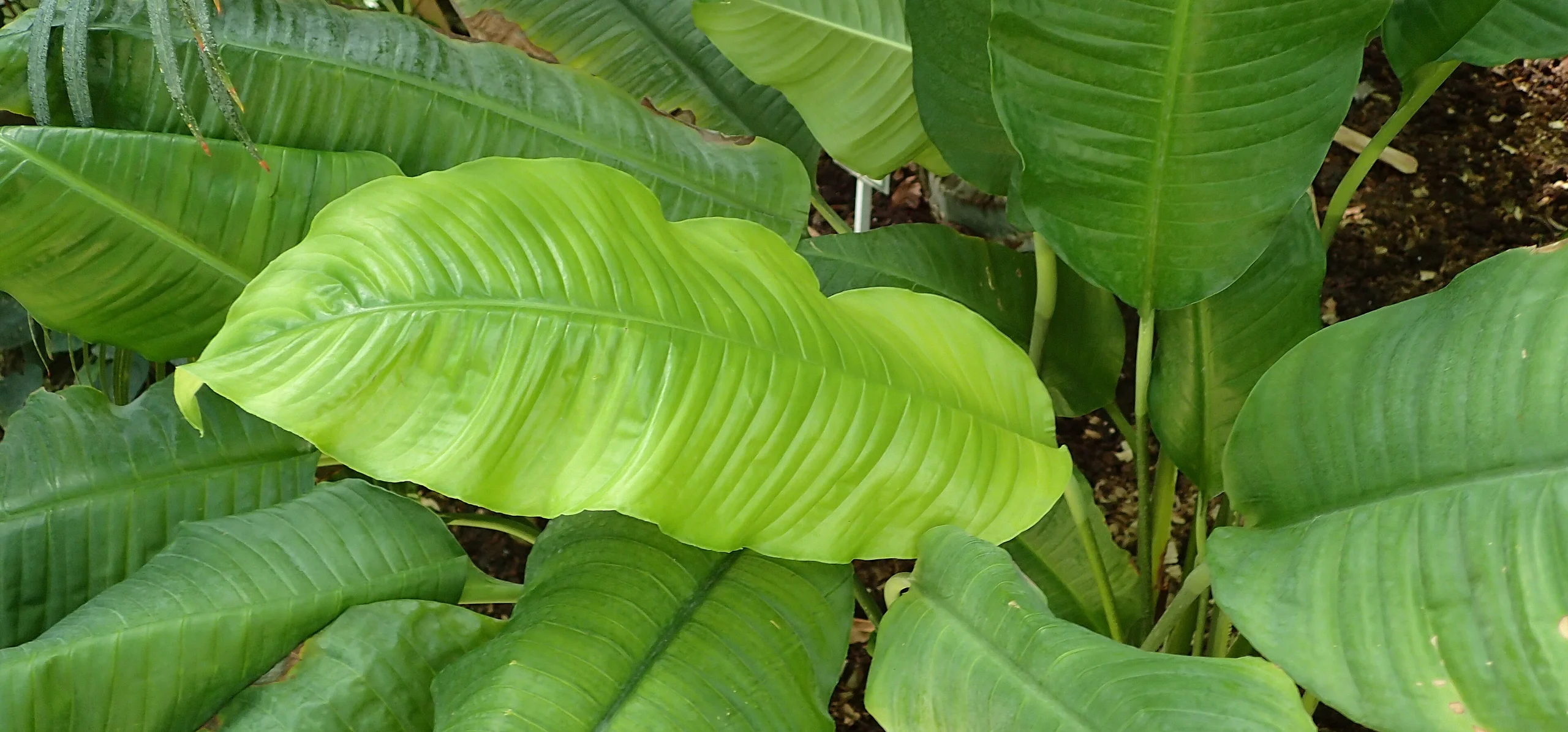
A peace lily that flops flat over the rim of its pot by evening is not dying, it is telling you the soil went dry days ago and the plant would rather collapse than keep pumping water it does not have. Give it a thorough soak and the same leaves that looked ready for the compost heap are usually standing again within a few hours, which is the plant's signature trick and the reason it survives owners who forget to water for a week at a time. Almost every peace lily sold at a garden centre is a compact hybrid bred for pot culture, typically a Spathiphyllum wallisii cross such as 'Mauna Loa' or 'Sensation', not the plant covered here: Spathiphyllum cochlearispathum, GBIF's accepted name for a larger-leaved species native to Mexico that eventually fills a corner rather than a windowsill. The care below applies to both, with mature size the main giveaway that you have the bigger species.
The wilt-and-recover routine
Wilting on a schedule, always a few days after the last watering, always reversible with a thorough soak, is close to a built-in moisture gauge, and it is far less risky than it looks: a plant that droops from thirst and gets watered promptly rarely loses more than a lower leaf or two. The one to worry about is a plant that wilts with wet soil, since that points to root rot rather than drought and a soak will not fix it. Letting the plant flop all the way down repeatedly before rescuing it does shorten leaf life over time, even though each individual episode looks dramatic and recovers cleanly.
Low to medium light, and why the flowers stop
Missouri Botanical Garden notes that Spathiphyllum tolerates reduced light but performs best in bright, filtered light with direct sun avoided, and that distinction matters most for flowering: the plant will hang on for years in a dim hallway or a north-facing corner, producing leaves and nothing else, because it does not have the light budget to also build a flower spike. Move the same plant somewhere it gets bright indirect light for most of the day, an east-facing room or a few steps back from an unshaded south or west window, and spathes typically start appearing within a season. Direct midday sun is the other failure mode, bleaching leaves pale and scorching the edges, so the target is bright shade rather than a sunny sill.


Watering, tap water, and brown tips
Keep the potting mix evenly moist rather than alternating between soggy and bone dry: Missouri Botanical Garden's guidance is to let the surface dry slightly between waterings without letting the plant wilt, and to use room-temperature water that has had time to lose dissolved chlorine. Chlorine, and more persistently fluoride, are the usual explanation when older leaf tips turn brown and crisp while the rest of the leaf stays green: both concentrate at the tip, the last stop for water moving through the leaf, and fluoride does not evaporate out of standing tap water the way chlorine partly does. Rainwater, distilled water, or tap water left uncovered overnight all reduce the chlorine load; only filtration strong enough to remove fluoride, such as reverse osmosis, addresses that part, which is why tip browning shows up even on plants watered conscientiously.
White spathes that turn green
The white, leaf-like spathe everyone calls the flower is a bract wrapped around the true flowers on the central spadix, and its colour change is part of the normal bloom cycle rather than a sign of decline: Missouri Botanical Garden describes the bloom as starting and ending green, turning white at its peak, and fading back to green as it ages. A spathe that greens within a couple of weeks of opening is running its ordinary course, not failing, and cutting it off at the base once it has gone fully green and papery tidies the plant at no cost, since that same spathe will not turn white again.
Repotting and dividing a crowded clump
Spathiphyllum is happiest kept somewhat potbound, and Missouri Botanical Garden recommends repotting in late winter, February or March, only once roots are visibly circling the pot or pushing above the surface, sizing up one pot diameter rather than jumping several sizes at once. A clump that has filled its container can be lifted and the rootball teased apart by hand, or cut with a clean blade into sections that each keep several leaves and a healthy share of roots; each division goes straight into fresh, rich, well-drained mix and usually resumes growth within a few weeks, kept out of direct sun while it settles.
Dust, and what "air purifying" really means
The wide, glossy leaves collect household dust fast enough to visibly dull within a month indoors, and a dusty leaf photosynthesises less efficiently and holds onto spider mites more easily, so wiping both surfaces with a damp cloth every few weeks, or standing the whole pot under a lukewarm shower, is worth doing rather than skipping. Peace lily was one of the plants NASA tested in its 1989 Clean Air Study, sealed inside a small chamber with a single injected pollutant and measured after 24 hours, work aimed at finding air-cleaning options for space stations, not at modelling a living room. Gas-exchange numbers from a sealed box scale badly to an open room with doors, drafts, and normal ventilation; independent reviews since have estimated that matching a houseplant's measured removal rate to what ordinary air exchange already does in a house would take dozens of plants per square metre of floor, not the one or two on a shelf. A peace lily is still a pleasant, easy plant, just not a substitute for opening a window.
Toxic to cats and dogs
The ASPCA lists peace lily as toxic to cats, dogs, and horses: the leaves and stems carry insoluble calcium oxalate raphides, needle-shaped crystals that release into the mouth the moment a pet bites into the tissue, causing immediate oral pain, drooling, and swelling, often followed by vomiting. It is rarely life-threatening on its own since the sharp taste and mouth irritation tend to stop most animals from eating much of it, but a cat that takes only one exploratory bite can still paw at its mouth and drool for an hour, and any pet showing those signs after chewing a leaf is worth a call to a vet or an animal poison control line.
Fungus gnats and other problems
Soil kept wet from top to bottom, rather than allowed to dry slightly between waterings, is the single biggest driver of fungus gnats: the small dark flies lay eggs in damp organic matter, and the larvae feed on fine roots and fungi in the top inch of soil, showing up as gnats hovering around the pot rather than real damage at low numbers. Letting that top inch dry between waterings, and watering only when the surface feels dry, breaks the cycle within a couple of weeks without any spray. Mealybugs and scale are the other pests Missouri Botanical Garden flags as occasional problems, usually tucked into the base of the leaf stalks, and are controlled the same way as on most houseplants: wiped off with a cotton swab dipped in rubbing alcohol, repeated over a week or two.
Test your plant knowledge
Tap a card to flip it and reveal the answer.
Peace lily leaves droop dramatically when the soil dries out, then usually recover within hours of a thorough watering. Tap to reveal ✓ True
The white part of a peace lily bloom is a petal that stays white for the life of the flower. Tap to reveal ✕ False
A peace lily kept in a dim, windowless corner will still flower reliably. Tap to reveal ✕ False
The ASPCA lists peace lily as toxic to cats and dogs because of calcium oxalate crystals in the leaves. Tap to reveal ✓ True
Most peace lilies sold in stores are this exact species, Spathiphyllum cochlearispathum. Tap to reveal ✕ False
Sources
References consulted for this guide
- Spathiphyllum cochlearispathum (Liebm.) Engl., GBIF Backbone Taxonomygbif.org
- Spathiphyllum cochlearispathum (Liebm.) Engl. | Plants of the World Online, Kew Sciencepowo.science.kew.org
- Spathiphyllum (group), Plant Finder, Missouri Botanical Gardenmissouribotanicalgarden.org
- Peace Lily, Toxic and Non-Toxic Plants, ASPCA Animal Poison Controlaspca.org
- Reference entity : Wikipédiaen.wikipedia.org