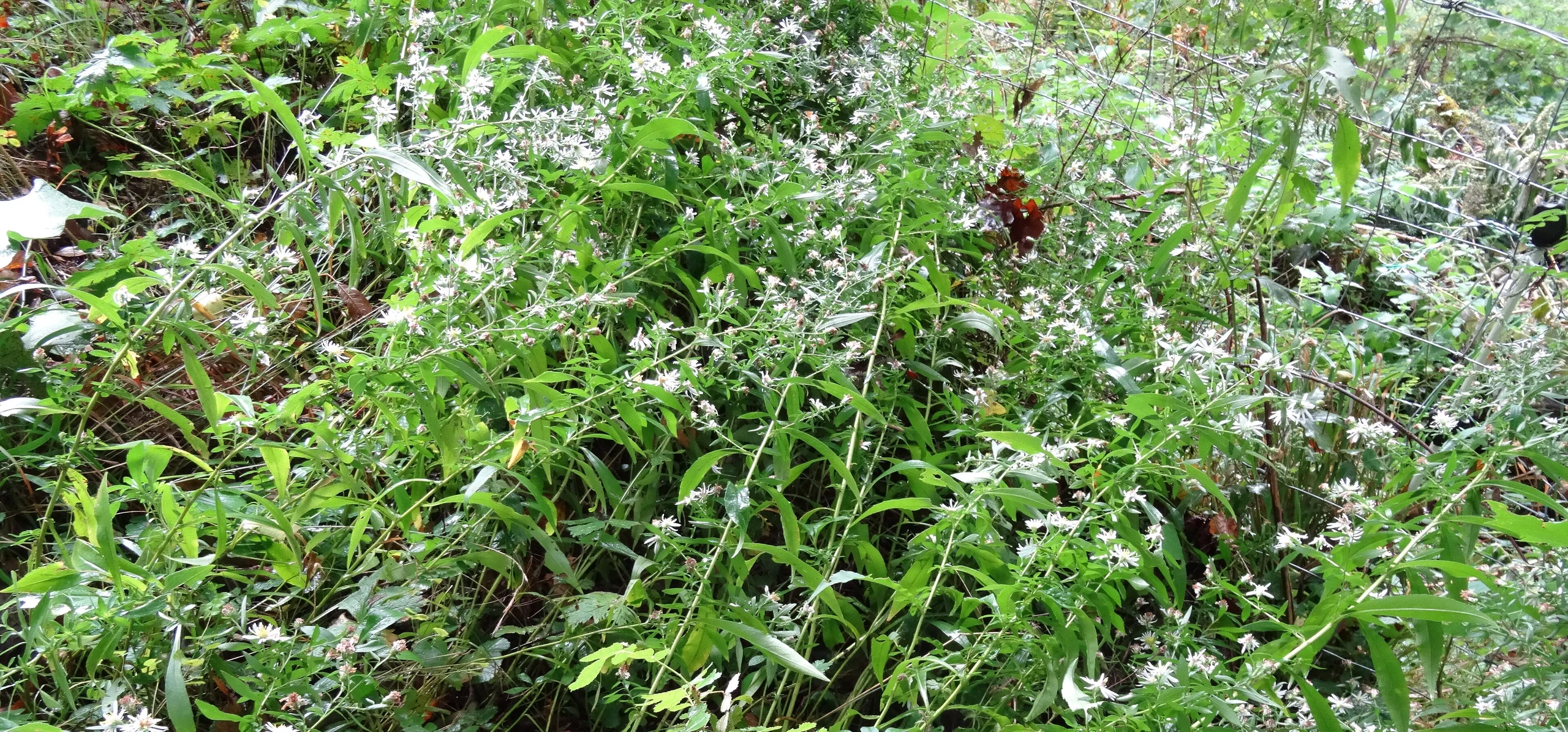
New York Aster
Symphyotrichum novi-belgii
Family · Asteraceae
New York aster wants full sun to part shade and evenly moist soil. Covers the Chelsea chop, why it gets powdery mildew, and dividing every three to five years.
Symphyotrichum novi-belgii
Plant profile
- WateringModerateWater every 5 days
- Light exposurePartial sun
Growth
- Family
- Asteraceae
- Life cycle
- Perennial
- Growth speed
- 7/10
- Mature size
- 100–150 cm
- Spread
- 50–100 cm
- Flowering
- Late summer into autumn
- Propagation
- Division
Dormancycut back to ground level after flowering, re-shoots from the rootstock in spring
Time to maturity2-5 years
Soil & climate
- Soil types
- chalk, clay, loam, sand
- Drought tolerance
- No
Light & Placement
- Origin
- Eastern Canada to the northeastern United States; widely naturalised across Europe
- Where to place it
- sunny to partly shaded border
- cottage garden
- cutting garden
- naturalistic or wildlife planting
- large container with fertile, moisture-retentive compost
Safety
- Toxicity
- CatsSafe
- DogsSafe
- HorsesSafe
Invasive speciesspreads by rhizome and naturalises readily; widely established on roadsides, railway banks and waste ground in central and northwest Europe
Data fromSymphyotrichum novi-belgii, GBIF BackbonPOWO: Symphyotrichum novi-belgii (L.) G.RHS: Symphyotrichum novi-belgii (MichaelRHS: How to grow Asters, growing guideASPCA: Aster (Symphyotrichum spp.) toxic
Where it grows
World distribution
New York Aster is native to 2 countries: Canada and United States.GBIF records 33,321 documented identifications across 75 countries, with the largest concentrations in United Kingdom, Canada, and United States.
- Canada
- United States
Yellow to orange dots: concentration of documented identifications per country. Green countries: sourced native range. Source: GBIFNative range from POWO (Kew).
New York aster, Symphyotrichum novi-belgii, is the plant most people mean when they say Michaelmas daisy: a rhizomatous perennial that sends up wiry stems 1 to 1.5 metres tall and closes out the border season with a mass of small, daisy-like flowers in purple, lavender-purple or white around a yellow centre, from late summer into autumn. If your plant came from a nursery in a named cultivar's pot, it was almost certainly bred for a shorter habit and better resistance to the mildew this species is famous for. If it turned up on its own along a hedge, verge or railway bank, you are looking at one of the many garden escapes that have naturalised across central and northwest Europe, often crossed with related garden asters. Either way it behaves the same in the ground: it spreads steadily by rhizome, wants soil that stays reliably moist through summer, and needs more attention to airflow than most autumn perennials.
Origin, Classification and What You're Growing
The GBIF backbone accepts Symphyotrichum novi-belgii (L.) G.L.Nesom as the current name for this species, in the daisy family Asteraceae, order Asterales. Plants of the World Online gives its native range as eastern Canada to the northeastern United States. Older books and plant tags may still list it as Aster novi-belgii, a name now treated as a synonym after the North American asters were split out into the genus Symphyotrichum. The common name Michaelmas daisy refers to the feast of St Michael on 29 September, which falls in the middle of this species' flowering window; New York aster and Confused Michaelmas Daisy are the other vernacular names GBIF records for it. Foliage is narrow and lance-shaped, mid-green and sometimes flushed purple, and stays green late into the season before the whole plant is cut back for winter.
Sun, Soil and Site
This aster flowers best in full sun but still performs in partial shade, just with fewer blooms. The RHS lists it as tolerant of chalk, clay, loam and sand in acid, neutral or alkaline soil, so the ground itself is rarely the limiting factor. What matters more is moisture: it wants soil that holds water through spring and summer without turning waterlogged, and the RHS is explicit that it will not tolerate standing water over winter, a heavy, poorly drained bed that suits it in July can rot the crown by January. Space plants generously. A crowded clump traps still, humid air around the foliage, and that still air is the single biggest driver of the mildew problem covered below.
Watering Through the Season
Keep the soil slightly moist but never soggy through the growing season, and check it more often once flower buds start forming in late summer, this is not a plant that shrugs off a dry August the way many border perennials do. A pot-grown plant dries out fast in summer heat and may need water daily; a border plant in reasonable soil needs it whenever the surface dries out, in most temperate summers every few days rather than daily. Ease off once the flowers fade and autumn rain sets in, the risk shifts from drought to the waterlogging that damages the crown over winter.


The Chelsea Chop
Symphyotrichum novi-belgii is one of the asters the RHS specifically recommends for the Chelsea chop, cutting the stems back hard in late May, timed to the RHS Chelsea Flower Show that gives the technique its name. The cut reduces the eventual height of the plant and can remove the need for staking altogether, though the RHS notes results vary between cultivars and from one season to the next depending on the weather. Chop the whole clump for a uniformly shorter, later display, or cut only the front stems for a two-tier effect, with the untouched rear stems flowering first and taller.
Powdery Mildew
Powdery mildew is the defining weakness of this species: a grey-white coating that spreads across the leaves, usually triggered by a dry spell followed by humid, still weather, and it is common enough that the RHS names Symphyotrichum novi-belgii cultivars specifically when discussing the disease. The most direct fix is choosing one of the many modern cultivars bred for good resistance rather than an old, unnamed, chronically mildewed clump. Where you are keeping an older plant, non-chemical management does most of the work: divide congested clumps to open up airflow, space new plants well apart, water at the base rather than overhead, and keep the soil from drying out, since moisture-retentive soil measurably lowers the risk.
Cutting Back and Dividing
Once flowering finishes and the foliage browns off, cut the stems close to the ground, or leave the seedheads standing into early winter for structure and food for birds, just clear them before new growth starts pushing through in spring. Lift and divide established clumps every three to five years in early spring, discarding the tired, often hollow centre and replanting vigorous young sections from the outer edge. Division is not optional upkeep here, it is what keeps the plant flowering well instead of thinning out in the middle, and it is the only reliable way to keep a named cultivar true, since seedlings from a naturalised or hybrid population rarely match the parent.
Pests, Other Diseases and Toxicity to Pets
Beyond powdery mildew, the RHS lists aphids, leaf and bud eelworms, slugs, snails and tarsonemid mite as the pests most likely to trouble it, and fusarium wilt, grey mould and leaf spot as occasional diseases in poorly drained or overcrowded conditions. On the safety side, the ASPCA lists Symphyotrichum, the genus this species belongs to, as non-toxic to cats, dogs and horses, so a bed of Michaelmas daisies is a reasonably low-risk choice around pets. A cat or dog that chews a leaf in passing may still get mild, transient stomach upset from the plant material itself, as with almost any greenery, but there is no specific toxic principle on record.
Test your plant knowledge
Tap a card to flip it and reveal the answer.
New York aster flowers in spring, earlier than most border perennials. Tap to reveal ✕ False
It flowers best in full sun but still blooms, just less freely, in partial shade. Tap to reveal ✓ True
This species is naturally resistant to powdery mildew and rarely needs attention. Tap to reveal ✕ False
The Chelsea chop can shorten this aster and cut down on the need for staking. Tap to reveal ✓ True
New York aster is toxic to cats and dogs. Tap to reveal ✕ False
Sources
References consulted for this guide
- Symphyotrichum novi-belgii, GBIF Backbone Taxonomygbif.org
- POWO: Symphyotrichum novi-belgii (L.) G.L.Nesompowo.science.kew.org
- RHS: Symphyotrichum novi-belgii (Michaelmas daisy)rhs.org.uk
- RHS: How to grow Asters, growing guiderhs.org.uk
- ASPCA: Aster (Symphyotrichum spp.) toxicity to petsaspca.org
- Reference entity : Wikipédiaen.wikipedia.org