Feverfew
Tanacetum parthenium
Family · Asteraceae
Feverfew self-seeds so readily it turns weedy in mild gardens: sow the fine seed on the surface, keep it in lean well-drained soil and cut back after flowering.
Tanacetum parthenium
Plant profile
- WateringLittleWater every 9 days
- Light exposurePartial sun
- Hardiness zoneUSDA 5–8
Growth
- Family
- Asteraceae
- Life cycle
- Perennial
- Growth speed
- 7/10
- Mature size
- 30–91 cm
- Spread
- 30–61 cm
- Flowering
- June to September, cut back hard after flowering
- Propagation
- Seed
- Division
- Cutting
DormancyHerbaceous top growth dies back in cold winters; often short-lived and renews itself through self-sown seedlings.
Soil & climate
- Soil types
- sand, loam, well-drained
- Drought tolerance
- Yes
Light & Placement
- Origin
- Southeastern Europe to the western Himalayas, naturalized widely
- Where to place it
- cottage garden bed
- gravel garden
- herb garden
- border edge
- container with good drainage
Safety
- Toxicity
- HumansToxic
Invasive speciesNot documented as invasive; NC State Extension tags it as self-seeding and potentially weedy under favorable garden conditions.
Data fromGBIF: Tanacetum parthenium (L.) Sch.Bip.Plants of the World Online (Kew): TanaceRHS: Tanacetum parthenium (feverfew)NC State Extension: Tanacetum partheniumUniversity of Rochester Medical Center H
Where it grows
World distribution
Feverfew is native to 12 countries: Afghanistan, Albania, Bulgaria, Croatia, Georgia, Greece, India, and Iran….GBIF records 170,075 documented identifications across 108 countries, with the largest concentrations in United Kingdom, France, and Germany.
- Afghanistan
- Albania
- Bulgaria
- Croatia
- Georgia
- Greece
- India
- Iran
- Iraq
- Pakistan
- Türkiye
- Ukraine
Yellow to orange dots: concentration of documented identifications per country. Green countries: sourced native range. Source: GBIFNative range from POWO (Kew).
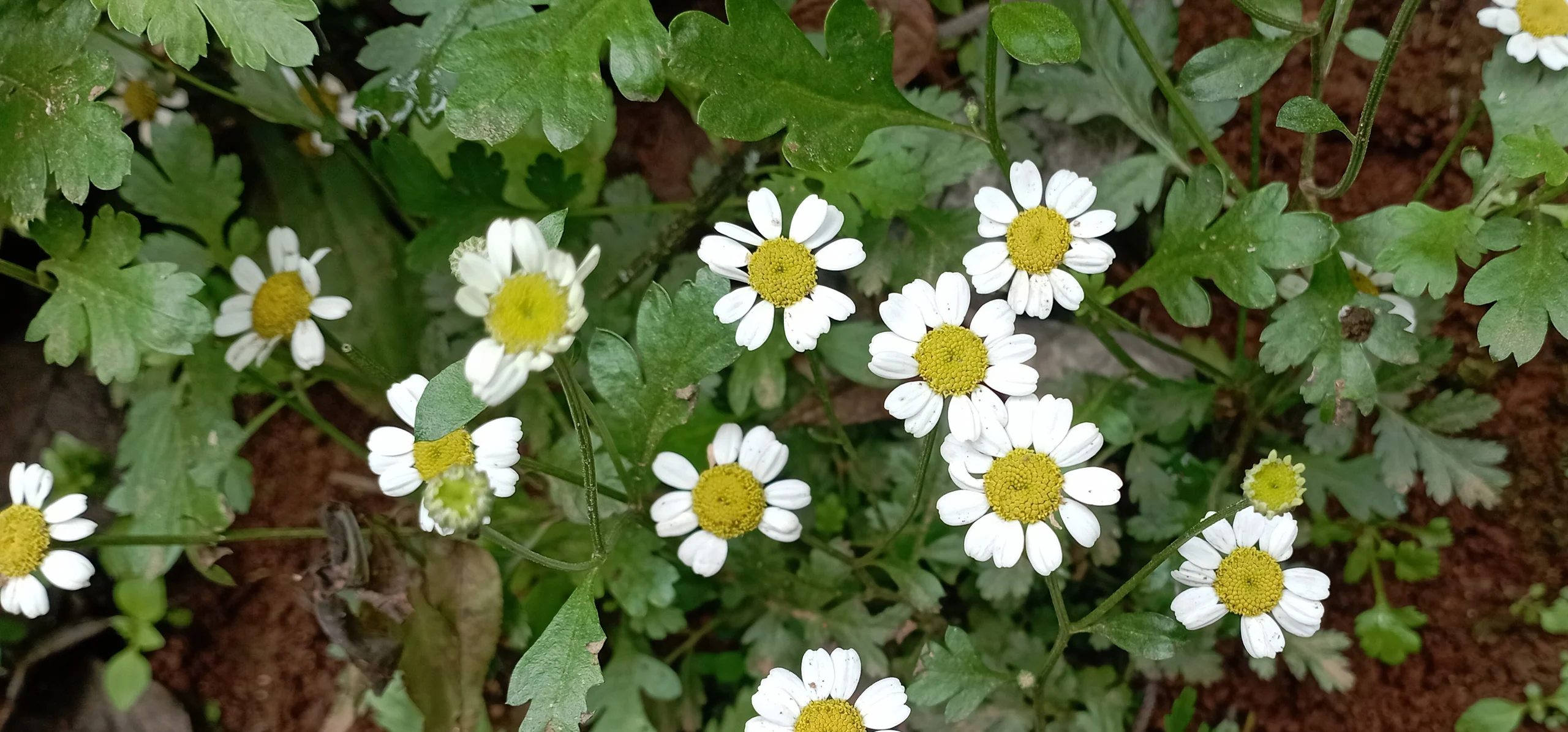
Feverfew (Tanacetum parthenium) is a short-lived perennial in the daisy family, grown for the cloud of small white, yellow-centered flowers it throws from early summer into fall and for foliage with a sharp, resinous scent when brushed or crushed. It is not the plant behind chamomile tea: the two are unrelated in use even though both carry small white daisies and belong to the Asteraceae family. Left to set seed, feverfew self-sows so freely that a single flowering season can fill nearby gravel, paving cracks and empty beds with volunteers the following spring, which is why some gardeners plant it deliberately and others spend years pulling it out. It asks for little in return: full sun, soil on the lean side, and a hard cut back once the flowers fade.
Origin and Cottage Garden History
Plants of the World Online lists the native range of Tanacetum parthenium as southeastern Europe to the western Himalayas, though it has naturalized as a roadside and garden escape well beyond that range across Europe and North America. GBIF records the accepted name as Tanacetum parthenium (L.) Sch.Bip., with a long list of synonyms built on the older genera Chrysanthemum, Matricaria, Pyrethrum and Chamaemelum. That name history has practical consequences: seed catalogues, herbals and older garden books call it Chrysanthemum parthenium or pyrethrum, and all of them describe the same plant. North Carolina State Extension notes it has been used as a folk remedy since at least the first century, long before it settled into its modern role as a cottage garden filler grown as much for its flowers and foliage as for any older medicinal use.
Feverfew or Chamomile
Feverfew and German chamomile (Matricaria chamomilla) get confused constantly, since both are Asteraceae with small white, yellow-centered flowers and finely cut leaves, but the plants are easy to separate once you know what to check. Feverfew is a perennial that returns from the same crown for a few years; German chamomile is an annual that finishes in one season. Feverfew's foliage is coarser, more deeply lobed and yellow-green rather than thread-fine, and it carries a sharp, almost bitter scent when crushed instead of chamomile's sweet apple smell, which is the quickest field test between the two. Feverfew leaves are also not brewed as tea the way chamomile flowers are; its traditional use has always centered on the fresh leaf, chewed or eaten, not steeped.


Sowing Feverfew From Seed
Feverfew seed is fine and dust-like, and like many small Asteraceae seeds it germinates best sown on the surface of the compost or barely covered rather than buried, since light helps trigger germination. Start it indoors six to eight weeks before the last frost: press the seed into a moist seed tray without covering it, and keep it somewhere bright and warm; seedlings usually show within one to three weeks. Once true leaves form and the weather has settled, harden the plants off and move them out, or direct-sow outdoors in spring once the soil has warmed, scattering seed thinly over bare, raked ground and firming it in without burying it. Established plants self-sow the same way without any help, which is worth remembering before deciding how many seed packets to buy.
Site, Soil and Light
Full sun suits feverfew best; RHS growing notes call for a sunny spot in any well-drained soil and specifically warn that the plant will not tolerate heavy, wet ground. It is one of the herbs that does better in poor, lean soil than in a rich, well-fed bed: heavy feeding pushes soft growth that flops over and flowers less freely than a plant left to cope on thinner ground. Good drainage matters more than fertility here, and a gritty or sandy amendment worked into heavy clay does more good than compost. North Carolina State Extension lists it as tolerant of acid, neutral and alkaline soils alike, so pH is rarely the limiting factor. Once established, plants shrug off dry spells; regular water matters most in the first season while roots are still spreading.
Choosing a Variety
The wild type carries single white flowers with yellow centers, but two garden forms turn up regularly at nurseries. 'Aureum', sold as golden feather or golden feverfew, has chartreuse to golden foliage that holds its color best in full sun and is often grown as much for that foliage as for its flowers, staying low and mounding. 'Flore Pleno' carries fully double, white pompom flowers instead of the plain daisy form, and RHS growing notes state it does not self-seed as aggressively as the single-flowered species, which makes it the better pick for a gardener who wants the flowers without volunteers turning up everywhere the next year.
Cutting Back and Deadheading
Cut plants back hard once the main flush of flowers fades, which is standard RHS practice for feverfew and one of the few maintenance jobs the plant actually needs. A hard cut back after flowering encourages fresh basal growth, keeps the clump compact instead of woody and sprawling, and in a mild climate can prompt a second, lighter flush of flowers later in the season. Deadheading spent flowers through the season serves a second purpose beyond tidiness: it is the main tool for controlling how much a planting self-seeds, since every flower head left to mature and shatter adds to next year's volunteers.
Self-Seeding: Charming Reseeder or Weed
Left unchecked, feverfew self-seeds prolifically, and North Carolina State Extension tags it explicitly as self-seeding and potentially weedy, noting it can become aggressive under favorable conditions. In a gravel path, a cracked patio or a loose bed, seedlings turn up by the dozen the spring after a plant is allowed to set seed, and an established patch can spread well beyond where it was originally planted within a couple of seasons. That is exactly the trait some gardeners want from a cottage garden filler that asks for no replanting, and exactly the trait that gets it pulled as a weed in a tidier border. Deadheading before seed heads dry and shatter is the only reliable way to keep a planting where it was put.
Traditional Use and Handling Safely
Feverfew's common name and its long folk history both point to the same traditional use: fresh leaves eaten or chewed as a preventive remedy for migraine headaches, a use the University of Rochester Medical Center's health encyclopedia traces back centuries and links to the plant's effect on serotonin and prostaglandins, substances involved in the blood vessel changes behind migraine attacks. The same source notes that chewing the fresh leaf directly is also the most common way feverfew causes problems: mouth ulcers and irritation inside the mouth are a well documented side effect in people who chew the raw leaf, and anyone considering it for migraines should talk to a doctor first rather than self-treat, particularly if they take blood thinners or are pregnant. Handling the growing plant carries a separate, milder risk: RHS growing notes flag that contact with the foliage can irritate skin and recommend gloves when pruning or deadheading, consistent with North Carolina State Extension's identification of parthenin as the toxic principle behind that contact dermatitis. Feverfew does not appear by name in the ASPCA's toxic and non-toxic plant database, which lists Roman chamomile under several common names but has no separate entry for Tanacetum parthenium.
Test your plant knowledge
Tap a card to flip it and reveal the answer.
Feverfew seed should be sown on the surface of the soil rather than buried deep. Tap to reveal ✓ True
Feverfew is a low, mat-forming plant that hugs the ground like Roman chamomile. Tap to reveal ✕ False
Handling feverfew foliage can irritate the skin, so gloves are recommended when pruning or deadheading. Tap to reveal ✓ True
Feverfew is listed by name in the ASPCA's toxic and non-toxic plant database. Tap to reveal ✕ False
The double-flowered 'Flore Pleno' cultivar self-seeds less aggressively than the single-flowered species. Tap to reveal ✓ True
Sources
References consulted for this guide
- GBIF: Tanacetum parthenium (L.) Sch.Bip.gbif.org
- Plants of the World Online (Kew): Tanacetum parthenium (L.) Sch.Bip.powo.science.kew.org
- RHS: Tanacetum parthenium (feverfew)rhs.org.uk
- NC State Extension: Tanacetum partheniumplants.ces.ncsu.edu
- University of Rochester Medical Center Health Encyclopedia: Feverfewurmc.rochester.edu
- Reference entity : Wikipédiaen.wikipedia.org