Fringed Willowherb
Epilobium ciliatum
Family · Onagraceae
Epilobium ciliatum has notched pink-white petals and spreads fast by seed and rooting stolons. Identify it, grow it on purpose, or pull it out for good.
Epilobium ciliatum
Plant profile
- WateringHighWater every 4 days
- Light exposurePartial sun
- Hardiness zoneUSDA 5–11
Growth
- Family
- Onagraceae
- Life cycle
- Perennial
- Growth speed
- 8/10
- Mature size
- 100–180 cm
- Spread
- 10–60 cm
- Flowering
- June to October, varies by subspecies (NC State Extension)
- Propagation
- Seed
- Division
- Layering
Time to maturityCan complete germination to seed production in about ten weeks under favorable conditions (RHS)
Soil & climate
- Soil types
- loam, clay, sand, chalk
- Drought tolerance
- No
Light & Placement
- Origin
- Russian Far East, North America to Guatemala and southern South America (POWO)
- Where to place it
- rain garden edges
- boggy borders and ditches
- wet meadow plantings
- woodland-edge margins
Safety
- Pet safe
- No
ToxicityNot listed by the ASPCA for cats, dogs or horses; related willowherbs like fireweed are listed non-toxic
Invasive speciesNC State Extension flags it as invasive outside its native range and increasingly weedy in nurseries; RHS also notes it can spread rapidly and become a garden thug if left unchecked
Data fromGBIF: Epilobium ciliatum Raf.Plants of the World Online (Kew): EpilobRHS: Epilobium ciliatum (American willowNC State Extension Gardener Plant Toolbo
Where it grows
World distribution
Fringed Willowherb is native to 9 countries: Argentina, Canada, Chile, Falkland Islands, Greenland, Guatemala, Mexico, and Russia….GBIF records 298,664 documented identifications across 67 countries, with the largest concentrations in United Kingdom, Sweden, and United States.
- Argentina
- Canada
- Chile
- Falkland Islands
- Greenland
- Guatemala
- Mexico
- Russia
- United States
Yellow to orange dots: concentration of documented identifications per country. Green countries: sourced native range. Source: GBIFNative range from POWO (Kew).
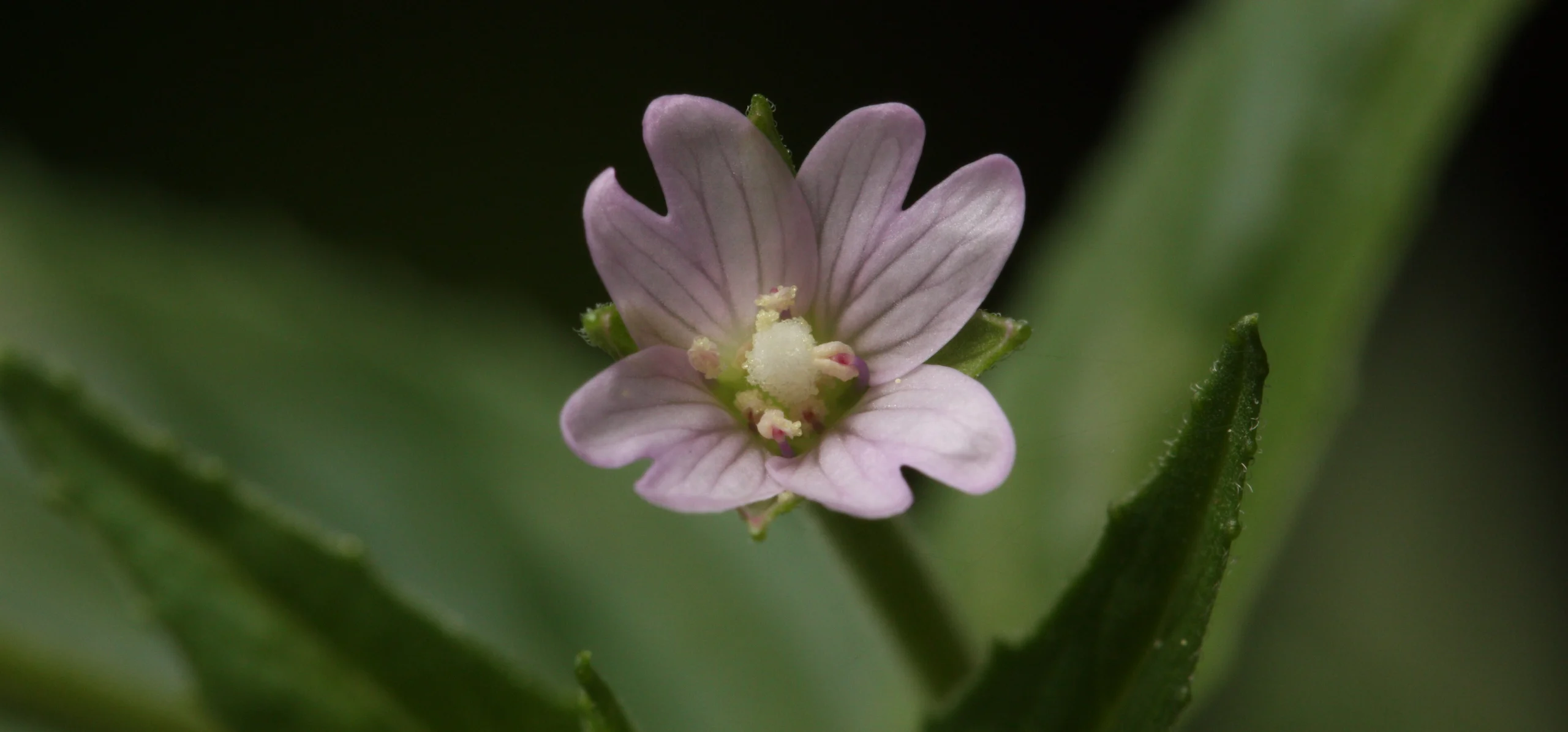
A plant with small pink and white flowers popping up uninvited in a damp flower bed, a shaded lawn edge or a nursery pot is very often Epilobium ciliatum, fringed willowherb. GBIF records the accepted name as Epilobium ciliatum Raf. in the evening primrose family, Onagraceae, and the fastest field check is the flower itself: four petals, each deeply notched at the tip, sitting atop a slender, four chambered seed capsule. It behaves less like a border perennial and more like a colonizer, since NC State Extension flags it as increasingly weedy in nurseries and disturbed wet ground, so the real question for most people who find it is not how to keep it alive but whether to keep it at all.
Identifying Fringed Willowherb: Notched Petals, Reddish Stems
The stems are green to reddish green and slightly squared in cross section, hairless near the base but covered in short, straight or curved hairs higher up, a texture worth checking with a fingertip when the flower alone leaves you unsure. Leaves run 1 to 3 in (2.5 to 7.5 cm) long and less than 1 in wide, lance to egg shaped with fine teeth along the margin, mostly opposite lower on the stem and often crowded into a basal rosette. The flowers are the real giveaway: four petals, pale pink to white and sometimes rosy purple with darker veining, each one notched deeply enough to look almost like two separate lobes, measuring about 0.25 to 0.33 in (6 to 8 mm) across, according to NC State Extension. After flowering, a long, straight, ridged seed capsule forms, 1.5 to 3 in (4 to 7.5 cm), that splits open at maturity to release tiny brown seeds tipped with a tuft of white hair, the same cottony parachute that lets willowherbs and their fireweed relatives drift on the wind.
Where It Comes From and Where It Turns Up Now
Plants of the World Online lists the native range as the Russian Far East, North America south to Guatemala, and southern South America, a genuinely wide native distribution for a plant this size. The name Epilobium adenocaulon, still printed on older nursery tags and field guides, is an outdated synonym for the same species. Outside that native range it has become a well established introduction: RHS records it as introduced to the UK and now widely naturalized there, turning up in gardens, waste ground and nursery containers far from where it started. In North America it favors wetlands, marshes, wet meadows and forest edges, but NC State Extension also lists it in agricultural land and container nurseries, tolerating occasional flooding as easily as a dry spell between waterings.
Growing It on Purpose: Light, Soil and Water
If you want fringed willowherb in a border rather than pulling it out of one, give it what RHS and NC State Extension both describe: a spot in full sun to partial shade, in loam, clay, sandy or even chalky soil, kept consistently moist. NC State Extension notes a preference for acidic soil under pH 6, though RHS lists UK grown plants tolerating acid, neutral and alkaline ground equally well, so local soil chemistry probably matters less than steady moisture does. It shrugs off occasional flooding, which makes it a candidate for a rain garden edge or a boggy corner where other perennials sulk, and RHS rates it hardy to H4 in the UK, roughly minus 10 to minus 5 degrees C. NC State Extension puts the wider hardiness range for its subspecies between USDA zones 5b and 11b depending on which one you have, so check a subspecies specific source before assuming a single number covers your climate.


Flowering and the Ten Week Life Cycle
Bloom time runs from around June into October across most of its North American range, per NC State Extension, though the exact window shifts by subspecies and region. What makes the species behave like a weed rather than a well mannered perennial is speed: RHS notes that under favorable conditions, the entire cycle from germination to seed production can finish in about ten weeks. In a long growing season that is enough time for more than one generation to set seed, which is why a single overlooked plant in midsummer can seed a whole bed by the time you notice it again a couple of months later.
Spread and Control: Pulling Before the Capsules Split
Two separate spread mechanisms work against anyone trying to remove it. The obvious one is seed: each capsule releases wind borne seed with a cottony tuft that carries it well beyond the parent plant, and NC State Extension notes it germinates readily wherever it lands on bare, disturbed, moist soil. The less obvious one is vegetative: extension weed profiles describe axillary buds at the base of the stem sending out short stolons that root at the tip and then swell into underground rhizomes, so a plant that looks like a single clump can already be anchored by more than one rooting point. Hand pulling works, but only if the whole root system comes out, since left behind rhizome fragments can resprout into new plants. Pull before the capsules split open and carry the whole plant away from the bed rather than leaving it lying on damp ground, because seed can go on maturing on a cut stem even after pulling. Herbicide control is unreliable, since few products give consistent results against established plants.
Not to Be Confused With: Great Willowherb and True Fireweed
Fringed willowherb shares its genus and its damp, disturbed habitat with several relatives that get mixed up with it constantly. Epilobium hirsutum, great willowherb, is the one most often confused with it according to NC State Extension's own plant profile: it grows to about 6 ft, roughly twice the height, and is covered in dense, soft, woolly hair on both stems and leaves, with flowers up to 1 in across, distinctly larger than fringed willowherb's 0.25 to 0.33 in blooms. True fireweed, once classified in this same genus as Epilobium angustifolium and now placed in the separate genus Chamerion, is a different plant again: taller and more upright, best known as the first flush of pink to colonize burned ground, a habit fringed willowherb does not share in the same dramatic way. If the plant in front of you is under 2 ft, has reddish, only lightly hairy stems and small notched flowers, it is far more likely to be Epilobium ciliatum than either of its showier cousins.
Pets and What the ASPCA Actually Says
Searching the ASPCA's toxic and non toxic plant databases for Epilobium ciliatum by name returns nothing, so this guide records its status as not listed rather than a confirmed safe or dangerous verdict either way. The ASPCA does carry entries for several close relatives under common names like fireweed, blooming Sally, great willow herb and willow herb, all traced back to Epilobium angustifolium and all marked non toxic to dogs, cats and horses, a reasonable hint that this genus is not a high risk one. That is not the same as a confirmed clearance for this exact species, though, so treat curious pets and grazing livestock with ordinary caution rather than either alarm or full confidence.
Test your plant knowledge
Tap a card to flip it and reveal the answer.
Epilobium ciliatum's flowers have four petals, each with a distinct notch at the tip. Tap to reveal ✓ True
This species is native only to North America and has never naturalized elsewhere. Tap to reveal ✕ False
Pulling the visible top growth removes the whole plant, since it has no underground storage structures. Tap to reveal ✕ False
The ASPCA has a species-specific listing confirming Epilobium ciliatum is non-toxic to pets. Tap to reveal ✕ False
Under favorable conditions, this plant can go from germination to seed production in about ten weeks. Tap to reveal ✓ True
Sources
References consulted for this guide
- GBIF: Epilobium ciliatum Raf.gbif.org
- Plants of the World Online (Kew): Epilobium ciliatum Raf.powo.science.kew.org
- RHS: Epilobium ciliatum (American willowherb)rhs.org.uk
- NC State Extension Gardener Plant Toolbox: Epilobium ciliatumplants.ces.ncsu.edu
- NC State Extension Gardener Plant Toolbox: Epilobium hirsutumplants.ces.ncsu.edu
- Reference entity : Wikipédiaen.wikipedia.org