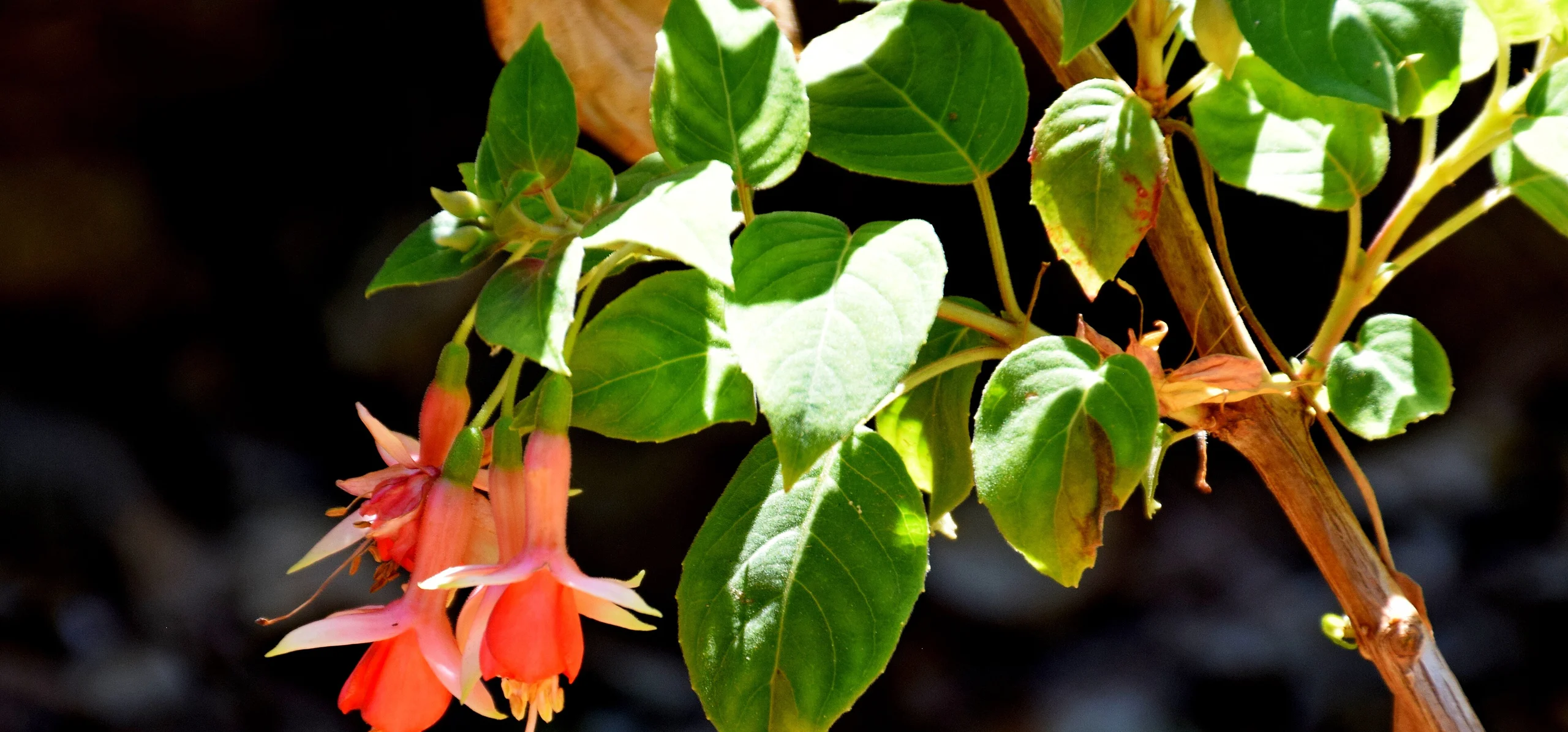
Hardy Fuchsia
Fuchsia magellanica
Family · Onagraceae
Hardy fuchsia dies to the ground most winters and regrows from a mulched crown. When to cut it back, why not to prune in autumn, and its hedging use in Ireland.
Fuchsia magellanica
Plant profile
- WateringHighWater every 5 days
- Light exposureIndirect light
- Hardiness zoneUSDA 5–10
Growth
- Family
- Onagraceae
- Life cycle
- Perennial
- Growth speed
- 6/10
- Mature size
- 150–250 cm
- Spread
- 100–150 cm
- Flowering
- Pendant scarlet-and-purple tubular flowers from midsummer to the first frost
- Propagation
- Cutting
- Seed
Dormancydeciduous; top growth commonly dies back to the ground in cold winters and resprouts from the mulched crown in spring
Time to maturityflowers in its first year from a cutting; reaches full hedge size in 2-4 seasons
Soil & climate
- Soil types
- chalk, clay, loam, sand
- Drought tolerance
- No
Light & Placement
- Origin
- Central and southern Chile to southern Argentina
- Where to place it
- sheltered mixed border
- informal or formal flowering hedge
- coastal garden
- woodland edge with dappled shade
- large container moved to a sheltered spot for winter
Safety
- Toxicity
- CatsSafe
- DogsSafe
- HorsesSafe
Invasive speciesNaturalized in hedgerows in parts of western Ireland and southwest England (Cornwall), where it can spread aggressively into wild hedges; not formally listed as a regulated invasive species there.
Data fromGBIF Backbone Taxonomy: Fuchsia magellanPlants of the World Online (Kew): FuchsiRHS: Fuchsia magellanica (lady's eardropASPCA: Toxic and Non-Toxic Plants, HoneyNC State Extension Gardener Plant Toolbo
Where it grows
World distribution
Hardy Fuchsia is native to 2 countries: Argentina and Chile.GBIF records 23,163 documented identifications across 56 countries, with the largest concentrations in United Kingdom, Chile, and Ireland.
- Argentina
- Chile
Yellow to orange dots: concentration of documented identifications per country. Green countries: sourced native range. Source: GBIFNative range from POWO (Kew).
Fuchsia magellanica is the fuchsia that behaves like a hardy garden shrub rather than a frost-tender basket plant. In a mild temperate garden its stems are cut down by the first hard frost, but the roots survive underground and push up a fresh flush of growth the following spring, so a dead-looking stick in January is a normal winter for this species, not a failure. Give it moist, humus-rich soil and some shade from the hottest sun, and it repays you with pendant scarlet-and-purple flowers from midsummer until the first frost. It is native to the far south of South America, and that origin, cool, damp and wind-battered, explains almost everything about how it wants to be grown.
Origin and Winter Dieback
According to Plants of the World Online (Kew), the species is native from central and southern Chile to southern Argentina, the same cool, oceanic, high-rainfall region as much of Patagonia. That background is why it tolerates cold better than almost any other fuchsia yet still behaves as a die-back perennial rather than a true evergreen shrub outside its mildest range: the top growth is soft compared with a true woody shrub, so it collapses at the first hard frost while the woody crown and roots, insulated by the surrounding soil, survive underneath. The RHS rates it H4, hardy to about -10°C, and NC State Extension lists it across USDA zones 5 to 10, a wide range that only makes sense once you separate the plant surviving from the top growth surviving: in the coldest part of that range you are effectively growing a herbaceous perennial that happens to be a shrub everywhere milder.
Site, Soil and a Mulched Crown
Plant it in soil that stays reliably moist but never waterlogged, enriched with compost or other organic matter; NC State Extension notes it tolerates clay, loam or high-organic soils across a wide pH range as long as drainage is adequate, and the RHS adds chalk and sand to that list of tolerated textures. Full sun suits it where summers stay cool and the ground never dries out, but in a hot or dry garden the flowers and foliage hold up better with shade for part of the day. The single most important piece of maintenance in the colder half of its range is a thick mulch, several centimetres of bark, compost or leaf mould, spread over the crown once the first frost blackens the stems; it is this mulch, not the stems above it, that gets the plant through winter and decides whether it returns as a modest sprout or a full-size shrub the following June.


Pruning: Cut Back in Spring, Not Autumn
Resist the tidy instinct to cut the blackened stems down as soon as frost hits them. Leaving the old growth standing over winter, even though it looks dead, gives the crown an extra layer of insulation, and cutting into a stem before new growth is visible risks damaging buds that would otherwise resprout lower down. Wait until leaf buds appear on the stems in mid to late spring, then cut everything back hard to that new growth, close to ground level in a cold garden, or to a permanent low framework in a milder one where some wood has survived. This falls into the RHS pruning group for shrubs cut back hard each spring because they flower on the current season's wood, which is exactly why the hard spring cut costs nothing in bloom.
Hedging in Ireland and Cornwall
In the mildest coastal parts of its introduced range, especially the west of Ireland and Cornwall in southwest England, Fuchsia magellanica barely dies back at all and is grown as a flowering hedge, clipped like any other hedging shrub rather than cut to the ground each spring. It reached Irish gardens in the 1820s and has since become one of the most familiar sights along west-coast hedgerows and roadsides, particularly in Kerry and west Cork, to the point that many visitors assume it is a native wildflower. That success has a cost: it has naturalized into wild hedgerows in parts of the west of Ireland, where it can crowd out native shrubs, even though it is not formally listed as a regulated invasive species the way species such as Japanese knotweed are. If you are hedging with it in a similarly mild, damp coastal climate, trim it back after flowering to stop it seeding into hedgerows and verges nearby.
Named Forms: var. gracilis, 'Riccartonii' and 'Alba'
The species is variable, and several named forms are sold more often than the straight species. Fuchsia magellanica var. gracilis, an RHS Award of Garden Merit holder, has slender arching branches and small leaves carrying the same crimson-and-violet flowers, and it is the form most often behind hedging plants in Ireland and Cornwall. 'Riccartonii', also an AGM holder, is the classic red-and-purple hedging cultivar, hardy on a south coast and tolerant of about -8°C inland according to the RHS, though it is not reliable in cold midland gardens away from the coast. 'Alba' is a pale, blush-white to pink sport of the species, grown in the same moist, fertile soil in sun or part shade, with the same winter mulch protecting the crown.
Fuchsia Gall Mite and Fuchsia Rust
The two problems worth watching for are specific enough to fuchsias that a gardener growing anything else nearby will not have seen them before. Fuchsia gall mite (Aculops fuchsiae), first found in mainland Britain in 2007 and since spread into Wales, is a microscopic mite that distorts growing tips into swollen, blistered, discoloured masses and stops flower buds developing normally; there is no effective chemical control available to home gardeners, so affected shoots need to be cut out and destroyed as soon as you spot the distortion, before wind, pollinating insects or birds spread it further. Fuchsia rust (Pucciniastrum epilobii) shows up as yellow-orange pustules on the undersides of leaves, with pale, chlorotic patches on top; it causes premature leaf drop when severe and worsens in humid conditions, so picking off and binning affected leaves and improving airflow around the plant keeps it in check.
Berries, Hummingbirds and Pets
Left unpicked, the fading flowers swell into small, dark red-purple berries; the RHS notes they are edible, though rarely produced in quantity on ornamental garden plants and not especially palatable, more a curiosity to taste than a crop to grow for. The tubular flowers are shaped for hummingbirds, their main pollinators in South America, and bees work them enthusiastically wherever the plant is grown, including well outside hummingbird range. For households with pets, the ASPCA's fuchsia listing records it as non-toxic to cats, dogs and horses, one of the few common flowering shrubs you do not need to keep out of reach.
Common Mistakes
The most common mistake is cutting the plant back as soon as frost blackens it in autumn, which removes the insulating layer of old growth right when the crown needs it most; leave the dead stems until spring and mulch instead. The second is planting it in a hot, dry, fully exposed bed and then wondering why the leaves scorch and flowering stalls: this is a plant from a cool, damp coastline, and it wants consistently moist soil and relief from the hottest afternoon sun, not a baking border. The third, specific to gardeners in Ireland and southwest England, is letting a boundary hedge run to seed unchecked next to open countryside; a trim after flowering keeps a beautiful hedge from becoming next spring's hedgerow escapee.
Test your plant knowledge
Tap a card to flip it and reveal the answer.
Fuchsia magellanica should be cut back hard as soon as autumn frost blackens the stems. Tap to reveal ✕ False
In the mildest coastal parts of its range, such as western Ireland and Cornwall, this fuchsia is grown as a flowering hedge that barely dies back in winter. Tap to reveal ✓ True
Fuchsia gall mite can be cleared up with a single home fungicide spray. Tap to reveal ✕ False
According to the RHS, the berries of Fuchsia magellanica are edible. Tap to reveal ✓ True
The ASPCA lists fuchsia as toxic to cats and dogs. Tap to reveal ✕ False
Sources
References consulted for this guide
- GBIF Backbone Taxonomy: Fuchsia magellanica Lam.gbif.org
- Plants of the World Online (Kew): Fuchsia magellanica Lam.powo.science.kew.org
- RHS: Fuchsia magellanica (lady's eardrops)rhs.org.uk
- ASPCA: Toxic and Non-Toxic Plants, Honeysuckle Fuchsiaaspca.org
- NC State Extension Gardener Plant Toolbox: Fuchsia magellanicaplants.ces.ncsu.edu
- Reference entity : Wikipédiaen.wikipedia.org