Blazing Star
Liatris spicata
Family · Asteraceae
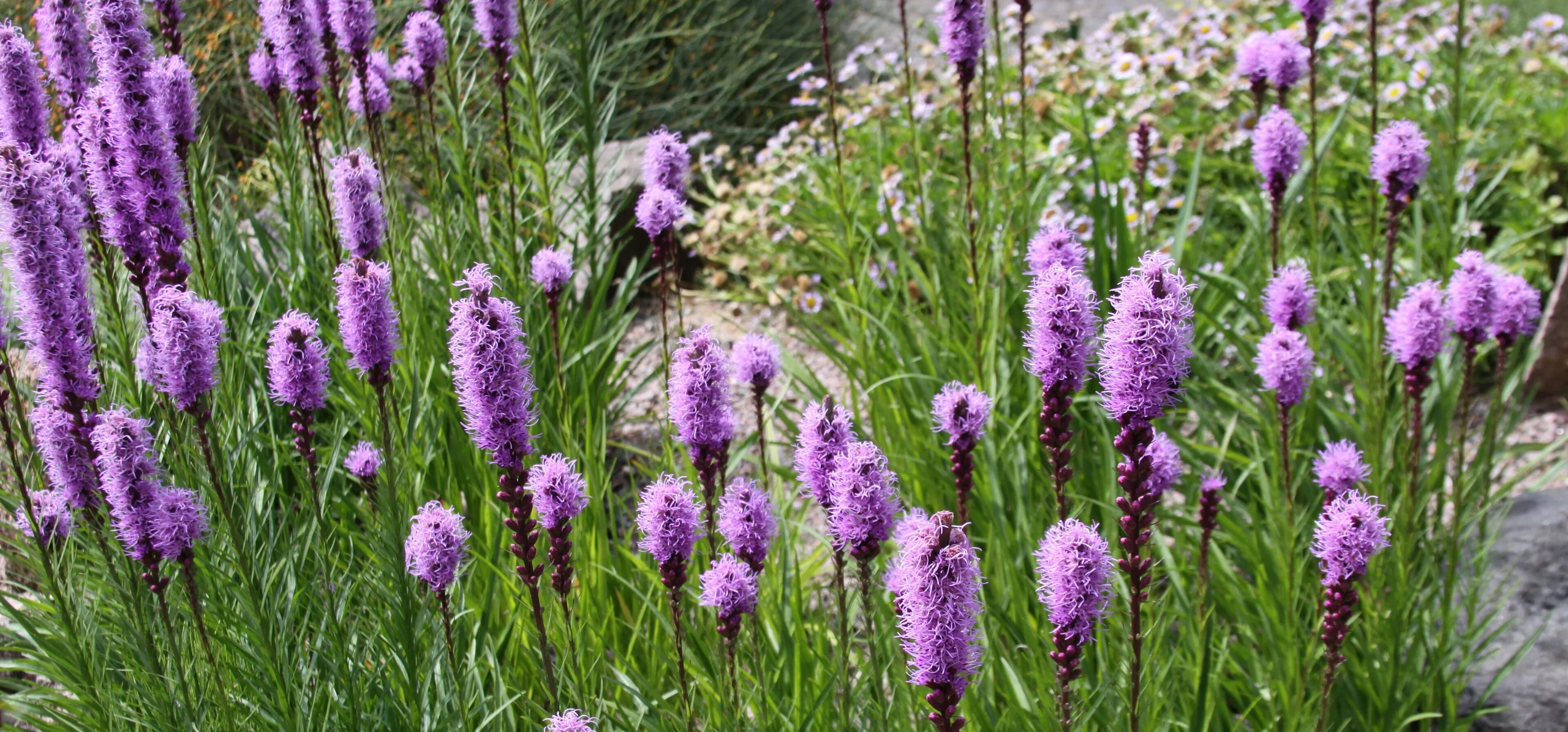
Liatris spicata opens its purple spikes from the top down, grown from spring-planted corms that need full sun and sharp winter drainage to avoid rot.
Liatris spicata
Plant profile
- WateringLittleWater every 7 days
- Light exposureFull sun
- Hardiness zoneUSDA 3–8
Growth
- Family
- Asteraceae
- Life cycle
- Perennial
- Growth speed
- 6/10
- Mature size
- 60–180 cm
- Spread
- 10–45 cm
- Flowering
- Mid to late summer, spikes open from the top down
- Propagation
- Seed
- Division
- Bulb
Dormancyfoliage blackens after fall frost and the plant dies back to a dormant belowground corm; new growth resprouts from the corm each spring
Time to maturityusually reaches flowering size and close to full height in its second summer after corms are planted, sometimes blooming lightly the first year
Soil & climate
- Soil pH
- pH 5.5–7
- Soil types
- clay, loam, sand
- Drought tolerance
- Yes
Light & Placement
- Origin
- Eastern Canada to north-central and eastern United States
- Where to place it
- sunny border or prairie-style planting
- cutting garden for cut flowers
- rain garden or moist meadow site with sharp winter drainage
- deep container with excellent drainage, useful where voles threaten in-ground corms
Safety
- Toxicity
- Not listed by the ASPCA on either its toxic or non-toxic plant lists
- Pet safe
- No
Invasive speciesnative to central and eastern North America; not documented as invasive or regulated within its native range
Data fromLiatris spicata (L.) Willd., GBIF BackboPOWO: Liatris spicata var. spicataMissouri Botanical Garden Plant Finder: NC State Extension Gardener Plant ToolboRHS: Liatris spicata 'Kobold'
Where it grows
World distribution
Blazing Star is native to 2 countries: Canada and United States.GBIF records 9,567 documented identifications across 28 countries, with the largest concentrations in United States, Canada, and Sweden.
- Canada
- United States
Yellow to orange dots: concentration of documented identifications per country. Green countries: sourced native range. Source: GBIFNative range from POWO (Kew).
Liatris spicata sends up dense, bottlebrush spikes of purple-pink flowers that do something most spike-flowering perennials do not: they open from the top of the spike downward instead of the bottom up. It grows from a small corm rather than a fibrous-rooted crown, planted shallow in spring, and really asks for only two things to thrive: full sun and soil that drains fast, especially through winter, when standing wet is the single most common way to lose it to corm rot. Once established the clump shrugs off dry spells on its own, though the tallest wild-type stems can still flop or need staking if the bed runs richer or wetter than the prairie ground this species comes from.
Native Range, Classification and the Top-Down Bloom
GBIF's backbone taxonomy accepts Liatris spicata (L.) Willd. as the current name, in the family Asteraceae, order Asterales, with older names filed away as synonyms under the genera Lacinaria and Kuhnia, among them Lacinaria spicata (L.) Kuntze. Plants of the World Online gives the native range of the accepted variety as eastern Canada to north-central and eastern United States, where NC State Extension places it in moist meadows, marsh margins and low prairie ground across the coastal plain and Piedmont. The trait that sets it apart from other spike flowers such as delphinium or veronica is the direction its buds open: from the top of the spike down, rather than the bottom up. That reversed sequence is also why a cut spike keeps producing fresh color further down the stem for days after the top has faded.
Planting Corms in Spring
Liatris spicata grows from a small, rounded corm with shallow fibrous roots rather than a woody crown. Plant dormant corms in spring once the soil has warmed, growing tip facing up, about 5 to 8 cm deep and 20 to 30 cm apart, in ground loosened well below planting depth so water cannot pool directly under the corm. First-year growth is usually a low tuft of narrow, grass-like leaves; full stem height and flowering more often show up in the second summer, sometimes with a lighter bloom the first year.
Full Sun and Drainage: Avoiding Corm Rot
Give it six or more hours of direct sun and average to fertile, well-drained soil. Missouri Botanical Garden notes the species tolerates clay, loam or sandy ground and average fertility, but is intolerant of wet soil in winter, and the RHS makes the same point about the 'Kobold' cultivar: plants may rot over winter if grown in heavy, poorly drained ground. The two facts sit together for a reason. This plant is not fussy about the sun it gets, since it takes summer heat and humidity easily; what it cannot take is water sitting around a dormant corm that has no leaves to use it. On heavy clay, raise the planting site a few inches or work in coarse grit before planting, rather than trying to fix drainage after the corms have already rotted.


Drought Tolerance Once Established
Once through its first season, an established clump handles ordinary dry spells with no supplemental water at all. NC State Extension lists the species as tolerant of both occasionally dry and occasionally wet conditions, unusual for a corm-forming plant. Water regularly through the first summer while the roots are still shallow and forming, then back off. The one exception is prolonged drought on fast, sandy soil during flowering, where a deep watering keeps the spikes from stalling partway open.
Staking Tall Types in Rich Soil
Wild-type Liatris spicata reaches 60 to 180 cm in favorable ground, tall enough that a single stem can outgrow its own support. NC State Extension flags taller stems as candidates for staking, and the risk climbs in richer, more fertile soil or with extra fertilizer, the same soft, over-fed growth that makes many prairie perennials flop over. Set stakes or a grow-through ring early in the season, before the spikes reach half their eventual height, rather than trying to prop up a stem that has already leaned.
Compact 'Kobold' and White-Flowered 'Alba'
Two cultivars cover most of what gardeners plant. 'Kobold', German for goblin, was selected for compact, sturdy stems that stay well under the species' wild height, which is why it has become the standard choice for border fronts and small cutting beds where the straight species would flop or crowd its neighbors. The RHS notes it can still rot over winter in heavy soil just like the species, so the drainage rule does not relax for a compact cultivar. 'Alba' keeps the same top-down bottlebrush habit but trades the purple-pink for creamy white, a straightforward substitute anywhere the species' color would clash with a planting scheme.
A Cut Flower Crop, and Dividing the Corms
Because the flowers open from the top of the spike down rather than all at once, a cut stem keeps producing new color further down for a week or more in a vase, longer than most spike flowers manage; the species is grown commercially for the florist trade for exactly that reason, one root of its common name Florist Gayfeather. Cut stems once the top third of the spike has opened for the longest vase life. In the garden, mature clumps slowly produce offset corms around the original over a few years; lift and separate these in spring or fall every three to four years to renew vigor and multiply named selections like 'Kobold', since seedlings will not come true to a named cultivar.
Butterflies, Goldfinches, Voles and Pet Safety
The flowers draw butterflies and other pollinators through a long mid to late summer bloom, and NC State Extension adds bees and hummingbirds to the list, along with two specialist insects, the Liatris flower moth and Liatris borer moth, that use the plant as a larval host. Left standing into fall instead of cut back, ripening seed heads bring in goldfinches, which the same extension service says eat the seeds with relish. The corms have their own admirer underground: meadow and prairie voles feed on dormant corms over winter, and a healthy vole population can hollow out or wipe out an entire planting. Where voles are a known problem, a wire mesh basket sunk around the corms at planting time, or growing the clump in a large container instead of open ground, keeps them out of reach. As for pets, Liatris spicata, marketed under the common names Blazing Star and Gayfeather, does not appear on the ASPCA's toxic or non-toxic plant lists at all, so no confirmed status exists either way; treat it with the same ordinary caution given any unlisted garden plant around cats, dogs or horses.
Test your plant knowledge
Tap a card to flip it and reveal the answer.
Liatris spicata flower spikes open from the bottom of the stem upward, like most spike-flowering perennials. Tap to reveal ✕ False
The plant grows from a corm that is planted shallow in spring rather than a fibrous-rooted crown. Tap to reveal ✓ True
Standing wet soil in winter is the most common way to lose Liatris spicata to corm rot. Tap to reveal ✓ True
'Kobold' is a selection bred to grow taller than the wild species. Tap to reveal ✕ False
The ASPCA lists Liatris spicata as toxic to cats and dogs. Tap to reveal ✕ False
Sources
References consulted for this guide
- Liatris spicata (L.) Willd., GBIF Backbone Taxonomygbif.org
- POWO: Liatris spicata var. spicatapowo.science.kew.org
- Missouri Botanical Garden Plant Finder: Liatris spicatamissouribotanicalgarden.org
- NC State Extension Gardener Plant Toolbox: Liatris spicataplants.ces.ncsu.edu
- RHS: Liatris spicata 'Kobold'rhs.org.uk
- Reference entity : Wikipédiaen.wikipedia.org