Chilean Jasmine
Mandevilla laxa
Family · Apocynaceae
Mandevilla laxa is the hardiest mandevilla, a scented deciduous twiner rated RHS H2, unlike the tender pink patio plant. Covers pruning, wall siting, sap.
Mandevilla laxa
Plant profile
- WateringModerateWater every 7 days
- Light exposureFull sun
- Ideal temperature1–35 °C
Growth
- Family
- Apocynaceae
- Life cycle
- Perennial
- Growth speed
- 6/10
- Mature size
- 250–400 cm
- Spread
- 100–150 cm
- Propagation
- Seed
- Cutting
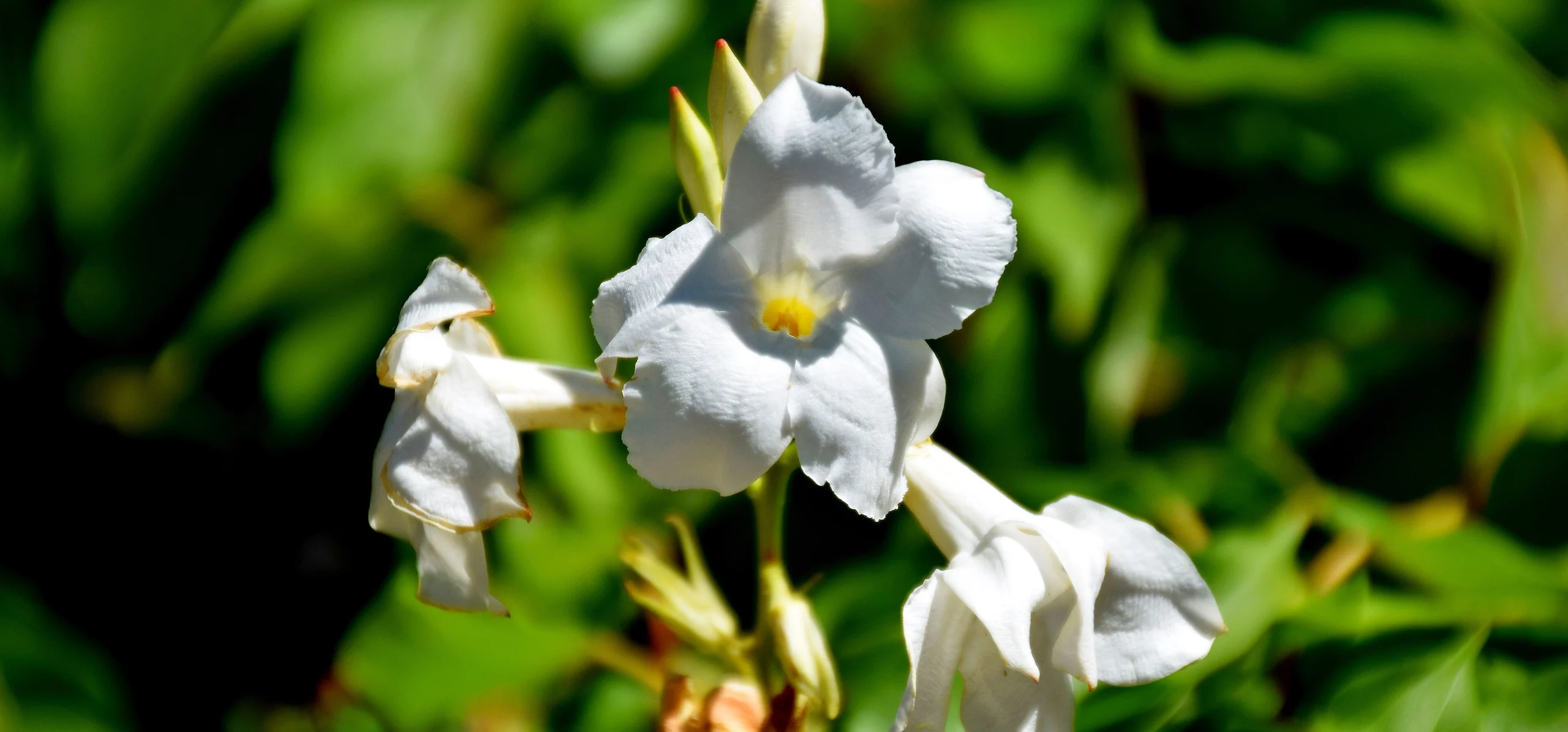
FloweringFragrant, funnel-shaped white flowers in sprays of 3-15 from late spring into summer, scented most strongly in the evening
Dormancysemi-deciduous; drops its leaves and rests when kept below about 10°C over winter
Time to maturityflowers within its first couple of seasons; reaches full height of 2.5-4 m against support over roughly 5-10 years (RHS)
Soil & climate
- Soil types
- loam
- Drought tolerance
- No
Light & Placement
- Origin
- Native from Peru to northern Argentina (POWO)
- Where to place it
- brightest available window
- cool or frost-free conservatory or greenhouse in full light
- south, east or west-facing sheltered wall in a mild, frost-free garden
- large container moved outdoors for summer
- large pot with peat-free, loam-based compost and a trellis or wires to climb
Safety
- Toxicity
- CatsSafe
- DogsSafe
- HumansToxic
Data fromMandevilla laxa (Ruiz & Pav.) Woodson, GPlants of the World Online (Kew): MandevRHS: Mandevilla laxa (Chilean jasmine)RHS: How to grow mandevillasASPCA: Toxic and Non-Toxic Plant List, D
Where it grows
World distribution
Chilean Jasmine is native to 3 countries: Argentina, Bolivia, and Peru.GBIF records 989 documented identifications across 23 countries, with the largest concentrations in Argentina, Bolivia, and New Zealand.
- Argentina
- Bolivia
- Peru
Yellow to orange dots: concentration of documented identifications per country. Green countries: sourced native range. Source: GBIFNative range from POWO (Kew).
Mandevilla laxa is the hardiest of the mandevillas: a deciduous, twining climber that drops its leaves and copes with cool conditions that would kill outright the tender pink Mandevilla and Dipladenia hybrids sold as patio plants. Its scented, funnel-shaped white flowers open in loose sprays of three to fifteen from late spring into summer, carrying a sweet fragrance that intensifies in the evening, which is why it is sold as Chilean jasmine even though it belongs to the dogbane family, not the true jasmines. Grow it against a warm, sheltered wall in a mild garden or keep a container plant under glass, and give it a hard cutback every late winter, since it flowers on the current season's new growth. Every part contains a milky, irritant sap typical of the Apocynaceae, so cut stems with care when pruning or taking cuttings.
Not the Same Plant as the Patio Mandevilla
Garden centres sell two very different things under the name mandevilla. The compact, waxy-flowered pink, red or white plants grown as summer patio and hanging-basket color, usually Mandevilla sanderi hybrids and often labelled Dipladenia, are frost-tender tropical shrubs with a weak, sprawling climbing habit and little to no scent; the RHS notes they need to be kept above roughly 15°C (60°F) at night, with only a few tolerating a drop to 10°C (50°F). Mandevilla laxa is a different plant entirely: a genuinely vigorous twining vine that wraps its own stems around wire or trellis, drops its leaves in a cool winter instead of sulking, and is singled out by the RHS as the one mandevilla able to cope down to about 5°C (41°F). If a plant tag says simply "mandevilla" with no species name and the flowers are pink and unscented, it is not this species.
Origin and a Once-Common Synonym
Plants of the World Online (Kew) gives the native range of Mandevilla laxa as Peru to northern Argentina, where it grows as a woody liana. GBIF's accepted classification places it in the family Apocynaceae, genus Mandevilla, order Gentianales; for decades it was widely grown and sold under the synonym Mandevilla suaveolens, a name that still turns up on older nursery labels and in older gardening books describing the same plant. The genus itself is named for Henry Mandeville, a 19th-century British diplomat in Buenos Aires who sent living material back to Kew.
Full Sun, Loam and Regular Water
The RHS lists full sun and an east- or west-facing aspect as the right position, in loam that stays moist but drains well; the species tolerates acid, alkaline or neutral soil, so pH is rarely the limiting factor. Water regularly through spring and summer while the vine is in full leaf and flower, letting the surface dry a little between waterings rather than keeping the compost saturated, then cut back sharply once the nights cool and growth slows. A large pot of peat-free, loam-based compost suits a plant grown under glass or moved outdoors for summer, since the vine's ultimate size means a small pot restricts it far more than the cold does.


Training a True Twining Climber
Unlike scramblers that need tying at every point of contact, Mandevilla laxa twines its own stems around whatever support it reaches, so the main job is offering wire, trellis or horizontal training wires on a wall and then guiding the questing new growth toward them before it wanders sideways into a neighbouring shrub. Given a wall to climb, the RHS records a mature spread of 2.5 to 4 metres in height with a 1 to 1.5 metre spread, reached over roughly five to ten years; a plant confined to a large pot with a wigwam of canes will flower well but stays considerably smaller. New stems are soft and need loose tying until they toughen, after which the twining habit holds them in place on its own.
Pruning Hard Every Late Winter
Because flowers form on the current season's new growth, the RHS places Mandevilla laxa in pruning group 12: cut back hard in late winter or very early spring, before growth resumes, shortening the previous year's sideshoots to within three or four buds of the permanent framework. This looks severe on a vine that may have covered several metres of wall the year before, but it is what produces the densest new growth and the most flower the following summer; skipping the cutback leaves a tangle of bare, woody stems with flowers only at the tips. Wear gloves for this job, since the pruning cuts weep the same irritant sap that runs through the rest of the plant.
A Sheltered Wall or a Cold Greenhouse in Winter
The RHS rates Mandevilla laxa H2: tolerant of low temperatures but not surviving a hard freeze, with a winter minimum in the region of 1 to 5°C. That makes it the most cold-tolerant mandevilla by a clear margin, but it still needs a cool or frost-free greenhouse or conservatory over winter everywhere except essentially frost-free, sheltered coastal or inner-city gardens, where a warm, wind-protected wall can be enough. A plant that gets too cold responds by dropping its leaves rather than dying outright, so losing foliage in a cold snap is a stress signal, not necessarily a death sentence; keep the compost on the dry side through this dormant, leafless period, since wet roots in cold weather rot far faster than dry ones. Resume normal watering once new growth appears and night temperatures settle back above roughly 10°C.
Whitefly and Spider Mite Under Glass
Grown in a greenhouse or conservatory, Mandevilla laxa is susceptible to glasshouse red spider mite and glasshouse whitefly, both of which build up fastest in the warm, still, dry air the plant itself enjoys, along with occasional mealybugs tucked into leaf joints. Spider mite shows first as a fine stippling on the upper leaf surface with webbing on the underside in a bad infestation, while whitefly flutters up in a small cloud when a leaf is disturbed; raising humidity around the plant and introducing the predatory mite Phytoseiulus persimilis or the parasitic wasp Encarsia formosa early controls both before they need a chemical spray. Plants grown outdoors for summer see far less pressure from either pest, since neither thrives once the air moves and cools at night.
Milky Sap and Pet Safety
The RHS toxicity note for Mandevilla laxa is straightforward: it may cause mild stomach upset if eaten, and the milky sap can irritate skin, so gloves are worth wearing when pruning or handling cuttings. For pets, mandevilla (sold under the related name Dipladenia) appears on the ASPCA's plant lists as non-toxic to cats and dogs, but that clearance is for the plant tissue generally, not a green light for a pet to chew on it regularly; the same sap that can mark a gardener's hands is enough to upset an animal's stomach in quantity, so keep an eye on any pet that shows interest in the foliage.
Test your plant knowledge
Tap a card to flip it and reveal the answer.
Mandevilla laxa is the most cold-tolerant species in the mandevilla genus. Tap to reveal ✓ True
The pink, unscented mandevilla or Dipladenia sold as a patio plant is the same species as Mandevilla laxa. Tap to reveal ✕ False
Because it flowers on new growth, Mandevilla laxa is cut back hard in late winter or early spring. Tap to reveal ✓ True
The ASPCA lists mandevilla as toxic to cats and dogs. Tap to reveal ✕ False
Mandevilla laxa needs no support because it scrambles loosely over the ground. Tap to reveal ✕ False
Sources
References consulted for this guide
- Mandevilla laxa (Ruiz & Pav.) Woodson, GBIF Backbone Taxonomygbif.org
- Plants of the World Online (Kew): Mandevilla laxa (Ruiz & Pav.) Woodsonpowo.science.kew.org
- RHS: Mandevilla laxa (Chilean jasmine)rhs.org.uk
- RHS: How to grow mandevillasrhs.org.uk
- ASPCA: Toxic and Non-Toxic Plant List, Dogsaspca.org
- Reference entity : Wikipédiaen.wikipedia.org