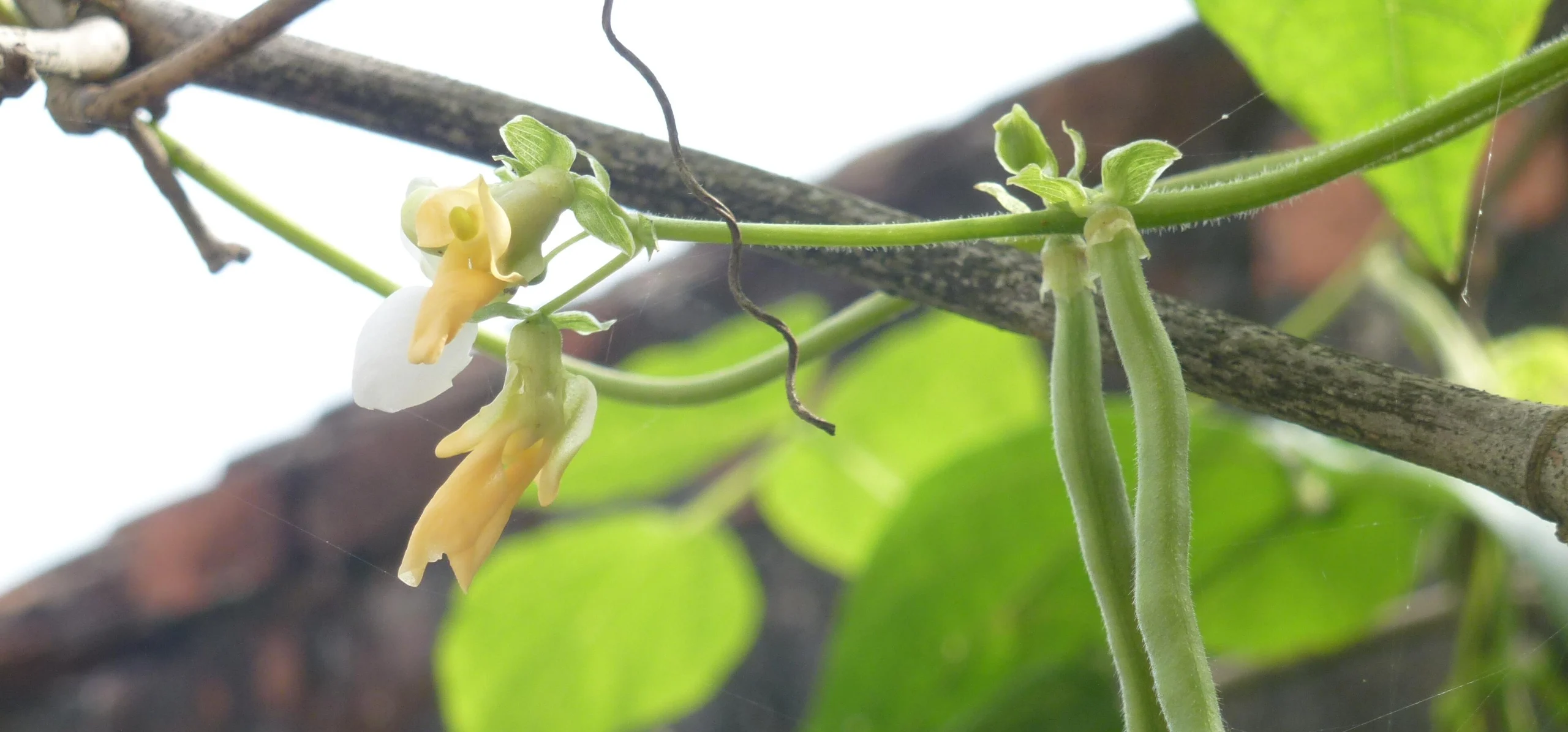
Common Bean
Phaseolus vulgaris
Family · Fabaceae
Common bean seed rots in cold soil below about 10-12°C, climbers need real supports, wet foliage spreads rust, and raw seed must be boiled hard before eating.
Phaseolus vulgaris
Plant profile
- WateringModerateWater every 4 days
- Light exposureFull sun
- Ideal temperature10–27 °C
Growth
- Family
- Fabaceae
- Life cycle
- Annual
- Growth speed
- 7/10
- Mature size
- 45–200 cm
- Propagation
- Seed
FloweringSmall white, pink or purple pea-like flowers, mostly self-pollinating, followed within days by pods
DormancyNone; a frost-tender annual killed outright at the first frost
Time to maturity8-10 weeks from sowing for bush types; longer to start but cropping into autumn for climbing types
Soil & climate
- Soil pH
- pH 6–7
- Soil types
- well-drained, fertile loam
- Drought tolerance
- No
Light & Placement
- Origin
- Central America, from Mexico to NW Venezuela and N Argentina (POWO)
- Where to place it
- bright windowsill or propagator for starting seed before planting out
- sunny, sheltered vegetable bed away from strong wind
- 30cm (12in)+ pot or large container with a cane wigwam or trellis for climbing types
Safety
- Toxicity
- HumansToxic
Invasive speciesNot invasive; a cultivated annual vegetable that does not persist or spread outside cultivation.
Data fromGBIF: Phaseolus vulgaris L.Plants of the World Online (Kew): PhaseoRHS: How to Grow French BeansRHS: How to Grow Beans for DryingRHS: Runner and French Bean RustPurdue University New Crops: Phaseolus v
Where it grows
World distribution
Common Bean is native to 13 countries: Argentina, Bolivia, Colombia, Costa Rica, Ecuador, El Salvador, Guatemala, and Honduras….GBIF records 244,135 documented identifications across 177 countries, with the largest concentrations in Mexico, Spain, and Peru.
- Argentina
- Bolivia
- Colombia
- Costa Rica
- Ecuador
- El Salvador
- Guatemala
- Honduras
- Mexico
- Nicaragua
- Panama
- Peru
- Venezuela
Yellow to orange dots: concentration of documented identifications per country. Green countries: sourced native range. Source: GBIFNative range from POWO (Kew).
A bean seed germinates fast once the soil is genuinely warm, pushing up a pair of thick, hooked seed leaves within a week, and from there the plant commits hard to one of two habits: a bush about 45cm tall that crops in a rush over a few weeks, or a vine that climbs to around 2m and keeps producing from midsummer into early autumn if picked often. Both are the same species, Phaseolus vulgaris, and the same plant can end up labelled French bean, kidney bean, haricot or borlotti depending only on whether the pod is eaten young or left to fill and dry on the vine. It is a warm-season crop from Central America with no frost tolerance at any stage, so the single decision that ruins more harvests than anything else is sowing too early into cold, wet ground.
Bush, Climbing and Drying Types Are the Same Plant
Seed catalogues split Phaseolus vulgaris into uses that all come from one species. Dwarf, or bush, French beans grow to about 45cm (18in), need no support, and according to the RHS begin cropping in just eight to ten weeks from sowing, but the harvest is concentrated into a few weeks. Climbing, or pole, French beans take longer to start but then crop from midsummer into early autumn if picked regularly, reaching around 2m (6ft) up a support in a fraction of the ground space a bush variety needs. A third group, grown for the seed rather than the pod, includes haricot, borlotti and kidney types; these are usually climbing or half-climbing plants left on the vine long after a snap bean would have been picked, until the pod itself dries and rattles.
Sowing Only Once the Soil Is Warm
Common bean seed rots in cold, wet ground instead of germinating, and this is the single biggest cause of gaps in a row. The RHS puts the minimum soil temperature at 10°C (50°F) for French beans, closer to 12°C (54°F) for reliable germination in cool springs, and Purdue University's crop guide gives the optimum monthly temperature for growth as 15.6 to 21.1°C (60-70°F); below that the seed simply sits and often rots before it swells. In practice this means sowing under cover from mid-spring for planting out once frost has passed, or direct in the ground once a soil thermometer pushed 5cm deep confirms warmth, rather than trusting the calendar. Because a single sowing crops hard and then tails off, especially in bush varieties, a short row sown every two to three weeks from late spring into midsummer keeps pods coming instead of gluts followed by empty weeks.
Supports for Climbing Types
A climbing bean left without a support collapses into a tangled heap, where pods rot against wet soil and slugs reach every leaf. The RHS recommends bamboo canes or hazel poles about 2.5m (8ft) tall, spaced 15cm (6in) apart within a row and at least 45cm (18in) between rows, tied together at the top into an A-frame or arranged as a wigwam; canes need to go at least 30cm into firm ground or the whole structure leans once it is carrying a full crop of foliage and pods. Netting strung between canes gives the twining stems more to grip early on. Bush varieties need no support at all, though a short twiggy stick beside each plant keeps pods off wet soil.


Slugs and Snails on Young Seedlings
A bean seedling is at its most vulnerable in the first two weeks after germination, when the seed leaves and first true leaves are exactly the soft, high-moisture tissue slugs and snails prefer, and a single night's grazing can remove a seedling completely. The RHS recommends starting seed in individual pots under cover rather than sowing directly where slug pressure is high, planting out only once the stem has toughened; wildlife-friendly slug pellets, copper rings around the stem, or a barrier of coarse, dry material such as crushed eggshell around each plant reduce losses further. Once a plant is past six or seven leaves and starting to climb, slug damage becomes cosmetic rather than fatal.
Bean Rust and Anthracnose: Never Work Wet Plants
Two fungal diseases account for most bean foliage problems, and both share the same trigger. Bean rust, caused by Uromyces appendiculatus, starts as pale raised spots on the upper leaf surface with matching white pustules underneath, turning brown then black as they mature through summer; the RHS notes infection is favoured by wet weather, and heavy late-season attacks reduce vigour and yield. Anthracnose, caused by Colletotrichum lindemuthianum, produces dark, sunken lesions on pods, stems and leaves, is seed-borne, and spreads by rain-splash, with cool, wet summers making it worse. Both fungi need free water to move their spores from leaf to leaf, and brushing against wet foliage carries spores on hands and clothing the same way rain-splash does; working the row only once leaves have dried, and watering at the base rather than overhead, removes the main route of spread without any fungicide.
Picking Pods Young and Often
For snap types, whether bush or climbing, the pod is best picked well before the seeds inside swell and it turns fibrous: young and slim enough to snap cleanly. The RHS is explicit that picking regularly encourages the plant to keep flowering and setting new pods, while pods left to mature and fill with seed signal that the plant's job for the season is done, so cropping slows or stops. This matters most for climbing varieties, which can keep producing from midsummer into early autumn if checked every two or three days; a bush variety crops in a shorter, more concentrated burst regardless of picking frequency, but still gives more total pods if nothing is left to overgrow.
Saving Seed and Growing Drying Beans
Haricot, borlotti and kidney types are the same plant grown to a different end point: instead of picking the pod young, it stays on the vine well past the point a snap bean would be harvested, until the pod itself has dried, turned brittle and papery, and rattles when shaken, typically from midsummer into early autumn according to the RHS. Pods should not be picked after rain, so the beans inside are as dry as possible before storage; once collected, they are shelled out and spread on a tray in a warm, airy place to finish drying hard before going into an airtight jar. The same principle saves seed for next year from any variety, snap types included: leave a few pods on the healthiest plants to dry fully on the vine, then store the shelled, hard seed somewhere cool and dry over winter.
Nitrogen Fixing, Rotation and the Toxicity of Raw Beans
Like other legumes, Phaseolus vulgaris roots form nodules that house rhizobia bacteria, pulling nitrogen from the air and fixing it into a form the plant, and afterwards the soil, can use; this is why beans are grown as part of a rotation, typically following a heavy feeder such as brassicas, and why spent plants are best cut off at the base after harvest rather than pulled, leaving the nitrogen-rich roots to break down in place. That benefit does not extend to the seed: raw or undercooked kidney beans and other Phaseolus vulgaris seed contain a lectin toxin, phytohaemagglutinin, recorded historically as phasin, which causes rapid nausea, vomiting and diarrhoea after just a few raw beans and is destroyed only by a full rolling boil, not the lower heat of a slow cooker; dried beans should be soaked, then boiled hard for at least ten minutes before finishing cooking through. Common bean does not currently appear on the ASPCA's toxic or non-toxic plant lists for cats, dogs or horses, so no official pet-safety verdict exists to cite, though the same raw-bean caution is worth extending to a pet that scavenges a dropped pod or dry seed.
Test your plant knowledge
Tap a card to flip it and reveal the answer.
Common bean seed germinates reliably in cold soil below 10°C (50°F). Tap to reveal ✕ False
Climbing French beans crop over a longer period than bush types if picked regularly. Tap to reveal ✓ True
Handling bean plants while the leaves are still wet from rain helps spread rust and anthracnose. Tap to reveal ✓ True
A slow cooker reaches a high enough temperature to destroy the toxin in raw kidney beans. Tap to reveal ✕ False
Bean roots return nothing useful to the soil once the crop is finished. Tap to reveal ✕ False
Sources
References consulted for this guide
- GBIF: Phaseolus vulgaris L.gbif.org
- Plants of the World Online (Kew): Phaseolus vulgaris L.powo.science.kew.org
- RHS: How to Grow French Beansrhs.org.uk
- RHS: How to Grow Beans for Dryingrhs.org.uk
- RHS: Runner and French Bean Rustrhs.org.uk
- Purdue University New Crops: Phaseolus vulgarishort.purdue.edu
- Reference entity : Wikipédiaen.wikipedia.org