Black Raspberry
Rubus occidentalis
Family · Rosaceae
Black raspberry roots wherever a cane tip touches soil: how to use or stop it, tip primocanes each summer, and keep viruses away from red raspberries.
Rubus occidentalis
Plant profile
- WateringModerateWater every 5 days
- Light exposureFull sun
- Hardiness zoneUSDA 4–8
Growth
- Family
- Rosaceae
- Life cycle
- Perennial
- Growth speed
- 8/10
- Mature size
- 90–180 cm
- Spread
- 120–240 cm
- Flowering
- Small white flowers in late spring, fruit ripens over several weeks in early summer
- Propagation
- Layering
- Cutting
Dormancydeciduous; floricanes die after fruiting, primocanes overwinter to fruit the next year
Time to maturityfruits in the second year, on canes (floricanes) produced the previous season
Soil & climate
- Soil pH
- pH 5.6–6.2
- Soil types
- loam, sandy loam
- Drought tolerance
- No
Light & Placement
- Origin
- Eastern Canada to north-central and eastern United States
- Where to place it
- bramble row
- fruit garden bed
- hedgerow planting
Safety
- Toxicity
- Not listed by the ASPCA; the ripe fruit is a common edible crop
- Pet safe
- Yes
Invasive speciesspreads by tip-layering into dense thickets if canes are not managed; not generally listed as invasive outside its native North American range
Data fromGBIF Backbone Taxonomy: Rubus occidentalPlants of the World Online (Kew): Rubus NC State Extension Gardener Plant ToolboUniversity of Maryland Extension: GrowinUniversity of Maine Cooperative Extensio
Where it grows
World distribution
Black Raspberry is native to 2 countries: Canada and United States.GBIF records 41,788 documented identifications across 47 countries, with the largest concentrations in United States, Canada, and France.
- Canada
- United States
Yellow to orange dots: concentration of documented identifications per country. Green countries: sourced native range. Source: GBIFNative range from POWO (Kew).
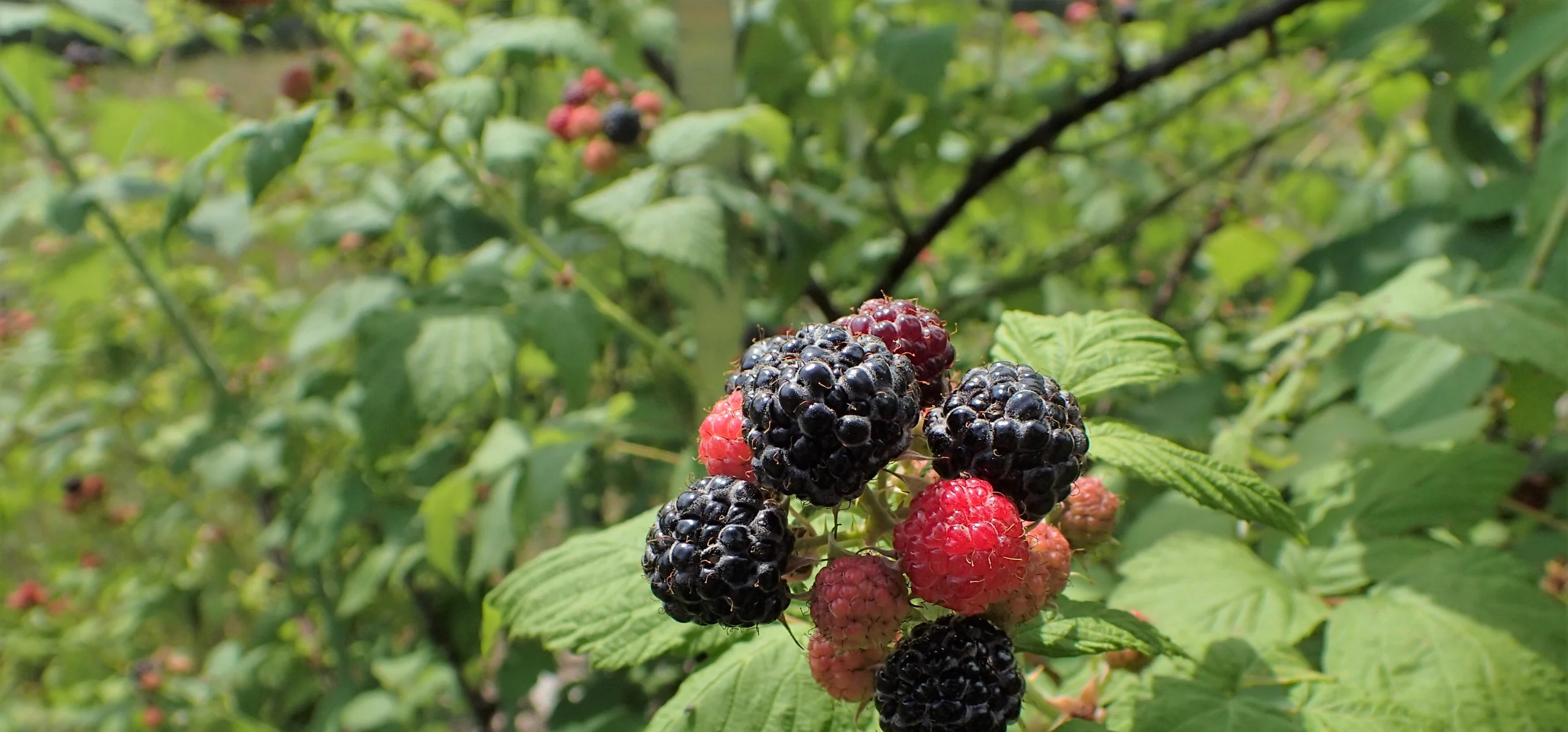
A black raspberry cane looks almost identical to a blackberry's until the fruit turns: the ripe berry pulls free of a pale conical core and leaves a hollow thimble behind, the same way a red raspberry does, instead of the solid knot a blackberry keeps around its stem. Rubus occidentalis is native to eastern Canada and the north-central and eastern United States, where it grows as an arching, thicket-forming bramble whose canes carry a waxy white bloom that wipes off on a thumb. It fruits once, on second-year wood, in early summer, and it spreads on its own by rooting wherever an arching cane tip touches bare soil, a habit worth understanding before the first season is out. Left next to a red raspberry patch or a hedge of wild brambles, it also tends to pick up viruses those plants can carry for years without ever looking sick.
Choosing a Variety: Jewel, Bristol and Munger
'Jewel', bred in New York, is usually named the hardiest black raspberry available and the one extension programs recommend first: canes are vigorous and upright, yield is heavy, and it shows somewhat more resistance to cane and leaf disease than most other cultivars, with firm, glossy, mid-season fruit. 'Bristol', also from New York, ripens a little earlier with large, good-flavored berries and good yield, but its canes are more disease-prone and reward closer attention to pruning and air circulation. On the West Coast, 'Munger' fills the role 'Bristol' plays in the East: an older Ohio-bred selection that became the standard commercial black raspberry in Oregon and Washington, valued for large, glossy, firm fruit. All three are straight Rubus occidentalis selections, not hybrids with red raspberry, so the same pruning and isolation rules below apply to any of them.
Site, Soil and Planting
Give it full sun; shaded canes stay leafy but set little fruit. The ideal soil is moist, well-drained and rich in organic matter, on the acid side of neutral, and it should never sit wet through spring, since standing water at the crown invites root rot faster than almost anything else that goes wrong with this plant. Unlike red raspberry, black raspberry does not sucker from wandering roots: new shoots come up only from the crown of each plant, so a row stays a row of separate clumps rather than turning into a spreading hedge, at least until tip-layering takes over.
Tip-Layering: How It Spreads on Its Own
This is the trait that sets black raspberry apart from red raspberry and from most garden shrubs: an arching primocane that touches the ground with its tip roots there on its own, usually by late summer, and the rooted tip can be dug and moved as a new plant once it has a season under it. Growers have propagated the species this way for generations, and it costs nothing but a spade. Left unmanaged, though, the same habit turns a tidy row into a dense, self-perpetuating thicket within two or three years, since every cane that arches far enough plants itself. To stop it, cut back primocanes before they bend to the ground, or push any tip that has started rooting back upright and detach it, and check the edges of the planting for tips that rooted where they were not wanted.


Watering and Feeding
Water matters most in the weeks the fruit is sizing and through the plant's first two seasons while roots establish; a dry spell during fruit development shows up quickly as small, seedy berries. Established plants tolerate short dry periods better than wet feet, and mulch over the shallow root zone does more to even out soil moisture than any fixed watering schedule. A balanced feed in early spring, before growth resumes, is usually enough; heavy nitrogen late in the season pushes soft cane growth that is more vulnerable to the cankers described below.
Pruning: Tipping Primocanes and Removing Spent Floricanes
Black raspberry needs three separate pruning passes, not one. In summer, once a primocane (this year's new, non-fruiting cane) reaches about three to four feet, pinch or cut out its growing tip; this single cut forces the cane to branch into the side shoots, called laterals, that will carry next year's fruit, and it keeps the plant lower and less prone to arching over and tip-layering where it is not wanted. In late winter or very early spring, shorten those laterals to around eighteen inches and thin crowded primocanes at the base to leave the strongest ones a few inches apart. As soon as harvest finishes, cut every spent floricane, the two-year-old cane that just fruited, off at ground level; it will not fruit again, and it is one of the main places cane diseases overwinter.
Keeping It Away from Red Raspberries and Wild Brambles
Black raspberry is far more susceptible to a group of aphid-spread viruses than red raspberry is, and red raspberries can carry those viruses for years while showing no symptoms at all, which is what makes them dangerous neighbors rather than obviously diseased ones. Extension guidance is blunt about the fix: site a new black raspberry planting at least three hundred feet from any wild bramble, and keep it well away from red raspberry plantings too, upwind if possible, since the aphids that carry the virus are mostly wind-dispersed rather than active fliers. Once a black raspberry planting is infected, plants decline steadily and there is no cure, only removal, which is why the isolation distance matters more than almost any other decision made at planting time.
Birds, Cane Blight and Anthracnose
Birds take black raspberries as readily as they take any soft fruit, and songbirds, along with small mammals, will strip a planting through the ripening weeks if it is not netted; the fruit and the seeds left in it also feed wildlife through winter. Anthracnose hits black raspberries harder than almost any other bramble: it starts as small, purple-margined spots on young canes that merge into gray, sunken cankers, and on leaves it leaves a scatter of shot-holes where lesion centers drop out. Cane blight is a separate fungus that only gets in through a wound, a pruning cut, an insect puncture, a rub against a support wire, so a wet season combined with careless pruning is exactly when it shows up as a cane that wilts and dies past a dark canker. Both spread fastest in wet, crowded plantings, and the fix for both is the same: prune out infected and spent wood promptly, keep rows open enough for canes to dry after rain, and remove any wild brambles nearby that harbor the spores.
Harvest, Common Mistakes and Pet Safety
Berries are ready when they pull free of the white core with almost no resistance; picking too early leaves fruit sour, and picking a day late loses it to birds or to the fruit softening in the sun. The most common mistake is skipping the summer tipping and letting primocanes run: the canes arch over, root themselves everywhere, and the planting turns into an unpruned thicket within two seasons that shades out its own fruiting wood. The second is planting a new bed downwind of an old red raspberry patch, or beside a fence line where wild brambles have seeded in, without allowing for the isolation distance above. The ASPCA does not list black raspberry, Rubus occidentalis, by name on either its toxic or non-toxic plant lists, so there is no species-specific entry to check; the ripe fruit itself is a common food crop grown and eaten with no toxicity concerns.
Test your plant knowledge
Tap a card to flip it and reveal the answer.
Black raspberry canes can root and form a new plant wherever an arching tip touches bare soil, a process called tip-layering. Tap to reveal ✓ True
Like red raspberry, black raspberry spreads mainly through underground root suckers that pop up throughout the bed. Tap to reveal ✕ False
Extension guidance recommends siting a new black raspberry planting at least 300 feet from wild brambles. Tap to reveal ✓ True
Birds rarely bother black raspberry fruit, so netting is not usually needed. Tap to reveal ✕ False
The ASPCA lists Rubus occidentalis by name on its toxic or non-toxic plant lists. Tap to reveal ✕ False
Sources
References consulted for this guide
- GBIF Backbone Taxonomy: Rubus occidentalis L.gbif.org
- Plants of the World Online (Kew): Rubus occidentalis L.powo.science.kew.org
- NC State Extension Gardener Plant Toolbox: Rubus occidentalisplants.ces.ncsu.edu
- University of Maryland Extension: Growing Raspberries and Blackberries in a Home Gardenextension.umd.edu
- University of Maine Cooperative Extension, Bulletin #2172e: Raspberry and Blackberry Varieties for Maineextension.umaine.edu
- Reference entity : Wikipédiaen.wikipedia.org