Common Sowthistle
Sonchus oleraceus
Family · Asteraceae
Common sowthistle bleeds milky sap, pulls out with a shallow taproot, and seeds faster than most gardeners hoe, though its young leaves feed people and rabbits.
Sonchus oleraceus
Plant profile
- WateringModerateWater every 7 days
- Light exposureFull sun
Growth
- Family
- Asteraceae
- Life cycle
- Annual
- Growth speed
- 8/10
- Mature size
- 30–150 cm
- Spread
- 50–100 cm
- Propagation
- Seed
FloweringSmall, dandelion-like yellow flower heads through summer, followed by wind-borne white seed clocks
Soil & climate
- Soil types
- chalk, clay, loam, sand, disturbed, cultivated
- Drought tolerance
- No
Light & Placement
- Where to place it
- vegetable garden beds
- containers and nursery pots
- cracks in paving and disturbed ground
OriginMacaronesia, Europe to the Mediterranean, Sahara to the Arabian Peninsula (naturalized worldwide)
Safety
- Toxicity
- HumansSafe
Invasive speciesNC State Extension's Plant Toolbox notes the species spreads aggressively by reseeding itself and is generally managed with preemergence control or hand removal before it sets seed.
Data fromGBIF: Sonchus oleraceus L.POWO: Sonchus oleraceus L.UC Statewide IPM Program: Annual SowthisPenn State Extension: Annual SowthistleNC State Extension Gardener Plant Toolbo
Where it grows
World distribution
Common Sowthistle is native to 54 countries: Albania, Algeria, Austria, Belarus, Belgium, Bulgaria, Burkina Faso, and Cape Verde….GBIF records 669,023 documented identifications across 211 countries, with the largest concentrations in United Kingdom, France, and Netherlands.
- Albania
- Algeria
- Austria
- Belarus
- Belgium
- Bulgaria
- Burkina Faso
- Cape Verde
- Chad
- Côte d’Ivoire
- Croatia
- Cyprus
Show 42 more countriesShow fewer countries
- Czechia
- Denmark
- Djibouti
- Egypt
- Eritrea
- Estonia
- Ethiopia
- Finland
- France
- Georgia
- Germany
- Greece
- Hungary
- Iran
- Iraq
- Ireland
- Italy
- Lebanon
- Libya
- Mali
- Mauritania
- Morocco
- Netherlands
- Norway
- Oman
- Palestinian Territories
- Poland
- Portugal
- Romania
- Russia
- Saudi Arabia
- Somalia
- Spain
- Sudan
- Sweden
- Switzerland
- Tunisia
- Türkiye
- Ukraine
- United Arab Emirates
- United Kingdom
- Yemen
Yellow to orange dots: concentration of documented identifications per country. Green countries: sourced native range. Source: GBIFNative range from POWO (Kew).
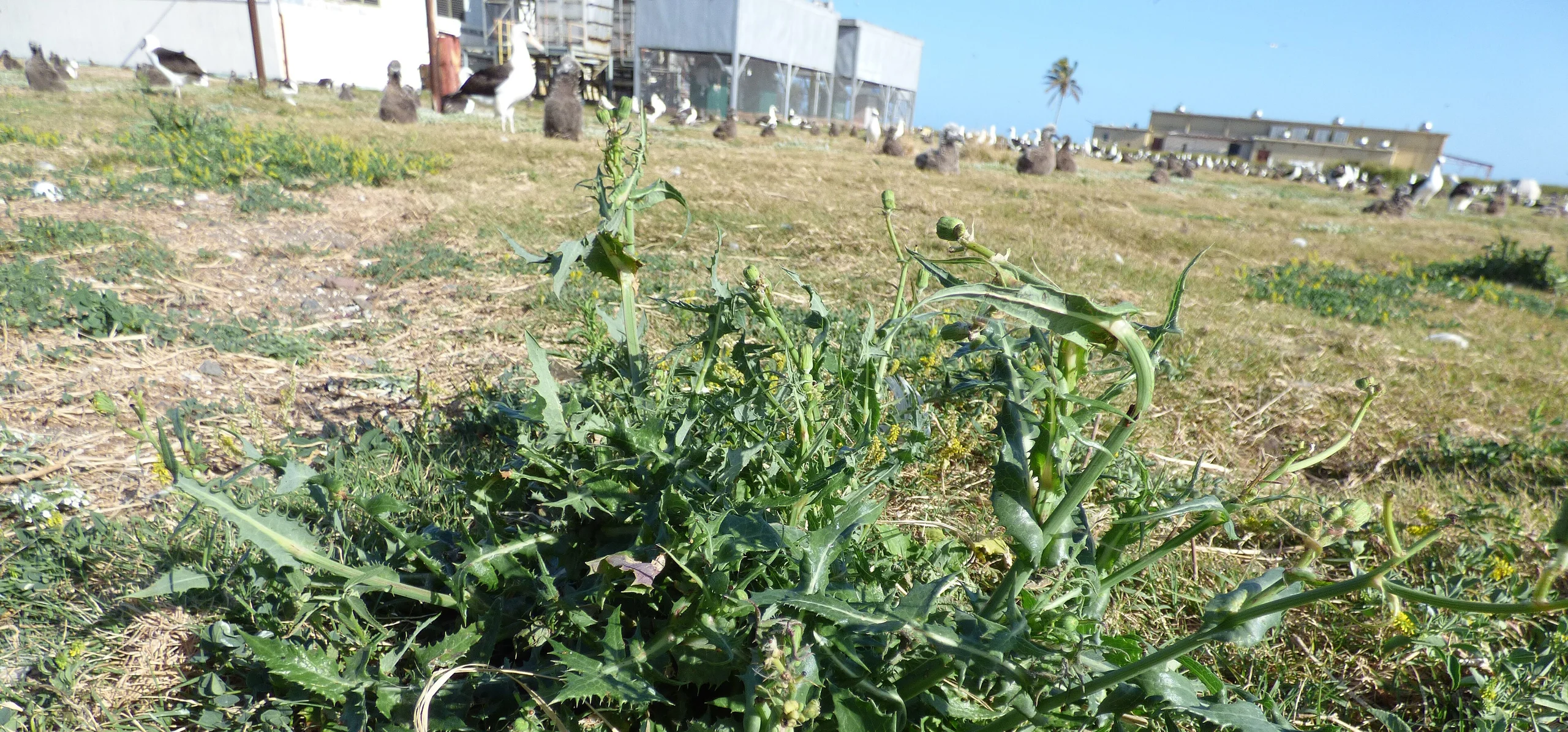
Sonchus oleraceus turns up in the same disturbed ground its cousins favor: a crack in the paving, the edge of a raised bed, a nursery pot left standing too long by a greenhouse. Snap a stem and it weeps white, milky sap within seconds, the fastest field check before looking at anything else. The soft, deeply lobed leaves clasp the stem with small, pointed lobes at the base, and by midsummer the plant tops out in small, dandelion-like yellow flower heads that turn into white, fluffy seed clocks within days of opening. None of that makes it a hard weed to deal with: pulled young, it comes out of the soil with almost no resistance, and the same leaves that mark it as a weed are edible, if bitter, greens that rabbits and chickens will clear from a bed faster than a gardener can.
Reading the Plant: Milky Sap and Clasping Leaves
Penn State Extension describes the stem as exuding white sap when broken, hollow between the nodes, and topped with alternate leaves whose lower portions are deeply lobed with a broader, arrow-shaped terminal lobe. Higher up the stem, the leaves shrink and lose their stalks, wrapping directly around the stem with small, pointed, claw-like lobes at the base, the detail that separates a young sowthistle rosette from a dandelion or a young lettuce seedling in the same bed. The whole plant stays soft to the touch: the leaf margins carry only small, weak spines, nothing like the stiff prickles found on its close relative. Height runs from about 12 inches on a plant just coming into flower to close to 4 to 5 feet by late summer, according to Penn State Extension and the University of California Statewide IPM Program.
Common Sowthistle vs. the Prickly Sonchus asper
The two weeds are mistaken for each other constantly, and Penn State Extension's identification notes give the cleanest separator: annual sowthistle carries only very small spines along the leaf margin, while spiny sowthistle (Sonchus asper) is armed with stiff, sharp prickles along the whole leaf edge. The base of the leaf tells the same story from a distance: Sonchus oleraceus clasps the stem with lobes that come to a point, while Sonchus asper wraps the stem with rounder, more spine-tipped auricles. In a mixed patch, running a thumb along a leaf edge settles the question in a second, soft and barely felt on Sonchus oleraceus, sharp enough to notice on Sonchus asper.
Why It Seeds Faster Than Most Gardeners Hoe
Every flower head on Sonchus oleraceus closes into a tight white puff built from a pappus, the same parachute-like tuft of fine hairs a dandelion uses, and NC State Extension's Plant Toolbox notes the seed spreads readily on wind as well as water. Because the plant reseeds itself continuously through a single growing season rather than setting one seed crop, a bed left unchecked for a couple of weeks around flowering time can go from a handful of rosettes to a stand releasing seed on the wind, and NC State Extension notes it needs to be caught before that point, since established plants can spread aggressively and are managed with either preemergence control or removal, not left to seed out. The practical rule from that seed biology is simple: walk the bed and pull rosettes before any plant shows a yellow flower head, not after.


Pulling It: A Taproot That Gives Up Easily
Unlike the deep, brittle taproot of a dandelion, Sonchus oleraceus grows what Penn State Extension describes as a shallow taproot, noting that it allows for easy hand removal in landscape settings when that is practical. That is the main reason it is a forgiving weed to keep on top of by hand: a young plant lifts cleanly with a gentle pull, roots and all, rather than snapping off at the crown and resprouting the way many taprooted perennials do. NC State Extension adds that the species does not regrow from root fragments left in the soil, so a shallow hoe pass or hand-pulling session that gets the crown out is normally the end of that particular plant, with no need to chase buried root pieces the way a gardener would for bindweed or dock.
Eating the Young Leaves
The same rosette leaves worth pulling are also worth eating, picked young and before the plant bolts to flower. NC State Extension's Plant Toolbox notes the leaves can be added to salads, and the milky sap that marks the species in the ground is also what gives the raw leaf its characteristic bitterness, closer to a chicory or dandelion green than to lettuce. Older, tougher leaves and the peeled stem hold up better cooked than raw, which softens both the texture and the bitterness. Anyone gathering it from a bed that has been sprayed or is near a road should treat it the same as any foraged green and skip it.
A Favorite of Rabbits and Chickens
Long before it was a garden nuisance, Sonchus oleraceus was livestock forage, and the common name itself points at that history: sow thistle, from pigs rooting it out, alongside the old English name hare's thistle for how readily rabbits graze it. A backyard flock of chickens will strip a pulled plant down to bare stem in minutes, and rabbits kept on cut greens generally take to it faster than to tougher garden weeds, which makes a hand-weeding session double as free feed rather than pure waste if there are hens or hutches nearby. The soft, spineless leaf is exactly why grazing animals prefer it over the prickly Sonchus asper when both are growing side by side.
A Host for Lettuce Aphids and Their Viruses
In a vegetable garden that includes lettuce, Sonchus oleraceus is not a neutral weed to ignore between rows. The University of California Statewide IPM Program notes that annual sowthistle can harbor pests that are economically important to vegetable and fruit crops, including lettuce aphid (Nasonovia ribisnigri) and other insects that vector plant viruses. A sowthistle plant left standing at the edge of a lettuce bed can act as a reservoir that lets aphids and the viruses they carry move into the crop once conditions favor an outbreak, which is one more reason the species is worth clearing from around lettuce, brassicas and other susceptible vegetables rather than only from paths and beds where nothing edible is growing nearby.
Is It Toxic to Pets?
Common sowthistle does not appear on the ASPCA's toxic or non-toxic plant lists for cats, dogs or horses, so no official ASPCA toxicity status exists for the species. That absence is not the same as a guarantee of safety, but it lines up with the plant's long history as deliberate rabbit and livestock feed: nothing in that record points to it being a plant pets need to be kept away from, only one that, like most garden greenery, is best offered or encountered in moderation rather than assumed safe in any quantity.
Test your plant knowledge
Tap a card to flip it and reveal the answer.
The milky white sap that oozes from a broken sowthistle stem is normal for the plant, not a sign of disease. Tap to reveal ✓ True
Sonchus oleraceus has a deep, brittle taproot like a dandelion, which makes it difficult to remove by hand. Tap to reveal ✕ False
Common sowthistle's leaf margins carry sharper, stiffer spines than those of prickly sowthistle (Sonchus asper). Tap to reveal ✕ False
A sowthistle plant left growing near a lettuce crop can act as a reservoir for lettuce aphid and the viruses it spreads. Tap to reveal ✓ True
The ASPCA lists common sowthistle as toxic to cats and dogs. Tap to reveal ✕ False
Sources
References consulted for this guide
- GBIF: Sonchus oleraceus L.gbif.org
- POWO: Sonchus oleraceus L.powo.science.kew.org
- UC Statewide IPM Program: Annual Sowthistleipm.ucanr.edu
- Penn State Extension: Annual Sowthistleextension.psu.edu
- NC State Extension Gardener Plant Toolbox: Sonchusplants.ces.ncsu.edu
- Reference entity : Wikipédiaen.wikipedia.org