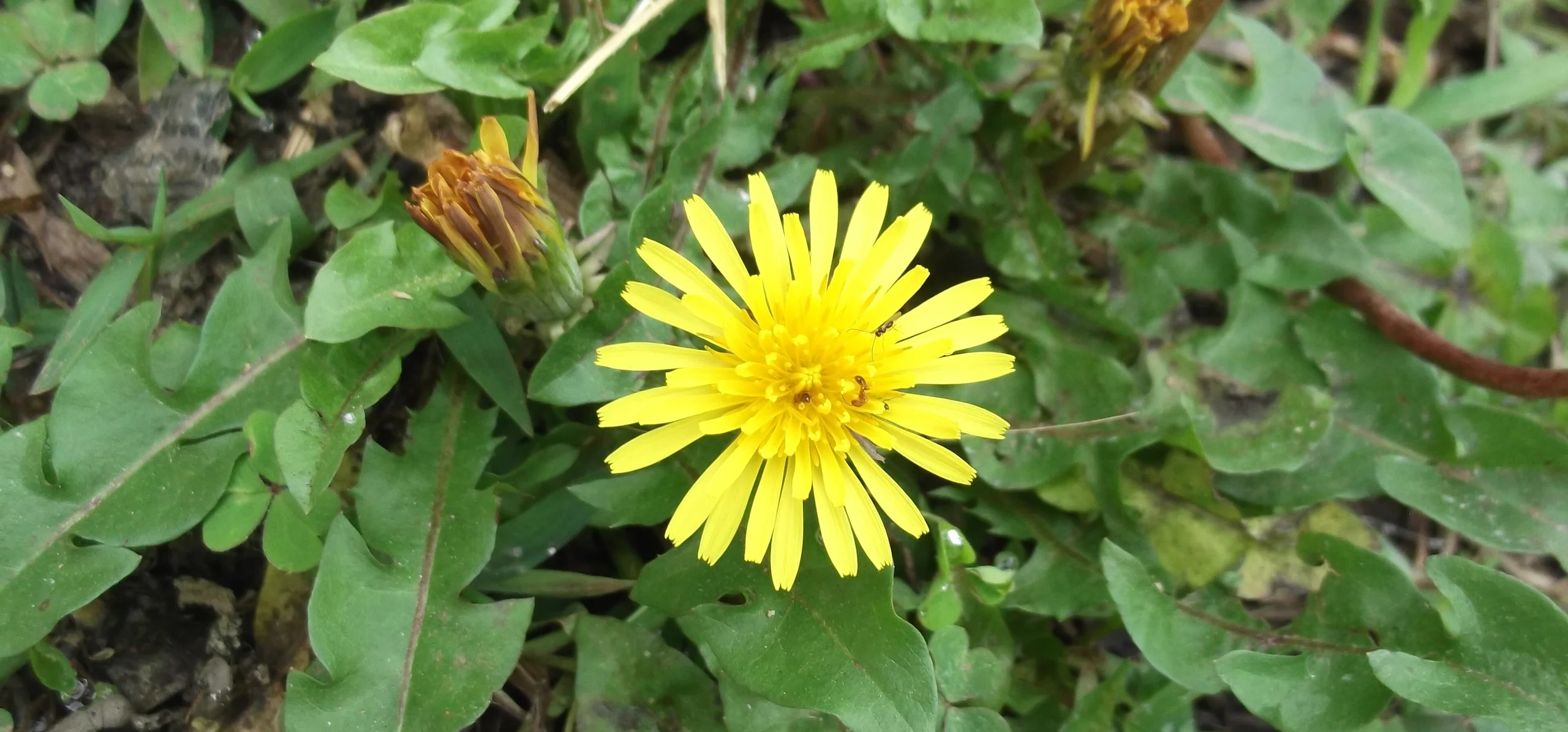
Dandelion
Taraxacum officinale
Family · Asteraceae
Identify true dandelion, understand its taproot, sun and soil range, seed dispersal, bloom rhythm, and why the ASPCA plant list leaves it out entirely.
Taraxacum officinale
Plant profile
- WateringLittleWater every 14 days
- Light exposurePartial sun
Growth
- Family
- Asteraceae
- Life cycle
- Perennial
- Growth speed
- 8/10
- Mature size
- 10–50 cm
- Spread
- 10–50 cm
- Flowering
- Nearly year-round in mild climates
- Propagation
- Seed
Dormancyminimal, stays evergreen
Time to maturityabout one year, seed to flower
Soil & climate
- Soil types
- chalk, clay, loam, sand
- Drought tolerance
- Yes
Light & Placement
- Origin
- Native to Eurasia, naturalised worldwide
- Where to place it
- lawns and grassy areas
- waste ground and verges
Safety
- Toxicity
- HumansSafe
Invasive speciesself-seeds prolifically by wind
Data fromGBIF Backbone Taxonomy: Taraxacum officiPlants of the World Online (Kew): TaraxaRHS: Taraxacum officinale (dandelion)ASPCA: Catsear (false dandelion), toxic
Where it grows
World distribution
Dandelion is native to 33 countries: Albania, Austria, Belarus, Belgium, Bulgaria, Croatia, Czechia, and Denmark….GBIF records 492,564 documented identifications across 151 countries, with the largest concentrations in Netherlands, France, and United States.
- Albania
- Austria
- Belarus
- Belgium
- Bulgaria
- Croatia
- Czechia
- Denmark
- Estonia
- Faroe Islands
- Finland
- France
Show 21 more countriesShow fewer countries
- Georgia
- Germany
- Greece
- Hungary
- Iceland
- Ireland
- Italy
- Lebanon
- Morocco
- Netherlands
- Norway
- Poland
- Portugal
- Romania
- Russia
- Spain
- Sweden
- Switzerland
- Türkiye
- Ukraine
- United Kingdom
Yellow to orange dots: concentration of documented identifications per country. Green countries: sourced native range. Source: GBIFNative range from POWO (Kew).
Taraxacum officinale, the common dandelion, rarely gets planted on purpose. It arrives as a single yellow flower head on a hollow, sap-filled stalk above a rosette of deeply toothed leaves, and within weeks that flower closes into a spherical seed head ready to scatter on the wind. The plant regrows from its taproot even after the leaves and flower are removed, which is the one fact that explains almost every question people ask about it, whether they want to keep it or be rid of it. Understanding that taproot, not the flower, is the key to managing this species.
Two Hundred Microspecies Under One Name
Taraxacum officinale belongs to the daisy family, Asteraceae, in the order Asterales, the classification GBIF's backbone taxonomy assigns to the accepted name Taraxacum officinale Weber ex F.H.Wigg. What gardeners call one species is treated by Kew's Plants of the World Online as an aggregate, Taraxacum officinale agg., a complex of roughly 200 microspecies that are hard to tell apart without technical keys. The older names attached to the plant tell the same story: botanical records list it historically as Leontodon taraxacum and Taraxacum dens-leonis, among other synonyms, a trail left by more than two centuries of reclassification within the genus. POWO records the species as native to Eurasia; it has since naturalised across temperate regions worldwide, including North America and parts of the southern hemisphere, wherever disturbed or grassy ground gives its wind-blown seed a foothold.
Full Sun or Half Shade, It Does Not Much Care
The RHS rates dandelion for full sun or partial shade and notes it tolerates east-, north-, south- or west-facing positions equally, in both exposed and sheltered spots. That flexibility is why it turns up in lawns, verges, cracks in paving and neglected borders rather than one particular garden zone. Flower heads open widest in direct sun and close on dull days and at night, following the light rather than the clock, and RHS records blooms appearing across spring, summer, autumn and even winter in mild spells, not one single flush in May. If the goal is a patch for pollinators or salad leaves rather than removal, an open, sunny corner produces sturdier rosettes and more flower heads than a shaded one, though shade alone will not stop the plant establishing.
Soil and the Taproot That Will Not Let Go
RHS lists dandelion as tolerant of chalk, clay, loam and sand, and of acid, alkaline or neutral pH alike, part of why it is nearly impossible to exclude by soil choice. The stated preference is moist but free-draining ground; waterlogged soil slows growth slightly but rarely kills the plant outright. The taproot is the real story: thick, fleshy and descending straight down, it stores enough reserves that a rosette severed at the crown by hoeing or mowing regrows within days from whatever root is left behind. A narrow, forked hand tool that reaches well below the crown removes more of the root than a flat hoe, and pulling after rain, when the soil loosens its grip, takes out noticeably more root length than pulling from dry ground.


Watering: Built for Neglect
Established dandelion needs no supplemental watering in most climates; the deep taproot reaches moisture that shallow-rooted lawn grass cannot, which is exactly why it outlasts grass through a dry summer. RHS moisture guidance for the species sits at moist-but-well-drained to well-drained, not a plant that wants its base sitting wet. For anyone growing it deliberately as a foraging patch, the only watering that matters is at the seedling stage, before the taproot has gone deep, when a dry week can kill young plants that a mature rosette would shrug off entirely.
How One Flower Becomes a Hundred Seedlings
RHS describes the species as one that seeds freely, and propagation in practice means almost nothing but seed. Each flower head closes after pollination and reopens as a spherical cluster of achenes, each one carried by a feathery pappus that catches even a light breeze and can carry it well beyond the parent plant. A single healthy plant produces several seed heads across a season, and because it flowers repeatedly through most of the year rather than once, seed production does not stop after the first flush the way it does in many perennials. Deadheading before a seed head turns from yellow to its cottony white intercepts this cycle; once the head has opened, the seed inside is already viable, and removing it only stops that particular head from dispersing, not the plant from flowering again.
Foliage and Flowering Through the Seasons
The basal rosette is evergreen by RHS's own description, so in mild climates there is no true winter dieback, only a slowdown in growth and flowering once temperatures drop. New leaves emerge pale green from the crown and darken and toughen over the following days as they expand into the jagged, backward-pointing lobes that give the genus its French-derived name, dent-de-lion, lion's tooth. Flower stalks lengthen after the leaves and stay hollow and leafless along their length, a trait that separates dandelion from several lookalike yellow composites that branch or carry leaves on the stem. RHS rates the species H7, hardy through the severest European continental winters, below -20°C, so cold is rarely what limits it; light and disturbance decide where it thrives instead.
Getting Rid of It, or Not
The most common mistake with dandelion is treating the visible rosette as the whole plant. Repeated shallow cutting or hoeing removes leaves and flowers but leaves the taproot's upper portion intact, and that portion resprouts, often producing several crowns where there was one. Full removal means levering the root out to the point where it tapers off, not just to where resistance first appears. RHS lists the species as generally pest-free and disease-free, so chemical intervention is rarely a response to plant health, it is almost always about controlling spread in lawns or beds. For anyone flipping the question around and cultivating it on purpose, the same seeds-freely habit that frustrates lawn owners makes dandelion one of the easiest plants to establish from a packet of seed sown directly where it is meant to stay.
What the Plant Is Safe Around
The ASPCA's toxic and non-toxic plant database, searched directly by name, does not include a dandelion entry at all, for cats, dogs or horses; the genus is simply absent from the list either way. That absence is different from a confirmed non-toxic rating, but it does mean there is no ASPCA record of poisoning risk to check against. For people, the plant has a long history as food: POWO records young leaves and flower heads used in salads and stir-fries, blanched leaf hearts eaten as a vegetable, flower heads fermented into wine, and the root dried and roasted as a coffee substitute. One identification note worth keeping: catsear (Hypochaeris radicata), a genuinely different plant also called false dandelion, is the species the ASPCA actually lists as toxic to horses, not Taraxacum officinale, so confusing the two in an animal-safety context is a real risk worth avoiding.
Test your plant knowledge
Tap a card to flip it and reveal the answer.
Cutting off a dandelion's flower and leaves is usually enough to kill the plant. Tap to reveal ✕ False
Dandelion tolerates a wide range of soil types, including chalk, clay, loam and sand. Tap to reveal ✓ True
The ASPCA lists dandelion (Taraxacum officinale) as toxic to cats and dogs. Tap to reveal ✕ False
Dandelion spreads almost entirely by windblown seed rather than by underground runners. Tap to reveal ✓ True
Dandelion flowers only once in spring and then stops blooming for the rest of the year. Tap to reveal ✕ False
Sources
References consulted for this guide
- GBIF Backbone Taxonomy: Taraxacum officinalegbif.org
- Plants of the World Online (Kew): Taraxacum officinalepowo.science.kew.org
- RHS: Taraxacum officinale (dandelion)rhs.org.uk
- ASPCA: Catsear (false dandelion), toxic to horsesaspca.org
- Reference entity : Wikipédiaen.wikipedia.org