Small-Leaved Linden
Tilia cordata
Family · Malvaceae
Tilia cordata thrives in full sun to part shade on moist, well-drained soil; site it clear of patios to avoid aphid honeydew, and prune it while dormant.
Tilia cordata
Plant profile
- WateringModerateWater every 7 days
- Light exposurePartial sun
- Hardiness zoneUSDA 3–7
Growth
- Family
- Malvaceae
- Life cycle
- Perennial
- Growth speed
- 5/10
- Mature size
- 1500–2100 cm
- Spread
- 1050–1500 cm
- Flowering
- Fragrant creamy-yellow flowers in clusters, June into early July
- Propagation
- Seed
- Cutting
- Layering
- Grafting
Dormancydeciduous, bare in winter
Time to maturityreaches full landscape size in roughly 20 to 50 years
Soil & climate
- Soil pH
- pH 6–8
- Soil types
- loam, clay, sand, chalk
- Saline soil
- Not tolerated
- Drought tolerance
- No
Light & Placement
- Origin
- Europe to N. Iran
- Where to place it
- Open lawn or parkland
- Street or urban planting site clear of paving and drains
- Well clear of patios, parking, or seating (aphid honeydew)
Safety
- Pet safe
- No
ToxicityNot evaluated by the ASPCA for cats, dogs, or horses; the ASPCA entry for Linden covers the related American species, Tilia americana, not this one
Invasive speciesNot listed as invasive; University of Illinois Extension notes little production of root sprouts
Data fromGBIF Backbone Taxonomy: Tilia cordata MiPlants of the World Online (Kew): Tilia RHS: Tilia cordata (small-leaved lime)NC State Extension Gardener Plant ToolboUniversity of Illinois Extension Hort An
Where it grows
World distribution
Small-Leaved Linden is native to 29 countries: Albania, Austria, Belarus, Belgium, Bulgaria, Croatia, Czechia, and Denmark….GBIF records 538,751 documented identifications across 61 countries, with the largest concentrations in Germany, United States, and Sweden.
- Albania
- Austria
- Belarus
- Belgium
- Bulgaria
- Croatia
- Czechia
- Denmark
- Estonia
- Finland
- France
- Georgia
Show 17 more countriesShow fewer countries
- Germany
- Greece
- Hungary
- Iran
- Italy
- Kazakhstan
- Netherlands
- Norway
- Poland
- Romania
- Russia
- Spain
- Sweden
- Switzerland
- Türkiye
- Ukraine
- United Kingdom
Yellow to orange dots: concentration of documented identifications per country. Green countries: sourced native range. Source: GBIFNative range from POWO (Kew).
A young Tilia cordata bought as a bare-root whip or a container-grown standard needs a permanent site chosen with its eventual size in mind: on good ground this tree reaches roughly 15 to 21 m (50 to 70 ft) with a spread of 11 to 15 m (35 to 50 ft), so the small, heart-shaped leaves that look neat on a nursery sapling will eventually shade a good part of a garden. It tolerates clay, sand, chalk, and loam, and copes well with compacted, polluted urban ground, but it sulks in waterlogged soil and in prolonged drought. The first two or three seasons after planting decide whether the tree establishes cleanly or struggles, so get the site and the watering routine right before anything else.
Choosing a Small-Leaved Linden for Your Site
The straight species makes a broad, rounded to pyramidal crown and is the parent of most street and park cultivars sold today. Where a narrower profile is needed, look for fastigiate selections bred for avenue planting; they hold a tighter, more upright shape and need less formative pruning to keep clear of pavements and windows. Buy from a nursery that has root-pruned or air-pot grown the tree: linden roots are notorious for circling inside a container, and a girdling root left uncorrected at planting can constrict the trunk a decade later.
Avoid siting any linden directly over a patio, parking space, or garden bench. Every named form still carries the same sap-sucking aphids as the species, and the sticky honeydew they drop, covered below, is a maintenance issue no cultivar solves.
Origin, Growth Habit, and Mature Size
Tilia cordata is native from Europe to northern Iran, where it grows as part of mixed deciduous woodland alongside oak and hornbeam. Planted in the open, it forms a dense, low-branched, broadly oval to pyramidal crown and typically reaches 15 to 21 m in height with a spread of 11 to 15 m, taking roughly 20 to 50 years to reach that full size. Growth is moderate rather than fast, steady but unspectacular each year once the roots are established, not the quick early growth of a birch or poplar.
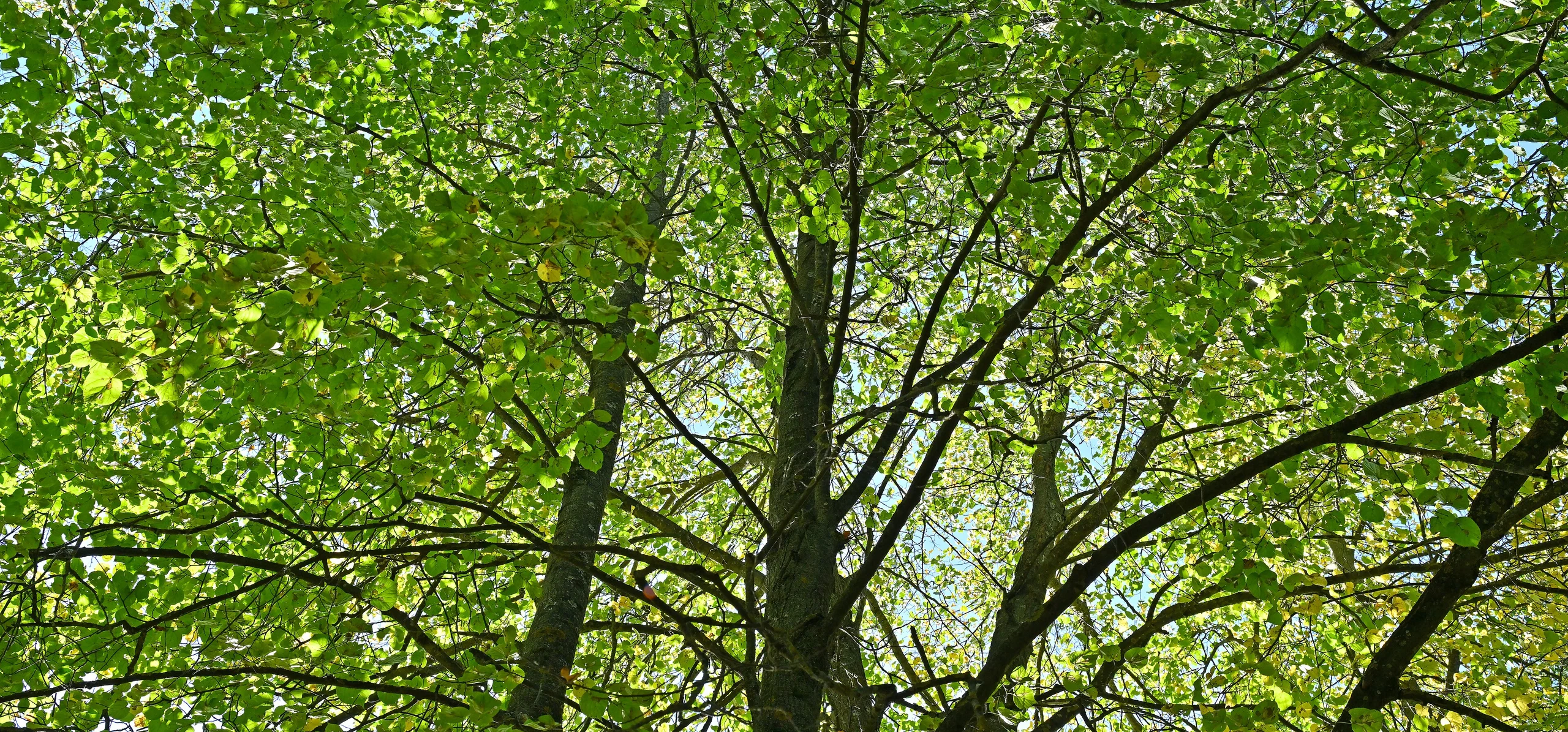
The glossy, dark green leaves are heart-shaped with a serrated edge and turn chartreuse to golden yellow in autumn. Small, fragrant, creamy-yellow flowers open in loose clusters in June into early July, followed by small, round, downy nutlets that hang from a pale, leafy bract into autumn.
Soil and Planting
Small-leaved linden is not fussy about soil texture, tolerating clay, sand, chalk, and loam, but it wants a neutral to alkaline pH, generally in the 6.0 to 8.0 range, and ground that stays moist without becoming waterlogged. Dig a planting hole at least twice the width of the root ball, loosen the sides so roots are not forced to circle, and set the trunk flare level with, or very slightly above, the surrounding soil. Backfill with the original soil rather than a rich amendment; roots that meet a sudden change in soil texture at the edge of the hole tend to stay inside it instead of spreading outward.
Stake a young standard loosely for the first year only, using a soft tie that allows some trunk movement, since movement in wind is what triggers the trunk to thicken. Remove the stake once the tree can stand unsupported, usually by the second growing season.


Watering Through Establishment and Beyond
For the first one to two growing seasons, water deeply and regularly, keeping the root ball and surrounding soil moist but never sodden. A newly planted linden that dries out in its first summer rarely recovers its vigor. Once established, the tree copes with normal seasonal rainfall in most temperate climates, but it does not tolerate severe or prolonged drought well, and stressed trees become noticeably more attractive to boring insects. During any extended dry spell in the first three to five years, give the root zone a slow, deep soak rather than a quick surface sprinkle.
Standing water is just as damaging as drought. Avoid a low spot that collects runoff, and if the ground is heavy clay, improve drainage before planting rather than trying to correct it afterward.
Siting for Sun and the Aphid Honeydew Problem
Tilia cordata grows best in full sun to partial shade and is not particular about aspect, doing equally well facing south, west, or east as long as it gets some shelter from harsh wind while young. The one siting decision that matters more than any other is what sits underneath the canopy at maturity. Linden aphids feed on the underside of the leaves in large numbers through summer and excrete honeydew that rains down onto everything below; cars, patio furniture, decking, and paving all end up coated in a sticky film that then grows black sooty mould.
There is no reliable way to prevent the aphids without also removing the ladybirds, lacewings, and hoverfly larvae that keep their numbers in check most seasons, and broad-spectrum insecticide is a poor trade for a large shade tree. The practical solution is siting: plant well clear of parking, seating, and anywhere washing might hang.
Pruning, Pollarding, and Hedging
Small-leaved linden takes heavy pruning better than almost any other large shade tree and has a long history in Europe of being pollarded, coppiced, and pleached into formal avenues and living screens. For a young standard grown as an ordinary shade tree, formative pruning in the dormant season, removing crossing, rubbing, or competing leaders, is usually all that is needed for the first several years. Established trees tolerate hard renovation cuts if the form needs correcting, though major pruning is best done in late autumn to midwinter, while the tree is fully dormant.
Because it responds so well to clipping, Tilia cordata is also a reasonable choice for a large formal hedge where a softer look than yew or box is wanted. Expect to clip it once or twice during the growing season to keep a tight outline.
Pests and Diseases
Beyond the aphids already covered, Japanese beetles feed heavily on the upper leaf surface through early and midsummer where the beetle is established, skeletonizing foliage on badly affected trees. Handpicking beetles into soapy water in the early morning, when they are sluggish, helps a small tree more than any spray. Newer imidacloprid product labels specifically prohibit use on Tilia because of the risk to pollinators visiting the flowers, so check the label before treating any pest on this genus with a neonicotinoid.
Other occasional problems include leaf miners, scale insects, and wood-boring borers, none of which usually threaten a healthy tree on its own. Verticillium wilt is the one disease worth watching for: it causes sudden wilting and dieback of individual branches, is soil-borne, and has no cure once established, so prune out and destroy affected limbs promptly.
Propagation
The species is grown from seed, though germination is slow and often erratic: seed typically needs a period of cold, moist stratification before it will germinate, and results can still be inconsistent from one seed lot to the next. For a faster, more predictable result, semi-hardwood cuttings taken in summer root reasonably well under mist, and layering, pegging a low branch into the soil until it forms its own roots, has long been used on mature trees where cuttings are impractical.
Because straight-species seed produces variable offspring, named cultivars selected for crown shape or vigor are propagated by grafting or budding onto seedling rootstock, which is why a cultivar name, rather than a size description alone, is the more reliable way to buy a specific growth habit.
Test your plant knowledge
Tap a card to flip it and reveal the answer.
Tilia cordata tolerates a wide range of soil types, including clay, sand, chalk, and loam. Tap to reveal ✓ True
A newly planted linden should be allowed to dry out between waterings during its first summer to encourage deep roots. Tap to reveal ✕ False
The sticky honeydew that coats cars and patios under a linden comes from the tree's sap dripping naturally. Tap to reveal ✕ False
Some imidacloprid pesticide labels prohibit its use on Tilia species because of the risk to pollinators. Tap to reveal ✓ True
Small-leaved linden tolerates heavy pruning and has traditionally been pollarded and pleached in Europe. Tap to reveal ✓ True
Sources
References consulted for this guide
- GBIF Backbone Taxonomy: Tilia cordata Mill.gbif.org
- Plants of the World Online (Kew): Tilia cordata Mill.powo.science.kew.org
- RHS: Tilia cordata (small-leaved lime)rhs.org.uk
- NC State Extension Gardener Plant Toolbox: Tilia cordataplants.ces.ncsu.edu
- University of Illinois Extension Hort Answers: Littleleaf Lindenweb.extension.illinois.edu
- Reference entity : Wikipédiaen.wikipedia.org