Nasturtium
Tropaeolum majus
Family · Tropaeolaceae
Nasturtium grows fast from direct-sown seed, flowers hardest in poor soil, and works as a trap crop that draws blackfly and caterpillars off vegetables.
Tropaeolum majus
Plant profile
- WateringLittleWater every 7 days
- Light exposureFull sun
Growth
- Family
- Tropaeolaceae
- Life cycle
- Annual
- Growth speed
- 7/10
- Mature size
- 20–250 cm
- Spread
- 30–250 cm
- Flowering
- Midsummer to first frost
- Propagation
- Seed
Soil & climate
- Soil types
- poor to average, well-drained
- Drought tolerance
- Yes
Light & Placement
- Origin
- Peru (cultigen)
- Where to place it
- vegetable garden bed, near beans or brassicas as a trap crop
- trellis or fence for climbing types
- hanging basket edge for trailing types
- container or hanging basket with drainage
Safety
- Toxicity
- CatsSafe
- DogsSafe
- HorsesSafe
- HumansSafe
Invasive speciesNaturalized and locally invasive in coastal California, Hawaii and parts of the Mediterranean; not a concern in temperate gardens where frost ends it every year.
Data fromGBIF: Tropaeolum majus L.Plants of the World Online (Kew): TropaeASPCA: Toxic and Non-Toxic Plants, NastuNC State Extension: Tropaeolum majusRHS: Tropaeolum majus
Where it grows
World distribution
Nasturtium is native to a single country: Peru.GBIF records 49,275 documented identifications across 128 countries, with the largest concentrations in United States, United Kingdom, and Portugal.
- Peru
Yellow to orange dots: concentration of documented identifications per country. Green countries: sourced native range. Source: GBIFNative range from POWO (Kew).
Nasturtium (Tropaeolum majus) is usually the first plant a new vegetable grower is told to sow straight into the ground, because the seed is big enough to place by hand and pushes up a seedling within a week or two once the soil has warmed. It flowers hardest on lean, unfed ground, which reverses the usual instinct to improve the soil before planting, and a rich bed pushes it into leaves instead of flowers. Left to its own devices it either climbs or trails depending on the variety sown, self-seeds hard enough that most beds never need resowing, and stops dead at the first real frost. Along the way it earns a permanent spot near beans and brassicas less for its own flowers than for the blackfly and cabbage white caterpillars it pulls off the vegetables next to it.
Origin and Two Growth Habits
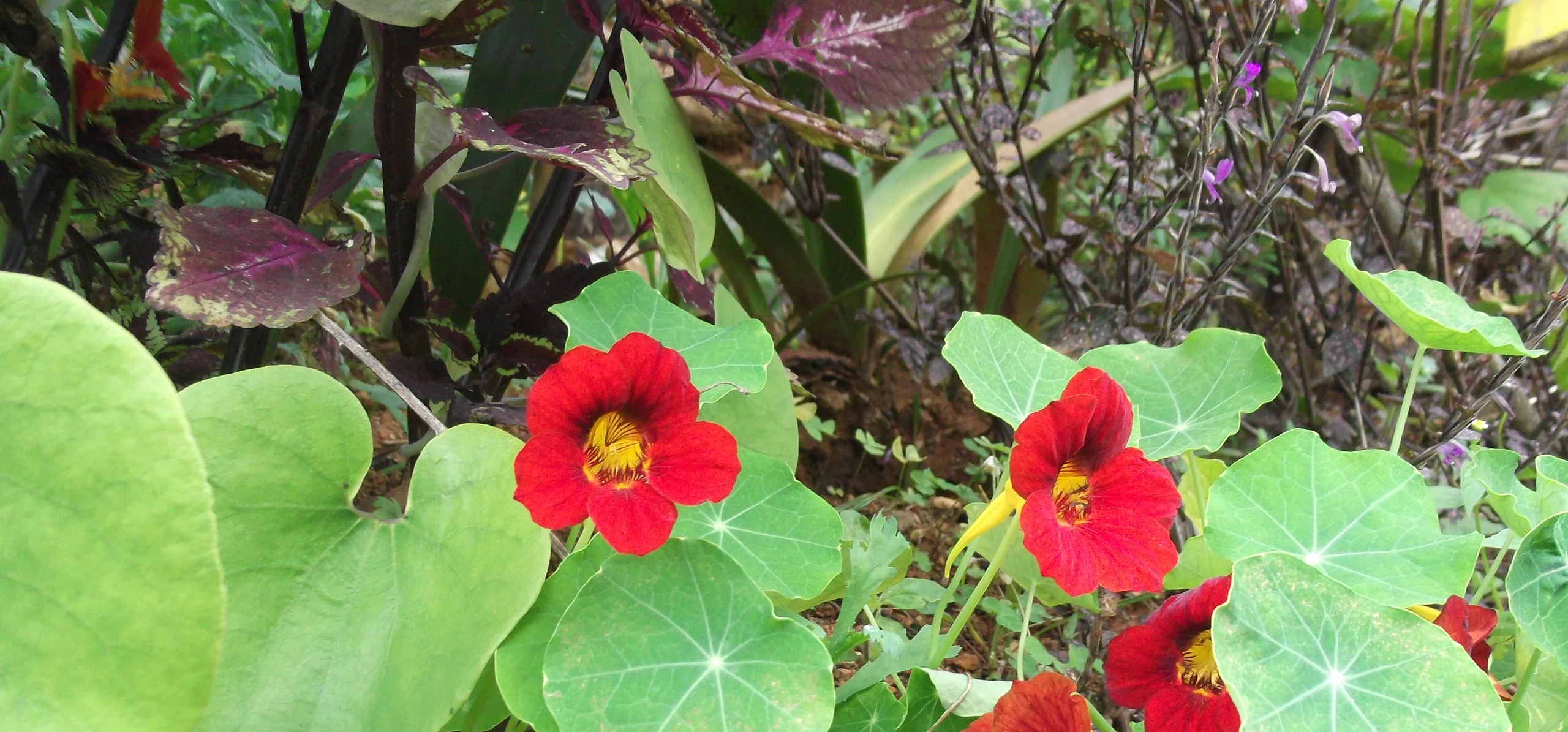
Plants of the World Online lists Tropaeolum majus as native to Peru as a cultigen, meaning the wild ancestor is not known in nature and the species as gardeners know it was shaped in cultivation from South American Tropaeolum relatives. It belongs to the family Tropaeolaceae, a small group of climbers and scramblers unrelated to the true watercress it sometimes gets confused with (see below). The rounded, wavy-edged leaves are peltate, meaning the stalk attaches near the centre of the leaf rather than at the edge, giving each one the look of a small green parasol. Flowers are long-spurred and funnel-shaped, in reds, oranges and yellows from midsummer into autumn. Two distinct growth habits show up depending on the variety: trailing or climbing types twine their leaf stalks around wire or twiggy supports and can reach 1.5 to 2.5 metres, according to the RHS, while bush types stay compact and mounding.
Choosing a Variety: Trailing or Bush
'Alaska' is a bush type grown as much for its foliage as its flowers: the leaves come out marbled with irregular cream-white variegation, so the plant reads as ornamental even before the first bud opens. 'Empress of India' is a compact, non-trailing selection with unusually dark, blue-green leaves that make its deep crimson-red flowers stand out hard against the foliage rather than blending into ordinary green. 'Jewel', sold as Jewel Mix or the Jewel Series, is a dwarf, bushy strain in mixed reds, oranges and yellows, some of them semi-double, bred for bedding and containers rather than climbing over a fence. None of these three trails or climbs the way the species does left to itself; if height and coverage on a trellis is the goal, look for plants simply sold as climbing nasturtium rather than one of these named bush selections.
Direct Sowing After the Last Frost
Wait until the soil has warmed and the last frost date has passed, then push each seed about 1 to 2 cm deep into the bed where the plant is meant to grow. Germination usually takes one to two weeks in warm soil, faster if the hard seed coat has been nicked or soaked overnight first. Nasturtium resents root disturbance enough that most growers skip trays altogether; where an early start is wanted in a cold climate, sow into biodegradable pots instead so the whole thing goes into the ground without exposing the roots. Space bush types roughly 25 to 30 cm apart and give climbing types a support to reach as they grow, since a trailing plant with nothing to climb will simply sprawl across the ground and root at the nodes as it goes.


Poor Soil for Flowers, Rich Soil for Leaves
The RHS is specific on this point: nasturtium is best grown in poor, well-drained soil in full sun, because soil that is too rich produces foliage at the expense of flowers. In practice this means skipping the compost and fertiliser most other annuals get, especially anywhere nitrogen has built up, such as a bed that recently grew beans or was heavily manured. A gardener chasing flowers for cutting or for the vegetable garden's pest-trapping role wants the leanest corner available; a gardener growing it mainly for the peppery leaves can afford average soil and will get a bushier, leafier plant for the trouble. Either way, drainage matters more than fertility: standing water rots the seed before it germinates and kills established plants faster than a dry spell ever will.
A Trap Crop for Blackfly and Cabbage White Caterpillars
Nasturtium does not repel pests; it attracts them, and that is exactly the point. Black bean aphid, known as blackfly in the UK, colonises nasturtium in preference to broad beans, runner beans and other legumes nearby, so a stand of nasturtium planted between rows or along the edge of a bean bed draws the colony onto itself instead. Once the aphids are concentrated there, a jet of water from a hose knocks most of them off, and ladybirds and hoverflies typically clean up what is left within a couple of weeks. The same plant lures large and small white butterflies, whose caterpillars would otherwise strip cabbages and other brassicas; the moths lay eggs on nasturtium leaves instead, and the ragged holes that follow are a sign the trap crop is doing its job rather than a problem to spray for. Picking caterpillars off by hand keeps the nasturtium from being defoliated outright while still leaving the main crop alone.
Harvest: Leaves, Flowers and Poor Man's Capers
Both leaves and flowers are edible and carry a sharp, peppery, mustard-like bite that gets stronger as the plant sits in full sun and dry soil. Pick leaves young for salads, where the flavour reads closer to watercress or arugula than to anything sweet, and pick flowers whole to use as an edible garnish; both wilt within hours of picking and are best used the same day. The unripe green seed pods, harvested while still soft and before they dry and split, can be pickled in vinegar and used in place of true capers, a substitution old enough to have earned nasturtium the nickname poor man's capers in some kitchens. Leave a portion of pods on the plant unpicked if self-seeding for next year is wanted, since a pod pickled today cannot also drop seed in autumn.
Self-Seeding and the End of Season
A nasturtium bed left to finish its own cycle drops seed heavily as pods dry and split in late summer, and NC State Extension lists self-seeding as the plant's main way of spreading through a garden from one year to the next. Volunteers turn up the following spring, often earlier and more numerous than a fresh sowing, which is why many gardeners stop deliberately sowing nasturtium after the first year and simply let the bed reseed itself. Deadheading spent flowers before the pods mature trades a shorter self-seeding cycle for fewer volunteers to weed out of paths and neighbouring beds. Regardless of how much seed is allowed to drop, the plant itself is frost-tender and collapses fast: a single hard frost blackens the leaves and stems overnight, and that, rather than any disease or pest, is usually what actually ends the season for good.
Toxicity and a Note on the Name
The ASPCA lists garden nasturtium (Tropaeolum majus) as non-toxic to cats, dogs and horses, which lines up with its long history as a salad and garnish plant for people as well. That non-toxic listing belongs specifically to Tropaeolum majus: the ASPCA keeps a separate entry for nasturtium (watercress), which covers Nasturtium officinale, a true watercress in the mustard family that happens to share the common name by historical accident rather than by any botanical relationship. The two plants taste peppery for unrelated reasons and are otherwise nothing alike, so garden nasturtium is worth calling by its Latin name, Tropaeolum majus, whenever there is room for confusion.
Test your plant knowledge
Tap a card to flip it and reveal the answer.
Nasturtium flowers most freely in poor, unfertilized soil rather than rich soil. Tap to reveal ✓ True
Nasturtium seedlings transplant easily and are usually started indoors in trays. Tap to reveal ✕ False
Nasturtium is used as a trap crop to draw blackfly and cabbage white caterpillars away from beans and brassicas. Tap to reveal ✓ True
The ASPCA lists garden nasturtium (Tropaeolum majus) as toxic to cats and dogs. Tap to reveal ✕ False
Garden nasturtium (Tropaeolum majus) is the same plant, botanically, as true watercress. Tap to reveal ✕ False
Sources
References consulted for this guide
- GBIF: Tropaeolum majus L.gbif.org
- Plants of the World Online (Kew): Tropaeolum majus L.powo.science.kew.org
- ASPCA: Toxic and Non-Toxic Plants, Nasturtiumaspca.org
- NC State Extension: Tropaeolum majusplants.ces.ncsu.edu
- RHS: Tropaeolum majusrhs.org.uk
- Reference entity : Wikipédiaen.wikipedia.org