Calla Lily
Zantedeschia aethiopica
Family · Araceae
Calla lily care: RHS H4 hardiness, planting in up to 30cm of water, mulching for winter, dividing rhizomes, and why it turns invasive in California.
Zantedeschia aethiopica
Plant profile
- WateringVery highWater every 3 days
- Light exposurePartial sun
- Ideal temperature-10–32 °C
- Hardiness zoneUSDA 8–10
Growth
- Family
- Araceae
- Life cycle
- Perennial
- Growth speed
- 5/10
- Mature size
- 50–100 cm
- Spread
- 10–50 cm
- Flowering
- Late spring into summer
- Propagation
- Seed
- Division
- Offsets
Dormancydeciduous to semi-evergreen, dies back in cold or dry winters
Time to maturity5-10 years to ultimate size
Soil & climate
- Soil types
- clay, loam
- Drought tolerance
- No
Light & Placement
- Origin
- South Africa, Lesotho and Eswatini
- Where to place it
- cool greenhouse or conservatory for winter storage
- pond margins and bog gardens
- consistently moist border in full sun or part shade
- large container in loam-based compost kept constantly moist
Safety
- Toxicity
- CatsToxic
- DogsToxic
- HumansToxic
Invasive speciesinvasive in California wetlands and along waterways in Western Australia and New Zealand
Data fromZantedeschia aethiopica (L.) Spreng., GBZantedeschia aethiopica (L.) Spreng., PlRHS: Zantedeschia aethiopica (arum lily,RHS: Zantedeschia aethiopica 'CrowborougZantedeschia aethiopica, Missouri BotaniToxic and Non-Toxic Plants: Calla Lily,
Where it grows
World distribution
Calla Lily is native to 3 countries: Eswatini, Lesotho, and South Africa.GBIF records 48,316 documented identifications across 102 countries, with the largest concentrations in Australia, South Africa, and Portugal.
- Eswatini
- Lesotho
- South Africa
Yellow to orange dots: concentration of documented identifications per country. Green countries: sourced native range. Source: GBIFNative range from POWO (Kew).
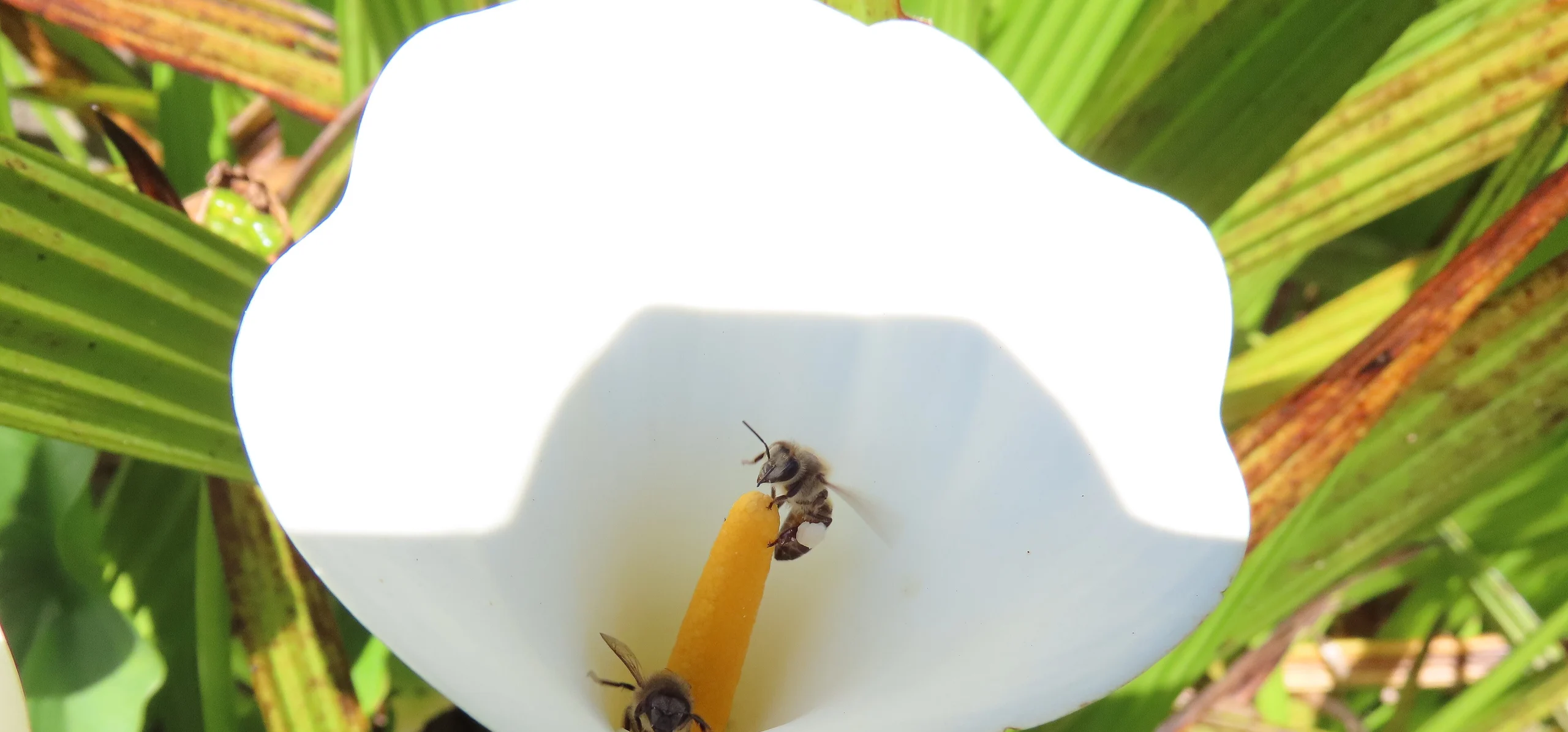
Zantedeschia aethiopica, the calla lily or arum lily, is a rhizomatous perennial from marshes and streambanks in southern Africa, and it behaves like a bog plant rather than an ordinary border perennial: the roots want to stay wet, not just watered occasionally. The white funnel-shaped spathe wrapped around a central yellow spadix opens from late spring into summer above arrow-shaped, glossy leaves that can reach knee to waist height in a good pond-edge planting. RHS rates the species H4, hardy to roughly -10 to -5 degrees C, so in most of the UK it survives outdoors under a thick mulch, while in colder regions the rhizomes need lifting before the first hard frost. Every part of the plant carries calcium oxalate crystals, harmful if eaten and irritating to skin, so gloves matter as much as watering.
Origin: Marshes and Streambanks, Not Dry Borders
The species is native to South Africa, Lesotho and Eswatini, where it grows in coastal marshes, montane grasslands and the damp ground around old homesteads rather than open veld. It is not a true lily at all, it belongs to the arum family, Araceae, and what looks like a single large petal is a spathe, a modified leaf that wraps around the spadix carrying the tiny true flowers. European gardeners have grown it since at least the 1660s, which is unusually long for a South African import and explains how many regional names it has picked up, altar lily, pig lily and trumpet lily among them.
Choosing 'Crowborough' and Other Forms
'Crowborough', named after the town in East Sussex, is the form most commonly sold as the hardy garden calla, and RHS lists it at the same H4 rating as the species, with a reputation among growers for flowering a little earlier and more reliably outdoors in cool summers than unnamed seedlings. Showier cultivars such as 'Green Goddess', with green-tipped spathes, and double-flowered forms are usually sold as container or florist plants rather than as pond-margin perennials, and are generally treated as more tender. If a label just says "Zantedeschia aethiopica" with no cultivar name, assume species-level hardiness and protect it accordingly the first winter.
Planting at the Pond Margin or in a Border
This is one of the few popular perennials that genuinely thrives as a marginal aquatic: RHS notes it can be grown in water up to 30cm deep, rhizome and crown submerged, alongside pickerel weed or marsh marigold. In ordinary ground, plant rhizomes 7 to 10cm deep and 30 to 45cm apart in spring once frost risk has passed, into clay or loam that RHS describes as tolerating poorly-drained conditions, a trait that would rot most other perennials. Soil pH is not fussy, acid, neutral or alkaline all work, which is one reason the plant has settled into such a wide range of habitats outside cultivation.


Light, Water and Feeding
Full sun suits calla lily in cool, reliably moist climates, but part shade produces better foliage where summers run hot, Missouri Botanical Garden specifically recommends part shade for its own St Louis conditions. The one rule that overrides all others is moisture: soil or mud that dries out even briefly during the growing season checks flowering and scorches leaf tips, so this is not a plant to pair with drought-tolerant neighbours on the same watering schedule. Feed monthly with a balanced liquid feed through spring and summer, container plants especially, since constant watering leaches nutrients out of the compost quickly.
Hardiness, Mulching and Winter Care
Missouri Botanical Garden rates the species winter hardy to USDA zone 8, with some plants surviving zone 7 given protection, which lines up with the RHS H4 figure of -10 to -5 degrees C. In marginal climates, a mulch layer over the crown, 10 to 15cm of bark or straw, gets an in-ground clump through winter in most years. Where winters run colder still, lift the rhizomes in autumn and store them in barely damp peat or sand somewhere frost-free, or simply pot up the plant and bring it indoors as a houseplant until spring, watering sparingly while it rests.
Dividing and Propagating
Divide congested rhizome clumps in spring as new growth starts, cutting or breaking the rhizome into sections that each carry at least one growing point, and replant immediately since the fleshy tissue dries out fast once exposed. RHS notes that flowers are sometimes followed by orange, berry-like fruits, and in the wild these seeds are spread by birds, which is the other route the species uses to colonise new ground well beyond where anyone planted it.
An Aggressive Escape: Invasiveness in California and Australia
Outside its native range, calla lily is not a background garden plant, it is an active management problem. UC ANR describes it as a fast-growing invasive in California, where bird-dispersed seed and dumped rhizome fragments let it escape cultivation and form dense stands in riparian and wetland areas that crowd out native vegetation. In Western Australia and parts of New Zealand it behaves the same way along waterways and pastures, aggressive enough that some Australian states restrict it as a declared weed. The practical takeaway for any grower near a stream, drain or wild wetland edge is simple, never tip spent rhizomes, thinnings or spent flower heads into a compost pile that drains toward open water.
Toxicity and Handling
ASPCA lists calla lily as toxic to both cats and dogs, the toxic principle is insoluble calcium oxalate crystals throughout the leaves and rhizome, and a chewed leaf typically causes oral irritation, intense drooling, vomiting and difficulty swallowing rather than anything more severe. RHS gives the same warning for people, harmful if eaten and a skin and eye irritant on contact with the sap, so wear gloves when dividing rhizomes or cutting back foliage, and keep cut stems away from curious pets and small children until any handling residue is washed off.
Test your plant knowledge
Tap a card to flip it and reveal the answer.
Zantedeschia aethiopica can be grown as a marginal aquatic plant, its rhizome submerged in up to 30cm of water. Tap to reveal ✓ True
Letting the soil dry out between waterings improves flowering in calla lily. Tap to reveal ✕ False
The RHS-rated hardy cultivar 'Crowborough' can survive outdoors in most of the UK with a deep winter mulch. Tap to reveal ✓ True
Calla lily is considered a background, non-invasive garden plant everywhere it has been introduced. Tap to reveal ✕ False
ASPCA lists calla lily as toxic to cats and dogs due to insoluble calcium oxalate crystals. Tap to reveal ✓ True
Sources
References consulted for this guide
- Zantedeschia aethiopica (L.) Spreng., GBIF Backbone Taxonomygbif.org
- Zantedeschia aethiopica (L.) Spreng., Plants of the World Online (Kew)powo.science.kew.org
- RHS: Zantedeschia aethiopica (arum lily, altar lily)rhs.org.uk
- RHS: Zantedeschia aethiopica 'Crowborough' (arum lily)rhs.org.uk
- Zantedeschia aethiopica, Missouri Botanical Garden Plant Findermissouribotanicalgarden.org
- Toxic and Non-Toxic Plants: Calla Lily, ASPCAaspca.org
- When Ornamentals Escape, UC ANR Pests in the Urban Landscapeucanr.edu
- Reference entity : Wikipédiaen.wikipedia.org