Montbretia
Crocosmia crocosmiiflora
Family · Iridaceae
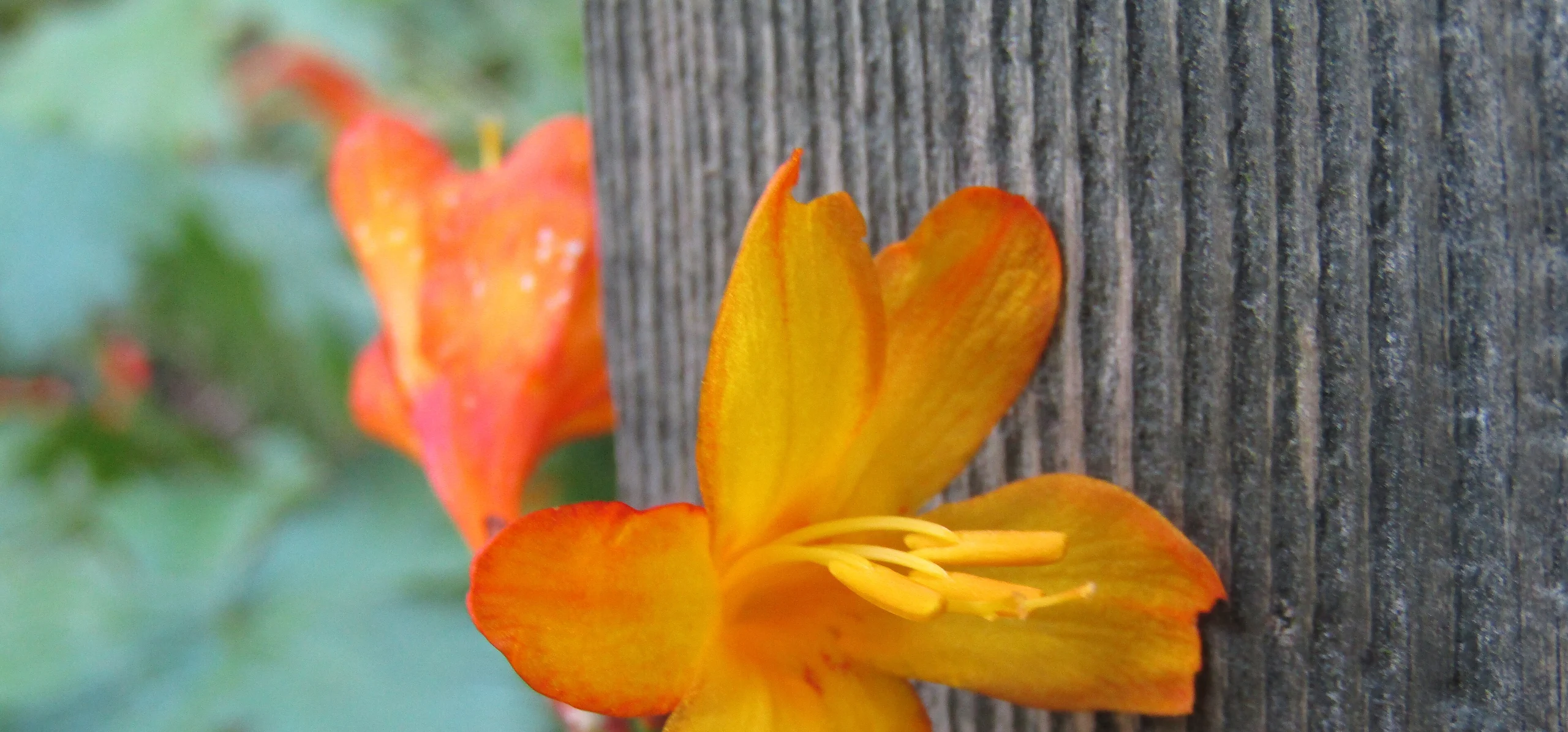
Crocosmia crocosmiiflora, montbretia, throws up orange sprays from fast-spreading corms bred in France in 1880. Planting depth, division, invasive status.
Crocosmia crocosmiiflora
Plant profile
- WateringModerateWater every 7 days
- Light exposurePartial sun
- Ideal temperature-10–-5 °C
Growth
- Family
- Iridaceae
- Life cycle
- Perennial
- Growth speed
- 6/10
- Mature size
- 50–100 cm
- Spread
- 10–50 cm
- Propagation
- Division
- Offsets
- Seed
FloweringMid to late summer; sprays of orange, funnel-shaped flowers 3-5 cm across on arching stems
Dormancydeciduous top growth dies back after autumn frosts; corms rest below ground and resprout in spring, per the RHS
Time to maturity2-5 years to a full-sized clump, per the RHS
Soil & climate
- Soil types
- chalk, clay, loam, sand
- Drought tolerance
- No
Light & Placement
- Where to place it
- sunny or lightly shaded border
- cottage garden bed
- large container on a patio
- naturalistic streamside or wildlife planting
- large container with free-draining compost, corms planted about three times their own depth
OriginGarden hybrid bred in France in 1880 from Crocosmia aurea and Crocosmia pottsii, two species native to South Africa from the Eastern Cape to KwaZulu-Natal, per Plants of the World Online
Safety
- Pet safe
- Yes
ToxicityNot individually listed by the ASPCA; discourage pets from digging up and chewing the corms
Invasive speciesListed on Schedule 9 of the UK Wildlife and Countryside Act: illegal to plant or cause it to grow in the wild in Great Britain, per the RHS. Also naturalized as a garden escape in Ireland, New Zealand, Australia and along the US West Coast; never dump corms or garden waste where they can spread.
Data fromCrocosmia × crocosmiiflora (Lemoine) N.ERHS: Crocosmia × crocosmiiflora, montbreRHS Growing Guide: how to grow crocosmiaRHS: Crocosmia 'Lucifer', montbretia 'Lu
Where it grows
World distribution
Montbretia is native to a single country: South Africa.GBIF records 20,777 documented identifications across 87 countries, with the largest concentrations in Australia, New Zealand, and United States.
- South Africa
Yellow to orange dots: concentration of documented identifications per country. Green countries: sourced native range. Source: GBIFNative range from POWO (Kew).
If clumps of strappy, sword-shaped leaves have thrown up wiry stems tipped with small, funnel-shaped orange flowers by late summer, this is very likely Crocosmia crocosmiiflora, the montbretia found along hedgebanks, stream sides and neglected borders across much of Britain. It is not a wild species collected from nature: French nurseryman Victor Lemoine crossed two South African plants, Crocosmia aurea and Crocosmia pottsii, and put the hybrid on sale in 1880. The tough, orange-flowered form that spreads on its own is usually this original cross or an unnamed seedling from it; named cultivars sold in nurseries today, such as 'Lucifer', 'Emily McKenzie' and 'George Davison', are a more deliberate proposition bred from the same parentage. Either way, corms planted in spring settle in fast and, once established, ask very little beyond water in dry spells and a tidy-up each winter.
A French Hybrid from Two South African Species
GBIF's backbone taxonomy records the accepted name as Crocosmia crocosmiiflora, family Iridaceae, order Asparagales, the same order as the true crocuses and gladioli it is unrelated to by common name alone. Plants of the World Online traces the native range of its two parent species to South Africa, specifically the area running from the Eastern Cape Province to KwaZulu-Natal, where Crocosmia aurea and Crocosmia pottsii grow as subtropical geophytes. Lemoine's cross combined the larger flowers of one parent with the hardiness of the other, and the result proved so vigorous in French and then British gardens that it had escaped cultivation within a few decades of its 1880 introduction. The long list of synonyms attached to it, Montbretia crocosmiiflora among them, reflects the old common name and the genus it was originally placed in before botanists moved it into Crocosmia.
The Tough Roadside Form versus Named Cultivars
The plant naturalized in ditches and on waste ground is almost always the tough old form: smaller flowers, a deep orange color, and a corm system that multiplies fast enough to out-compete whatever grows around it. Garden cultivars bred from the same cross are more restrained and far more varied in color. 'Emily McKenzie' carries large, burnt-orange flowers marked with a deep mahogany-red throat and holds an RHS Award of Garden Merit; 'George Davison', raised by the Norfolk head gardener whose name it bears and given an RHS Award of Merit in 1902, opens earlier than most, in arching sprays of golden-orange. 'Lucifer', the cultivar most often sold for its fiery color and its height of around 1.5 m, is technically classified by the RHS as Crocosmia 'Lucifer' rather than as a crocosmiiflora cultivar, though it is commonly grouped with montbretia in catalogs; it is also rated hardier, RHS H5 to about -15 degrees C, against H4 for the species itself.
Planting Corms in Spring
Plant corms in spring, in full sun for the strongest flowering, though the RHS notes light shade is tolerated with some loss of bloom. The RHS recommends setting each corm at about three times its own depth, roughly 8-10 cm for an average corm, spaced 10-20 cm apart, pointed end up and in groups rather than singly for the best display. Soil should be moist but well-drained; the RHS lists chalk, clay, loam and sand as all workable, across acid, neutral or alkaline pH, but warns against both waterlogged ground and very dry, free-draining spots. Container-bought plants already in growth go in the same way as any other herbaceous perennial and should flower in their first year.


Watering and Feeding Through the Growing Season
Newly planted corms need regular water until they root in; established clumps are more forgiving but still flower better with a drink during a dry spell, since the RHS names poor flowering from dry soil as one of the most common problems reported. Containers dry out faster than open ground and are worth checking often in summer heat. Crocosmia is not a heavy feeder: a spring mulch of garden compost over the corms does most of the work, adding both nutrients and, in cold areas, a layer of insulation for the corms beneath.
Dividing Congested Clumps
Left alone, a montbretia clump multiplies by forming chains of small new corms stacked on top of the old ones, and after three to five years this crowding shows up as fewer flowers rather than more. The RHS fix is to lift the dormant corms in early spring, before growth restarts, break the chains apart into individual corms, discard the oldest and driest ones at the bottom, and replant the healthy corms in smaller, better-spaced groups. This is also the easiest way to propagate the plant deliberately, since named cultivars do not come true from self-sown seed.
Winter Protection and Red Spider Mite
Leave the faded foliage standing over winter if there is no strong reason to tidy it, since the RHS notes it gives shelter to garden wildlife; cut it back to ground level in late winter or early spring, just before new growth appears. In cold gardens, a thick mulch laid over the corms in late autumn protects them through frost, since the species itself is rated RHS H4, hardy to only about -10 to -5 degrees C, noticeably less hardy than 'Lucifer' at H5; where winters regularly fall colder than that, growing the plant in a container that can be moved under cover for winter is the more reliable option. In the opposite season, the pest worth watching for is red spider mite, which the RHS flags as a risk specifically in hot, dry summers, when it feeds on sap from the underside of the sword-shaped leaves and leaves a fine, dry mottling across the foliage; keeping the soil from drying out completely during a heatwave is the main defense, since the mite thrives on stressed, drought-affected plants, and a soak during a prolonged dry spell does more to prevent an infestation than any treatment does to cure one once mottling has already spread.
A Garden Escape Well Beyond Britain
The RHS lists Crocosmia crocosmiiflora on Schedule 9 of the Wildlife and Countryside Act: it remains legal to grow and to sell, but it is an offence to plant it, or allow it to spread, in the wild anywhere in Great Britain. The same spreading habit, by corm chains and by seed, has also made it a naturalized garden escape in Ireland, an environmental weed along roadsides, stream banks and coastal ground in New Zealand and Australia, and an established plant along parts of the US West Coast. None of this is a reason to avoid growing it in a garden bed, but corms and garden waste from a clump should go into a bin, never onto a verge, a hedge bottom or a compost heap that might spread it further; where a clump needs thinning, the surplus corms are worth offering to another gardener before anything else.
Pollinators and Pet Safety
The tubular flowers suit long-tongued visitors: bees work them for nectar in British gardens, and in North America, where the plant is also grown as an ornamental, hummingbirds are drawn to the same orange, trumpet-shaped blooms. The ASPCA's toxic and non-toxic plants database carries no individual montbretia or crocosmia entry, so no formal toxicity status has been published either way; as with any corm plant, it is sensible to discourage pets from digging up and chewing on the corms rather than to assume they are entirely risk-free.
Test your plant knowledge
Tap a card to flip it and reveal the answer.
Crocosmia crocosmiiflora is a naturally occurring wild species. Tap to reveal ✕ False
In Great Britain, it is an offence to plant montbretia in the wild. Tap to reveal ✓ True
Crocosmia corms should be planted around 30 cm deep for the best results. Tap to reveal ✕ False
Dividing congested clumps every few years keeps them flowering well. Tap to reveal ✓ True
The ASPCA lists montbretia as toxic to cats and dogs. Tap to reveal ✕ False
Sources
References consulted for this guide
- Crocosmia × crocosmiiflora (Lemoine) N.E.Br., GBIF Backbone Taxonomygbif.org
- Crocosmia × crocosmiiflora (Lemoine) N.E.Br., Plants of the World Online (Kew)powo.science.kew.org
- RHS: Crocosmia × crocosmiiflora, montbretiarhs.org.uk
- RHS Growing Guide: how to grow crocosmiasrhs.org.uk
- RHS: Crocosmia 'Lucifer', montbretia 'Lucifer'rhs.org.uk
- Reference entity : Wikipédiaen.wikipedia.org