Zonal Geranium
Pelargonium hortorum
Family · Geraniaceae
Pelargonium hortorum needs full sun and compost that dries between waterings; covers deadheading, feeding, overwintering, rust, whitefly and toxicity to pets.
Pelargonium hortorum
Plant profile
- WateringLittleWater every 7 days
- Light exposurePartial sun
- Ideal temperature1–35 °C
Growth
- Family
- Geraniaceae
- Life cycle
- Perennial
- Growth speed
- 6/10
- Mature size
- 10–50 cm
- Spread
- 10–50 cm
- Propagation
- Seed
- Cutting
FloweringDense, rounded clusters of red, pink, salmon, white or bicolor flowers from late spring to first frost with regular feeding
Dormancynone in frost-free climates; semi-dormant when cut back and kept near-dry indoors over winter
Time to maturityflowers within a single growing season; seed strains germinate in 1 to 3 weeks and typically bloom by early summer from a late-winter sowing
Soil & climate
- Soil pH
- pH 6.5–7.5
- Soil types
- chalk, clay, loam, sand
- Drought tolerance
- Yes
Light & Placement
- Where to place it
- sunny south-facing windowsill for overwintered cuttings
- full-sun bed or border
- window box or hanging basket in full sun
- sheltered south, west or east-facing spot
- well-drained pot with peat-free, loam-based potting compost
OriginGarden hybrid (Pelargonium zonale x Pelargonium inquinans) with no wild native range; both parents native to South Africa's Cape provinces
Safety
- Toxicity
- CatsToxic
- DogsToxic
- HorsesToxic
Data fromPelargonium x hortorum L.H.Bailey, GBIF Plants of the World Online (Kew): PelargRHS: Pelargonium x hortorum (zonal geranRHS: Pelargonium Rust, how to manageASPCA: Toxic and Non-Toxic Plants, GeranUniversity of Florida IFAS Extension (FP
Where it grows
World distribution
GBIF records 1,309 documented identifications across 39 countries, with the largest concentrations in Sweden, United States, and Brazil.
Yellow to orange dots: concentration of documented identifications per country. Green countries: sourced native range. Source: GBIF.
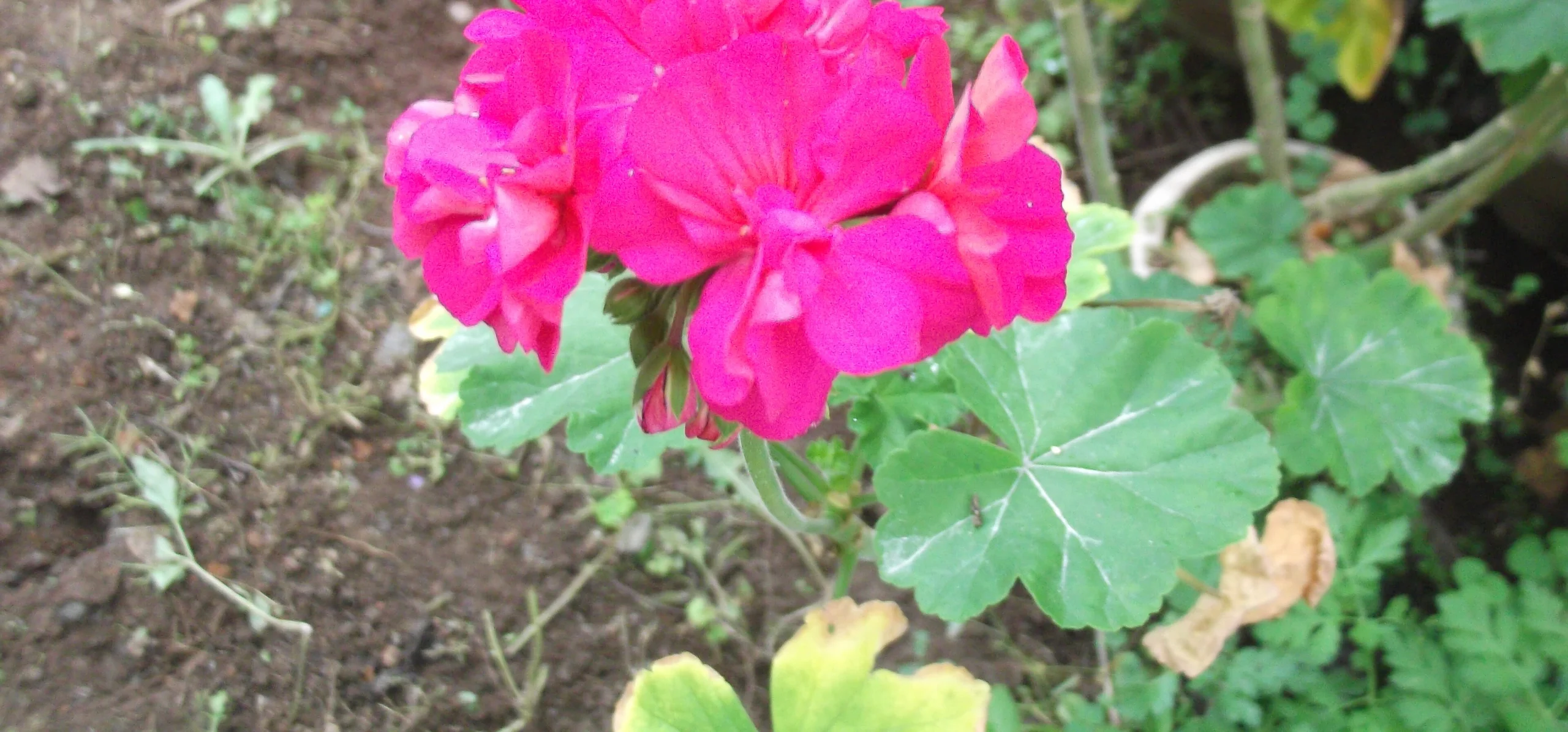
The geranium sold by the flat every spring, the plant that fills window boxes and porch pots in dense balls of red or pink, is not a hardy Geranium at all: it is Pelargonium hortorum, a frost-tender hybrid gardeners have shortened to geranium since Victorian times. It wants a full day of direct sun and a pot or bed that drains fast enough for the compost to go properly dry between waterings, because kept damp, the stems rot and the lower leaves develop soft, grey mould before anything else goes wrong. Deadhead whole flower stalks rather than picking off single florets, feed it through the growing season, and one plant keeps producing rounded flower heads from late spring until the first hard frost. Every part of it is toxic to cats and dogs, so keep pots out of reach of a chewing pet.
A Bred Hybrid With No Wild Home
Plants of the World Online lists Pelargonium hortorum as a nothospecies, the term for a hybrid stable enough to carry its own name: it arose from crosses between Pelargonium zonale, native from South Africa's Cape Province to KwaZulu-Natal, and Pelargonium inquinans, native from Mpumalanga to the Eastern Cape. Because it is a garden-bred cross rather than a species that evolved on its own, it has no native range; GBIF's accepted classification places it in Geraniaceae, the geranium family, under the genus Pelargonium in the order Geraniales, a different genus entirely from the hardy, temperate Geranium that shares the common name. The word zonal refers to the dark, horseshoe-shaped band that crosses each rounded leaf, ranging from a faint bronze tint to a near-black ring depending on the cultivar; it is a normal identifying mark of this hybrid, not a nutrient problem. An older name, Pelargonium monstrum, sometimes turns up on very old plant tags for the same cross.
Seed-Raised Strains and Cutting-Grown Cultivars
Two distinct production methods supply the geraniums sold each spring. F1 seed strains, bred for uniform, fast flowering, germinate in one to three weeks at 70 to 75 degrees Fahrenheit according to University of Florida IFAS Extension and typically reach bloom by early summer from a late-winter sowing; they tend to shrug off summer heat and are the type most often sold in cell packs. Cutting-raised, or vegetative, cultivars such as Ginger Rogers or Vancouver Centennial are cloned from a named parent plant, so every plant of that name is genetically identical, unlike a seed strain that shows some variation from plant to plant. Vegetative cultivars usually cost more and are the type worth keeping over winter as cuttings, since a seed strain will not reliably come back true from its own seed.
Full Sun and a Compost That Dries Between Waterings
The RHS is specific about both light and water: full sun to part shade in a sheltered spot with a south, west or east-facing aspect, and irrigation that is moderate from spring to summer and sparing in winter, always letting the compost dry out between waterings. In practice that means checking the pot by feel rather than watering on a fixed schedule: a plant that wilts slightly between waterings and perks back up within the hour is being treated correctly, while one that stays limp after watering, or whose lower leaves yellow and drop, is usually sitting too wet. Overwatering, not underwatering, kills most zonal geraniums: waterlogged compost brings on stem and root rot, and in cool, humid weather the classic symptom is grey mould felting over damaged flowers and soft stem tissue. A pot with a generous drainage hole matters more for this plant than for most bedding annuals.


Feeding for Nonstop Bloom
RHS guidance calls for a balanced liquid feed through the growing season, switching to a high-potassium formula, the kind sold for tomatoes, once flowering starts, since potassium favours flowers over leafy growth. University of Florida IFAS Extension makes the same point from the other direction: yellowing leaves and a plant that stalls out by midsummer usually mean feeding has lapsed rather than pointing to a pest or disease. A weekly diluted feed alongside watering, rather than one slow-release dose at planting, keeps flower heads coming through the hottest weeks of summer, when an unfed plant puts out mostly leaf.
Deadheading the Whole Flower Stalk
Each rounded flower head sits on its own long, leafless stalk, and the RHS recommends removing the entire spent stalk down to its base rather than pinching off individual dead florets, since the stalk itself has no more buds left to open. Snapping or cutting the stalk close to where it meets the main stem, done every few days through summer, keeps a plant looking continuously in flower instead of cycling between a full flush and a scruffy in-between stage. The RHS also recommends pinching back shoot tips on young plants in spring or early summer, which forces side branching and produces a fuller plant than one left to grow a single tall stem.
Overwintering: Cut Back and Kept Near-Dry, or Fresh Cuttings
Rated H2 by the RHS, tolerant down to 1 to 5 degrees Celsius but not surviving an actual frost, Pelargonium hortorum has to come indoors or into a greenhouse before the first frost anywhere winters drop below that. The traditional route is to lift the plant, cut it back by about a third, and store it nearly dry in a cool, frost-free, reasonably bright spot over winter, watering only enough to stop the compost fully shrivelling; growth and watering resume together in spring, when the plant can be cut back further and repotted. The more reliable alternative, especially for a plant that has gotten woody, is to skip overwintering the parent altogether and take fresh cuttings in late summer instead: three-node cuttings rooted in vermiculite or a light potting mix, per University of Florida IFAS Extension, overwinter as small, easy plants on a bright windowsill and go back outside once the last frost has passed.
Pelargonium Rust and Whitefly
Pelargonium rust is the disease to watch for, especially on plants overwintering under glass: the RHS describes small yellow spots on the upper leaf surface with dark brown, powdery pustules underneath, worse in cool, moist conditions and capable of defoliating a plant in a bad year even though its spores need damp leaves to germinate. Picking off and disposing of infected leaves promptly, and watering the soil rather than the foliage, are the main controls, since there is no cure once a leaf is infected. Whitefly, mainly the glasshouse whitefly Trialeurodes vaporariorum, is the most common pest: tiny white insects flutter up in a cloud when a leaf is disturbed and leave sticky honeydew behind, and RHS advice for glasshouse whitefly, yellow sticky traps and the parasitic wasp Encarsia formosa under glass, applies equally here. Thrips, vine weevil grubs in the compost, leafhoppers and root mealybugs round out the pest list the RHS records for this hybrid.
Toxic to Cats and Dogs
The ASPCA lists geranium, an entry covering Pelargonium species including this hybrid, as toxic to dogs, cats and horses, with geraniol and linalool as the toxic principles and vomiting, loss of appetite, depression and skin irritation as the signs of exposure. That puts every part of the plant off-limits for a chewing pet, not just the flowers, and a window box or hanging basket within a cat's reach is exposure enough for a curious nibble to cause a problem. Signs usually resolve with supportive care once the plant is out of reach, but the ASPCA recommends calling a veterinarian or the ASPCA Animal Poison Control Center if a pet has eaten a significant amount.
Test your plant knowledge
Tap a card to flip it and reveal the answer.
Pelargonium hortorum is a garden hybrid that has no native range of its own in the wild. Tap to reveal ✓ True
The dark horseshoe-shaped band on a zonal geranium's leaf is a sign of nutrient deficiency. Tap to reveal ✕ False
Zonal geraniums flower best when the compost is kept constantly moist and never allowed to dry out. Tap to reveal ✕ False
The ASPCA lists geranium (Pelargonium) as toxic to cats, dogs and horses. Tap to reveal ✓ True
Pelargonium rust needs damp leaf surfaces to germinate and spread. Tap to reveal ✓ True
Sources
References consulted for this guide
- Pelargonium x hortorum L.H.Bailey, GBIF Backbone Taxonomygbif.org
- Plants of the World Online (Kew): Pelargonium x hortorum L.H.Baileypowo.science.kew.org
- RHS: Pelargonium x hortorum (zonal geranium)rhs.org.uk
- RHS: Pelargonium Rust, how to managerhs.org.uk
- ASPCA: Toxic and Non-Toxic Plants, Geraniumaspca.org
- University of Florida IFAS Extension (FPS458/FP458): Pelargonium x hortorum Geraniumedis.ifas.ufl.edu
- Reference entity : Wikipédiaen.wikipedia.org