Heartleaf Philodendron
Philodendron hederaceum
Family · Araceae
Heartleaf philodendron thrives in medium to bright indirect light, tolerates low light, and roots readily in water; here is how to tell it apart from pothos.
Philodendron hederaceum
Plant profile
- WateringModerateWater every 7 days
- Light exposurePartial shade
- Hardiness zoneUSDA 11–12
Growth
- Family
- Araceae
- Life cycle
- Perennial
- Growth speed
- 7/10
- Mature size
- 10–183 cm
- Spread
- 15–183 cm
- Flowering
- Rarely flowers as a houseplant
- Propagation
- Cutting
DormancyNo true dormancy indoors; growth slows in cooler, lower-light winter conditions
Time to maturityReaches a full, cascading habit within one to two years of steady growth
Soil
- Soil types
- Well-draining potting mix that still holds some moisture (NC State Extension)
Light & Placement
- Origin
- Mexico to Tropical America (POWO)
- Where to place it
- Several feet back from a bright window, or a windowless bathroom or office corner it will tolerate (NC State Extension)
- Shelf or hanging basket for a trailing habit
- Shaded to partly shaded bed outdoors, only in USDA zones 11a to 12b (NC State Extension)
- Hanging basket for trailing growth, or a pot with a moss pole or bark totem for climbing
Safety
- Toxicity
- CatsToxic
- DogsToxic
- HorsesToxic
- HumansToxic
Data fromPhilodendron hederaceum (Jacq.) Schott, Philodendron (Philodendron hederaceum), Heartleaf Philodendron, ASPCA Animal PoiPhilodendron hederaceum var. hederaceum,
Where it grows
World distribution
Heartleaf Philodendron is native to 25 countries: Antigua & Barbuda, Belize, Bolivia, Brazil, Cayman Islands, Colombia, Costa Rica, and Cuba….GBIF records 5,109 documented identifications across 75 countries, with the largest concentrations in Colombia, Brazil, and Mexico.
- Antigua & Barbuda
- Belize
- Bolivia
- Brazil
- Cayman Islands
- Colombia
- Costa Rica
- Cuba
- Dominican Republic
- Ecuador
- El Salvador
- French Guiana
Show 13 more countriesShow fewer countries
- Guatemala
- Guyana
- Honduras
- Jamaica
- Mexico
- Nicaragua
- Panama
- Peru
- Puerto Rico
- St. Lucia
- Suriname
- Trinidad & Tobago
- Venezuela
Yellow to orange dots: concentration of documented identifications per country. Green countries: sourced native range. Source: GBIFNative range from POWO (Kew).
A trailing vine with glossy, heart-shaped leaves that unfurl coppery pink before settling into deep green over about a week is almost always Philodendron hederaceum, the heartleaf philodendron. GBIF's accepted name for the species is Philodendron hederaceum (Jacq.) Schott, in the arum family Araceae, and Plants of the World Online records its native range as Mexico to Tropical America, where it climbs tree trunks in humid forest using aerial roots instead of trailing along the ground. It ranks among the most forgiving houseplants sold anywhere, tolerating low light and an irregular watering can, and it roots from a stem cutting in a jar of water with almost no effort. The plant it gets mistaken for most often is golden pothos, Epipremnum aureum: North Carolina State Extension notes the giveaway is this species' papery stipules, conspicuous on new growth and falling away messily as the stem ages, plus its smooth, ungrooved leaf stalks, where pothos has a groove running down the petiole.
Light: From Bright Indirect Down to Genuinely Low
North Carolina State Extension rates this philodendron's light tolerance from deep shade, under two hours of direct sun a day, through partial shade of two to six hours, and adds that while it prefers medium light, it tolerates low light better than almost any other houseplant vine, which is why it keeps growing in windowless bathrooms and dim office corners where most plants fail. Move it into brighter, still indirect light and the stems thicken with shorter gaps between leaves; in deeper shade it survives but stretches, with longer bare sections of stem between each leaf. Keep it out of direct sun, which scorches the thin leaf tissue within a day or two.
Watering and Humidity
Keep the soil slightly moist through spring and summer and slow down over autumn and winter, watering again once the top layer has started to dry, the routine North Carolina State Extension recommends for the species. It prefers medium relative humidity and appreciates an occasional misting, but the same extension service also notes it tolerates dry air better than a true rainforest plant, which is why it survives central heating and air conditioning that would scorch a more demanding aroid. Soft, yellowing leaves on wet soil point to overwatering and the root rot that follows; crisp, brown leaf tips are usually the air, not the pot.


Soil and Potting
Plant it in a potting mix North Carolina State Extension describes as well-draining but still moisture-retentive, in any pot with a drainage hole so water never pools around the roots. Cultivated plants documented by the same extension service run from about four inches to six feet tall and six inches to six feet wide, a range wide enough to cover a compact trailing pot on a shelf and a specimen trained several feet up a support. Give it a moss pole or bark totem if you want it to climb rather than cascade: the leaves that grow while the vine is climbing and rooting into a damp support come out noticeably larger than the ones on a trailing stem left to hang.
Feeding and Pruning for a Fuller Vine
Feed with a balanced liquid houseplant fertiliser at around half the label strength once a month through the growing season, and stop over autumn and winter while growth slows. Pinch or cut a stem just above a leaf and it branches from that point, which is the single most effective way to turn a few long, bare vines into a dense, bushy plant; save the pieces you trim off rather than composting them, since they root easily. Regular light pruning through spring and summer keeps the plant fuller than letting a handful of stems run on indefinitely.
Propagating in Water
Stem cuttings, the propagation method North Carolina State Extension lists for this species, are about as forgiving as houseplant propagation gets. Cut a section that includes at least one leaf and one node, the small bump on the stem where roots emerge, then stand the cutting in a glass of water with the node submerged and the leaf above the surface. Roots typically appear within a couple of weeks in a bright spot out of direct sun; once they reach a few centimetres, pot the cutting into moist soil rather than leaving it in water indefinitely, since roots grown in water are structured differently from soil roots and need time to adjust. Potting several rooted cuttings together in one container is the fastest route to a full, bushy plant rather than a single thin vine.
Cultivars and Color Forms
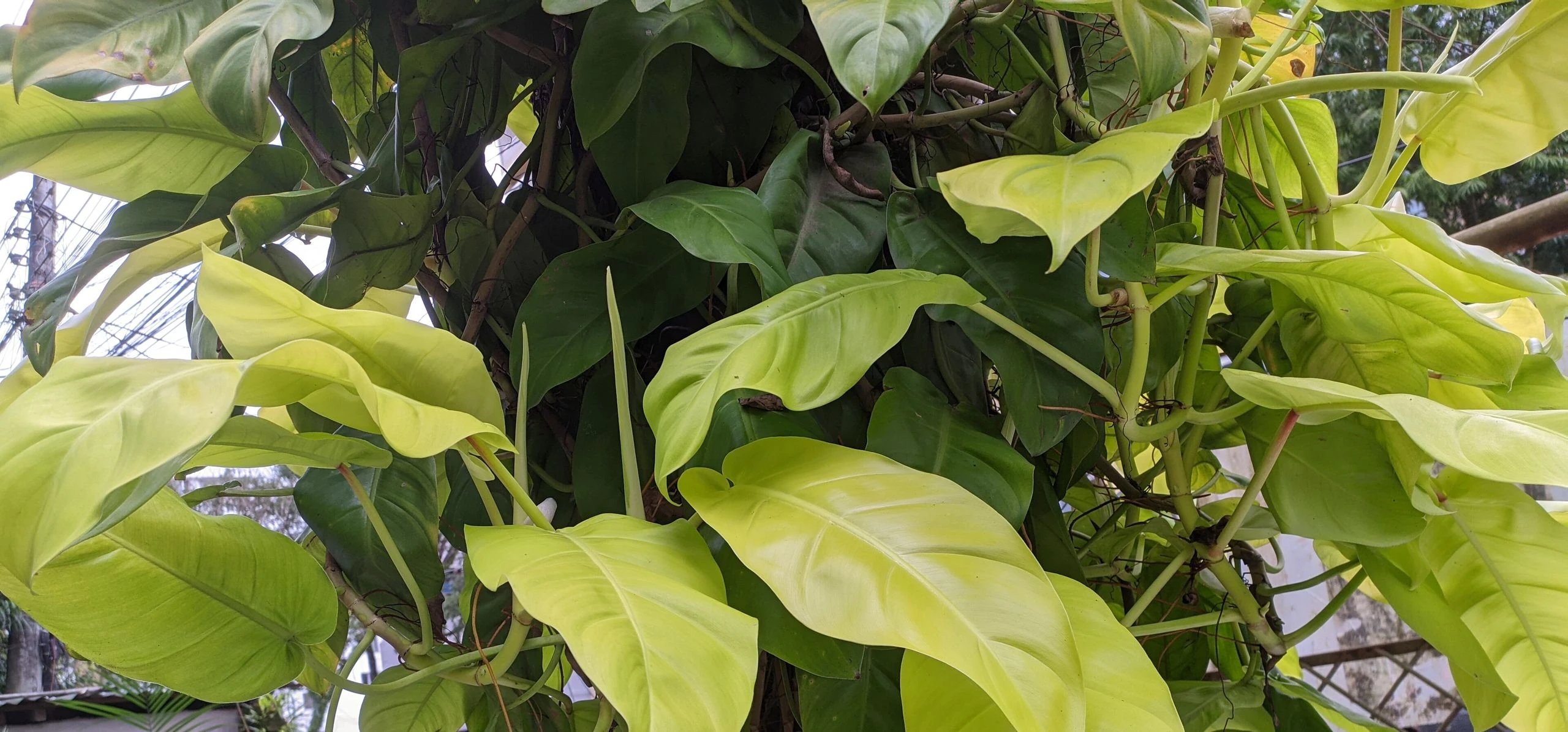
The species sold in the trade is not always plain green. The RHS lists 'Brasil', with a broad, irregular yellow-green stripe running down the centre of each leaf, and 'Mica', a trailing form with a velvety, bronze-green sheen on leaves that stay smaller than the species type, around ten centimetres long. Gold-to-lemon-green forms like the one in the photo above, where entire new leaves emerge pale yellow-green and either hold that colour or deepen toward green with age, are also widely sold; how strongly the colour holds depends heavily on how much light the plant receives, since more light generally keeps variegated and colour-form leaves brighter.
Pests, Common Mistakes and Toxicity
This philodendron has no serious pest or disease problems under normal care, though North Carolina State Extension flags aphids, spider mites, mealybugs and scale as occasional visitors, plus leaf spot and root rot in soil kept too wet. The most common mistake is not the watering can but the light: growers blame yellow leaves on overwatering when the plant is simply stretching for more light, so check the spot it is in before cutting back on water. Every part of the plant, including the sap, contains calcium oxalate crystals; the ASPCA lists the heartleaf philodendron as toxic to dogs, cats and horses, with oral irritation, drooling and vomiting among the reported signs, and North Carolina State Extension adds that it is also a skin and mouth irritant to people, so keep cuttings and fallen leaves away from pets and children who put plants in their mouths.
Test your plant knowledge
Tap a card to flip it and reveal the answer.
Heartleaf philodendron can be told apart from pothos by its smooth, ungrooved leaf stalk and stipules that fall away as the stem ages. Tap to reveal ✓ True
This species needs at least six hours of direct sun a day to grow well. Tap to reveal ✕ False
A heartleaf philodendron can be propagated by rooting a stem cutting in a glass of water. Tap to reveal ✓ True
The ASPCA lists heartleaf philodendron as safe for dogs, cats and horses to chew. Tap to reveal ✕ False
Pinching a stem just above a leaf encourages the plant to branch and grow fuller. Tap to reveal ✓ True
Sources
References consulted for this guide
- Philodendron hederaceum (Jacq.) Schott, GBIF Backbone Taxonomygbif.org
- Philodendron hederaceum (Jacq.) Schott, Plants of the World Online (Kew)powo.science.kew.org
- Philodendron (Philodendron hederaceum), NC State Extension Gardener Plant Toolboxplants.ces.ncsu.edu
- Heartleaf Philodendron, ASPCA Animal Poison Controlaspca.org
- Philodendron hederaceum var. hederaceum, RHS Gardeningrhs.org.uk
- Reference entity : Wikipédiaen.wikipedia.org