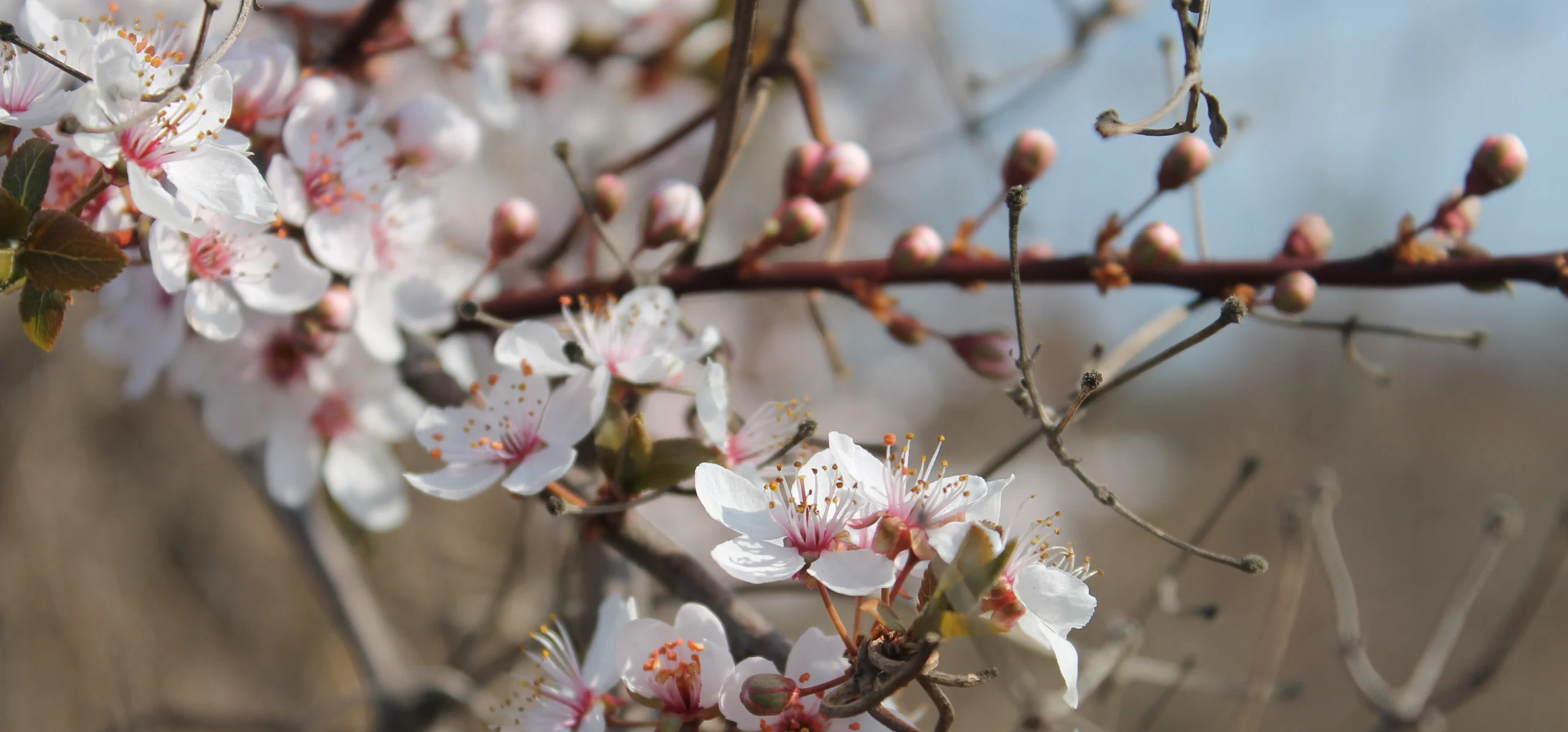
Japanese Flowering Cherry
Prunus serrulata
Family · Rosaceae
Grow a Japanese flowering cherry like 'Kanzan': site it away from lawns and paths, prune only in summer, and expect a short, showy spring bloom.
Prunus serrulata
Plant profile
- WateringModerateWater every 10 days
- Light exposureFull sun
- Hardiness zoneUSDA 5–9
Growth
- Family
- Rosaceae
- Life cycle
- Perennial
- Growth speed
- 6/10
- Mature size
- 800–1200 cm
- Spread
- 800–1200 cm
- Flowering
- Mid to late spring, 1-2 weeks
- Propagation
- Grafting
- Cutting
Dormancywinter dormant, deciduous
Time to maturity20-50 years to full size
Soil & climate
- Soil types
- loam, clay, sand, chalk
- Drought tolerance
- No
Light & Placement
- Origin
- E. & S. China to N. Korea
- Where to place it
- open lawn or garden in full sun
- sheltered from strong wind
- large container while young, before it outgrows one
Safety
- Toxicity
- Not listed by the ASPCA; Prunus leaves and pits contain cyanogenic compounds
- Pet safe
- No
Where it grows
World distribution
Japanese Flowering Cherry is native to 2 countries: China and South Korea.GBIF records 15,593 documented identifications across 40 countries, with the largest concentrations in Germany, United Kingdom, and United States.
- China
- South Korea
Yellow to orange dots: concentration of documented identifications per country. Green countries: sourced native range. Source: GBIFNative range from POWO (Kew).
A Japanese flowering cherry, most often sold as the double pink cultivar 'Kanzan', earns its place in a garden for two or three weeks of dense spring blossom rather than for year-round structure. It grows easily in almost any well-drained soil and full sun, but it carries two real risks that catch new owners out: prune it outside summer and it can pick up silver leaf or bacterial canker, and its shallow, spreading roots make it a difficult neighbour for a mown lawn or a paved path. Most garden trees sold under the name Prunus serrulata are grafted cultivars rather than the wild species, so what you plant is really one specific clone chosen for flower colour and form.
Choosing a Cultivar: 'Kanzan' and Other Japanese Cherries
'Kanzan' (also spelled Kwanzan, and sold as 'Sekiyama') is the cultivar behind most Japanese cherry avenues: crimson buds open into deep pink, fully double flowers with 23 to 28 petals, hanging in clusters of around five on a stiffly vase-shaped young tree that spreads with age. It is sterile and sets no fruit, holds the RHS Award of Garden Merit, and is generally the toughest of the double-flowered cherries in cultivation. For something different, 'Taihaku' (the Great White Cherry) carries some of the largest single white flowers of any cherry against bronze young leaves; 'Shirotae', sometimes sold as 'Mount Fuji', opens semi-double, white and fragrant on wide, horizontal branches; and 'Amanogawa' grows narrow and upright, useful where a spreading 'Kanzan' would simply not fit. Whichever one you buy, it is a grafted clone on a rootstock, not a seed-grown tree, so suckers appearing low on the trunk come from the rootstock and should be pulled off, not left to grow.
Siting and Planting in a Lawn
Give it full sun and shelter from strong wind, which shreds the petals early. The RHS rates 'Kanzan' hardy to H6, tolerating winter lows down to about -20°C, and lists it as adaptable to chalk, clay, loam and sandy soils as long as drainage is reasonable; across US nursery and extension listings it is generally placed in USDA zones 5 to 9. It is a classic lawn specimen tree, but that combination needs some care: like the rest of the Prunus genus, its roots run shallow and wide rather than deep, and a mower running close to the trunk each week bruises surface roots and provokes suckering. Strim or hand-trim the grass under the canopy instead of mowing it flush, and keep the base clear of a raised mulch volcano, which only encourages more surface rooting. Leave real distance, several metres at least, from drives, paths and drains, since a mature tree eight to twelve metres across will eventually lift anything running through its root zone.
Blossom Timing
Flowering runs mid to late spring, typically around two weeks after the earlier-blooming Yoshino cherry (Prunus × yedoensis) where both grow in the same garden, with 'Kanzan' among the latest of the widely planted cherries to open. The double flowers appear just before or alongside the first coppery-bronze leaves, so a tree in full bloom still shows some warm-coloured new growth rather than bare wood. A calm, dry spring stretches the display to nearer two weeks; one hard rain or a warm windy spell can strip the petals in a couple of days, so treat the bloom as a short, weather-dependent event rather than something to plan a whole season's garden view around.


Pruning: Summer Only, Never Winter
This is the one rule that most affects how long the tree stays healthy. Prunus species, cherries included, are vulnerable to silver leaf and bacterial canker, both of which infect through fresh pruning wounds during cool, damp weather. RHS guidance is specific: cut in July or August, when the tissue resists infection best, and never in autumn, winter or early spring. Bacterial canker shows as sunken, gummy patches of dead bark in spring and early summer, dieback in new shoots, and small round holes in the leaves known as shothole; there is no fungicide available to home gardeners, so the only real defence is cutting out infected wood promptly, well back into clean tissue, and sealing the cut with wound paint. Kept to RHS pruning group 1, a Japanese cherry needs very little cutting beyond removing dead, damaged or crossing branches while the tree is young, then largely being left alone.
Shallow Roots and a Short Lifespan
Unlike an oak or a beech, a Japanese flowering cherry is not a tree for the next century. Ornamental cultivars like 'Kanzan' are relatively short-lived, and trees growing in compacted urban soil, a restricted pit or a heavily trafficked lawn tend to decline earlier than one given open ground and room to root. The same shallow root system that makes it a poor lawn companion also makes it a poor candidate for site work nearby: hard digging to lay a path or a border, or trenching for a drain, damages roots that never grew deep enough to escape the disturbance, and root damage is one of the more common triggers for the sudden dieback that shortens these trees' lives. Planting it well from the start, in full sun with room to spread and without turf mown right up to the trunk, does more for its longevity than any feeding regime afterwards.
Pests and Other Problems
Beyond the two bark diseases, the RHS lists caterpillars and leaf-mining moths as occasional pests, both cosmetic rather than serious on an established tree. Bullfinches are a more particular nuisance: in late winter they strip developing flower buds for food, and a hard winter can mean a visibly thinner bloom the following spring with no disease involved at all. Peach leaf curl and blossom wilt occasionally affect Japanese cherries too, both worth ruling out before assuming a poor season is down to pruning timing or root stress.
Toxicity: Leaves, Pits and Pets
The ASPCA does not carry a specific toxicity listing for Prunus serrulata or its garden cultivars. That is not the same as a clean bill of health: the wider Prunus genus, cherries, plums and apricots alike, produces amygdalin and related cyanogenic compounds concentrated in the leaves, especially once wilted or damaged, and in the kernel inside the pit, which break down into hydrocyanic acid if chewed. 'Kanzan' itself is sterile and sets no fruit, so pit exposure is not a concern with that particular cultivar, but single-flowered types that do fruit, and any fallen leaves after a storm, are worth keeping dogs and grazing animals away from as a precaution rather than because a confirmed case exists for this exact species.
Test your plant knowledge
Tap a card to flip it and reveal the answer.
A Japanese flowering cherry like 'Kanzan' should be pruned in mid to late summer rather than winter. Tap to reveal ✓ True
Japanese flowering cherries typically live as long as an oak, well over a century. Tap to reveal ✕ False
A mower can safely run right up to the trunk of a lawn-planted cherry without harming its roots. Tap to reveal ✕ False
'Kanzan' is a sterile, double-flowered cultivar that does not set fruit. Tap to reveal ✓ True
The ASPCA has published a toxicity listing specific to Prunus serrulata. Tap to reveal ✕ False
Sources
References consulted for this guide
- GBIF - Prunus serrulatagbif.org
- Plants of the World Online (Kew) - Prunus serrulatapowo.science.kew.org
- RHS - Prunus serrulata 'Kanzan'rhs.org.uk
- RHS - Bacterial Cankerrhs.org.uk
- Reference entity : Wikipédiaen.wikipedia.org