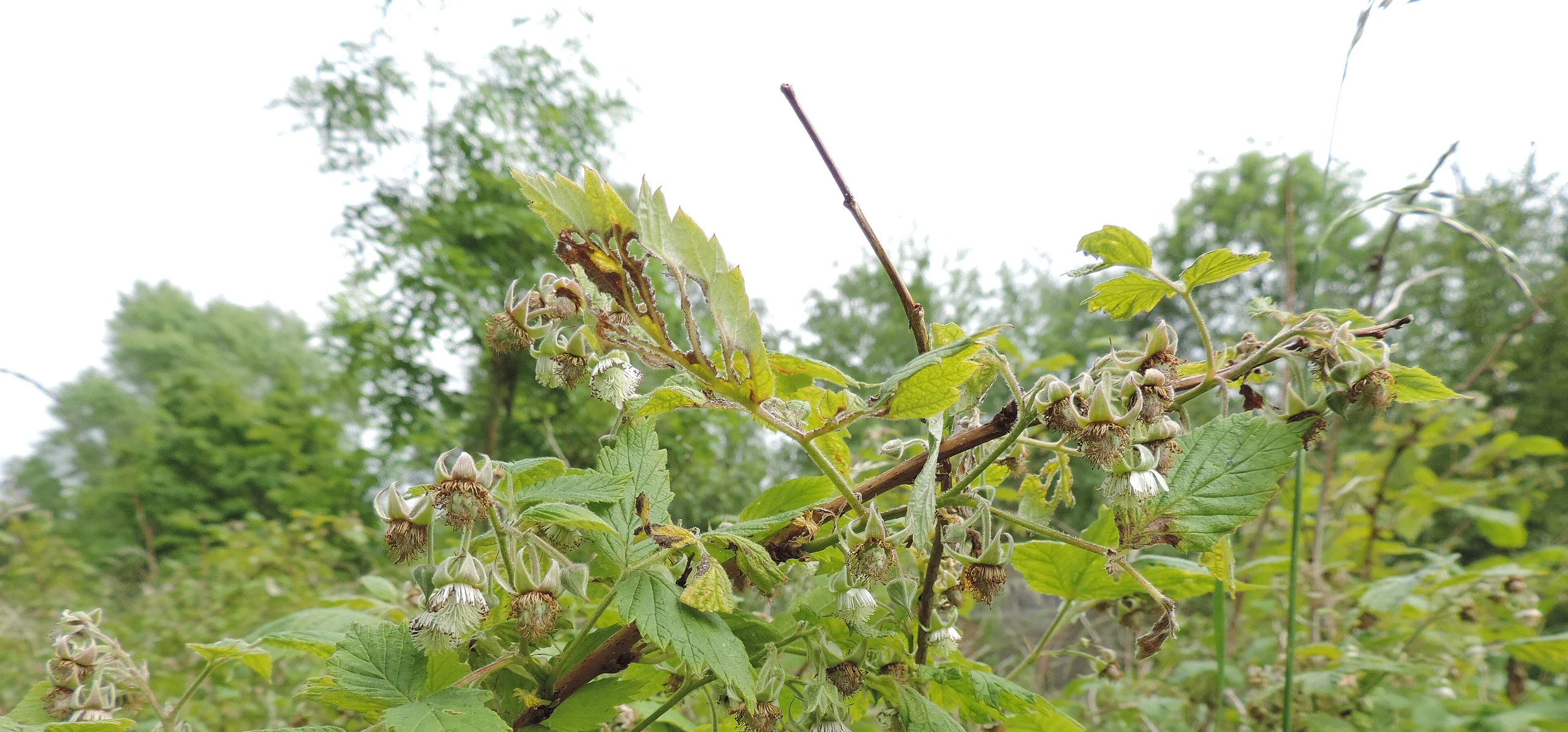
Red Raspberry
Rubus idaeus
Family · Rosaceae
Red raspberry (Rubus idaeus) needs two different pruning routines depending on type, plus posts and wires, spacing, suckers control, mulch and netting.
Rubus idaeus
Plant profile
- WateringHighWater every 4 days
- Light exposurePartial sun
- Ideal temperature-20–-15 °C
- Hardiness zoneUSDA 4–8
Growth
- Family
- Rosaceae
- Life cycle
- Perennial
- Growth speed
- 6/10
- Mature size
- 120–250 cm
- Spread
- 50–100 cm
- Propagation
- Division
- Cutting
FloweringWhite flowers from spring; fruit ripens early to late summer (floricane types) or late summer into autumn (primocane types)
Dormancydeciduous, dormant in winter
Time to maturityfull cropping by year 2-3
Soil & climate
- Soil pH
- pH 6–6.7
- Soil types
- loam, sand, clay
- Drought tolerance
- No
Light & Placement
- Where to place it
- sunny fruit garden row
- sheltered kitchen garden bed
- allotment trained on posts and wires
- large container or half-barrel for compact patio varieties
OriginNative to the temperate Northern Hemisphere, south to Mexico (Eurasian and North American subspecies)
Safety
- Toxicity
- HumansSafe
Invasive speciesspreads by root suckers and can naturalise into hedgerows or waste ground if left unmanaged
Data fromRubus idaeus L., GBIF Backbone TaxonomyRHS: How to grow raspberriesRHS: Raspberry beetleRHS: Raspberry cane blightNC State Extension Gardener Plant Toolbo
Where it grows
World distribution
Red Raspberry is native to 38 countries: Albania, Austria, Belarus, Belgium, Bulgaria, Canada, China, and Croatia….GBIF records 818,624 documented identifications across 82 countries, with the largest concentrations in United Kingdom, Sweden, and France.
- Albania
- Austria
- Belarus
- Belgium
- Bulgaria
- Canada
- China
- Croatia
- Czechia
- Denmark
- Estonia
- Finland
Show 26 more countriesShow fewer countries
- France
- Georgia
- Germany
- Greece
- Hungary
- Ireland
- Italy
- Japan
- Kazakhstan
- Kyrgyzstan
- Mexico
- Mongolia
- Netherlands
- Norway
- Poland
- Romania
- Russia
- South Korea
- Spain
- Sweden
- Switzerland
- Türkiye
- Turkmenistan
- Ukraine
- United Kingdom
- United States
Yellow to orange dots: concentration of documented identifications per country. Green countries: sourced native range. Source: GBIFNative range from POWO (Kew).
The single question to answer before anything else is whether a batch of bare-root canes is a summer-fruiting or an autumn-fruiting type, because the two need almost opposite pruning and the plant label rarely spells it out beyond a variety name. Rubus idaeus grows from a permanent, perennial root system, but each cane in the classic summer-fruiting habit only lives two years, fruiting once on second-year wood before it is cut away entirely. Autumn-fruiting types break that pattern: they flower and fruit on the current season's growth, so the whole planting is felled to the ground every winter instead of being thinned. Get the type wrong and the pruning shears either remove next year's crop or leave a summer row unpruned and tangled by August.
Summer-Fruiting or Autumn-Fruiting: Two Plants Under One Name
Summer-fruiting (floricane) types put up canes one year that overwinter, then flower and fruit the following June to August before dying back, so the row always carries a mix of this year's new canes and last year's fruiting ones. Autumn-fruiting (primocane) types skip that wait entirely: the cane that emerges in spring flowers and fruits on its own tip from late summer into October. 'Glen Ample', bred in Scotland and holding an RHS Award of Garden Merit, is a mid-season summer-fruiting variety with large, spine-free berries on spine-free canes and useful resistance to the aphids that spread raspberry viruses. 'Autumn Bliss', the East Malling variety that effectively created the modern autumn-fruiting category, needs almost no support and crops from late August. 'Polka', a later Polish variety bred with 'Autumn Bliss' as a parent, produces roughly double the yield and starts cropping about two weeks earlier still. Growing one of each type stretches the picking season from midsummer to the first hard frosts.
Planting Bare-Root Canes: Spacing, Posts and Wires
Plant dormant bare-root canes between late autumn and early spring, no deeper than about 5 cm so the roots sit just below the surface, spacing plants 40-60 cm apart within the row and leaving 1.5-2 m between rows so light and air reach both sides. Because canes grow tall and carry a heavy crop, a permanent post-and-wire system pays for itself: a fence of 1.8 m posts every 3.6 m along the row, strung with three horizontal wires roughly 60 cm apart, gives summer-fruiting canes something to tie into as they grow, while shorter, largely self-supporting autumn types can get by with a lower parallel-wire system and cross-ties instead of individual tying.


Pruning Summer-Fruiting Canes After Harvest
Once the last berries are picked, cut every cane that fruited that summer right down to ground level, since a floricane never fruits a second time and only shades the new growth needs light to ripen. From the new canes that grew alongside the fruiting ones, keep the six to eight strongest per plant, tie them onto the wires roughly 10 cm apart, and pull out the rest at the base. Those selected canes are the ones that overwinter and carry next year's crop.
Pruning Autumn-Fruiting Canes to the Ground
Primocane types get the opposite treatment. In February, before growth restarts, cut every cane in the row to ground level with nothing carried over at all, since the entire coming crop grows from stems that have not yet emerged. Where a clump gets crowded once new shoots appear in early summer, thin them to around 10 cm apart rather than leaving every one to compete for light. Pruning a summer type this way removes the fruiting wood before it has cropped, and pruning an autumn type the summer way leaves old stems cluttering the row for nothing, which is why knowing which type is in the ground matters more than any other single decision.
Suckers and Keeping the Row Narrow
Raspberry roots send up new canes well beyond where they were planted, and left alone a single row widens into a thicket within a couple of seasons. Chop out or pull any cane emerging outside a defined strip, ideally kept to no more than about 30-45 cm wide, as soon as it appears rather than waiting for a winter tidy-up; a spade driven vertically along the row edge severs wandering roots before they throw up growth further out. Healthy suckers lifted with some root attached are also the easiest way to raise more plants for free, provided the parent row shows no sign of virus.
Watering and Mulching While the Fruit Swells
Raspberry roots sit shallow in the top layer of soil, so the row dries out faster than the height of the canes suggests, and the weeks when fruit is swelling are when a dry spell costs the most in crumbly, undersized berries. Water deeply rather than little and often through that period, then apply a 5-7.5 cm mulch of well-rotted manure or garden compost in late winter, keeping it clear of the cane bases to avoid rotting the crowns. Skip mushroom compost, which is alkaline and works against the acid to neutral, pH 6-6.7 soil raspberries prefer.
Raspberry Beetle, Cane Blight and Viruses
Raspberry beetle grubs, the larvae of a 4 mm brown beetle that lays eggs on the flowers from May to July, burrow into the stalk end of ripening fruit and leave a dried, greyish patch behind; summer-fruiting varieties take the brunt of it, while berries ripening after late August on autumn types largely escape. Cane blight is a fungal disease that enters through wounds, pruning cuts, frost cracks or midge damage, and turns the base of a cane dark brown and brittle enough to snap by hand; the only real fix is cutting infected canes out below soil level and disinfecting tools between cuts, since there is no cure once it has taken hold. Several unrelated viruses, spread mostly by aphids, quietly reduce vigour and yield over a few seasons without dramatic symptoms, which is why buying canes certified as virus-free from a reputable supplier matters more for raspberries than for almost any other soft fruit; planting stock from an infected garden swap bakes the problem into the row from day one.
Birds, Netting and a Note on Pet Safety
Birds strip a raspberry row as fast as the fruit colours up, so netting is close to essential rather than optional once the crop starts to ripen. Support the net clear of the canes on hoops or the same wire framework so birds cannot perch on top and reach through the mesh, and peg it firmly to the ground so nothing gets trapped underneath. On the safety side, common raspberry does not appear on the ASPCA's toxic or non-toxic plant lists at all, only the unrelated Creeping Rubus (Rubus pedatus), so its status for cats, dogs and horses is officially undetermined rather than confirmed safe; the ripe fruit itself is, of course, a widely grown food crop for people.
Test your plant knowledge
Tap a card to flip it and reveal the answer.
Summer-fruiting raspberry canes flower and fruit on wood that grew the previous year. Tap to reveal ✓ True
Autumn-fruiting raspberry canes should be left standing after harvest so they fruit again next year. Tap to reveal ✕ False
A permanent post-and-wire system is the standard way to support a row of raspberry canes. Tap to reveal ✓ True
Buying certified virus-free canes matters less for raspberries than for most other soft fruit. Tap to reveal ✕ False
The ASPCA has assessed common raspberry (Rubus idaeus) and lists it as non-toxic to pets. Tap to reveal ✕ False
Sources
References consulted for this guide
- Rubus idaeus L., GBIF Backbone Taxonomygbif.org
- RHS: How to grow raspberriesrhs.org.uk
- RHS: Raspberry beetlerhs.org.uk
- RHS: Raspberry cane blightrhs.org.uk
- NC State Extension Gardener Plant Toolbox: Rubus idaeusplants.ces.ncsu.edu
- Reference entity : Wikipédiaen.wikipedia.org