Japanese Spiraea
Spiraea japonica
Family · Rosaceae
Japanese spiraea (Spiraea japonica) tolerates most soils and part shade, but needs a hard spring prune, not a post-bloom one, to keep flowering well.
Spiraea japonica
Plant profile
- WateringModerateWater every 7 days
- Light exposurePartial sun
- Hardiness zoneUSDA 4–8
Growth
- Family
- Rosaceae
- Life cycle
- Perennial
- Growth speed
- 5/10
- Mature size
- 100–150 cm
- Spread
- 100–150 cm
- Flowering
- Pink to rose-red flower clusters, early to midsummer
- Propagation
- Seed
- Cutting
Dormancydeciduous, leafless in winter
Time to maturity5 to 10 years
Soil & climate
- Soil types
- chalk, clay, loam, sand
- Drought tolerance
- Yes
Light & Placement
- Origin
- China, N. Myanmar, central and southern Japan, Taiwan
- Where to place it
- mixed border
- low hedge
- foundation planting
- mass planting
- large container with a well-drained mix
Safety
- Toxicity
- Not listed by the ASPCA; no official toxicity data published
- Pet safe
- No
Invasive speciesself-seeds freely; several older cultivars are documented as spreading and outcompeting native plants in parts of the eastern United States
Data fromSpiraea japonica, GBIF Backbone TaxonomyPOWO: Spiraea japonicaRHS: Spiraea japonica (Japanese spiraea)University of Illinois Extension: JapanePenn State Extension: Spirea, The Good a
Where it grows
World distribution
Japanese Spiraea is native to 4 countries: China, Japan, Myanmar (Burma), and Taiwan.GBIF records 36,702 documented identifications across 65 countries, with the largest concentrations in United States, Germany, and China.
- China
- Japan
- Myanmar (Burma)
- Taiwan
Yellow to orange dots: concentration of documented identifications per country. Green countries: sourced native range. Source: GBIFNative range from POWO (Kew).
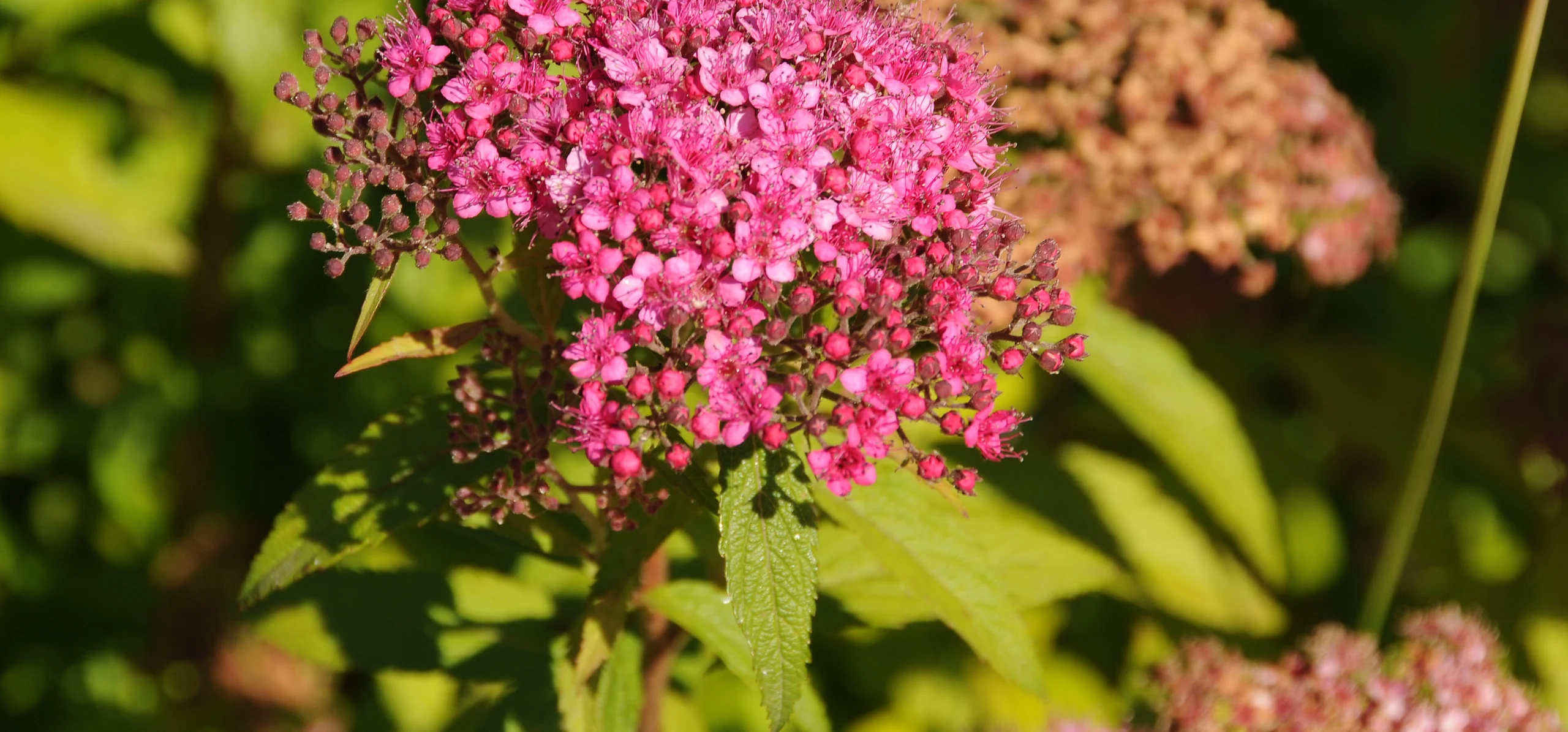
That mound of serrated leaves topped with flat, dusty-pink flower clusters in your border is almost certainly Spiraea japonica, Japanese spiraea, one of the most widely planted flowering shrubs in temperate gardens. It is native to China, N. Myanmar, and central to southern Japan and Taiwan, and reaches full size in five to ten years without asking for much beyond sun and a yearly cut-back. The single fact that matters most in the first season: unlike white spring-flowering spiraeas that bloom on last year's wood, this species flowers on stems it grows the same year, so pruning happens before growth starts in spring, not right after the flowers fade.
Choosing a Variety
The wild species is a dense, upright, rounded shrub that the RHS lists at 1 to 1.5 m in both height and spread, but almost none of the plants sold in garden centres are the straight species. Cultivars vary widely in size and foliage colour:
- 'Little Princess', compact to about 75 cm, carries the classic deep rose-pink flowers most gardeners picture.
- 'Goldflame' and 'Golden Princess' are grown mainly for foliage that opens bronze-red in spring, turns yellow-green through summer, then copper-orange in autumn.
- 'Crispa' has twisted, crinkled leaves on a compact 60 to 90 cm mound.
- 'Magic Carpet' is one of the lowest-growing selections, useful at the front of a border or in a large pot.
Newer cultivars are sometimes sold as sterile, seedless selections, worth checking on the plant label if self-seeding is a concern (see Invasive Concerns and Better Alternatives below).
Light and Placement
Japanese spiraea flowers most heavily in full sun but tolerates partial shade, and the RHS lists it as suitable for south, east or west-facing aspects, in exposed or sheltered positions alike. In hot summer climates, a little afternoon shade keeps the flat flower heads from bleaching and stops the foliage cultivars, 'Goldflame' and 'Golden Princess', from scorching at the leaf edges. Give it room: mature plants can reach 1 to 1.5 m across, so crowding it against a wall or between other shrubs cuts flowering and airflow.
Soil and Planting
This is one of the more soil-tolerant shrubs available: the RHS lists chalk, clay, loam and sand as all acceptable, in acid, neutral or alkaline conditions. The one soil-related problem noted by university extension services is chlorotic, pale yellow foliage on strongly alkaline soils, where high pH locks up iron; if new leaves come in pale and veiny, that is the likely cause rather than a watering or pest issue. Plant in moist but free-draining ground. Heavy clay that stays waterlogged through winter is the condition most likely to shorten the shrub's life.


Watering
Once established, usually by the second growing season, Japanese spiraea handles short dry spells without complaint, but it performs best with consistently moist soil rather than a drought regime. Water new plants two to three times a week through their first summer while roots spread, then taper to a deep soak whenever the top 5 cm of soil dries out, typically weekly in hot weather and rarely at all once autumn rain arrives. Containers dry out faster than open ground and need checking more often, especially for the compact cultivars often grown in pots.
Pruning for Reliable Bloom
Japanese spiraea flowers on stems produced the same season, RHS pruning group 6, which means the cut happens in late winter or early spring, before growth starts, not after flowering as with spring-blooming spiraeas like S. vanhouttei that flower on last year's wood. Cut the previous year's stems back hard, to a low framework or to within one or two buds of older wood, before the buds swell. Pruned this way every year, plants stay compact and floriferous for a decade or more; skip it for a few seasons and the shrub turns leggy and bare at the base, with flowers only at the stem tips. Deadheading spent flower clusters through summer can trigger a lighter second flush.
Propagation
The straightforward way to increase named cultivars true to type is semi-ripe cuttings taken in mid to late summer: four to six inches of firm, non-flowering stem, stripped of its lower leaves and rooted in a free-draining cutting mix. The species also grows readily from seed, which is exactly why it self-sows so freely in gardens and disturbed ground (see below), so seed is not the method to reach for when a cultivar's exact flower colour or foliage needs to come true.
Pests, Diseases, and Common Mistakes
Japanese spiraea is genuinely low-trouble: the RHS rates it as generally pest and disease-free, with occasional powdery mildew in humid, crowded conditions, and university extension sources note spirea aphid as the main pest, curling and distorting new leaf tips without doing lasting damage. The two mistakes that actually disfigure or shorten the life of a plant are pruning at the wrong time, cutting off the current year's flower buds by trimming in summer instead of late winter, and planting in soil that stays wet through winter, which leads to root problems the shrub cannot outgrow. Deer generally leave it alone, a genuine advantage in gardens where browsing is a problem.
Invasive Concerns and Better Alternatives
The trait that makes Japanese spiraea easy is also its biggest drawback. Penn State Extension documents that it spreads through tiny, abundant, fertile seed, with seedlings turning up near parent plants and along roadsides, where they outcompete native vegetation. Long-planted cultivars such as 'Anthony Waterer' and 'Little Princess' have contributed significantly to this spread in parts of the eastern United States. If this is a concern in your region, choose a cultivar explicitly labelled sterile or seedless, deadhead spent flowers before they set seed, or plant a native alternative such as ninebark (Physocarpus opulifolius), which offers a similar rounded habit and flat white flower clusters without the seeding problem.
Test your plant knowledge
Tap a card to flip it and reveal the answer.
Japanese spiraea flowers on the current season's new growth, so it should be pruned in late winter or early spring, not right after flowering. Tap to reveal ✓ True
Established Japanese spiraea needs daily watering through summer to avoid wilting. Tap to reveal ✕ False
Every Spiraea japonica cultivar sold today is bred sterile and cannot spread by seed. Tap to reveal ✕ False
Japanese spiraea tolerates a wide range of soils, including chalk, clay, loam, and sand. Tap to reveal ✓ True
The ASPCA lists Japanese spiraea as toxic to cats and dogs. Tap to reveal ✕ False
Sources
References consulted for this guide
- Spiraea japonica, GBIF Backbone Taxonomygbif.org
- POWO: Spiraea japonicapowo.science.kew.org
- RHS: Spiraea japonica (Japanese spiraea)rhs.org.uk
- University of Illinois Extension: Japanese Spirea, Hort Answersweb.extension.illinois.edu
- Penn State Extension: Spirea, The Good and the Badextension.psu.edu
- Reference entity : Wikipédiaen.wikipedia.org