Chinese Wisteria
Wisteria sinensis
Family · Fabaceae
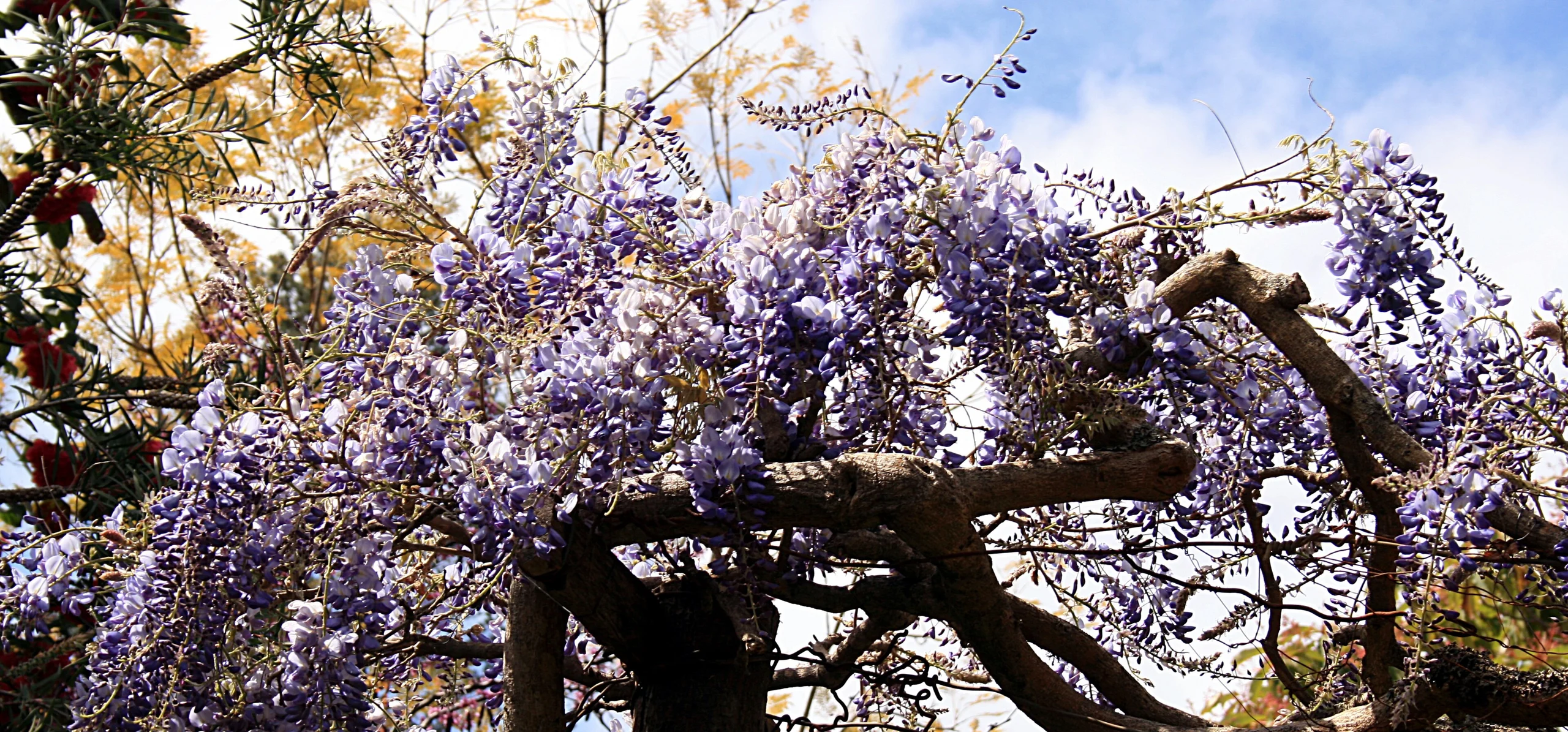
Chinese wisteria needs a twice yearly prune to flower, a support built for the weight it becomes, and a spot well clear of gutters, seedlings included.
Wisteria sinensis
Plant profile
- WateringModerateWater every 10 days
- Light exposureFull sun
- Hardiness zoneUSDA 5–8
Growth
- Family
- Fabaceae
- Life cycle
- Perennial
- Growth speed
- 8/10
- Mature size
- 300–900 cm
- Spread
- 120–900 cm
- Propagation
- Seed
- Cutting
- Grafting
FloweringFragrant blue-violet racemes in mid to late spring; needs full sun and twice-yearly pruning to bloom well
Dormancydeciduous, bare in winter
Time to maturitygrafted or cutting-grown plants can flower within a few years; seed-grown plants often take 10-20 years and some never flower reliably
Soil & climate
- Soil types
- clay, sand, loam
- Drought tolerance
- Yes
Light & Placement
- Origin
- Central and southern China
- Where to place it
- steel-cabled pergola or arbor
- masonry wall fitted with wire supports
- stout dedicated post
- large container at least 45 cm (18 in) across, trained as a standard on a permanent stake
Safety
- Toxicity
- CatsToxic
- DogsToxic
- HorsesToxic
- HumansToxic
Invasive speciesinvasive in parts of the southeastern United States, where it roots from trailing stems and suckers, girdles and kills native trees as it climbs, and can hybridize with Wisteria floribunda; also listed as a noxious weed in some states
Data fromGBIF Backbone Taxonomy: Wisteria sinensiPlants of the World Online (Kew): WisterASPCA Toxic and Non-Toxic Plants: WisterRHS Growing Guide: WisteriaRHS: Wisteria sinensis 'Prolific'NC State Extension Gardener Plant Toolbo
Where it grows
World distribution
Chinese Wisteria is native to a single country: China.GBIF records 7,601 documented identifications across 65 countries, with the largest concentrations in United States, France, and China.
- China
Yellow to orange dots: concentration of documented identifications per country. Green countries: sourced native range. Source: GBIFNative range from POWO (Kew).
A young Wisteria sinensis bought as a one-gallon vine, its tag promising cascades of blue-violet racemes, gives almost no hint of what it becomes: a woody climber whose stems thicken into a twisted, trunk-like base over the years, strong enough to lift roof tiles and crush a flimsy trellis. Two decisions made in the first season determine everything that follows. The first is whether the plant was grown from seed or grafted, since that alone can be the difference between flowers next spring and flowers in fifteen years. The second is what it is planted against, because this vine does not stop climbing once it reaches the top of a fence.
Buy a Grafted or Cutting-Grown Plant, Not a Seedling
Wisteria sinensis raised from seed goes through a long juvenile phase before it can flower at all, typically ten to twenty years, and some seedlings never bloom reliably no matter how well they are grown. Named cultivars propagated by grafting or from cuttings skip that wait almost entirely: a vegetatively propagated plant carries the maturity of its parent and can flower within its first few years in the ground. When buying, look for a graft union near the base of the stem, or buy a plant already in flower so its age is not in question. This single choice matters more than soil, feeding or exposure for how soon you see color.
Origin and How It Differs from Japanese Wisteria
Chinese wisteria is native to central and southern China. It was introduced to the United States for ornamental planting in 1816 and has since been grown across temperate gardens worldwide. The most useful field mark for telling it apart from its close relative Wisteria floribunda, Japanese wisteria, is the direction the stems twine: Wisteria sinensis twines anticlockwise around its support, while Japanese wisteria twines clockwise. Where the two have been planted near each other, especially across the southeastern United States, they have also crossed to produce fertile hybrids, which is one more reason a labeled, vegetatively propagated plant from a known source is worth paying for over an unlabeled seedling.
A Support Built for the Weight It Will Become
Given years and a strong anchor, this vine develops stems that extension horticulturists describe as massive and trunk-like, capable of climbing well past nine meters on named cultivars trained up a wall or tall pergola. That mass has to go somewhere, and it will find the weakest point of whatever it is growing on. Never train it onto guttering, a downspout, a wood-frame porch roof or a lightweight garden trellis; those all eventually get pulled apart or torn loose. The right structures are a steel-cabled pergola, a masonry wall fitted with wire supports rated for the load, or a stout post set specifically for the plant. Give it that from the start, because moving an established wisteria to a sturdier structure later means cutting it back hard and losing years of growth.


The Two Prunings That Make It Flower
Left alone, Wisteria sinensis will cover a structure in leaves and put most of its energy into extending new stems rather than setting flower buds. The fix is a prune twice a year. In July or August, cut back the current season's whippy new growth to five or six leaves from the main framework; this checks the plant's size and pushes it toward forming buds instead of more foliage. Then in January or February, go back over those same summer-pruned shoots and shorten them further, to two or three buds close to the older wood. Skipping the summer cut and doing only the winter one is the most common reason an established plant covers its support in green but produces few racemes.
Light, Soil and Water
Full sun, at least six hours a day, is what pushes a mature plant into heavy bloom; part shade keeps it alive and leafy but flowers thin out fast. It is not particular about soil texture and grows in clay, sandy or loamy ground as long as drainage is good, tolerating a wide pH range better than it tolerates wet feet. Water regularly through the first one to two seasons while roots establish, then taper off; a mature vine growing in rich, consistently moist, heavily fertilized soil tends toward lush foliage and disappointing bloom, so resist the urge to feed it well once it is established. Chinese wisteria is hardy across USDA zones 5 to 8.
An Invasive Species in the Southeastern United States
Outside cultivation, Wisteria sinensis is flagged as an invasive species across parts of the southeastern United States, where it escapes gardens by rooting wherever a trailing stem touches soil and by suckering from the base. Left unchecked it climbs into the canopy of native trees and shrubs and girdles them as the stems thicken, altering light levels on the forest floor as those trees die back. It is also listed as a noxious weed in some states outside its ornamental range. Before planting it in the Mid-Atlantic or Southeast, check local and state invasive-species lists, and if you already have an established vine, keep root suckers and any stem that touches bare ground cut back rather than letting them root in.
Every Part Is Toxic, Especially the Seeds
All parts of this plant, bark, leaves, flowers, roots, sap and seeds, contain the toxic compounds lectin and wisterin glycoside, and the ASPCA lists it as toxic to dogs, cats and horses. Ingestion causes vomiting, sometimes with blood, along with diarrhea and depression; symptoms are classed as low severity but still warrant a call to a vet or poison control if a pet gets into the pods. The same compounds make it toxic to people, and the seeds are the most concentrated and most often the cause of accidental poisoning, since the long, bean-like pods and the seeds inside can look enough like an edible legume to tempt a child. Keep pods picked up around play areas and paths, and wear gloves when clearing cut vines, since sap and plant matter should not be handled bare-handed for extended periods.
Named Varieties and Growing It as a Standard
Two widely grown cultivars show the range within the species. 'Prolific' is a vigorous, heavily flowering selection with very fragrant, soft blue-violet racemes 25 to 30 cm long that open in dense hanging clusters in late spring, and being vegetatively propagated it flowers younger and more reliably than a seedling ever would. 'Amethyst' carries reddish-violet, strongly fragrant flowers that open before the leaves unfurl, giving a bare-branched flush of color, and both cultivars hold the Royal Horticultural Society's Award of Garden Merit. Where space is too tight for a vine on a wall, Wisteria sinensis can also be trained as a standard: a single stem run up a stout stake in a large container of at least 45 cm across, with the leader stopped once it reaches the top of the support and the resulting sideshoots pruned back hard each winter to build a rounded head. A standard still needs the same twice-yearly pruning as a wall-trained plant, and the permanent stake stays in place for the life of the plant since the trunk never becomes fully self-supporting.
Test your plant knowledge
Tap a card to flip it and reveal the answer.
Wisteria sinensis grown from seed usually flowers within its first three years. Tap to reveal ✕ False
Cutting back the current year's whippy growth to five or six leaves in summer encourages flower buds instead of more foliage. Tap to reveal ✓ True
Chinese wisteria twines in the same direction as Japanese wisteria (Wisteria floribunda). Tap to reveal ✕ False
All parts of Wisteria sinensis, including the seeds, are toxic if eaten. Tap to reveal ✓ True
Wisteria sinensis is considered an invasive species in parts of the southeastern United States. Tap to reveal ✓ True
Sources
References consulted for this guide
- GBIF Backbone Taxonomy: Wisteria sinensis (Sims) DC.gbif.org
- Plants of the World Online (Kew): Wisteria sinensis (Sims) DC.powo.science.kew.org
- ASPCA Toxic and Non-Toxic Plants: Wisteriaaspca.org
- RHS Growing Guide: Wisteriarhs.org.uk
- RHS: Wisteria sinensis 'Prolific'rhs.org.uk
- NC State Extension Gardener Plant Toolbox: Wisteria sinensisplants.ces.ncsu.edu
- Reference entity : Wikipédiaen.wikipedia.org