Oriental Bittersweet
Celastrus orbiculatus
Family · Celastraceae
Oriental bittersweet fruits along the whole stem instead of only at the tips like American bittersweet, and its twining stems can girdle and topple trees.
Celastrus orbiculatus
Plant profile
- WateringModerateWater every 10 days
- Light exposurePartial sun
- Hardiness zoneUSDA 5–8
Growth
- Family
- Celastraceae
- Life cycle
- Perennial
- Growth speed
- 9/10
- Mature size
- 900–1800 cm
- Spread
- 150–300 cm
- Propagation
- Seed
- Cutting
FloweringSmall five-petaled greenish-yellow flowers in clusters of two or three at nearly every leaf axil, late spring, followed by yellow-orange capsules that split to reveal red-orange fruit through winter
Dormancydeciduous; Penn State Extension notes the leaves turn vivid yellow in late summer, often before native plants show fall color, then drop, leaving the yellow-orange and red fruit capsules on bare stems through winter
Time to maturityUniversity of Maryland Extension describes a rapid growth rate of several feet per year; a single root system can eventually support dozens of climbing stems, and Penn State Extension notes stems can reach 60 feet given a tall enough tree to climb
Soil & climate
- Soil types
- sandy, loamy, clay
- Saline soil
- Tolerated
- Drought tolerance
- No
Light & Placement
OriginTemperate East Asia: the Russian Far East, China and central to southern Japan (Plants of the World Online); Missouri Botanical Garden also lists Korea
Where to place itNowhere in North America. Where a vine already grows on your land, treat it as a removal project, not a plant to cultivate
Safety
- Pet safe
- No
ToxicityNot listed by the ASPCA under this name; the fruit is ornamental only, not a food source
Invasive speciesDeclared a noxious weed in Pennsylvania, where it can no longer be sold, propagated or intentionally planted (Penn State Extension), and listed as a noxious weed in Midwestern states beyond Missouri as well (Missouri Botanical Garden). Its twining stems tighten around host trunks as they thicken, which University of Maryland Extension notes can disfigure, strangle and kill the tree, and a heavy vine canopy can also bring a tree down under wind or ice load.
Data fromGBIF: Celastrus orbiculatus Thunb.Plants of the World Online (Kew): CelastMissouri Botanical Garden Plant Finder: University of Maryland Extension: OrientPenn State Extension: Oriental Bitterswe
Where it grows
World distribution
Oriental Bittersweet is native to 4 countries: China, Japan, Russia, and South Korea.GBIF records 51,738 documented identifications across 36 countries, with the largest concentrations in United States, Japan, and South Korea.
- China
- Japan
- Russia
- South Korea
Yellow to orange dots: concentration of documented identifications per country. Green countries: sourced native range. Source: GBIFNative range from POWO (Kew).
If you found a woody vine twining tightly around a fence post or a young tree, its leaves glossy, rounded to egg-shaped and finely toothed, with small yellow-green flowers or berries crowded into little clusters at nearly every leaf axil rather than only at the branch tips, you are very likely looking at Celastrus orbiculatus, Oriental bittersweet. Penn State Extension calls it an extremely aggressive and damaging invader of natural areas in the eastern United States, and the goal here is not to cultivate it, it climbs sixty feet up a tree with no encouragement at all, but to confirm the identification before you cut, because a vine sold as American bittersweet at a nursery is sometimes this species mislabeled, which is exactly how it keeps arriving in new yards.
Reading the Leaves, Flowers and Fruit
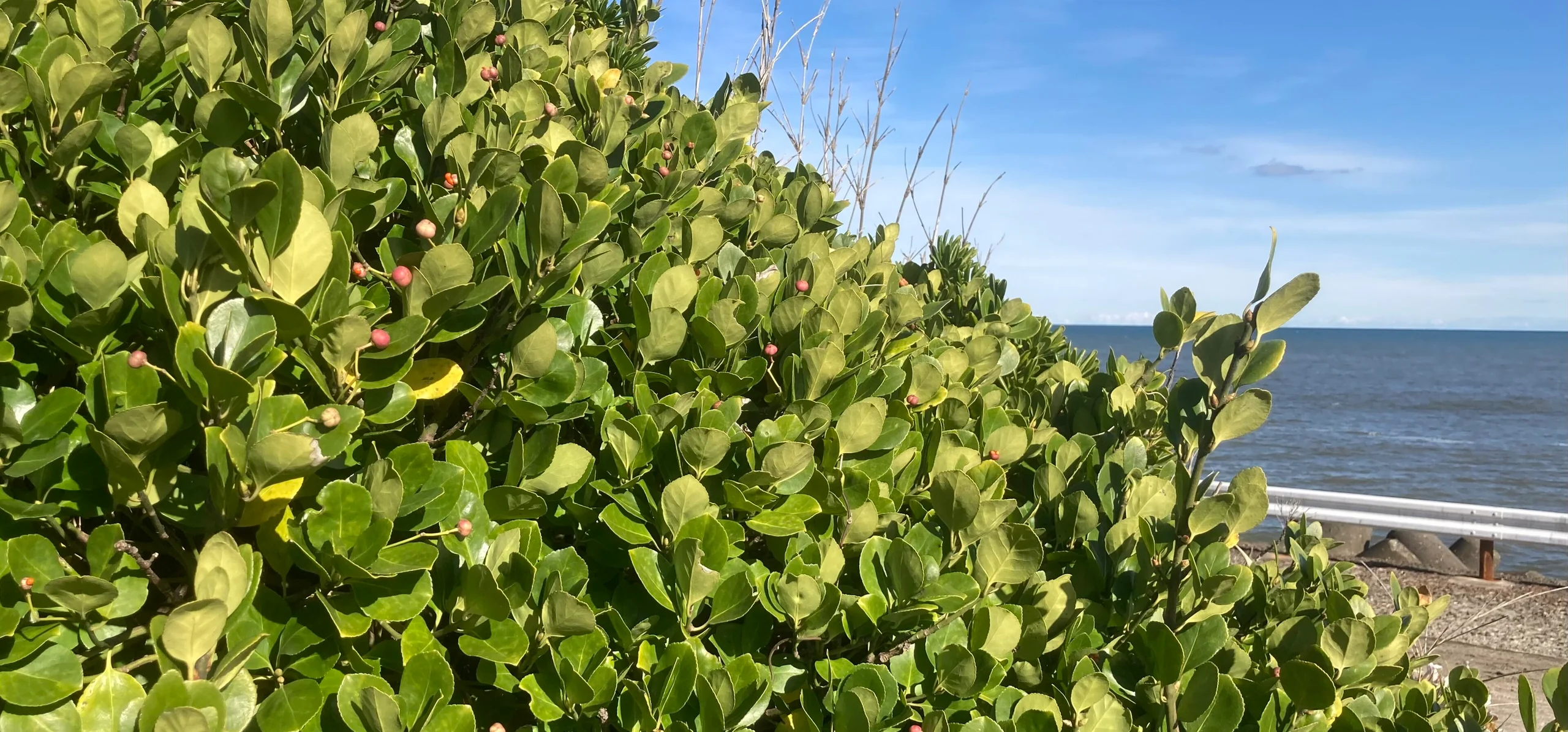
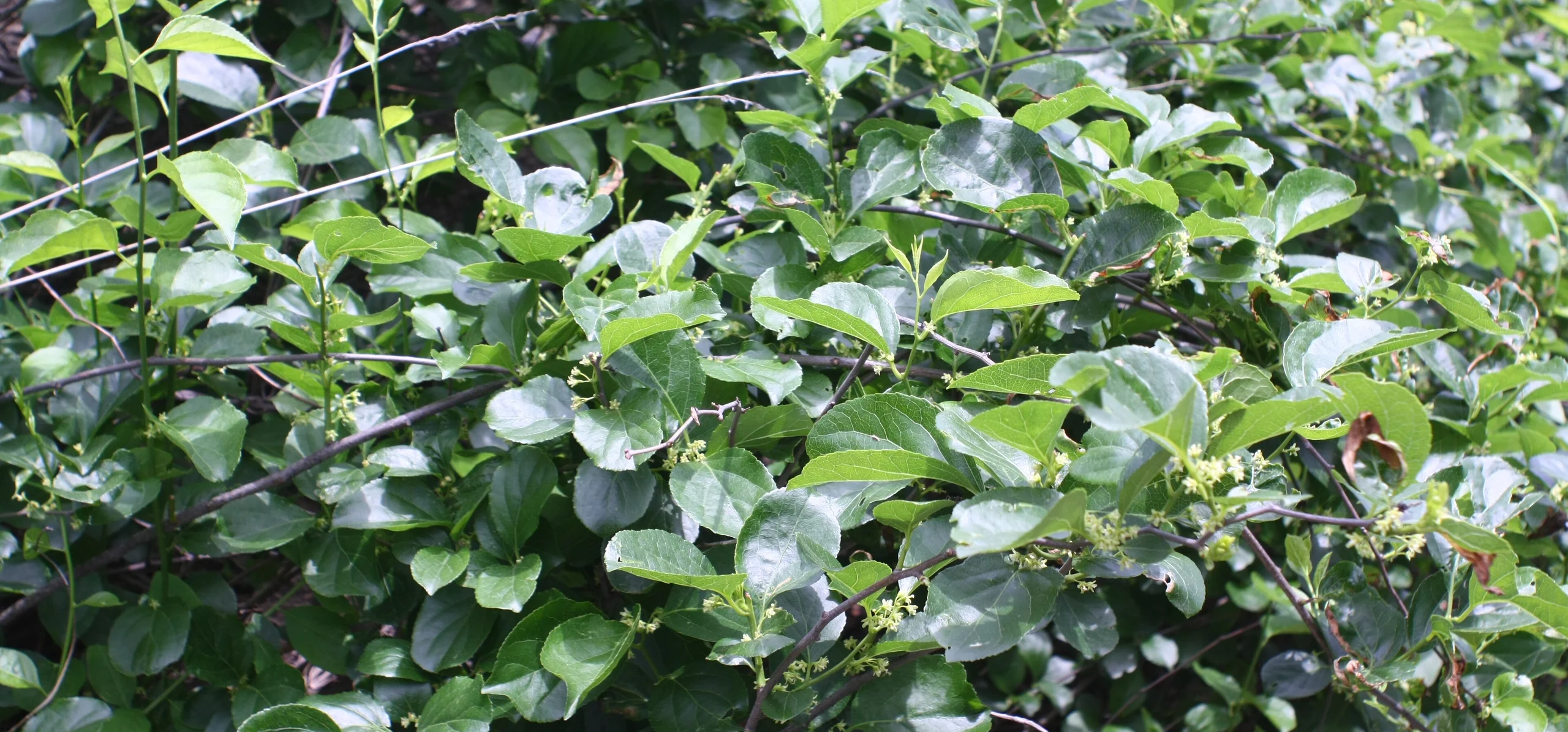
Leaves are simple, alternate, glossy and finely toothed. University of Maryland Extension describes the lower leaves on a single vine as distinctly round and the upper leaves as more elongated and football-shaped, a mix that alone causes plenty of misidentification. In late spring, female plants open small, five-petaled, yellow-green flowers, each under half an inch long, clustered two or three together at the leaf axils all along the stem; male flowers are similarly inconspicuous. By late summer those clusters have become berries with a yellow to orange skin, and in fall that skin splits to expose a bright red center. Penn State Extension notes the combination of yellow-orange and red persists on the bare stems well into winter, which is exactly what makes the vine so easy to spot from a distance once its leaves are down.
Oriental Bittersweet Versus the Native American Bittersweet
The single most reliable field mark is where the flowers and fruit sit. University of Maryland Extension and Penn State Extension agree on the same rule: native American bittersweet, Celastrus scandens, bears its flowers and fruit only at the very tips of its branches, in clusters of more than seven, while Oriental bittersweet scatters clusters of two or three at nearly every leaf axil along the entire stem. American bittersweet's fruit capsule is red rather than yellow-orange, and Penn State Extension warns that the native species is now rare enough in much of its range that nurseries sometimes sell Oriental bittersweet mislabeled under the native name, so check axil by axil before buying or planting anything called bittersweet. University of Maryland Extension adds that the two species also hybridize where they grow together, a further threat to the native plant's survival.


How It Girdles and Brings Down Trees
This is a twining vine with no tendrils, no aerial roots and no barbs; University of Maryland Extension notes it simply wraps its stems tightly around whatever it is climbing. That grip does not loosen as the vine's own stem thickens with age. Instead it constricts the host's bark and cambium, and University of Maryland Extension describes the outcome plainly: a tight enough grip can disfigure, strangle and kill the tree. A heavy vine canopy adds a second, unrelated failure point, dense foliage piled into a mature crown catches wind and ice like a sail, and trees that would otherwise survive a storm come down under the added weight.
Why Holiday Wreaths Keep Spreading It
The same yellow-orange and red berries that make the bare vine easy to identify in winter are exactly what made it popular for wreaths and fall arrangements in the first place. Penn State Extension identifies decorative wreaths as a significant dispersal vector in their own right, separate from birds, because the seeds inside those berries remain viable even after the cut branches have dried out on someone's front door, and they can germinate the moment a spent wreath is discarded onto open ground. Treat cut fruiting stems as trash rather than compost or yard waste, bag them, and never leave a spent wreath or garland where its seeds can reach bare soil.
Cutting, Herbicide and the Window-Cut Method
University of Maryland Extension is blunt about the basic mistake: cutting the vine down does not eradicate it, since cut stems and any root fragments left in the ground regrow. For anything climbing a tree worth saving, Penn State Extension recommends the window-cut method, cutting each vine in two places, once at the ground and once at eye level, which drops the vine's dead weight out of the canopy right away and clears a working space at the base. Because most of a mature vine's leaf area sits high in the host tree's canopy, out of reach for spraying, the practical sequence is to cut first, let the roots push up new sprouts, then treat that low, accessible regrowth with a foliar herbicide, a triclopyr-and-surfactant mix, or glyphosate combined with triclopyr where other invasives are present, once it has had at least eight weeks to grow back. Both extensions time herbicide applications from midsummer through early fall, no earlier than July 1, when the plant is naturally moving sugars down into its roots and will carry the chemical with them.
Pulling Seedlings While the Roots Are Still Shallow
Young plants are the easy case. Before an extensive root system has built up, University of Maryland Extension recommends removing new sprouts and seedlings by hand as soon as they appear, repeating the process until the roots run out of stored energy to push up more growth. Mowing is not a shortcut: Penn State Extension found that mowing established plants actually encourages root sprouting rather than controlling it, and skipping even one round of follow-up cutting gives the vine a chance to fully recover. Check the same ground again the following spring, since birds keep bringing in new seed from any vine left standing nearby, and a site can need attention for several growing seasons after the visible vine is gone.
Regulated at Home, Ordinary in Its Native Range
Oriental bittersweet is native to temperate East Asia, Missouri Botanical Garden lists China and Japan specifically, and it was brought to the United States around the 1860s as an ornamental vine and for erosion control, the same qualities that made it desirable there are what make it dangerous here. Because of the damage it does to natural areas, Pennsylvania has declared it a noxious weed, meaning it can no longer be sold, propagated or intentionally planted anywhere in the state, and Missouri Botanical Garden notes it is also listed as a noxious weed in Midwestern states beyond Missouri itself. None of this makes an existing vine on your own property illegal to remove, quite the opposite, but it does mean checking your state's noxious weed list before buying anything sold as bittersweet, and asking exactly which species is actually in the pot.
Test your plant knowledge
Tap a card to flip it and reveal the answer.
Oriental bittersweet's flowers and fruit form in small clusters scattered along the whole length of each stem, while the native American bittersweet clusters them only at the branch tips. Tap to reveal ✓ True
Cutting an Oriental bittersweet vine down to the ground is normally enough to stop it from coming back. Tap to reveal ✕ False
The seeds inside dried bittersweet berries used in wreaths and fall arrangements lose the ability to sprout once the material has dried out. Tap to reveal ✕ False
The ASPCA lists Oriental bittersweet (Celastrus orbiculatus) by that name as toxic to cats and dogs. Tap to reveal ✕ False
In its native range in East Asia, this same vine is grown as an ornamental without becoming a runaway problem the way it has in North America. Tap to reveal ✓ True
Sources
References consulted for this guide
- GBIF: Celastrus orbiculatus Thunb.gbif.org
- Plants of the World Online (Kew): Celastrus orbiculatuspowo.science.kew.org
- Missouri Botanical Garden Plant Finder: Celastrus orbiculatusmissouribotanicalgarden.org
- University of Maryland Extension: Oriental Bittersweetextension.umd.edu
- Penn State Extension: Oriental Bittersweetextension.psu.edu
- Reference entity : Wikipédiaen.wikipedia.org