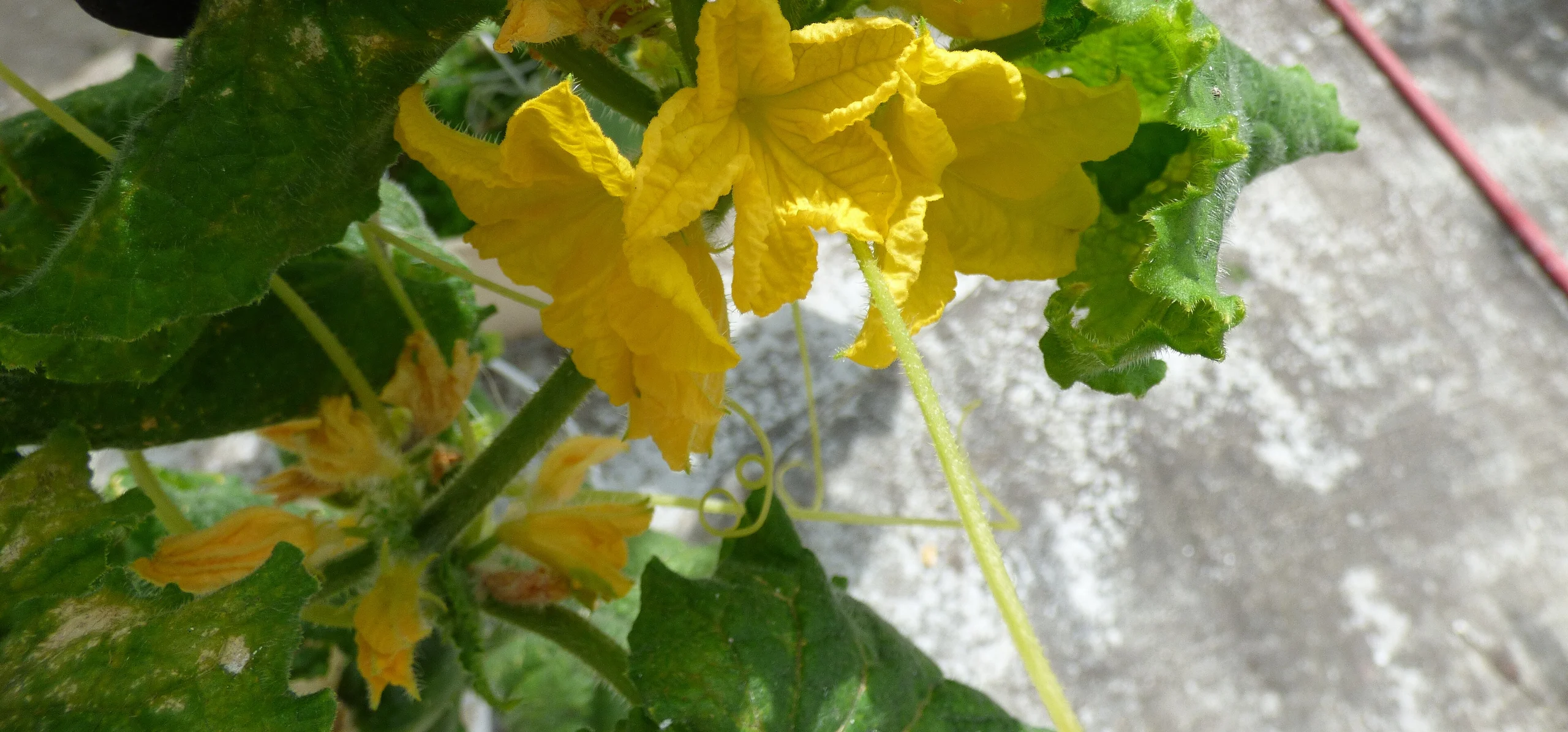
Cucumber
Cucumis sativus
Family · Cucurbitaceae
Cucumber needs the right type for your space, steady moisture and a string or net to climb; here is how to sow, train and pick it without bitter, hollow fruit.
Cucumis sativus
Plant profile
- WateringHighWater every 3 days
- Light exposureFull sun
- Ideal temperature24–29 °C
Growth
- Family
- Cucurbitaceae
- Life cycle
- Annual
- Growth speed
- 8/10
- Mature size
- Climbing annual vine, trained vertically
- Flowering
- Yellow star-shaped flowers, male and female (all-female in most greenhouse types)
- Propagation
- Seed
DormancyNone; a frost-tender annual killed outright by the first autumn frost
Time to maturity50-70 days from seed to first harvest
Soil & climate
- Soil pH
- pH 6–6.5
- Soil types
- well-drained, sandy loam, clay loam
- Saline soil
- Not tolerated
- Drought tolerance
- No
Light & Placement
- Origin
- Himalaya to China (Yunnan, Guizhou, Guangxi) and N. Thailand
- Where to place it
- heated or unheated greenhouse
- polytunnel
- sunny sheltered vegetable bed
- raised bed against a warm wall
- 30cm (12in)+ pot or growbag, trellised with a cane or net
Safety
- Toxicity
- CatsSafe
- DogsSafe
- HorsesSafe
Invasive speciesNot invasive; a cultivated annual vegetable vine that does not persist or spread outside cultivation.
Data fromGBIF: Cucumis sativus L.Plants of the World Online (Kew): CucumiASPCA: Toxic and Non-Toxic Plants, CucumRHS: How to Grow CucumbersClemson Cooperative Extension HGIC: Cucu
Where it grows
World distribution
Cucumber is native to 7 countries: Bangladesh, Bhutan, China, India, Myanmar (Burma), Nepal, and Thailand.GBIF records 27,034 documented identifications across 160 countries, with the largest concentrations in United States, Afghanistan, and India.
- Bangladesh
- Bhutan
- China
- India
- Myanmar (Burma)
- Nepal
- Thailand
Yellow to orange dots: concentration of documented identifications per country. Green countries: sourced native range. Source: GBIFNative range from POWO (Kew).
A cucumber seedling looks like nothing in particular for the first two or three weeks, then the vine finds a support and takes off, gaining new growth fast through midsummer. Almost every problem that shows up later traces back to one of three things: growing the wrong type for the space available, letting the soil dry out and then soaking it in cycles, or leaving ripe fruit on the vine too long. Sort those three out and a single plant, trained upright rather than left to sprawl across the ground, keeps a kitchen supplied from midsummer into early autumn.
Greenhouse All-Female Types or Outdoor Ridge Types
The first decision is which kind of cucumber to grow, and it is not optional. According to the RHS, most greenhouse varieties, such as 'Carmen' or 'Emilie', are all-female, producing almost exclusively female flowers with a tiny fruit already behind each one; these must not be pollinated, or the resulting fruit may turn bitter, which is why all-female seed packets are sold with a warning to remove any stray male flowers under glass. Outdoor, or ridge, varieties such as 'Marketmore' are a different plant for a different job: they carry both male and female flowers, need insects to set fruit, and are bred to cope with the wind and temperature swings of a British summer rather than the steady warmth of a greenhouse. Buying a greenhouse variety for a plot with no glass, or an outdoor ridge type for a heated greenhouse, is the single most common way a cucumber season disappoints from the very first flower.
Sowing Warm and Moving Plants Out Slowly
Cucumber seed needs consistent warmth of around 21°C (70°F) to germinate reliably, per the RHS, and the sowing date then depends entirely on where the plant will finish its life: mid-February to mid-March for a heated greenhouse, April for an unheated greenhouse or polytunnel, and late April indoors (for planting out in late May or June) or direct sowing outdoors once the soil itself has warmed. Clemson Cooperative Extension gives cucumber's own comfort zone as 75 to 85°F (24 to 29°C) once growing, well above the temperature most other vegetables tolerate, so a plant rushed outside into a cold snap simply stalls rather than dying outright, sitting pale and stunted until conditions catch up.
Training the Vine Up a String or a Net
Left on the ground, a cucumber vine sprawls, and the fruit that touches damp soil rots or yellows on the underside long before it is ripe. Under glass, the RHS recommends a tall, sturdy bamboo cane reaching the greenhouse roof, or a vertical wire or string tied loosely around the young stem as it grows; outdoors, a wigwam of canes or stout netting supported on upright stakes does the same job for a ridge variety. Either way the plant is trained as a single main stem climbing upward, with the fruiting side shoots coming off that stem at intervals rather than a tangle of stems competing for light and airflow.


Pinching Side Shoots the Right Way for Each Type
Greenhouse and outdoor cucumbers are pinched differently, and mixing up the method wastes a season of fruit. For greenhouse, all-female types, the RHS advises pinching out the tip of each side shoot two leaves beyond a female flower, and pinching out any flowerless side shoot once it reaches 60cm (2ft) long, so the plant's energy keeps going into fruit rather than bare vine. For outdoor ridge types, the method is the opposite: pinch out the main growing tip once the plant has developed seven leaves, which forces it to branch and produce the side shoots that carry most of the crop, rather than pinching shoot by shoot as the season goes on.
Watering for Crisp Fruit, Not Bitter or Hollow Ones
Cucumber has a shallow, thirsty root system, and Clemson Extension recommends moistening the soil to at least 6 inches deep and watering at the base of the plant in the morning, avoiding wetting the foliage. Uniformity matters more than volume: both Clemson and the RHS point to inconsistent watering, a dry spell followed by a heavy soak, as a leading cause of bitter, misshapen or hollow-centred fruit, since a stressed plant answers with cucurbitacins, the compounds behind that sharp, bitter taste concentrated near the stem end. A pot sunk into the soil next to the root ball, filled at each watering, sends the water straight down to the roots instead of pooling around the base of the stem, where it can rot the crown.
Feeding With a High-Potash Liquid Fertiliser
Clemson recommends working a balanced fertiliser into the bed before planting, then side-dressing with a nitrogen feed before the vines start running, but warns that too much nitrogen at this stage encourages leafy growth at the expense of fruit. The RHS approach for container-grown plants is to feed every 10 to 14 days with a general liquid fertiliser until flowering starts, then switch to a high-potash liquid feed such as a tomato feed to keep flowering and fruiting going through the rest of the season. Ground-grown plants in reasonable soil rarely need feeding beyond that first application; it is the plant in a growbag or pot, with a small volume of compost to draw on, that runs short first.
Powdery Mildew, Cucumber Mosaic Virus and Red Spider Mite
Powdery mildew shows up as a white, dusty coating on the upper leaf surface, favoured by high humidity combined with still air, drought-stressed plants and crowded spacing; the RHS advises against fungicides here and instead recommends full sun, good spacing, consistent watering, and watering overhead in the morning if at all, since the fungus dislikes direct contact with water but thrives on leaves left damp overnight. Cucumber mosaic virus is more serious: it causes yellow mottling, distorted leaves and stunted growth, spreads by aphids and by contaminated hands and tools, and the RHS is explicit that there is no chemical cure, so an infected plant should be pulled and destroyed promptly and hands and tools washed with soapy water before touching healthy plants. Red spider mite mottles the foliage and can strip a greenhouse plant of leaves in a hot, dry summer; regular syringing of the foliage with water and keeping humidity high reduce the risk, per the RHS, though the predatory mite Phytoseiulus persimilis, sold for biological control, is the more reliable fix once an infestation is established under glass.
Picking Small and Often
Cucumber size at picking depends on the variety: the RHS gives roughly 8cm (3in) for mini types, 15cm (6in) for small-fruited varieties and 20 to 25cm (8 to 10in) for full-sized ones, cut with a sharp knife or secateurs rather than pulled, which can strip the stem or damage the next flower along it. Checking the vine every few days matters as much as the size itself: a cucumber left to swell past its best turns seedy and dull-skinned, and just as importantly, a plant carrying one oversized fruit slows down or stops setting new ones, so picking regularly and picking small is what keeps the vine producing into autumn rather than tailing off after the first flush.
Test your plant knowledge
Tap a card to flip it and reveal the answer.
Most greenhouse cucumber varieties are all-female, and pollinating them by hand can make the fruit taste bitter. Tap to reveal ✓ True
Outdoor ridge cucumbers are pinched exactly like greenhouse types, two leaves beyond every female flower. Tap to reveal ✕ False
Letting the compost dry out and then soaking it heavily keeps the fruit crisp. Tap to reveal ✕ False
There is no chemical cure for cucumber mosaic virus, so an infected plant should be removed rather than treated. Tap to reveal ✓ True
Picking cucumbers small and checking the vine every couple of days encourages the plant to keep setting fruit. Tap to reveal ✓ True
Sources
References consulted for this guide
- GBIF: Cucumis sativus L.gbif.org
- Plants of the World Online (Kew): Cucumis sativus L.powo.science.kew.org
- ASPCA: Toxic and Non-Toxic Plants, Cucumberaspca.org
- RHS: How to Grow Cucumbersrhs.org.uk
- Clemson Cooperative Extension HGIC: Cucumberhgic.clemson.edu
- Reference entity : Wikipédiaen.wikipedia.org