Pothos
Epipremnum aureum
Family · Araceae
Pothos (Epipremnum aureum) wants bright indirect light and dry soil between waterings; the ASPCA lists it toxic to pets, Florida calls it high-risk invasive.
Epipremnum aureum
Plant profile
- WateringLittleWater every 8 days
- Light exposureIndirect light
- Ideal temperature15–29 °C
- Humidity30–70 %
- Hardiness zoneUSDA 10–11
Growth
- Family
- Araceae
- Life cycle
- Perennial
- Growth speed
- 7/10
- Mature size
- 400–800 cm
- Spread
- 100–150 cm
- Propagation
- Cutting
- Layering
FloweringRarely flowers in cultivation; the cultivated form is notoriously shy-flowering (UF/IFAS)
DormancyNo true dormancy indoors; growth slows in low light and cooler winter temperatures, which is why the RHS feeding schedule stops in October
Time to maturityReaches its full 4 to 8 m size in about 10 to 20 years under glass (RHS); kept far more compact and slower by regular pruning as a houseplant
Soil & climate
- Soil types
- Airy, well-draining potting mix, amended with perlite or bark (Clemson HGIC)
- Drought tolerance
- Yes
Light & Placement
- Origin
- Society Islands (Mo'orea), French Polynesia (POWO)
- Where to place it
- A few feet back from a bright window, out of direct midday sun (RHS growing guide)
- Low-light corners and offices, though growth slows and variegation fades there (Clemson HGIC)
- Sheltered, frost-free spot outdoors in summer only, in warm-summer climates (RHS)
- Any pot with a drainage hole; a moss pole or trellis if trained to climb rather than trail
Safety
- Toxicity
- CatsToxic
- DogsToxic
- HorsesToxic
- HumansToxic
Invasive speciesUF/IFAS rates it a high invasion risk in Florida's natural areas: escaped stems reroot from any surviving node, and the vine climbs into tree canopies, smothering native ferns and orchids in South and Central Florida hammocks
Data fromEpipremnum aureum (Linden & André) G.S.BEpipremnum aureum (golden pothos), RHSDevil's Ivy, ASPCA Animal Poison ControlHow to Grow Pothos Indoors (Epipremnum sEpipremnum aureum, UF/IFAS Assessment of
Where it grows
World distribution
Pothos is native to a single country: French Polynesia.GBIF records 8,350 documented identifications across 123 countries, with the largest concentrations in United States, Taiwan, and Puerto Rico.
- French Polynesia
Yellow to orange dots: concentration of documented identifications per country. Green countries: sourced native range. Source: GBIFNative range from POWO (Kew).
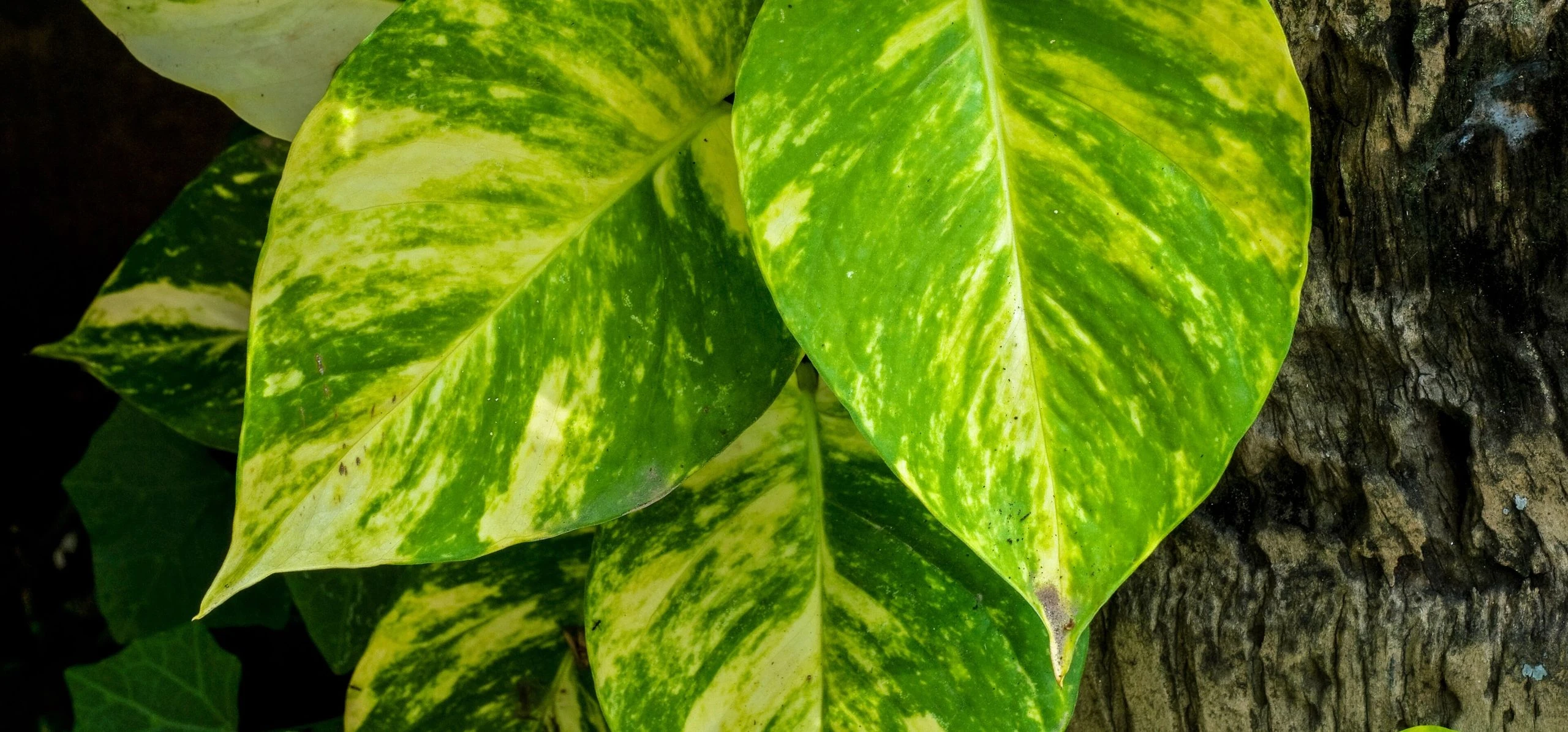
A pothos that arrives with unevenly marbled cream-and-green leaves, trailing from a hanging pot or climbing a moss pole, is almost always Epipremnum aureum: golden pothos, devil's ivy, or, confusingly, money plant. GBIF records the accepted name as Epipremnum aureum (Linden & André) G.S.Bunting, in the arum family Araceae alongside monstera and philodendron. It tolerates skipped waterings, low light and a cramped pot for months at a stretch, and it keeps unfurling one heart-shaped leaf at a time regardless. The one thing it will not shrug off for long is a pot that never dries out.
Light: Bright but Indirect
The RHS growing guide for epipremnum recommends bright but indirect light and specifically warns against both full sun and deep shade. Clemson University's Home & Garden Information Center describes tolerance for low light as one of the plant's defining traits, which is why it survives in offices and hallways where little else grows, though growth slows and variegated leaves drift toward plain green when light stays too dim for too long. A spot a step or two back from an unobstructed window, or a few feet from a north- or east-facing one, gives it enough light to keep its markings without scorching the foliage.
Watering: Let the Soil Dry, Then Soak It
Both the RHS and Clemson HGIC give the same instruction: let the soil approach dryness, or dry out completely, before watering again, then water thoroughly so the whole root ball is wetted. The RHS recommends testing with a finger rather than watering on a fixed schedule, and using rainwater or filtered water at room temperature where possible. Clemson's horticulturists list overwatering, not underwatering, as the top cause of the yellowing leaves and root rot that send most pothos owners looking for help in the first place.
Soil and Potting
Clemson HGIC calls for an airy, well-draining soil mix, the kind sold for general houseplants or amended with a little perlite or bark for extra air at the roots. Repot when roots start showing through the drainage holes or the plant becomes root-bound, typically every one to two years, moving up only one pot size at a time. A pot without a drainage hole is the single easiest way to guarantee the root rot both sources warn about.


Feeding and Pruning for a Fuller Vine
The RHS recommends feeding once a month during the growing season, from April to October, with a general houseplant fertiliser, then pausing over winter when growth slows on its own. Its own pruning notes place epipremnum in pruning group 11: tip-prune in spring to encourage branching rather than one long runner. Clemson's schedule is a little more conservative, suggesting fertiliser every other month through spring and summer. Either way, a plant left unpruned simply gets longer instead of fuller, so cutting just above a leaf node is what actually thickens the vine.
Propagating From Stem Cuttings
Every cutting needs at least one node, the small bump on the stem where a leaf meets it and where new roots form; Clemson HGIC notes that cuttings root readily in either soil or water once a node is present. The University of Florida's invasive species assessment of this plant records roots forming within weeks in warm summer conditions and more slowly in winter, and adds a blunter fact: any node or stem fragment left behind after pruning or removal will root and grow into a new plant on its own, which is exactly why it spreads so easily both in a plant collection and, outdoors in warm climates, in the wild.
A Houseplant That Turns Invasive Outdoors
That same rooting ability is why the University of Florida's Assessment of Non-Native Plants in Florida's Natural Areas rates golden pothos a high invasion risk in every region it studied, scoring it 17 in Central and South Florida and 11 in the North, both above the threshold for that rating. In frost-free climates it stops behaving like a houseplant: freed from a pot, it climbs tree trunks by aerial roots into the canopy, its leaves growing far larger than the houseplant form, and it has been found growing wild in at least a dozen Florida counties, mostly by escaping as discarded garden cuttings. The assessment describes cut stems resprouting from any surviving node, which is why control there means repeated cutting and herbicide on the fresh stump rather than one removal.
Yellow Leaves, Root Rot and Other Warning Signs
Clemson HGIC traces yellow leaves to two causes: overwatering most often, low fertility occasionally. Brown, crisping leaf tips point to low humidity or too much direct light, since the plant prefers 50 to 70 percent humidity but tolerates the 30 to 60 percent typical of most homes. Spider mites and mealybugs are the pests Clemson flags as occasional visitors, usually on a plant already stressed by dry air or crowded roots. Root rot itself, from a pot that stays wet, is the one problem worth catching early, since by the time the leaves show it the roots underneath are often already gone.
Toxic to Pets and People
The ASPCA's Devil's Ivy entry lists this species as toxic to dogs, cats and horses, naming insoluble calcium oxalate crystals as the toxic principle and oral irritation, swelling of the mouth and lips, drooling and difficulty swallowing as the clinical signs; vomiting is listed for dogs and cats but not horses. Clemson HGIC adds that all parts of the plant are mildly toxic to humans too if chewed or swallowed, for the same reason. None of this makes the plant dangerous to simply keep in the house, but it is worth placing out of reach of a chewing puppy, a curious cat or a toddler who treats every leaf as a snack.
Test your plant knowledge
Tap a card to flip it and reveal the answer.
Pothos should be watered on a fixed weekly schedule no matter how the soil feels. Tap to reveal ✕ False
A stem cutting needs at least one node to root in soil or water. Tap to reveal ✓ True
The University of Florida rates golden pothos a high invasion risk in the state's natural areas. Tap to reveal ✓ True
The ASPCA lists golden pothos as safe for dogs, cats and horses. Tap to reveal ✕ False
Pruning just above a leaf node encourages the vine to branch instead of just getting longer. Tap to reveal ✓ True
Sources
References consulted for this guide
- Epipremnum aureum (Linden & André) G.S.Bunting, GBIF Backbone Taxonomygbif.org
- Epipremnum aureum (golden pothos), RHSrhs.org.uk
- Devil's Ivy, ASPCA Animal Poison Controlaspca.org
- How to Grow Pothos Indoors (Epipremnum spp.), Clemson HGIChgic.clemson.edu
- Epipremnum aureum, UF/IFAS Assessment of Non-Native Plants in Florida's Natural Areasassessment.ifas.ufl.edu
- Reference entity : Wikipédiaen.wikipedia.org