Himalayan Blackberry
Rubus armeniacus
Family · Rosaceae
Himalayan blackberry canes root wherever a tip touches soil and can grow six meters in a season. Identification, fruiting, control methods and legal status.
Rubus armeniacus
Plant profile
- WateringLittleWater every 10 days
- Light exposurePartial sun
Growth
- Family
- Rosaceae
- Life cycle
- Perennial
- Growth speed
- 10/10
- Propagation
- Seed
- Cutting
- Layering
Mature sizeArching, thorny canes to about 3 m (10 ft) tall, individual canes reaching 6 m (20 ft) or more in a season
FloweringWhite to pale pink flowers in early summer, ripening to glossy black fruit by late summer
Dormancysemi-evergreen in mild climates
Time to maturityfloricanes flower and fruit in year two
Soil & climate
- Drought tolerance
- Yes
Soil typesBest on deep, fertile ground, but colonizes almost any disturbed site with adequate moisture
Light & Placement
- Origin
- Native to the Transcaucasus region and northwestern Iran, not the Himalayas
- Where to place it
- sunny riparian bank or roadside
- hedgerow or fence line
- disturbed or recently logged ground
- not suited to containers; a deep-rooted, spreading forest-edge shrub
Safety
- Toxicity
- HumansSafe
Invasive speciescanes root at every tip and node, resprout vigorously from rhizomes and root crowns, and a mature stand can shed up to 13,000 seeds per square meter that stay viable in soil for years; Washington State lists it a Class C noxious weed
Data fromRubus armeniacus Focke, GBIF Backbone TaPOWO: Rubus armeniacus FockeOregon State University Extension: InvasOregon State University Landscape PlantsWashington State University Magazine: Bu
Where it grows
World distribution
Himalayan Blackberry is native to 2 countries: Georgia and Iran.GBIF records 96,263 documented identifications across 43 countries, with the largest concentrations in Switzerland, United Kingdom, and United States.
- Georgia
- Iran
Yellow to orange dots: concentration of documented identifications per country. Green countries: sourced native range. Source: GBIFNative range from POWO (Kew).
A cane that roots the moment its tip touches bare soil is not misbehaving, it is doing exactly what Rubus armeniacus evolved to do. Found it scrambling over a fence, colonizing a ditch bank, or planted on purpose for its late-summer berries, this bramble is one of the most successful invasive shrubs on the Pacific Coast of North America, and its two-year cane cycle is the key to either harvesting it responsibly or keeping it out of a garden altogether. Left untended for a single season, one plant can throw new canes over six meters long and root a ring of new crowns around itself before autumn.
The Himalaya Name Is a Myth
Plants of the World Online lists the native range of Rubus armeniacus as the Transcaucasus region through to northwestern Iran, and GBIF's accepted classification places it in the rose family, Rosaceae, alongside raspberries and the rest of the genus Rubus. The Himalayas have nothing to do with it. According to Washington State University Magazine, the plant reached American growers because Luther Burbank, breeding fruit in Santa Rosa, California, received a packet of seed by mail from India in the 1880s and assumed the parent plant grew in the Himalayan foothills. He named it Himalaya Giant, introduced it commercially in 1885, and by 1894 was marketing canes directly to Pacific Northwest growers. Oregon State University's Landscape Plants database is blunt about it: there is no evidence the species is native to the Himalayan region at all.
Identifying Rubus armeniacus
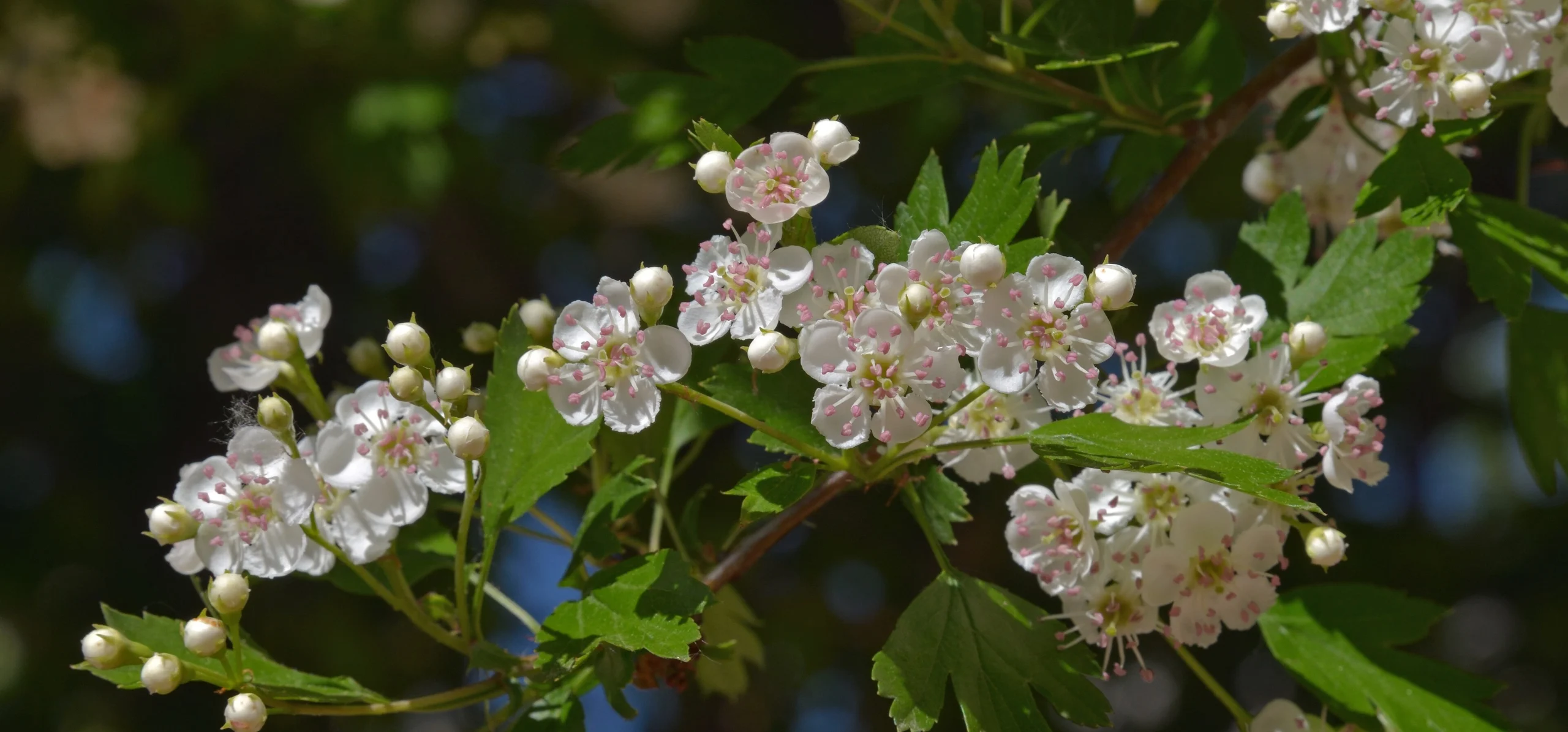
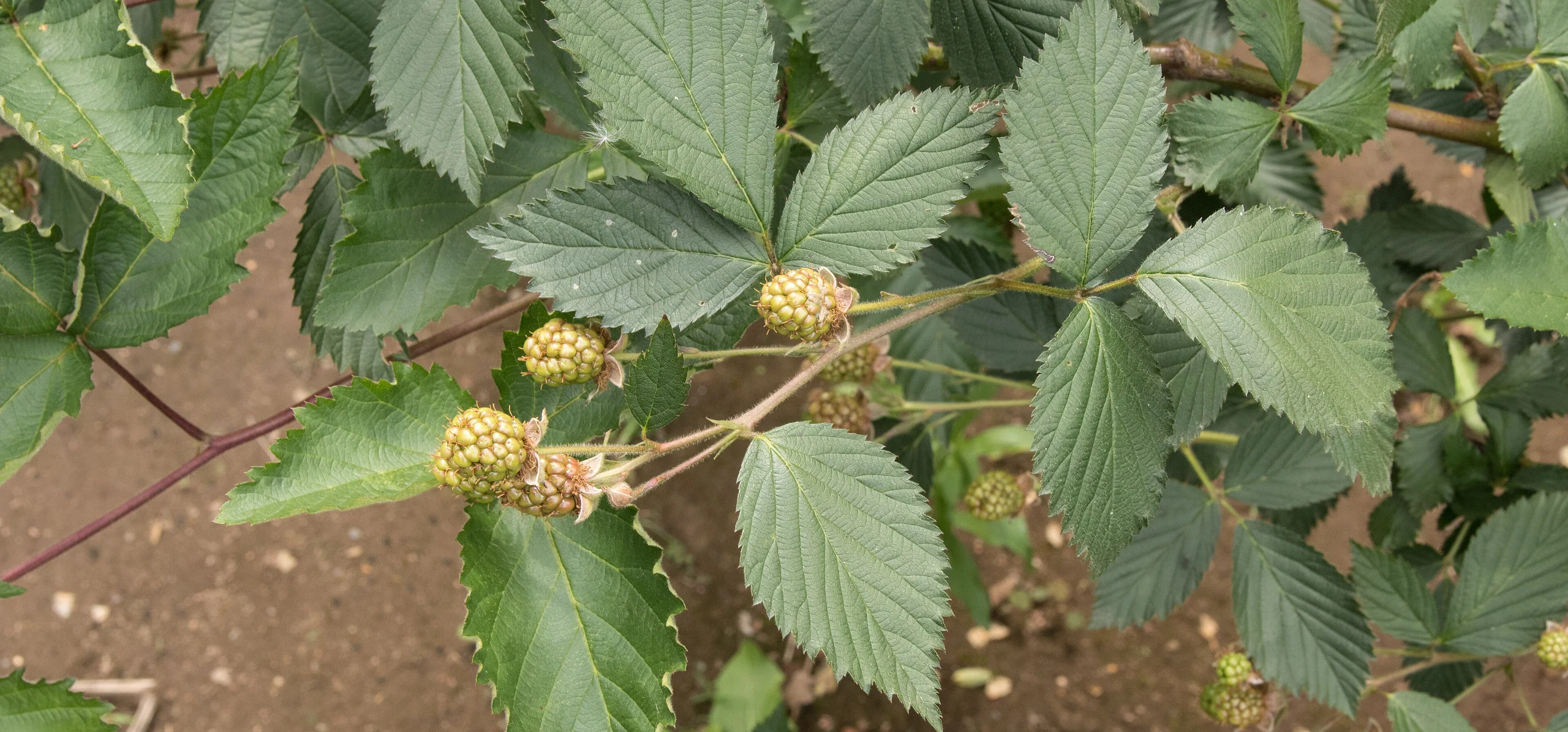
The canes are the giveaway before the leaves are: sharply angular in cross-section, hairless, dark purplish, and armed with stout, bowed prickles rather than true thorns. Leaves are alternate and palmately compound, almost always in fives, each leaflet oval to elliptic, 4 to 8 centimeters long, dark green and glossy above and pale gray-green with a soft felting underneath, a two-tone leaf that is one of the more reliable field marks for telling this species apart from native brambles. Flowers open white to pale pink in loose clusters wider than they are long, each bloom about 2.5 centimeters across. The fruit that follows is a glossy black aggregate of drupelets, roughly the same 2.5 centimeters long, and genuinely good to eat, sweeter and juicier than most people expect from a roadside weed.


Why It Spreads Faster Than Almost Any Other Bramble
Every cane on this plant is biennial. A first-year cane, a primocane, emerges from a bud at or just below the soil surface and produces only leaves, arching over as it lengthens through the season. The following spring, side branches called floricanes grow from that same cane's buds and carry both leaves and flowers, then die once the fruit ripens, while a fresh crop of primocanes is already rising from the root crown to replace them. That alone would make it a vigorous shrub. What makes it a takeover artist is that any cane tip left resting on damp soil roots there within weeks, planting a new, self-sufficient crown still attached to the parent; cut roots and rhizome fragments left in the ground resprout on their own; and a mature stand can shed up to 13,000 seeds per square meter, seeds that birds and mammals carry off after eating the fruit and that stay viable in soil for years afterward.
Site, Sun and Soil
Oregon State University Extension notes that growth is best in full sun, though established plants tolerate part shade without much complaint, just a thinner flush of flowers. It performs best on deep, fertile ground, but that is a preference, not a requirement: the same extension guidance describes it colonizing almost any disturbed site, roadside, or logged clearing as long as soil moisture is adequate through the growing season. A plant that has been in the ground more than a year shrugs off dry spells on the strength of that deep, spreading root system, which is also exactly why pulling it and walking away rarely finishes the job.
Picking the Fruit Without Feeding the Problem
Where a stand is already established and welcome, harvest runs through the back half of summer as the drupelets turn from red to fully glossy black; like most brambles the fruit does not sweeten further once picked, so a tug that meets resistance means another day or two on the cane. Cut each floricane out at the base as soon as it finishes fruiting rather than leaving the spent, woody growth in place, both to make room for the new season's primocanes and to reduce the tangle of cane tips that would otherwise find soil to root in. Never let a trimmed cane lie where its cut end or a leftover tip can touch damp ground, and rake up and bin, rather than compost, any fruit that drops and goes soft before the birds find it.
Bringing an Unwanted Plant Under Control
A single round of mowing or cutting is close to useless on its own. Oregon State University Extension found that cutting back Himalayan blackberry tends to trigger more branching and more suckers from the lateral roots, so only repeated mowing across several consecutive years produces any lasting reduction in cover, and hand grubbing out the roots and root crown, though thorough, is realistic only on a small patch. A more unusual ally arrived on the Oregon coast in 2005: the blackberry leaf rust fungus, Phragmidium violaceum, which has since spread through most of western Oregon and causes partial to complete defoliation without killing the plant outright, buying time for native vegetation to reestablish underneath. Where herbicide is an option, the same extension guidance lists triclopyr, glyphosate, and metsulfuron as effective foliar treatments, with applications in late summer through early fall reducing resprouting far more reliably than a spray in spring, and any program is best rotated between chemicals so resistant strains do not build up.
A Regulated Weed in Parts of North America
By the early 1900s the plant Burbank had marketed was already thriving unassisted around Puget Sound, spread by birds and animals until, as Washington State University Magazine recounts, many residents assumed it had always grown there. It has since naturalized from southern British Columbia south to northern California and east to Idaho, with separate populations established from Delaware to Virginia, and Washington State classified it a Class C noxious weed in 2009, a category that lets individual counties require control where it threatens agriculture or natural areas. None of that has anything to do with pets or people: the species does not appear in the ASPCA's toxic or non-toxic plant listings at all, and the fruit itself is edible, so the only real hazard, for a curious dog or a gardener in short sleeves, is entirely mechanical, delivered by the prickles on every cane.
Test your plant knowledge
Tap a card to flip it and reveal the answer.
Rubus armeniacus is native to the Himalayan mountains, despite its common name. Tap to reveal ✕ False
A cane can root and grow into a new, independent plant wherever its tip touches damp soil. Tap to reveal ✓ True
This bramble needs full sun and cannot survive in partial shade. Tap to reveal ✕ False
The ASPCA lists Rubus armeniacus as toxic to dogs and cats. Tap to reveal ✕ False
Washington State classifies Himalayan blackberry as a Class C noxious weed. Tap to reveal ✓ True
Sources
References consulted for this guide
- Rubus armeniacus Focke, GBIF Backbone Taxonomygbif.org
- POWO: Rubus armeniacus Fockepowo.science.kew.org
- Oregon State University Extension: Invasive Weeds in Forest Land, Himalayan Blackberry (EC 1594-E)extension.oregonstate.edu
- Oregon State University Landscape Plants: Rubus armeniacuslandscapeplants.oregonstate.edu
- Washington State University Magazine: Bullying Blackberriesmagazine.wsu.edu
- Reference entity : Wikipédiaen.wikipedia.org