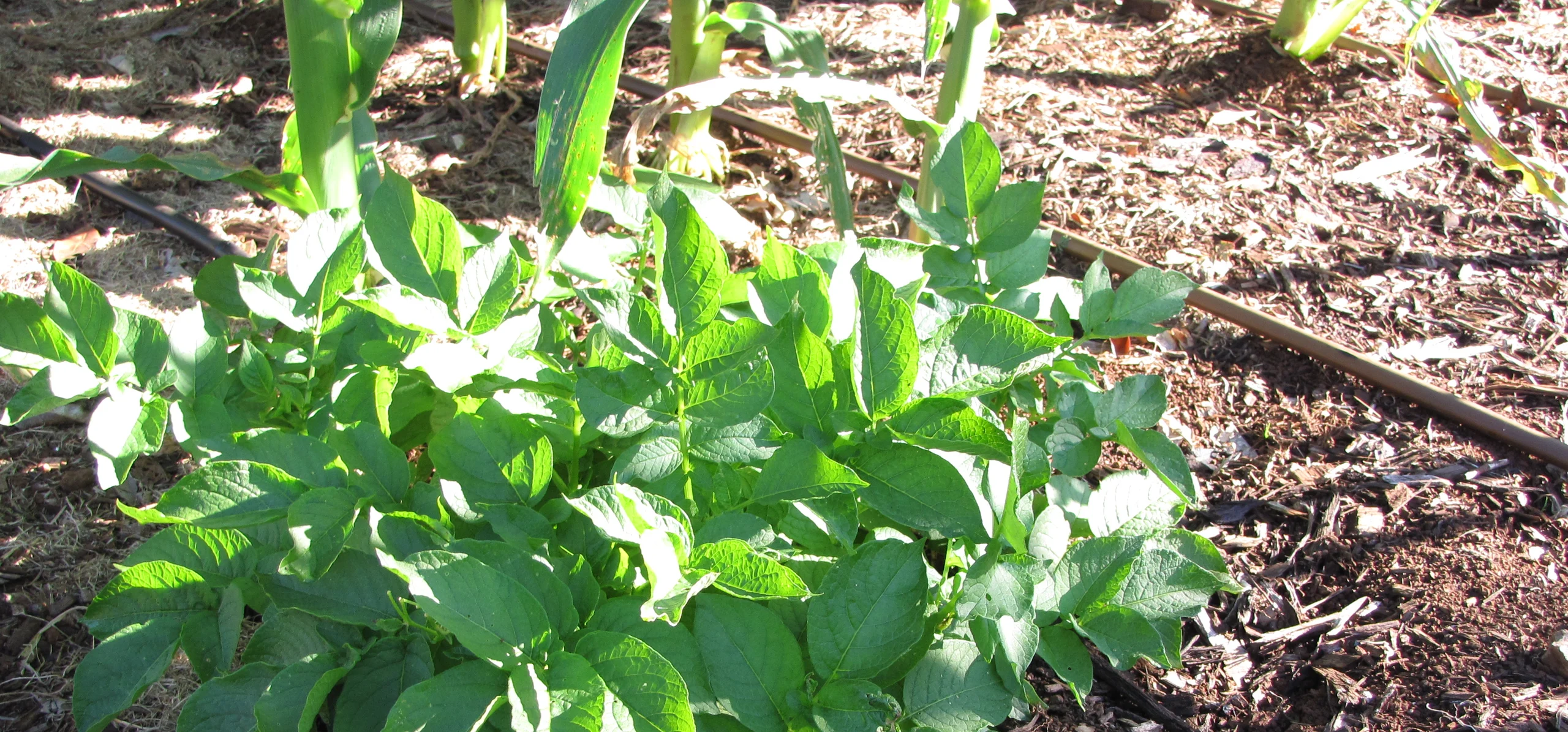
Potato
Solanum tuberosum
Family · Solanaceae
Grow potatoes from chitted seed tubers: correct depth and spacing, earthing up to stop greening, blight and scab control, and when to lift and cure each type.
Solanum tuberosum
Plant profile
- WateringModerateWater every 7 days
- Light exposureFull sun
- Ideal temperature7–27 °C
- Hardiness zoneUSDA 3–10
Growth
- Family
- Solanaceae
- Life cycle
- Perennial
- Growth speed
- 7/10
- Mature size
- 50–100 cm
- Spread
- 10–50 cm
- Flowering
- White, pink or purple flowers in summer; not needed for a tuber crop
- Propagation
- Division
DormancyFoliage is killed by the first autumn frost; in mild climates missed tubers can resprout the following year
Time to maturity70 to 120 days from planting, depending on variety
Soil & climate
- Soil pH
- pH 5–6.5
- Soil types
- Sandy loam, Loam, Well-drained soil rich in organic matter
- Drought tolerance
- No
Light & Placement
- Origin
- Andes of Peru and Bolivia (W. and S. South America to NW. Venezuela)
- Where to place it
- Open vegetable bed
- Raised bed
- Allotment row
- Grow bags
- Large containers with drainage
- Potato barrels
Safety
- Toxicity
- HumansToxic
Invasive speciesNot considered invasive; missed tubers can resprout as volunteer plants the following season
Data fromSolanum tuberosum L., GBIF Backbone TaxoSolanum tuberosum L., Plants of the WorlSolanum tuberosum (potato), RHS GardeninHow to grow potatoes, RHSGrowing Potatoes in a Home Garden, Unive
Where it grows
World distribution
Potato is native to 7 countries: Argentina, Bolivia, Chile, Colombia, Ecuador, Peru, and Venezuela.GBIF records 98,599 documented identifications across 142 countries, with the largest concentrations in United Kingdom, Peru, and Germany.
- Argentina
- Bolivia
- Chile
- Colombia
- Ecuador
- Peru
- Venezuela
Yellow to orange dots: concentration of documented identifications per country. Green countries: sourced native range. Source: GBIFNative range from POWO (Kew).
Solanum tuberosum grows not from seed but from seed potatoes, tuber pieces carrying at least one eye. A bag of chitted seed potatoes bought in late winter is ready for the ground within weeks, and a single 3-metre row can return several kilograms of tubers by late summer. The two decisions that matter most are timing, soil at least 7°C (45°F) before planting and no exposed foliage during a late frost, and depth, earthed up repeatedly so developing tubers never see light. Get those right and the rest of the crop mostly looks after itself.
Choosing Seed Potatoes and Varieties
Solanum tuberosum was domesticated in the high Andes near Lake Titicaca in Peru and Bolivia, likely 7,000 to 10,000 years ago, long before it became one of the staple crops now grown at scale from China and Russia to Poland, Ukraine, Germany, the United States and India. Garden varieties fall into three timing groups: first earlies are lifted as new potatoes 9 to 12 weeks after planting, second earlies follow a few weeks later, and maincrop varieties stay in the ground the longest and store best over winter. Buy certified, disease-free seed potatoes rather than supermarket tubers, which are often treated with sprout suppressant and carry a higher risk of virus. Match the type to your plans: earlies for small salad potatoes through summer, maincrop for the bulk of a winter store.
Chitting Before Planting
Chitting, standing seed potatoes with their eyes (the small dormant buds) facing upward in egg boxes or shallow trays, gets a head start on the season. Set them in a bright, frost-free spot, a cool windowsill or unheated porch, from late January in milder regions to early March further north, and leave them until the sprouts reach about 5 cm. Rub off all but two or three of the strongest, most compact sprouts per tuber; thin, pale shoots produced in the dark are weak and snap off easily when planted. Chitting is not essential for maincrop varieties, which have longer to grow regardless, but it reliably brings earlies forward by two to three weeks.
Site, Soil and Planting Depth
Potatoes need an open, sunny site with no shade for more than an hour or two a day, and one that does not sit in a frost pocket, since young shoots are killed by a late spring frost. Work plenty of compost or well-rotted manure into the bed the previous autumn or winter; potatoes are hungry plants and perform poorly in thin, compacted soil. Aim for a pH of 6.0 to 6.5 on ordinary ground, or as low as 4.8 to 5.8 if your soil has a history of common scab, since the organism that causes it struggles in more acidic conditions. Do not plant until the soil has reached at least 7°C (45°F); planting into cold, wet ground invites rot before shoots even emerge. Set seed potatoes 7.5 to 15 cm deep, shallower for early crops planted in mild soil, deeper for later plantings, spacing first earlies 30 cm apart in rows 60 cm apart, and maincrop 37 cm apart in rows 75 cm apart.
Watering and Feeding
Established plants tolerate short dry spells, but water becomes critical once flowering starts and the tubers begin to bulk up underground; a prolonged dry spell at this stage produces small, misshapen or hollow tubers that never recover. Water deeply during dry weather rather than little and often, and direct water at the soil rather than over the foliage, since wet leaves left damp overnight encourage blight. Potatoes grown in open ground rarely need extra feeding if the bed was well prepared beforehand. Container-grown crops are the exception: mix a balanced fertiliser into the compost at planting, or begin a liquid feed roughly six weeks in, since nutrients wash out of pots faster than they do from garden soil.
How often to water your Potato
Earthing Up as the Plants Grow
Once the shoots reach about 23 cm tall, draw soil up around the base of each plant with a hoe, leaving only the top 10 cm of foliage exposed. Repeat every few weeks as growth continues, building a ridge 20 to 30 cm high by midsummer. Earthing up does two jobs at once: it buries the developing tubers deep enough that sunlight never reaches them, and it adds extra rooting depth where new tubers can form along the buried stem. Skipping this step is the single most common reason home-grown potatoes turn green near the surface.
Pests and Diseases to Watch For
Late blight is the disease that matters most: a fast-spreading pathogen favoured by warm, humid weather that turns leaves brown and collapses the whole plant within days, and it can travel down into the tubers if they are left in wet ground. Early varieties, lifted before blight typically takes hold in mid to late summer, largely dodge it. Common scab produces rough, corky patches on the skin, cosmetic rather than dangerous, and is worst in dry, alkaline soil. The Colorado potato beetle and its striped larvae strip foliage fast enough to check growth if not picked off early, while potato tuberworm larvae burrow into stored tubers left exposed near the surface. Wireworms, the larvae of click beetles, tunnel narrow holes through tubers in soil recently converted from grass, and slugs do the same in damp maincrop beds close to harvest.
Harvest, Curing and Storage
New potatoes are ready to dig from first earlies 9 to 12 weeks after planting, generally once the plants flower or the lower leaves start to yellow; lift a test plant with a fork before committing to the whole row. Second earlies follow through July and August, and maincrop varieties are left until the foliage dies back naturally in late August to October, which signals the skins have set firm enough for storage. Cure freshly lifted maincrop tubers for 10 to 14 days somewhere cool and humid, around 10 to 15°C (50 to 60°F), to toughen the skins before storage. Store only clean, undamaged, dry tubers in the dark at 4 to 10°C (40 to 50°F) with high humidity, in paper or hessian sacks rather than plastic, and check the store every few weeks; one rotting tuber spreads quickly through a sack.
Common Mistakes and the Green Tuber Problem
Green-skinned tubers are the most frequent problem in home-grown potatoes, caused by light reaching them during growth or storage. Light exposure triggers the production of solanine and related glycoalkaloids, which concentrate in the green tissue, the sprouts, and the leaves and stems, giving a bitter taste and, in quantity, causing nausea and gastrointestinal upset in people and pets. Cut away any green patches generously, or discard tubers that are green throughout, and never plant potatoes that have been left uncovered by soil. Other frequent errors: planting too early into cold, waterlogged ground before the 7°C soil threshold; watering overhead in humid weather, which spreads blight spores; and skipping curing before storage, which shortens keeping time from months to weeks. Rotating potatoes to a different bed each year, avoiding ground that grew tomatoes or other Solanaceae the previous season, keeps soil-borne scab and blight pressure from building up.


Test your plant knowledge
Tap a card to flip it and reveal the answer.
Seed potatoes should be chitted (pre-sprouted) in a bright, frost-free spot before planting. Tap to reveal ✓ True
Potatoes grow best in full shade, since shade helps stop the tubers turning green. Tap to reveal ✕ False
Green potato skin contains solanine and should be cut away or discarded. Tap to reveal ✓ True
Watering the foliage overhead in humid weather helps prevent potato blight. Tap to reveal ✕ False
First early potato varieties are ready to harvest sooner than maincrop varieties. Tap to reveal ✓ True
Sources
References consulted for this guide
- Solanum tuberosum L., GBIF Backbone Taxonomygbif.org
- Solanum tuberosum L., Plants of the World Online (Kew)powo.science.kew.org
- Solanum tuberosum (potato), RHS Gardeningrhs.org.uk
- How to grow potatoes, RHSrhs.org.uk
- Growing Potatoes in a Home Garden, University of Maryland Extensionextension.umd.edu
- Reference entity : Wikipédiaen.wikipedia.org