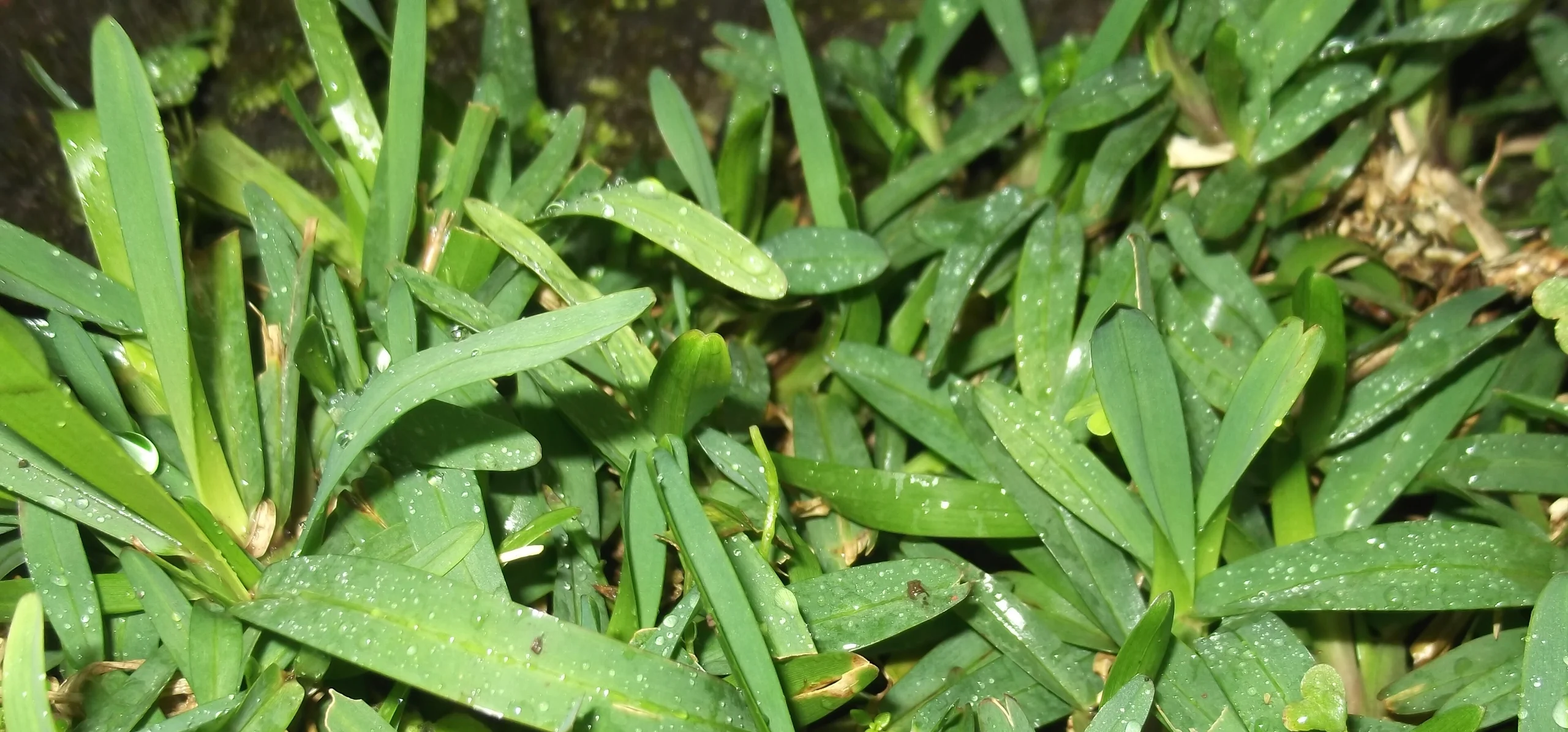
St. Augustine Grass
Stenotaphrum secundatum
Family · Poaceae
St. Augustine grass is planted as plugs or sod, not seed, mows to 2.5-4 in, and beats other warm-season lawns in shade, but not in cold, traffic or drought.
Stenotaphrum secundatum
Plant profile
- WateringModerateWater every 6 days
- Light exposurePartial sun
- Hardiness zoneUSDA 7–12
Growth
- Family
- Poaceae
- Life cycle
- Perennial
- Growth speed
- 3/10
- Propagation
- Cutting
- Division
Mature sizeLow, dense, stoloniferous turf mowed to 2.5 to 4 in (6 to 10 cm); spreads indefinitely as a groundcover via surface stolons
FloweringInconspicuous spike-like flower clusters in the lawn form; grown for foliage and turf cover, not for bloom
DormancyGoes dormant and turns brown or tan through winter outside the tropics, greening up again as soil warms in spring
Time to maturityFills in as turf cover within one growing season from plugs or sod
Soil & climate
- Soil types
- clay, loam, sand
- Saline soil
- Partially tolerated
- Drought tolerance
- No
Light & Placement
- Where to place it
- full-sun to lightly shaded lawn
- coastal or sandy-soil turf
- shaded lawn area under tree canopy
OriginNative along the southeastern U.S. coast, South America and West Tropical Africa to Chad (POWO); found on sandy beaches, swamp and lagoon edges, and roadsides (NC State Extension)
Safety
- Toxicity
- Not listed by the ASPCA for cats, dogs or horses
- Pet safe
- No
Data fromGBIF: Stenotaphrum secundatum (Walter) KPlants of the World Online (Kew): StenotNC State Extension Gardener Plant ToolboClemson HGIC: St. AugustinegrassTexas A&M AgriLife Extension: St. August
Where it grows
World distribution
St. Augustine Grass is native to 45 countries: Antigua & Barbuda, Argentina, Bahamas, Belize, Benin, Bermuda, Bolivia, and Brazil….GBIF records 15,661 documented identifications across 121 countries, with the largest concentrations in Australia, United States, and South Africa.
- Antigua & Barbuda
- Argentina
- Bahamas
- Belize
- Benin
- Bermuda
- Bolivia
- Brazil
- Cameroon
- Cayman Islands
- Chad
- Chile
Show 33 more countriesShow fewer countries
- Colombia
- Congo - Brazzaville
- Congo - Kinshasa
- Costa Rica
- Côte d’Ivoire
- Cuba
- Dominican Republic
- Equatorial Guinea
- French Guiana
- Gabon
- Ghana
- Guatemala
- Guyana
- Haiti
- Honduras
- Jamaica
- Liberia
- Mexico
- Nicaragua
- Nigeria
- Panama
- Paraguay
- Peru
- Puerto Rico
- São Tomé & Príncipe
- Senegal
- Sierra Leone
- St. Lucia
- Suriname
- Togo
- Trinidad & Tobago
- United States
- Uruguay
Yellow to orange dots: concentration of documented identifications per country. Green countries: sourced native range. Source: GBIFNative range from POWO (Kew).
Sod or plugs of Stenotaphrum secundatum root fastest when the runners are pressed firmly into moist soil and kept damp until new growth appears, usually within two to three weeks in warm weather. This is a stoloniferous, warm-season turfgrass identified by broad, blunt-tipped blades folded at the base, spreading entirely by surface stolons rather than a fixed crown. GBIF records the accepted name as Stenotaphrum secundatum (Walter) Kuntze, in the grass family Poaceae, and the common names St. Augustine grass, buffalo grass and Augustine grass all refer to the same plant. It is grown for one job, dense low turf, and almost every problem it develops traces back to mowing it too short, watering it too little, or planting it somewhere too cold or too worn for it.
Planted as Plugs or Sod, Never Seed
Unlike bermudagrass or tall fescue, St. Augustine grass has no commercially viable seed. Texas A&M AgriLife Extension lists sod, plugs and sprigs as the only establishment methods, because the species rarely sets fertile seed and what little it produces is not sold at scale. Plugs, small rooted squares of turf, are pressed into holes on a grid across bare soil and left to spread by stolons until they knit together, typically over one growing season; sod delivers instant cover at a higher cost. Either way, the new lawn needs daily light watering for the first one to two weeks so the cut edges of the stolons do not dry out before they root.
Native Range and Where It Spreads Naturally
Plants of the World Online lists the native range as the southeastern United States east and south through South America, and separately West Tropical Africa to Chad, an unusually wide, disjunct native distribution for a single turfgrass species. The NC State Extension Gardener Plant Toolbox describes its natural habitat as sandy beaches, the edges of swamps and lagoons, island streams and lakes, marshes, and roadsides, all low-lying, damp, sandy ground near the coast. That origin explains why it performs best in the same conditions in cultivation, coastal and southeastern soils that stay moist, rather than the dry interior plains where bermudagrass and buffalograss dominate instead.


Mowing Height: Cutting It Short Backfires
Extension guidance is consistent on keeping the blade high. Texas A&M AgriLife Extension recommends 2.5 to 3 in for standard cultivars in sun, rising to 3 to 3.5 in in shade, and warns against removing more than one third of the leaf blade in any single cut. Clemson HGIC gives a similar range for the Carolinas, 3 to 4 in for standard cultivars and around 2.5 in for dwarf types, again higher in shaded lawns. Scalping the lawn below these heights exposes the stolons to sun and heat stress, slows recovery, and is one of the fastest ways to open the turf up to both large patch disease and southern chinch bugs.
The Reason to Choose It: Shade Tolerance
St. Augustine grass earns its place in southern lawns mainly because of what happens where trees block the sun. The NC State Extension Plant Toolbox calls it the most shade-tolerant of the common warm-season turfgrasses, able to hold reasonable density under partial or dappled shade where bermudagrass and zoysiagrass thin out and die back. That tolerance is relative, not absolute: it still needs meaningful daily sun to stay dense, and the extension guidance to mow shaded stands taller, 3 to 3.5 in rather than 2.5 in, exists precisely because a shaded plant already has less energy to spare and cutting it hard on top of low light compounds the stress.
Southern Chinch Bugs, the Fastest-Acting Pest
Clemson HGIC identifies the southern chinch bug as the major insect pest of St. Augustine grass, sucking sap from the base of the blades and injecting a toxin that yellows and kills patches of turf, with damage appearing fastest on lawns already stressed by drought or heat. The same factsheet gives a treatment threshold of roughly 20 to 25 chinch bugs per square foot before insecticide is warranted, found by parting the grass at the edge of a yellowing patch and checking the thatch line rather than guessing from the discoloration alone. Because drought stress accelerates the damage, keeping the lawn adequately watered through summer is itself part of chinch bug management, not a separate task.
Large Patch and Gray Leaf Spot
The two diseases Clemson HGIC flags most often on this species are large patch, formerly called brown patch, and gray leaf spot. Large patch is a fungal disease that is most active in cool, humid spring and fall weather, not the heat of summer, and Clemson notes that mowing either too low or too high makes it worse, too low stresses the turf and too high slows leaf drying and keeps humidity in the canopy. Gray leaf spot instead favors hot, humid, rainy conditions and is worsened by excess nitrogen fertilizer pushing soft, disease-prone growth. Both are managed the same practical way: correct mowing height, watering in the morning so blades dry by evening, and avoiding heavy nitrogen applications during the disease's active season.
Thatch Buildup and When to Dethatch
St. Augustine grass has an above-average tendency to build up thatch, the layer of undecomposed stems and roots between the green blades and the soil surface. Clemson HGIC recommends dethatching once that layer exceeds about half an inch, since beyond that thickness it starts blocking air, water, fertilizer and pesticides from reaching the soil. Texas A&M AgriLife Extension sets a higher working threshold, three quarters of an inch, and recommends removing it gradually with a vertical mower or by scalping in April or May while the grass is actively growing and can recover quickly. Heavy fertilizing and watering both accelerate thatch formation, so a lawn pushed hard for color needs more frequent dethatching checks, not less.
Winter Dormancy and Where It Fails
As a warm-season grass, St. Augustine grass goes dormant with the first hard cold snaps; Texas A&M AgriLife Extension describes it turning brown or tan through winter dormancy across the cooler parts of its Texas range and greening up again once the soil warms in spring, which is normal and not a sign the lawn has died. NC State Extension Publications rate it the least cold tolerant of the common warm-season turfgrasses, which is why it fails outright north of the milder parts of USDA zone 7 and is not planted as a lawn grass in the transition zone or further north, where tall fescue or zoysiagrass are used instead. It also fails, regardless of climate, wherever a lawn gets heavy foot or vehicle traffic or goes without irrigation in a dry summer, since poor wear tolerance and poor drought tolerance are two of its most consistent weak points across every extension source that covers it.
Test your plant knowledge
Tap a card to flip it and reveal the answer.
St. Augustine grass is established from sod, plugs or sprigs rather than grown from seed. Tap to reveal ✓ True
St. Augustine grass is the most shade-tolerant of the common warm-season lawn grasses. Tap to reveal ✓ True
Large patch disease in St. Augustine lawns is most active during hot, dry summer weather. Tap to reveal ✕ False
St. Augustine grass tolerates heavy foot traffic as well as bermudagrass does. Tap to reveal ✕ False
Of the common warm-season turfgrasses, St. Augustine grass is rated the least cold tolerant. Tap to reveal ✓ True
Sources
References consulted for this guide
- GBIF: Stenotaphrum secundatum (Walter) Kuntzegbif.org
- Plants of the World Online (Kew): Stenotaphrum secundatumpowo.science.kew.org
- NC State Extension Gardener Plant Toolbox: Stenotaphrum secundatumplants.ces.ncsu.edu
- Clemson HGIC: St. Augustinegrasshgic.clemson.edu
- Texas A&M AgriLife Extension: St. Augustinegrass Lawn Managementagrilifeextension.tamu.edu
- Reference entity : Wikipédiaen.wikipedia.org